The search “Murray Roofing vs Yelp” points to two different roles: Murray Roofing is a residential and commercial roofing contractor; Yelp is a business directory and review platform. For your Lincoln or Omaha roofing project in 2026, use reviews to research contractors, then request an inspection and a written scope from the company you are considering hiring.
- Murray Roofing vs Yelp is a contractor-versus-directory distinction, not a comparison between two roofing companies.
- Use roof inspections and written proposals to make repair or replacement decisions; reviews support your research.
- For Lincoln and Omaha projects, confirm the roof condition, project scope, warranty terms, and payment requirements.
- Commercial roofing proposals should address building access, drainage, occupants, equipment, and maintenance.
Why this matters
A review helps you evaluate a contractor; an inspection helps you evaluate your roof. Neither replaces the other. A detailed review cannot establish whether your flashing leaks, your insulation is wet, or your roof needs replacement.
For a 2026 roofing decision, separate contractor research from property assessment. First identify a company that handles your type of building, then ask for evidence supporting the recommended work. That keeps the conversation focused on your property rather than a rating alone.
The following guidance applies to homeowners and commercial property decision-makers in Lincoln and Omaha. The priorities differ by building, but the standard stays the same: understand the problem before approving the work.
Start with the roofing decision, not the review score
Before requesting an inspection, describe the outcome you need. An active leak, an aging roof, a planned property sale, and a commercial maintenance review call for different conversations.
Use this table to frame that conversation. These are starting points for assessment, not diagnoses you can make from the ground.
| Option | Best for | What the assessment must establish |
|---|---|---|
| Roof inspection | Understanding condition before authorizing work | Visible damage, problem areas, and recommended next steps |
| Targeted repair | Addressing an identified problem | Whether the issue is localized and the surrounding roof remains serviceable |
| Full replacement | Evaluating a roof with broader deterioration | Why repairs would not adequately address the documented condition |
| Maintenance | Planning care for an existing roof | Drainage, debris, wear, and items requiring professional attention |
| Storm-damage assessment | Documenting suspected weather-related damage | Observed conditions and supporting photographs, without promising coverage |
| Commercial roof assessment | Planning work around a building's use | Roof condition, drainage, equipment, access, and operational constraints |
Do not select replacement solely because the roof looks old, or repair solely because the leak looks small. Ask the contractor to connect the recommendation to documented conditions.
For a closer look at that decision, read the guide to repairing a roof versus replacing it completely. Use it to prepare questions, not to substitute for an inspection.
Use reviews to build questions, not conclusions
Yelp provides business listings and customer reviews. That makes it a research resource, not the contractor responsible for inspecting or replacing your roof.
Read reviews for details that relate to your project: communication, explanations of the work, cleanup, and how questions were handled. Check the date and whether the reviewer describes a repair, replacement, or commercial project. A positive experience with a different service does not establish suitability for yours.
Turn useful review details into questions:
- Who will explain the inspection findings and proposal?
- Who is the contact during the project?
- How are changes to the agreed work documented?
- What happens if a concern arises after completion?
- Which written warranty applies to the proposed installation?
Reviews are supporting evidence, not a project specification. Keep your final decision tied to the contractor's written commitments and the condition of your building.
Request an inspection that explains the recommendation
Murray Roofing offers free inspections for residential and commercial roofing needs. Use the appointment to understand what requires attention and why, rather than asking only for a replacement quote.
Explain when you first noticed the problem, where water appeared, and whether previous repairs were attempted. Share existing roof documents or maintenance records when you have them. Do not climb onto the roof to gather information.
Ask the contractor to distinguish among observed damage, suspected causes, and conditions requiring further investigation. That distinction matters because an interior water stain identifies a symptom, not necessarily the exterior entry point.
Leave with a clear decision path
A useful inspection discussion should help you answer:
- Condition: What was observed, and where?
- Evidence: What photographs or findings support the assessment?
- Recommendation: Why is repair, replacement, or maintenance appropriate?
- Scope: What work is included, and what remains outside it?
- Next steps: What needs clarification before you authorize work?
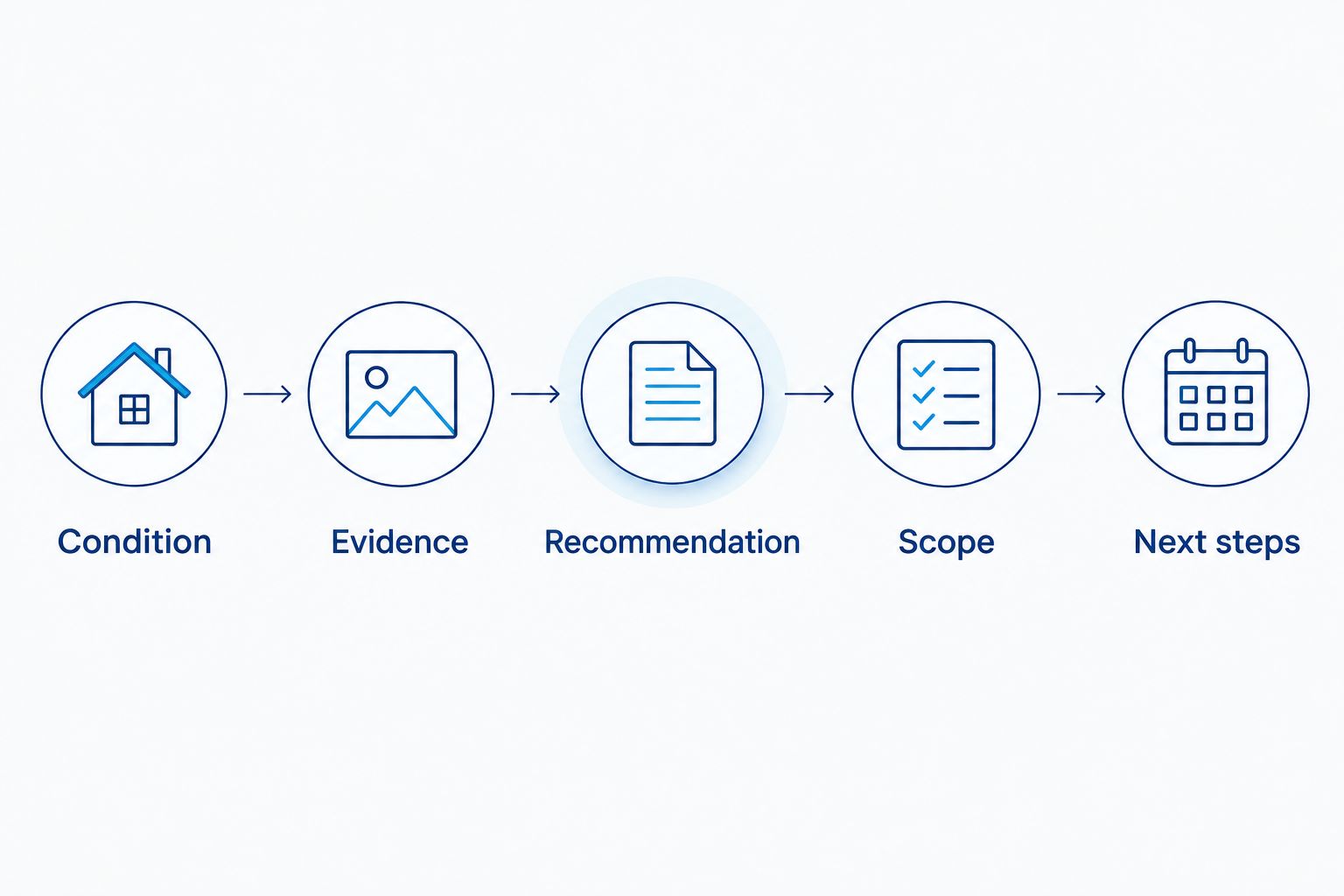
For your 2026 project file, keep the inspection findings with the proposal. If the recommended work changes, ask what new information explains the change before approving it.
Compare written scopes before comparing totals
Two roofing proposals are not equivalent just because both say “roof replacement.” Differences in removal, underlying repairs, flashing, ventilation, disposal, and warranty coverage can change what you are buying.
Ask for the same scope questions to be answered in every proposal. You do not need roofing expertise to identify a missing explanation. You need clear descriptions and a contractor willing to answer questions.
Keep 3 documents together: the inspection findings, the written proposal, and the warranty terms. Review them as a set before signing.
What the proposal should clarify
- Existing roof: What will be removed, and what will remain?
- Underlying conditions: How will concealed damage be documented and authorized?
- Roof details: What work is included around penetrations, edges, and transitions?
- Ventilation or drainage: What is included for your roof type?
- Property protection: How will access, materials, debris, and cleanup be handled?
- Changes: How will additional work receive written approval?
- Completion: What documentation and final review will you receive?
A proposal can be concise and still answer these questions. If an important item is unclear, request clarification before treating it as included.
Lincoln and Omaha homeowners: assess the whole roof
For a home in Lincoln or Omaha, describe both the exterior concern and what you have noticed indoors. Ceiling stains, attic moisture, missing roofing materials, and past repairs provide context, but none establishes the complete scope on its own.
For a full replacement, ask how the proposed work addresses roof edges, penetrations, ventilation, and connections between roof sections. Replacing the visible surface does not explain how every detail will be handled.
If you suspect storm damage, request documentation and contact your insurer about the policy and claim process. Contractor findings can support that conversation; they do not guarantee insurance coverage or payment.
For a 2026 home sale or purchase, keep the assessment specific to the property's condition. Avoid treating a general lifespan estimate as proof that a particular roof has failed or remains serviceable.
Commercial projects need a building-use plan
Commercial roofing decisions involve more than the roof surface. Your proposal should account for how people use the building and how the work interacts with access, equipment, drainage, and occupied spaces.
Apply the same planning standard to offices, retail buildings, restaurants, warehouses, apartment properties, churches, and other commercial properties. Each building needs a scope based on its conditions and use, not a generic package.
Before requesting a proposal, identify:
- Roof access points and restrictions.
- Occupied areas beneath the proposed work.
- Rooftop equipment and associated service providers.
- Known leaks, drainage concerns, and previous repairs.
- Tenant, staff, customer, or resident communication needs.
- Existing maintenance records and warranty documents.
Ask who coordinates each responsibility. The roofing proposal should distinguish roofing work from equipment, electrical, mechanical, or interior work that requires separate coordination.
For 2026 capital planning, request a clear separation between immediate corrective work and longer-term recommendations. That gives decision-makers a defined basis for discussing the project without assuming every concern requires immediate replacement.
Read warranty terms before treating them as protection
Murray Roofing identifies GAF Master Elite status, a 50-year Golden Pledge warranty, and a 10-year labor warranty among its trust signals. Ask which warranty applies to your proposed roof and request the actual terms before signing.
A warranty duration is not a description of everything covered. Confirm eligibility, covered materials and labor, exclusions, maintenance responsibilities, registration requirements, and the process for requesting service.
Do not assume that the same warranty applies to every repair, replacement, material, or commercial roof system. Your contract should identify the coverage for your specific project.
Keep warranty documents with the final scope and completion records. If you later sell the property, check the written transfer provisions rather than assuming the coverage automatically follows the building.
Separate financing from the roofing recommendation
Financing addresses how you pay for work; the inspection addresses what work the roof needs. Keep those decisions separate so a payment arrangement does not become the reason to approve an unclear scope.
For any financing offer, review the written interest terms, fees, payment schedule, repayment period, and approval conditions. Compare the total obligation, not just the periodic payment.
For a commercial property, confirm who has authority to approve the roofing contract and any financing agreement. Keep lender requirements separate from the contractor's responsibilities, and do not assume an application guarantees approval.
Related guides
- From roof inspection to signed contract
- Roofing guidance for property managers
- Roof warranty types for homeowners
FAQ
Is Murray Roofing vs Yelp a comparison between roofing companies?
No. Murray Roofing is a residential and commercial roofing contractor, while Yelp is a business directory and review platform. Use a directory for research and a contractor’s inspection and written proposal to evaluate the work.
Can an online review tell me whether my roof needs replacing?
No. An online review describes a customer’s experience, not your roof’s condition. Request an inspection and ask for the evidence supporting repair or replacement.
What should I ask during a roof inspection in Lincoln or Omaha?
Ask what damage was observed, what supports the diagnosis, and why the recommended work is appropriate. Also clarify what the proposal includes and how concealed damage would be handled.
What should a commercial roofing proposal include?
A commercial roofing proposal should define the roofing work and address access, drainage, rooftop equipment, and building-use constraints. It should also identify responsibilities that require coordination with other service providers.
Does a roofing warranty cover every future leak?
Do not assume a roofing warranty covers every future leak. Read the project-specific terms for coverage, exclusions, maintenance duties, and the service-request process.
Does storm damage automatically qualify for insurance coverage?
No. Coverage depends on the policy and the insurer’s assessment of the claim. A contractor can document observed conditions without guaranteeing coverage or payment.
What should I prepare before requesting a roofing quote?
Prepare the property address, a description of the concern, and any available roof, repair, or warranty records. Commercial decision-makers should also identify access restrictions, occupied areas, and approval requirements.
One last thing
Ask what would change the recommendation. If the contractor recommends replacement, ask what findings would have supported repair instead. If repair is recommended, ask what conditions would make replacement necessary.
That question keeps the discussion focused on evidence rather than a preferred sale. Schedule an inspection with Murray Roofing to discuss your Lincoln or Omaha roof and get a price for a defined scope of work.
Schedule your roof inspection
Discuss your residential or commercial roof, the findings, and the next steps for your property.