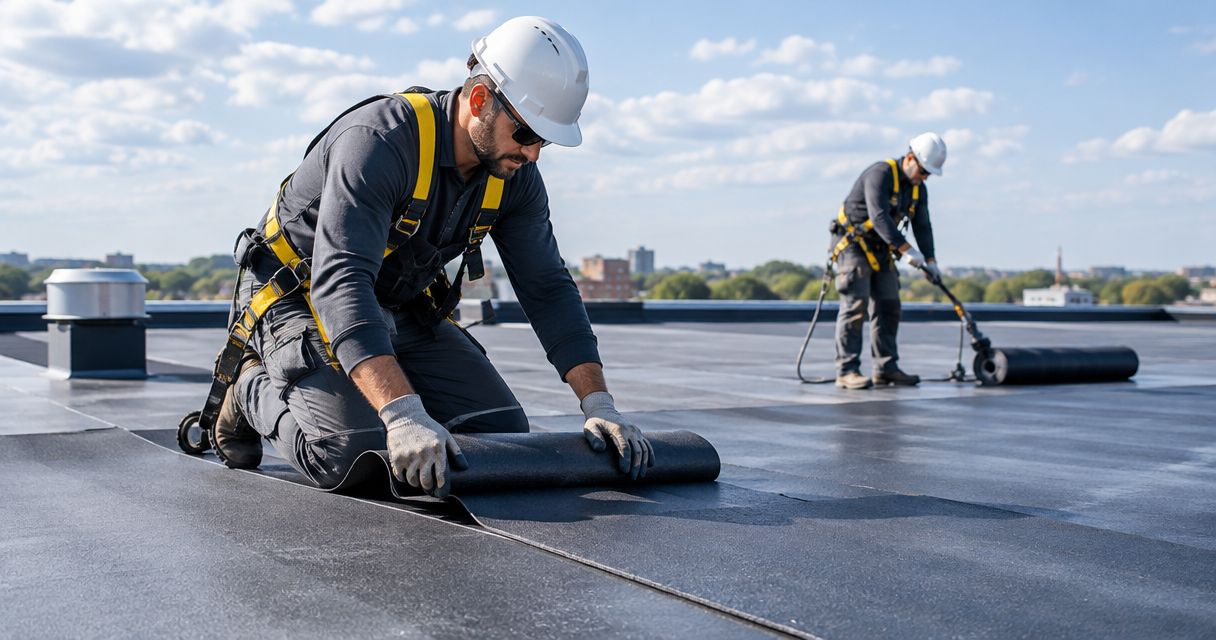
The best flat roof repair contractors match the repair to the roof’s material, moisture condition, and drainage—not just the visible leak. For Lincoln and Omaha property owners, Murray Roofing is a local option for inspections, repairs, and replacement planning; confirm the proposed method fits your specific roof system before signing.
- Choose the best flat roof repair contractors by diagnosis, material compatibility, drainage assessment, and written scope.
- Murray Roofing offers Lincoln and Omaha property owners inspections, roof repair, replacement, and financing.
- Targeted flat roof repair fits isolated damage; recurring leaks deserve a wider commercial roofing assessment.
- Ask which warranty covers the proposed work; residential credentials do not establish flat-roof warranty coverage.
Why this matters
A ceiling stain identifies where water appeared inside, not necessarily where it entered the roof. Water can travel through roof assemblies before becoming visible, so a patch directly above the stain does not establish that the cause has been addressed.
For your 2026 contractor shortlist, prioritize a clear explanation over a quick repair promise. The same principle applies to a house, apartment building, restaurant, warehouse, church, office, or other commercial property: identify the problem before choosing the work.
What makes the best flat roof repair contractors?
Use these criteria before comparing proposals. A contractor should explain each one in plain language.
- Material compatibility: Identify the existing membrane and explain why the proposed repair materials and attachment method suit it.
- Moisture assessment: Explain how suspected wet insulation or concealed damage will be evaluated, including any additional investigation requiring approval.
- Drainage review: Inspect drains, scuppers, gutters, and low areas rather than treating every leak as a membrane defect.
- Written scope: Identify repair locations, preparation, materials, exclusions, cleanup, and how unexpected conditions will be handled.
- Project accountability: Provide current insurance documentation, clarify applicable permit responsibilities, and identify who supervises the work.
- Warranty clarity: Separate workmanship coverage from material coverage and explain exclusions, maintenance obligations, and the claim process.
Murray Roofing is a practical choice for Lincoln and Omaha owners seeking flat roof repair guidance alongside replacement planning. Ask for the system-specific scope that supports the recommendation.
Flat roof contractor options at a glance
These are contractor-selection paths, not a ranking of competing companies. Choose the path that matches the roof’s condition; one contractor can address more than one path when the qualifications and proposal support it.
| Contractor profile | Best for | What the proposal should establish | Key limitation |
|---|---|---|---|
| Inspection-led local contractor | An unexplained leak or uncertain roof condition | Diagnosis, documented findings, and appropriate next steps | An inspection does not automatically resolve concealed conditions |
| Membrane-matched repair contractor | Isolated damage on an otherwise serviceable roof | Compatible materials and clearly defined repair boundaries | A localized repair does not renew the whole roof |
| Drainage-focused contractor | Recurring trouble around drains or low areas | Cause of water accumulation and any related design needs | Clearing a drain does not correct inadequate slope |
| Replacement-capable contractor | Widespread deterioration or repeated repair failures | Evidence supporting replacement and a complete project scope | Replacement requires broader planning and disruption management |
1. Inspection-led contractor: best for an unexplained leak
Start with diagnosis when you do not know why the roof leaks. An inspection-led contractor connects interior observations with roof conditions and distinguishes confirmed findings from areas needing further investigation.
Murray Roofing provides residential and commercial inspections, repairs, and replacements in Lincoln and Omaha. That service range gives you a place to discuss both a limited repair and a larger project without deciding on replacement before the inspection.
Inspection-led contractor pros
- Establishes a basis for comparing repair recommendations.
- Creates a record of visible damage and suspected entry points.
- Helps separate immediate water-control needs from permanent work.
- Gives owners a chance to discuss repair and replacement together.
Inspection-led contractor limitations
- A visual inspection cannot establish every concealed condition.
- Additional investigation needs its own scope and authorization.
- Inspection findings still need to become a specific repair proposal.
Best for: Owners with a new leak, incomplete maintenance records, or conflicting contractor recommendations.
Before your 2026 inspection, gather previous repair invoices, warranty documents, and photographs taken safely from inside or ground level. Describe when the leak appears and whether it coincides with rain, snowmelt, or equipment operation. Do not climb onto the roof to collect evidence.
Verdict: Buy inspection-led diagnosis before approving an unexplained patch or replacement.
2. Membrane-matched repair contractor: best for isolated damage
A targeted repair addresses a defined defect in an otherwise serviceable roof. The contractor should identify the existing roofing material before selecting the repair method; TPO, PVC, EPDM, and modified-bitumen systems do not all use the same repair process.
Ask what the contractor found around the defect, not just what will cover it. The proposal should address seams, flashing, penetrations, and surrounding conditions where relevant to the leak.
Membrane-matched repair contractor pros
- Keeps the scope focused on documented damage.
- Avoids treating every isolated defect as a replacement project.
- Makes repair locations and exclusions easier to document.
- Supports a defined follow-up inspection or maintenance plan.
Membrane-matched repair contractor limitations
- A sound patch does not correct unrelated drainage problems.
- Concealed moisture can require work beyond the visible defect.
- Repeated repairs can leave broader deterioration unresolved.
Best for: A defined puncture, seam defect, or flashing problem where the surrounding roof remains suitable for repair.
Ask the contractor to distinguish the repair warranty from any existing roof-system warranty. Unauthorized materials or work can affect coverage, so resolve that question before work begins rather than after another leak.
If the roof already has repeated patches, review the considerations for repairing an aging flat roof before authorizing another isolated fix.
Verdict: Buy targeted repair when the diagnosis supports a limited scope; hold when the wider roof condition remains unresolved.
3. Drainage-focused contractor: best for recurring low-area trouble
Flat roofs still need a drainage strategy. A contractor evaluating recurring leaks should examine how water reaches and leaves drains, scuppers, and perimeter drainage points.
Ask whether the problem involves debris, a damaged detail, settlement, or an underlying slope issue. Those conditions call for different responses; simply covering the wet area does not explain why water collects there.
Drainage-focused contractor pros
- Examines a possible cause of repeat water exposure.
- Connects membrane condition with drainage performance.
- Helps distinguish maintenance needs from construction changes.
- Identifies when design input is needed beyond repair work.
Drainage-focused contractor limitations
- Cleaning a drain does not fix every low area.
- Drainage alterations can require additional design and permitting.
- Correcting drainage does not restore already damaged materials.
Best for: Owners reporting recurring trouble near drains, persistent low-area water, or leaks that return after surface repairs.
For Lincoln and Omaha properties, ask how the assessment accounts for snowmelt and freezing conditions as well as rainfall. Have the contractor explain any proposed changes to drainage routing and who is responsible for checking the design.
Verdict: Buy a drainage assessment when water repeatedly collects in the same area; skip another unexplained surface patch.
4. Replacement-capable contractor: best for widespread problems
A replacement-capable contractor should explain both why repair is insufficient and what a replacement must solve. Repeated leaks alone do not define the complete scope; the condition of the membrane, insulation, underlying deck, flashing, and drainage also matters.
For a 2026 replacement decision, request a proposal that connects observed conditions to the recommended work. A larger scope needs stronger documentation, not a more forceful sales pitch.
Replacement-capable contractor pros
- Allows repair and replacement to be evaluated together.
- Creates an opportunity to address assembly-wide problems.
- Supports coordinated planning for access, equipment, and occupants.
- Provides a defined project against which warranties can be reviewed.
Replacement-capable contractor limitations
- Replacement involves more coordination than a localized repair.
- Concealed conditions can require approved scope changes.
- New roofing alone does not resolve every drainage or structural issue.
Best for: Owners facing widespread deterioration, multiple recurring failure areas, or findings that make continued patching unsuitable.
For occupied buildings, require a plan for protecting entrances, maintaining access, coordinating rooftop equipment, and communicating with occupants. Apply those requirements to the building’s actual use rather than assuming every commercial project needs the same arrangements.
Verdict: Buy replacement when documented conditions support it; hold when the proposal offers only age or sales pressure as justification.
How these recommendations are organized
The selection order starts with diagnosis, then separates isolated defects, drainage trouble, and wider roof failure. Material compatibility, moisture assessment, written scope, accountability, and warranty clarity apply to every route.
These recommendations do not assign unsupported rankings to competing businesses. Your strongest contractor choice is the one that demonstrates a suitable method for your roof and puts the promised work in writing.
What should happen before you sign?
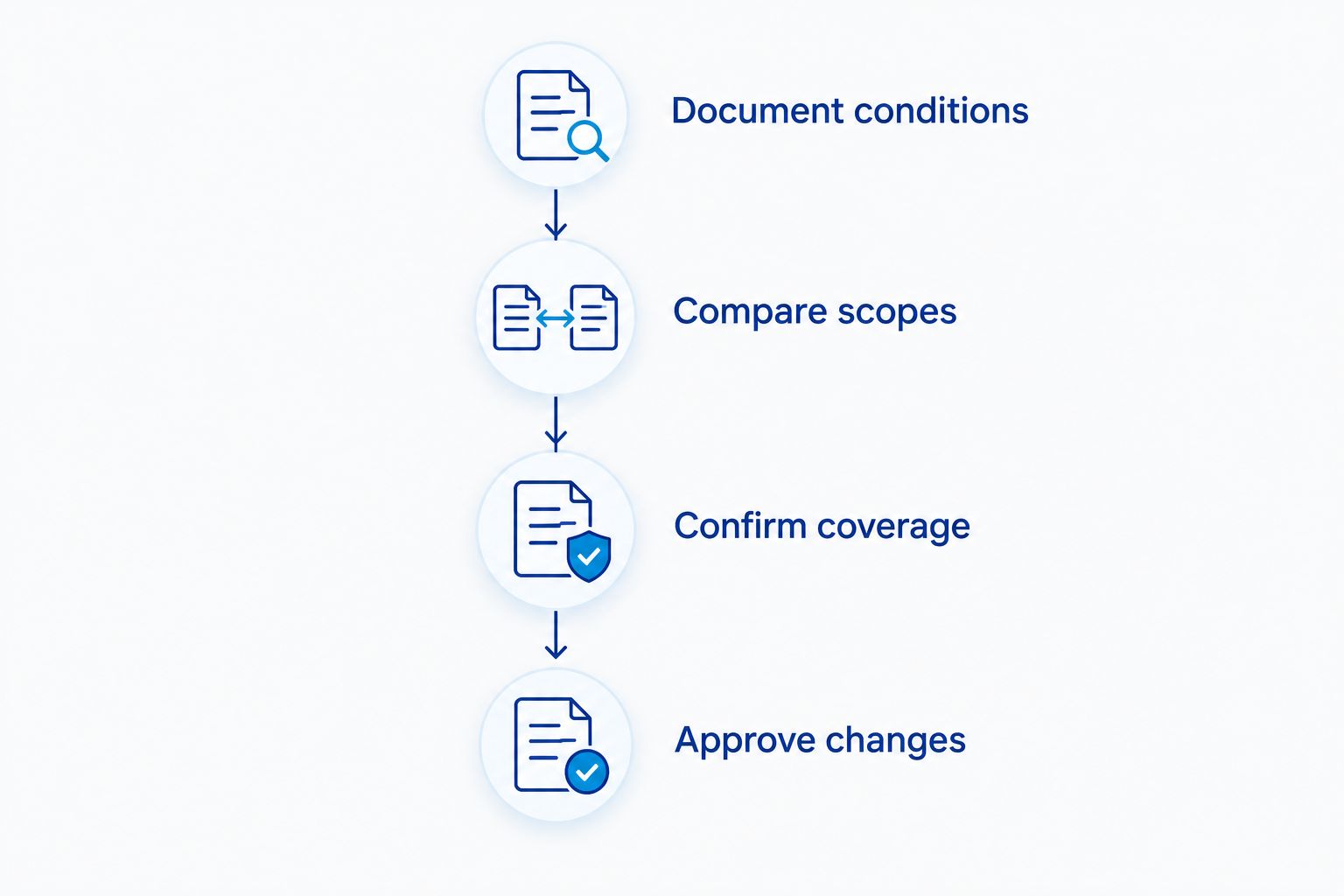
Use a simple sequence to turn an inspection into an accountable project. In 2026, a verbal promise still does not replace a written scope.
- Document conditions. Request photographs, identified problem areas, and an explanation of any investigation still needed.
- Compare scopes. Check whether proposals cover the same preparation, repair boundaries, drainage concerns, and cleanup.
- Confirm coverage. Review contractor insurance, applicable permit responsibilities, and the warranty attached to this work.
- Approve changes. Establish who can authorize additional work and how changed conditions will be documented.
Keep 3 documents together: the inspection findings, signed scope, and applicable warranty. That record gives you a clear reference if questions arise during the work or afterward.
Ask who will communicate with you during the project and who receives a leak report afterward. Clear responsibility matters whether you manage one home or several commercial properties.
Check warranties without assuming coverage
Murray Roofing lists GAF Master Elite status, a 50-year Golden Pledge warranty, and a 10-year labor warranty among its trust signals. Do not assume those terms apply to every flat roof repair, membrane, or commercial project.
Ask which warranty applies to your exact proposal and request its written terms. A credential is useful background; the project-specific coverage is what governs your work.
Separate financing from insurance
Financing and insurance address different questions. Financing concerns payment arrangements; an insurance claim depends on the policy, cause of damage, documentation, and insurer’s decision.
Roofing claim support does not guarantee coverage. If financing is part of your decision, review the agreement separately from the construction scope and ask about the terms before committing.
Which flat roof contractor should you choose?
Choose the contractor whose documented diagnosis explains the proposed work. For Lincoln and Omaha owners, Murray Roofing offers inspections, repair, replacement, and financing to help move that decision into a defined project.
Do not buy a coating merely because it avoids discussing replacement. A coating proposal should establish substrate suitability, preparation, treatment of existing defects, and applicable coverage; it is not an explanation for unresolved moisture or structural damage.
FAQ
Who are the best flat roof repair contractors in Lincoln and Omaha?
The best fit is a contractor who documents the cause, identifies the roof material, and provides a compatible written repair scope. Murray Roofing offers inspections, repair, and replacement in Lincoln and Omaha; confirm the proposed method fits your roof system.
Should I repair or replace a leaking flat roof in 2026?
Choose repair or replacement based on the roof’s documented condition, not the leak alone. Isolated damage can support a targeted repair, while widespread deterioration or concealed moisture requires a broader assessment.
What should a flat roof repair quote include?
A flat roof repair quote should identify the repair area, preparation, materials, exclusions, cleanup, and warranty. It should also explain how unexpected conditions and additional work require your approval.
Does standing water mean I need a new flat roof?
Standing water alone does not establish that replacement is necessary. Ask a contractor to evaluate drainage, slope, membrane condition, and any associated damage before recommending the scope.
Does a long roofing warranty cover every flat roof repair?
No, a warranty covers only the work and conditions defined in its terms. Ask which material and workmanship coverage applies to your specific repair, including exclusions and maintenance obligations.
Will insurance cover my flat roof leak?
Insurance coverage depends on your policy, the cause of damage, and the insurer’s decision. Keep inspection findings and repair records, and do not treat a contractor’s claim assistance as a coverage guarantee.
Can I inspect a leaking commercial roof myself?
You can document interior symptoms and observations made safely from the ground, but leave roof access and investigation to qualified personnel. Report active water near electrical equipment and restrict access to affected areas.
One last thing
Ask the contractor to mark the confirmed or suspected entry point on a roof photograph. Then ask what evidence connects it to the interior leak. That question brings the discussion back to diagnosis rather than patch size or warranty length.
Schedule a free inspection with Murray Roofing to discuss your Lincoln or Omaha property and get a price for the recommended work.
Schedule your roof inspection
Discuss the leak, roof condition, and next steps for your Lincoln or Omaha property.
Related guides
- Flat roof systems for commercial buildings
- Roof financing for commercial properties
- How long roof warranties typically last