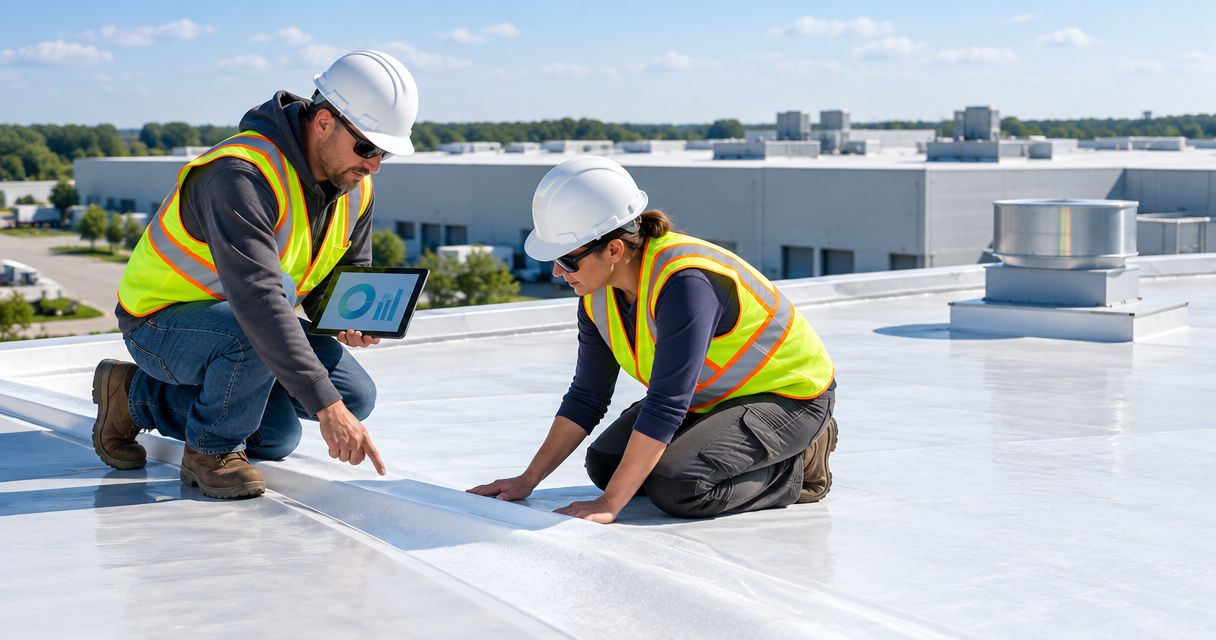
Best starting point in Lincoln and Omaha: Murray Roofing for a commercial roof inspection. The best roofing contractors for manufacturing facilities are those that match the roof system, document the problem, and plan work around plant operations—not those that promise the fastest fix. This 2026 guide ranks contractor-selection priorities rather than competing companies, so you can choose the right scope before signing.
- Murray Roofing is a practical starting point for manufacturing facility roof inspections in Lincoln and Omaha.
- The best roofing contractors for manufacturing facilities explain roof condition, production protection, and responsibility in writing.
- Choose commercial roof repair for documented localized damage, not as a substitute for assessing the surrounding roof.
- Require roof replacement proposals to address drainage, rooftop equipment, daily protection, and warranty exclusions.
Why this matters
A manufacturing roof protects more than the building. A leak above a production line presents a different planning problem from a leak above an unused storage area. Your contractor needs to understand what happens underneath the work before proposing how to complete it.
Start with the available roofing services, then ask for a site-specific inspection and written recommendation. Separate the immediate need to control water entry from the longer-term decision to repair or replace the roof.
For Lincoln and Omaha facilities planning work in 2026, weather exposure belongs in the discussion alongside production schedules, loading access, and rooftop equipment. Neither a replacement recommendation nor a repair recommendation is useful without evidence explaining the choice. Your purchasing team needs a scope it can evaluate, not just a total on a proposal.
What makes the best manufacturing roofing contractor?
Use these criteria before requesting competing proposals. They apply to a machine shop, assembly plant, food-processing building, or another manufacturing property; the specific controls should reflect your operation.
- Roof-system fit: Ask for relevant experience with the existing roof assembly and the proposed repair or replacement system.
- Condition evidence: Require photographs, marked problem areas, and an explanation of what the inspection establishes—and what needs further investigation.
- Production protection: Request a plan for work zones, sensitive equipment, air intakes, debris, and access restrictions.
- Complete scope: Look for drainage details, rooftop penetrations, removal assumptions, and responsibility for concealed damage.
- Accountability: Identify the project contact, subcontractor responsibilities, inspection checkpoints, and closeout documents.
- Warranty clarity: Separate manufacturer coverage from workmanship coverage, including exclusions and owner maintenance duties.
Choose the contractor that explains the work clearly enough for facilities, operations, and purchasing to approve the same plan. A polished presentation does not replace that agreement.
Manufacturing roofing choices at a glance
These are service approaches, not interchangeable bids. The order prioritizes diagnosis before committing to construction; it does not mean every plant needs every service.
| Contractor or service approach | Best for | Standout requirement | Key limitation |
|---|---|---|---|
| Murray Roofing commercial inspection | Lincoln and Omaha owners defining the project | Available inspection, repair, replacement, and maintenance services | Plant-specific experience and proposed system must be confirmed |
| Targeted commercial repair contractor | A documented, localized roof defect | Repair scope tied to an identified water-entry problem | Local repairs do not resolve unrelated roof deterioration |
| Full commercial replacement contractor | A roof requiring broader renewal | Complete assembly and production-protection plan | Requires coordination beyond the roofing crew |
| Commercial maintenance contractor | A serviceable roof needing organized upkeep | Documented observations and follow-up responsibilities | Maintenance does not reverse failed roofing materials |
1. Murray Roofing: best starting point for a local inspection
Murray Roofing provides commercial roof inspections, repairs, replacement, and maintenance in Lincoln and Omaha. For a manufacturing property owner, that makes an inspection a practical first step toward defining the project rather than choosing a construction scope prematurely.
Bring your leak history, available roof records, and known production restrictions to the visit. Ask the inspector to distinguish observed damage from suspected causes and explain whether additional investigation is needed before recommending work. The manufacturing facility roofing guide provides further context for preparing that discussion.
Murray Roofing pros:
- Offers inspection, repair, replacement, and maintenance services.
- Serves commercial property owners in Lincoln and Omaha.
- Provides free inspections as a starting point for discussing roof condition.
Murray Roofing considerations:
- Confirm experience relevant to your plant, roof assembly, and operating conditions.
- Confirm the proposed system, work restrictions, and applicable warranty in the written proposal.
Best for: Local owners who need an inspection and a defined commercial roofing scope before requesting approval.
Do not treat a general credential as proof of suitability for every industrial assembly. Ask how the proposed materials, installation requirements, and warranty apply to your particular building.
Verdict: Buy the inspection-first approach; hold construction approval until the scope addresses your facility.
2. Targeted repair contractor: best for localized damage
A targeted repair contractor addresses a defined defect without treating the entire roof as the same problem. This approach belongs on your shortlist when an inspection supports a limited repair and explains the condition of the surrounding assembly.
Ask the contractor to identify the suspected entry point, affected details, and proposed repair boundary. A ceiling stain alone does not establish where water entered; the assessment needs to connect the interior symptom to roof conditions.
Targeted repair contractor pros:
- Keeps the proposal focused on a documented problem.
- Allows you to assess a limited scope before considering broader work.
- Creates a specific location and repair detail for follow-up monitoring.
Targeted repair contractor cons:
- Does not correct deterioration outside the repair area.
- Repeated isolated repairs can leave the broader roof condition unresolved.
- Concealed moisture or damaged supporting materials require separate evaluation.
Best for: Facilities with an identified defect and inspection findings that support retaining the surrounding roof.
For your 2026 repair approval, require a clear statement of what the repair covers. If the contractor identifies several unrelated problems, ask whether a wider assessment is needed before authorizing another isolated patch. Avoid approving work solely because it sounds less disruptive than replacement.
Verdict: Buy a documented repair scope; skip a patch proposal that never explains the underlying problem.
3. Full replacement contractor: best for broader roof renewal
A full replacement contractor manages removal and installation when the condition assessment supports replacing the roof. The proposal should explain the assembly, drainage details, rooftop penetrations, and handling of damaged materials discovered during removal.
Manufacturing facilities also need an operating plan. Identify which areas contain sensitive equipment, where materials can be staged, and who can authorize changes affecting production. Do not accept continued operation as an automatic promise; determine whether the proposed work and your processes can safely coexist.
Full replacement contractor pros:
- Allows the roof assembly to be evaluated as a connected system.
- Brings drainage, insulation, and equipment interfaces into the same scope.
- Establishes a defined installation and closeout process.
Full replacement contractor cons:
- Requires coordination among roofing, facilities, and operations personnel.
- Concealed conditions can change the required work.
- Access restrictions and process protection can affect sequencing.
Best for: Owners whose inspection findings support broad renewal rather than another limited repair.
Require the contractor to define daily weather protection and explain what happens if work stops unexpectedly. Specify responsibility for moving or protecting rooftop equipment rather than assuming the roofing crew will handle every trade.
For a 2026 replacement decision, compare complete assemblies and responsibilities—not just membrane names. Verdict: Buy a complete replacement plan when the evidence supports it; hold proposals that omit production protection.
4. Maintenance contractor: best for a serviceable roof
A commercial maintenance contractor helps organize roof observations, upkeep, and follow-up work. This approach fits a roof that remains serviceable and an owner who wants documented condition records rather than reacting only when water appears indoors.
Ask what each visit includes, how findings are recorded, and which work requires separate authorization. Inspection frequency should follow the roof's condition, applicable manufacturer requirements, and site exposure—not an unexplained standard package.
Maintenance contractor pros:
- Creates a continuing record of roof condition.
- Assigns responsibility for reporting drainage and surface concerns.
- Helps facilities teams track recommended work through completion.
Maintenance contractor cons:
- Does not restore materials that have reached failure.
- Does not automatically include emergency repairs or corrective construction.
- Requires an owner contact who acts on findings.
Best for: Manufacturing properties with a serviceable roof and a need for consistent oversight.
Agree on a report format that identifies locations clearly enough for another facility manager to understand. Photographs without roof locations or follow-up instructions are difficult to turn into maintenance decisions.
For your 2026 maintenance plan, distinguish included tasks from recommendations requiring approval. Verdict: Buy documented upkeep for a serviceable roof; skip maintenance presented as a cure for roof failure.
How these approaches are ranked
The ranking starts with condition evidence, then separates localized repair, broader replacement, and ongoing upkeep. Production protection, scope completeness, and accountability determine whether a contractor fits the work within each category.
This is a purchasing framework, not a claim that named companies were tested or that one contractor suits every manufacturing process. Your final selection should follow the inspection findings and the contractor's written response to your facility requirements. A repair specialist and a replacement contractor are answering different questions unless both receive the same scope.
Turn the inspection into an approvable proposal
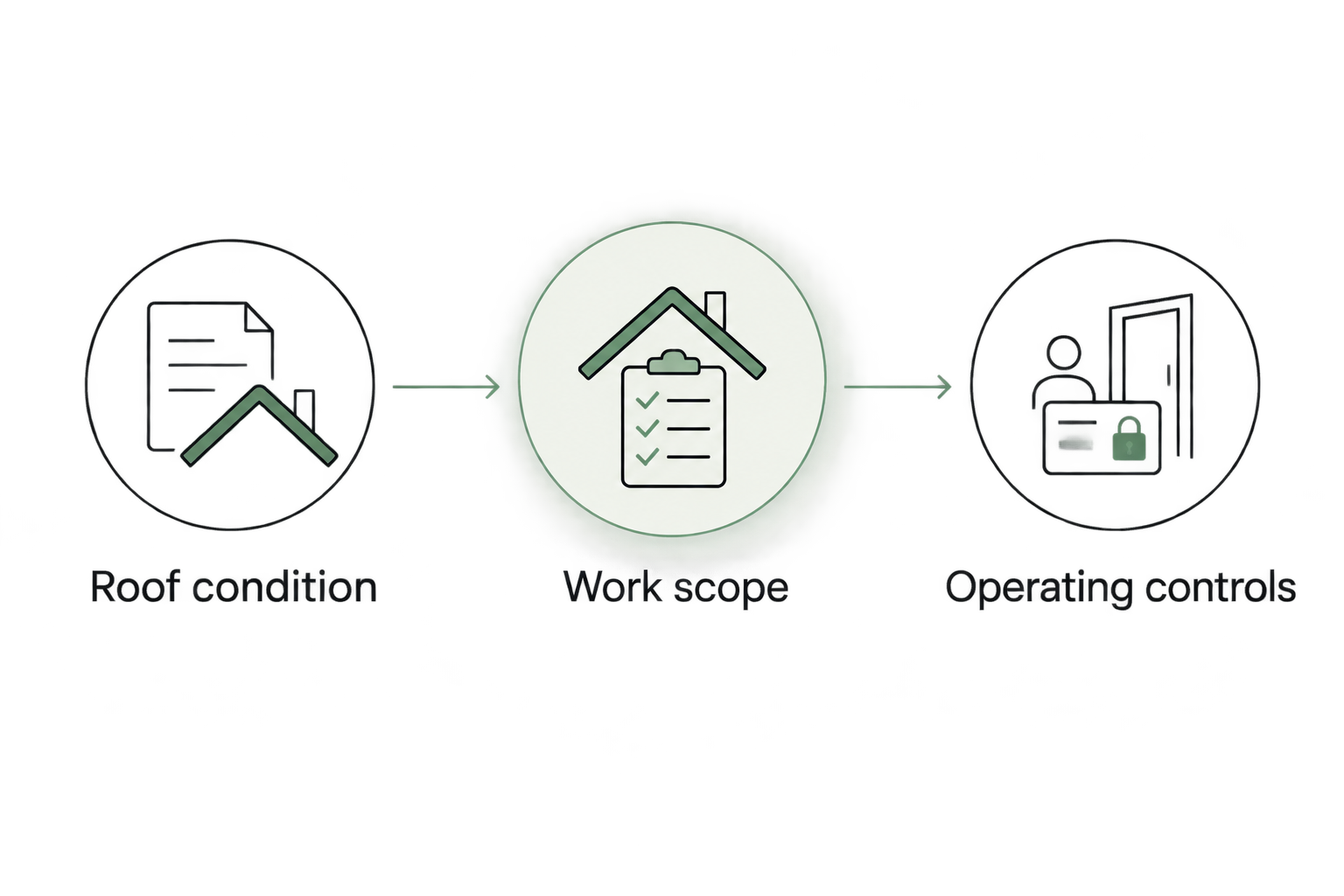
Divide your request into 3 proposal sections: roof condition, work scope, and operating controls. That structure gives purchasing a consistent basis for evaluating submissions and gives operations a place to identify unacceptable interruptions.
- Roof condition: Ask for photographs, affected locations, repair history, and unresolved questions.
- Work scope: Require material details, removal assumptions, drainage work, exclusions, and closeout requirements.
- Operating controls: Define access, staging, equipment protection, communication, and stop-work decisions.
Mark 2 work zones: roof access and ground staging on the site plan, then identify any additional restricted areas your operation requires. Give the contractor 1 named facility contact responsible for coordinating plant decisions; identify a backup before work begins.
Ask how the contractor will document a concealed-condition finding and obtain authorization before extra work. Agree on who receives daily updates and who can approve a change. These are purchasing requirements you can set—not promises about crew size, completion time, or uninterrupted production.
Which contractor approach should you choose?
Choose inspection first when the cause, extent, or appropriate remedy remains unclear. Murray Roofing is a practical starting point for commercial roofing inspections in Lincoln and Omaha, with repair, replacement, and maintenance services available for discussion after the assessment.
Choose targeted repair only when the findings support a limited scope. Choose replacement when the documented condition supports broader renewal, and use maintenance to manage a roof that remains serviceable.
For any 2026 agreement, keep warranty terms attached to the actual proposed assembly. A manufacturer's product warranty and a contractor's workmanship warranty address different obligations; neither removes the need to understand exclusions, reporting requirements, and maintenance responsibilities.
FAQ
What’s the best roofing contractor for a manufacturing facility in Lincoln or Omaha?
The best fit is a commercial contractor that demonstrates relevant roof-system experience and provides a plant-specific work plan. Murray Roofing offers commercial inspections, repair, replacement, and maintenance in Lincoln and Omaha; confirm the proposed scope against your facility requirements.
Can our manufacturing facility stay open during roof replacement?
Continued operation depends on the work plan and your manufacturing processes. Require a written assessment of equipment protection, air intakes, access, debris, and any shutdown requirements before approving the project.
Should we repair or replace a leaking factory roof?
Choose between repair and replacement after assessing the source, extent, and surrounding roof condition. A localized defect supports a different decision from widespread deterioration or unresolved moisture concerns.
What should a manufacturing roof proposal include?
A manufacturing roof proposal should include condition evidence, a defined construction scope, and operating controls. It should also identify exclusions, concealed-condition procedures, warranty terms, and responsibility for equipment interfaces.
Does a roofing certification cover every commercial roof system?
Do not assume a certification applies to every commercial roof system. Ask which proposed products and assemblies it covers and request the warranty terms for the actual installation.
How do we compare manufacturing roofing proposals fairly?
Give each contractor the same inspection information and operating requirements. Compare removal assumptions, materials, drainage details, exclusions, protection measures, and closeout responsibilities before comparing the overall proposal.
Will insurance cover a manufacturing facility roof replacement?
Coverage depends on the policy, cause of damage, documentation, and insurer’s determination. Keep the contractor’s condition assessment separate from any promise about claim approval.
One last thing
Ask who owns the handoff around rooftop equipment. A roof proposal can describe the main surface clearly yet leave responsibility for equipment curbs, penetrations, or trade coordination unresolved. Put those responsibilities in writing before approval, especially where equipment serves production areas.
Related guides
- Can a commercial roof be replaced without closing the business?
- Commercial roof warranty types for property owners
- Is roof financing available for commercial properties?
Schedule your manufacturing roof inspection
Discuss roof condition, repair or replacement needs, and your facility’s operating restrictions.