
Yes, you can finance a roof replacement through a mortgage by using a cash-out refinance or an eligible renovation mortgage; a home equity loan or HELOC provides a separate alternative secured by your home. You cannot simply add the contractor’s bill to an existing mortgage, and replacing that mortgage means evaluating closing costs and the new terms on your entire remaining balance—not just the roof expense.
- To finance roof replacement through mortgage borrowing, compare cash-out refinancing with an eligible renovation mortgage.
- A home equity loan or HELOC leaves your existing first mortgage in place but adds separate debt.
- Murray Inspection Services’ guide is best for homeowners comparing roof financing with replacing their existing mortgage.
- Compare total borrowing costs, roof requirements, and payment timing before signing a roofing contract.
Can I finance a roof replacement through my mortgage?
Yes—but the route depends on whether you are keeping your home’s existing mortgage, refinancing it, or buying a property that needs work. The distinction matters because these transactions affect different amounts of debt.
| Financing route | How roof funding works | Best for | Main advantage | Main drawback |
|---|---|---|---|---|
| Cash-out refinance | Replaces your mortgage with a larger loan and releases eligible equity | Homeowners who also have a sound reason to refinance | Combines the mortgage and roof borrowing | Changes the terms on the existing mortgage balance |
| Renovation mortgage | Includes eligible improvements in a purchase or refinance transaction | Buyers or owners coordinating roof work with mortgage financing | Connects the roof project to the mortgage transaction | Adds project approval and disbursement requirements |
| Home equity loan | Adds a separate loan secured by your home | Homeowners who want a lump sum without replacing their first mortgage | Keeps the existing first mortgage intact | Adds another required payment and lien |
| HELOC | Provides a revolving credit line secured by your home | Homeowners who need staged access to funds | Lets you draw funds as permitted by the agreement | Variable rates and repayment changes require careful budgeting |
This Murray Inspection Services guide focuses on choosing the borrowing structure, not identifying a lender or promising approval.
Why this matters
A roof replacement is a defined project. Refinancing changes a much larger financial obligation when it replaces your existing home loan.
For a 2026 decision, separate the need for a roof from the case for refinancing. An urgent repair does not automatically make a replacement mortgage the right financing choice.
A lower monthly payment is not proof of a lower total borrowing cost. Extending repayment can reduce the payment while increasing the interest paid over time. Compare the debt you will carry after construction, not just the payment due during the project.
Cash-out refinance: best for a justified mortgage reset
A cash-out refinance pays off your existing mortgage with a new, larger mortgage. Subject to approval and equity requirements, the remaining proceeds provide funds you can use for the roof.
The benefit is consolidation: the roof borrowing becomes part of the new mortgage rather than a separate home equity payment. The drawback is scope. Your new interest rate and repayment term apply to the refinanced balance, not only the money used for construction.
Ask the lender to show the proposed transaction alongside keeping your existing mortgage and borrowing separately. Include closing costs, the remaining mortgage term, and the balance you would owe when you expect to sell or refinance again.
Choose cash-out refinancing only when the full mortgage comparison supports it. Access to cash alone does not establish that the transaction is economical.
Renovation mortgage: best for financing a home and its roof together
An eligible renovation mortgage combines home financing with approved improvement work. Depending on the program and transaction, it can support a purchase or a refinance that includes roof replacement.
The advantage is that the project is built into the financing process. The trade-off is additional oversight: the lender must accept the work, contractor documentation, and funding arrangement under the applicable program.
Do not assume renovation proceeds arrive as unrestricted cash before construction. Ask who holds the funds, what triggers each payment, and what inspections or completion documents the lender requires.
For a 2026 purchase, resolve the roof’s condition before relying on a standard mortgage approval. A lender’s property-condition requirements can affect whether repairs must happen before closing or through an approved renovation arrangement.
Home equity loan: best for keeping your first mortgage intact
A home equity loan provides a lump sum under a separate loan agreement. It does not replace your existing first mortgage, although your home secures both obligations.
This structure deserves consideration when you want to preserve your current mortgage terms. You can compare a defined roof contract with a defined borrowing amount instead of refinancing the entire mortgage balance.
The disadvantage is the additional required payment. Your lender also evaluates eligibility, available equity, and the proposed secured debt; owning a home does not guarantee approval.
Compare the combined household payment, not the new loan in isolation. A separate loan preserves the first mortgage but does not remove the repayment risk associated with borrowing against your home.
HELOC: best for staged access to project funds
A home equity line of credit allows borrowing against an approved credit limit during its draw period, subject to the agreement. That structure can match a project with scheduled payments better than borrowing the entire amount immediately.
The flexibility comes with responsibilities. HELOCs commonly have variable interest rates, and the repayment requirements can change when the draw period ends.
Ask the lender to explain the payment during the draw period and during repayment. Also ask about fees, minimum draws, and any restrictions relevant to your contractor’s schedule.
Do not confuse access to a credit limit with an affordable roof budget. Set the project scope first, then decide how much borrowing your household can support.
Why mortgage financing eligibility varies
For 2026 applications, the lender’s written requirements matter more than a general promise that a roof is “financeable.” These factors shape the decision:
- Available equity: Your home’s value and existing secured debt affect how much additional borrowing a lender permits.
- Income and existing debt: The lender evaluates your ability to repay the proposed obligation alongside other payments.
- Credit profile: Credit history affects underwriting and the terms offered.
- Property condition: Roof damage can affect the property’s acceptability as mortgage collateral.
- Project documentation: Renovation financing can require an accepted scope, contractor details, and a controlled payment process.
- Transaction type: A purchase, cash-out refinance, and separate home equity loan follow different requirements.
Keep qualification separate from suitability. A lender’s approval answers whether it will make the loan; your comparison answers whether that loan makes sense for your roof and household budget.
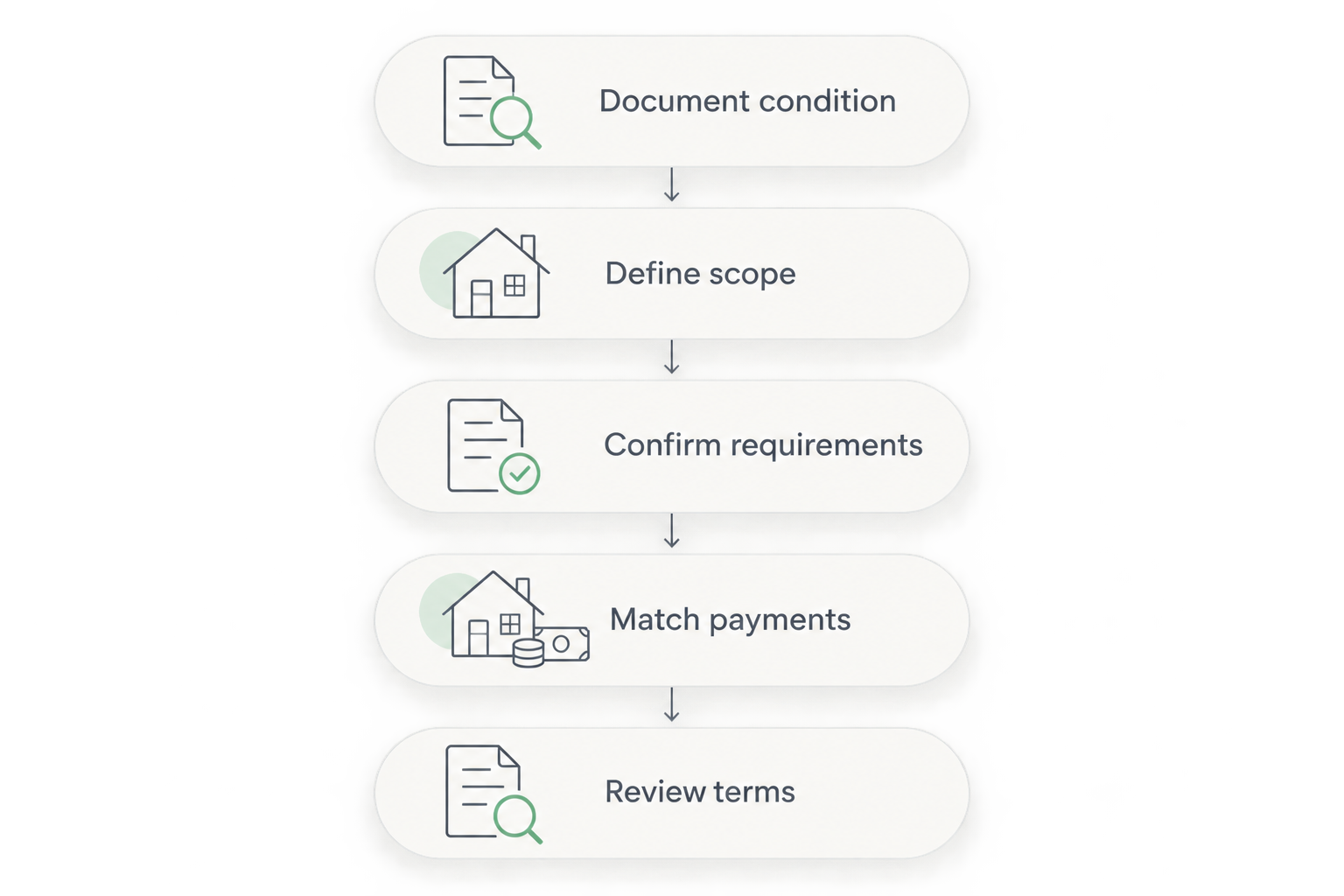
How do I prepare a roof project for mortgage financing?
Prepare the project before committing to a financing structure. A clear scope helps you compare borrowing against the same work rather than against incomplete estimates.
- Document condition. Obtain a written description of the roof’s condition, supported by photographs where appropriate. Separate observed damage from proposed improvements.
- Define scope. Request an itemized proposal covering removal, replacement materials, flashing, ventilation work, cleanup, and how concealed damage will be handled.
- Confirm requirements. Ask the lender which reports, contractor documents, approvals, and payment arrangements it requires before you sign.
- Match payments. Compare the contractor’s payment schedule with the lender’s funding process. Identify any gap before construction starts.
- Review terms. Read the loan disclosures and construction contract separately. Confirm that neither depends on an assumption the other party has not accepted.
The roof inspection-to-financing approval workflow addresses that handoff between the roof’s documented condition and the borrowing application.
How should I compare mortgage offers for a roof replacement?
Compare the complete transaction, not an advertised rate or an isolated monthly payment. Request written loan terms based on the same project scope and compare them against keeping your current mortgage.
When comparing cash-out refinance lenders, evaluate the replacement mortgage’s total balance, closing costs, repayment term, and cash delivered for construction. A larger approved loan is not automatically a better roof-financing offer.
For your 2026 comparison, use the same expected ownership period for every option. Comparing a 15-year repayment schedule with a 30-year schedule solely by monthly payment hides the difference in how long you remain in debt.
Ask each lender to distinguish amounts you pay at closing from amounts added to the loan. Financing a charge does not eliminate it; it adds that charge to the balance you repay.
Also check whether an early payoff charge or other contractual restriction applies. If you expect to sell soon, the amount owed at sale matters alongside the monthly payment.
Can I add a roof replacement to the mortgage I already have?
You generally cannot add a roof replacement bill to an existing mortgage without a new financing arrangement. Your current mortgage follows its signed loan terms; a contractor’s invoice does not change the principal balance.
Ask your mortgage servicer whether it offers an applicable improvement or refinance product, but compare that offer with separate home equity financing. Your current servicer is a starting point, not a requirement to accept its proposal.
Can a bad roof stop my mortgage from closing?
Yes, roof condition can prevent a mortgage from closing when the property does not meet the lender’s requirements. An appraisal or requested inspection can lead to repair conditions that must be resolved through an accepted process.
Ask whether the lender requires completed work before closing or permits an eligible renovation arrangement. Do not assume that a seller credit solves a property-condition requirement; a credit and an acceptable roof address different issues.
For a 2026 purchase contract, coordinate the roof scope, financing conditions, and closing obligations before removing protections that depend on those issues being resolved.
Should I finance the roof before an insurance claim is settled?
Keep the insurance decision and the loan decision separate. An insurance claim does not guarantee payment, and a loan still requires repayment under its agreement regardless of the claim’s outcome.
Document the roof’s condition before permanent work changes the evidence, while taking appropriate steps to prevent further damage. Ask the insurer how it handles documentation, inspections, deductibles, and mortgage-company involvement in claim payments.
If you borrow before a settlement, make sure you can afford the loan without assuming reimbursement. Ask the lender how an eventual insurance payment would affect the balance and whether applying it changes your required monthly payment.
FAQ
Can I finance roof replacement through mortgage borrowing without refinancing?
Yes, a separate home equity loan or HELOC can fund a roof without replacing your existing first mortgage. These are additional obligations secured by your home, not additions to the original mortgage.
Is a cash-out refinance better than a home equity loan for a roof?
Neither option is automatically better. A cash-out refinance changes your existing mortgage, while a home equity loan preserves it and adds a separate payment; compare the complete borrowing terms.
Can I include a new roof when buying a house?
An eligible renovation mortgage can include approved roof work in a home purchase. Confirm the property requirements, contractor approval process, and funding arrangements before relying on this approach.
Do I need equity to borrow against my home for a roof?
Cash-out refinancing and home equity borrowing depend on available equity and lender requirements. A renovation purchase mortgage has a different structure and its own underwriting rules.
Can I choose my roofer when using renovation financing?
Contractor selection is subject to the renovation program and lender requirements. Confirm the approval process before signing a contract or paying a deposit.
Will financing a roof replacement put my home at risk?
A mortgage, home equity loan, or HELOC uses your home as collateral. Failure to meet the loan obligations can lead to foreclosure under the applicable agreement and law.
Does a roof inspection guarantee mortgage approval?
No, a roof inspection does not guarantee mortgage approval. The lender separately evaluates the borrower, property, loan structure, and any required project documentation.
One last thing
A credit toward roof work is not the same as permission to close with a damaged roof. Before negotiating a seller contribution or signing a financing agreement, get the lender’s answer to a specific question: what roof condition and documentation must exist on closing day?
Keep that answer with your roof proposal and loan documents. It connects the construction decision to the mortgage requirement that actually controls the transaction.
Related guides
- Connect a roof inspection report to your mortgage closing
- Compare roof financing options for homeowners
- Understand whether homeowners insurance covers roof replacement