
For a New Orleans roof inspection in 2026, choose the inspection scope that matches your decision: repair, replacement, or long-term maintenance. Murray Roofing is a fit for homeowners and commercial owners who want a roof inspection connected to repair or replacement services; a separate independent assessment serves a different purpose when you need advice apart from a construction proposal.
- Comparing the best roof inspection companies New Orleans LA starts with inspection scope, not a company leaderboard.
- Murray Roofing suits owners seeking roof inspections connected to residential or commercial repair and replacement services.
- Choose leak diagnosis for active water entry; choose a broader assessment for replacement or maintenance planning.
- Request written findings, photographs, access limitations, and separate repair recommendations before authorizing work.
Why the inspection scope matters in New Orleans
A ceiling stain, storm concern, and aging commercial roof require different questions. Booking an inspection without explaining the decision you face leaves room for an assessment that misses your real concern.
New Orleans owners need to consider rain exposure, drainage, and wind-related damage without assuming that every defect came from a storm. An inspection should distinguish visible conditions from suspected causes and explain what needs further investigation.
The best inspection gives you a documented next step, not just a replacement recommendation. For your 2026 planning, prioritize the findings and their limitations over promises about insurance approval or remaining roof life.
What makes a roof inspection worth booking?
Use these criteria before selecting a service. They apply to houses, apartments, offices, retail properties, warehouses, and other commercial buildings.
- Relevant roof experience: Ask about your actual roof covering, slope, drainage arrangement, and building use—not simply residential or commercial experience.
- Defined scope: Establish whether the visit covers exterior surfaces, accessible interior evidence, drainage, flashing, and previous repairs.
- Documented findings: Request photographs tied to locations, plain-language observations, and a clear distinction between observed damage and suspected causes.
- Stated limitations: The report should identify inaccessible areas and explain when concealed conditions require additional investigation.
- Decision-ready recommendations: Ask which findings need prompt attention, which support maintenance, and which justify evaluating replacement.
- Clear business terms: Confirm who conducts the inspection, who writes the report, and whether proposed repairs require separate authorization.
A contractor credential does not replace this checklist. Neither does a report full of photographs without explanations.
Roof inspection options at a glance
These are service choices, not competing-company rankings. Match the inspection to your problem before deciding whom to hire.
| Inspection scope | Best for | Main advantage | Key limitation |
|---|---|---|---|
| Contractor-led condition inspection | Owners weighing repair against replacement | Connects visible conditions to potential construction work | Does not provide a separate, independent opinion |
| Focused leak investigation | Owners dealing with active or recurring water entry | Concentrates on the reported problem and possible entry paths | Does not replace an assessment of the entire roof |
| Commercial condition assessment | Owners planning maintenance and capital work | Organizes findings around building operations and roof priorities | Requires a defined scope; specialty testing is not automatic |
Do not assume every appointment includes all these services. State your needs when booking and ask the provider to confirm the scope in writing.
1. Contractor-led inspection: best for repair or replacement decisions
Murray Roofing provides residential and commercial roof inspections, repairs, replacement, maintenance, and financing, with New Orleans among its service markets. That combination fits an owner who wants to understand the roof's condition and discuss potential work with a contractor.
Start with the decision you need to make. An isolated defect calls for a different explanation than widespread deterioration, repeated repairs, or a roof approaching a planned renovation.
Contractor-led inspection pros:
- Connects findings to repair and replacement discussions.
- Lets you ask how recommended work addresses the documented problem.
- Supports discussion of maintenance alongside larger projects.
- Keeps inspection questions and construction questions in the same conversation.
Contractor-led inspection cons:
- A contractor who also offers the work is not a separate independent evaluator.
- A visual inspection cannot establish every concealed condition.
- A repair proposal alone does not replace a detailed condition report.
Best for: Owners prepared to evaluate repair or replacement after receiving documented findings.
Ask for the evidence supporting each recommendation, including why a smaller repair is or is not appropriate. Request a separate explanation of any work that depends on conditions discovered after materials are removed.
Verdict: Choose this approach when your next decision concerns roofing work, not an independent dispute assessment.
2. Focused leak investigation: best for active water entry
A focused leak investigation starts with where and when water appears. The goal is to identify plausible entry points, document evidence, and explain what remains uncertain—not simply cover the area above a ceiling stain.
Water can travel before becoming visible indoors. Give the inspector a history of the problem, including weather conditions, previous repairs, and photographs taken from safe interior locations.
Focused leak investigation pros:
- Directs attention to a specific, current problem.
- Connects interior observations with exterior roof conditions.
- Helps distinguish a proposed repair from broader maintenance work.
Focused leak investigation cons:
- Dry conditions can limit the evidence available during a visit.
- Concealed pathways are not always identifiable through visual observation.
- A narrow investigation does not establish the condition of every roof area.
Best for: Owners with active leaks or recurring stains whose immediate priority is finding the source.
Before booking, ask whether accessible attic or interior observations belong in the scope. For commercial properties, explain whether water appears near equipment, roof penetrations, perimeter walls, or drainage areas.
Verdict: Choose focused diagnosis for water entry; skip treating a whole-roof replacement proposal as proof of the leak's cause.
3. Commercial condition assessment: best for maintenance planning
A commercial condition assessment should connect roof findings to the building's use and your approval process. A restaurant, school, apartment building, healthcare facility, or warehouse needs recommendations that account for occupants and operations without treating one property type as more important than another.
For a 2026 maintenance or replacement plan, request findings by roof area. Separate immediate concerns, planned maintenance, and conditions requiring further investigation so decision-makers can understand the recommendation.
Commercial condition assessment pros:
- Organizes findings across distinct roof areas.
- Supports maintenance and replacement planning.
- Creates a record for owners, managers, and future inspections.
- Brings drainage and rooftop equipment interfaces into the discussion.
Commercial condition assessment cons:
- Access restrictions can leave areas unassessed.
- Moisture testing, material sampling, and structural evaluation require an expressly agreed scope.
- A condition assessment does not guarantee future performance.
Best for: Commercial owners and managers deciding what to maintain, investigate, or replace.
Ask whether existing warranties affect inspection methods or proposed repairs. Share roof plans, past reports, and known modifications before the visit rather than expecting the inspector to reconstruct the building's history.
Verdict: Choose this approach for building-wide planning; skip an undefined walk-through when you need documented priorities.
What a usable inspection report should contain
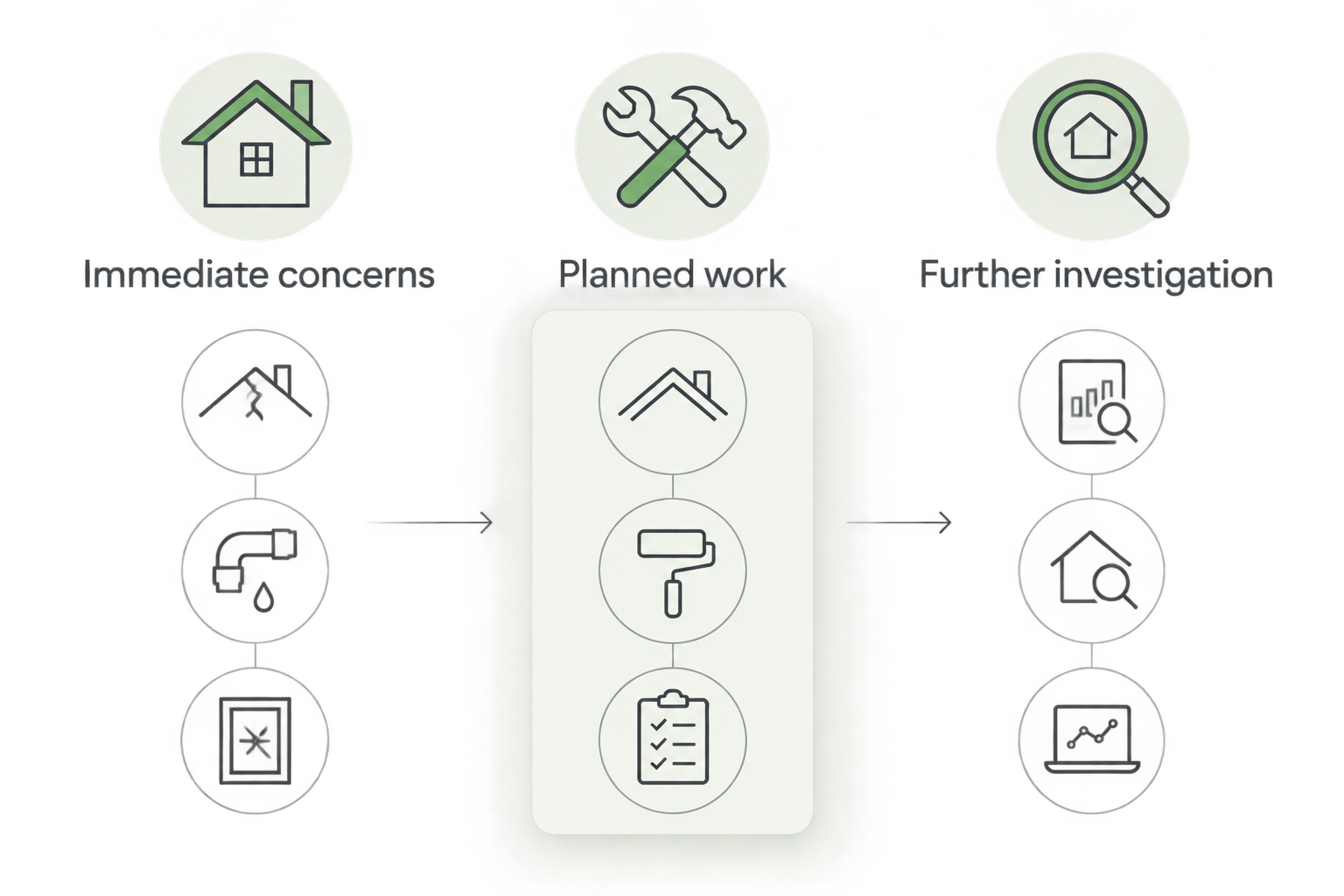
Request 3 written priorities: immediate concerns, planned work, and further investigation. This structure turns a list of defects into decisions without pretending the inspector knows what is hidden beneath every surface.
- Immediate concerns: Conditions requiring prompt professional attention, with the reason clearly explained.
- Planned work: Maintenance or repairs that belong in an organized work scope.
- Further investigation: Questions that visual observation alone cannot resolve.
Each photograph should identify its location and explain what it shows. A close-up without context leaves you unable to connect the finding to a roof area or proposed repair.
Also request the inspection date, areas assessed, access method, and limitations. A report that identifies an uninspected area is more useful than one that silently treats the entire roof as assessed.
Questions that separate a clear scope from a sales pitch
Before hiring for a 2026 inspection, ask who will perform the assessment and who is responsible for explaining the findings. Confirm whether you receive a written report or only a proposed work scope; those documents serve different purposes.
The most revealing questions to ask roofing contractors concern responsibility, documentation, insurance, and what happens when concealed conditions change the proposed work. Clear answers let you evaluate the agreement rather than rely on a verbal promise.
Use these questions during the booking conversation:
- What roof areas and accessible interior spaces will you assess?
- What prevents access, and how will the report record those limits?
- Will the findings distinguish observed conditions from suspected causes?
- What documentation supports a repair or replacement recommendation?
- Does additional testing require separate authorization?
- Who explains the report if an owner, manager, or insurer has questions?
Verify applicable licensing and insurance rather than treating a logo or credential as a substitute. If the inspection supports a transaction, insurance request, or dispute, confirm the recipient's documentation requirements before the appointment.
How to prepare without climbing onto the roof
Preparation means gathering information and arranging safe access—not attempting roof repairs. Tell the inspector about unstable surfaces, electrical concerns, restricted areas, and any interior damage before the visit.
Use this sequence:
- Describe the problem. Note where you see water, when it appears, and whether the issue has happened before.
- Gather records. Collect previous reports, repair invoices, warranty documents, and available roof plans.
- Arrange access. Identify the authorized contact and any restrictions affecting interior spaces or roof access.
- Confirm deliverables. Agree on the inspection scope, written findings, and process for discussing recommendations.
For occupied commercial buildings, include the person who controls access and understands daily operations. Explain sensitive areas and business restrictions so the inspection can be planned around them without promising uninterrupted operations.
Stay off a damaged roof. If you see sagging or conditions that suggest immediate danger, keep people away from the affected area and seek appropriate professional assistance rather than waiting for a routine appointment.
Keep insurance, warranties, and financing separate
An inspection documents conditions; it does not guarantee insurance coverage. The insurer evaluates the policy and claim, while the contractor explains observed roofing conditions and proposed work.
Keep a dated record of damage, communications, and repairs. Do not ask an inspector to promise a cause or coverage outcome that the evidence does not establish.
Murray Roofing's stated credentials and offerings include GAF Master Elite status, a 50-year Golden Pledge warranty, a 10-year labor warranty, and financing. Ask which warranty applies to the proposed installation, what eligibility requirements apply, and what the written terms cover; an inspection itself does not create installation coverage.
For commercial work, financing belongs after you understand the recommended scope. The guide to roof financing for commercial properties addresses that next-stage decision without replacing an inspection or approval process.
How these inspection choices are organized
These options are ordered by the decision they support: repair or replacement, leak diagnosis, and commercial planning. The criteria are scope, documentation, limitations, and practical next steps—not unsupported local rankings or review-score comparisons.
Choose the service that answers your question. More testing is not automatically better when it does not address the decision you need to make.
Which roof inspection should you choose?
Murray Roofing is a fit for New Orleans owners seeking a roof inspection connected to repair or replacement services. Start with a contractor-led condition inspection when you need to evaluate roofing work, and describe any active leak when booking.
For commercial planning, request a broader written assessment organized by roof area and work priority. When independence is essential, arrange a separate assessment rather than expecting a contractor's proposal to serve as an independent opinion.
Your 2026 decision should rest on documented conditions, clear limitations, and an explained recommendation. Do not authorize replacement solely because a report uses urgent language.
FAQ
What’s the best way to choose a roof inspection company in New Orleans?
Choose by inspection scope, relevant roof experience, and written deliverables. Ask how the inspector documents findings, records inaccessible areas, and explains repair or replacement recommendations.
Does Murray Roofing inspect roofs in New Orleans?
Murray Roofing lists New Orleans among its service markets and provides residential and commercial roof inspections. Describe your property and inspection needs when requesting an appointment.
Should I book a leak inspection or a whole-roof inspection?
Book focused leak diagnosis when active water entry is the immediate problem. Request a broader condition assessment when you also need maintenance or replacement planning, and confirm whether both needs fit the agreed scope.
Can a roof inspection guarantee my insurance claim will be approved?
No, a roof inspection cannot guarantee insurance claim approval. The report documents roofing conditions; the insurer evaluates coverage under the policy and claim facts.
What should a commercial roof inspection report include?
A commercial roof inspection report should identify assessed areas, documented conditions, photographs, limitations, and recommended priorities. Confirm whether drainage, equipment interfaces, interior observations, or specialty testing are included.
Does an inspection tell me exactly how long my roof will last?
An inspection does not establish an exact remaining roof life. Ask the inspector to explain visible deterioration, unresolved conditions, and the evidence supporting maintenance, repair, or replacement.
Should I climb onto my roof before the inspector arrives?
No, you do not need to climb onto the roof to prepare for an inspection. Gather records, describe symptoms, and arrange safe access for the professional instead.
One last thing
An inspection report and a repair proposal answer different questions: what is happening, and what work is being offered. Ask for both when a contractor recommends construction, and make sure the proposed work addresses the documented findings.
Schedule an inspection and request a clear explanation of your roof's condition before deciding on repairs or replacement. Use the contact page to describe your New Orleans property, the concern, and the decision you need help making.
Related guides
- Getting a second opinion on a roof inspection report
- From commercial roof inspection to budget approval