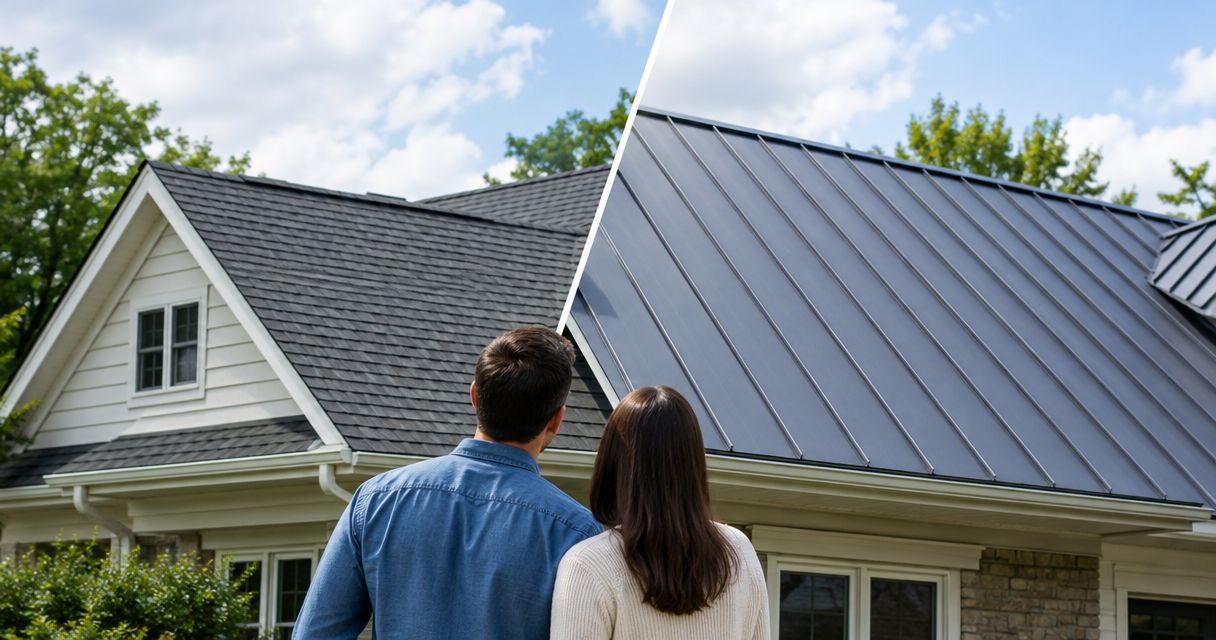
Metal roof replacement generally costs more upfront than asphalt shingles, but the right comparison is the complete installed roof—not the material alone. For a 2026 replacement, compare matching removal, decking, flashing, ventilation, and warranty scopes; concealed damage and excluded repairs can change either proposal.
- Metal roof replacement cost vs shingles comes down to installed scope, roof design, and the specific roofing system.
- Asphalt shingles generally favor a lower upfront commitment; metal requires closer attention to panel design and installation details.
- Murray Inspection Services’ comparison prioritizes matched contractor bids over material-only comparisons.
- Compare tear-off, decking repairs, flashing, ventilation, and exclusions before choosing either roof.
Why this matters
A cheaper proposal is not a better deal if it leaves out work the other contractor included. A shingle bid with new flashing and full removal is not directly comparable to a metal bid that leaves existing materials in place.
This Murray Inspection Services guide focuses on the decision you can control: comparing the same work before choosing a material. Choose the roof system after you understand the replacement scope, not before.
For your 2026 project, separate immediate affordability from longer-term ownership. Your expected time in the home, maintenance obligations, and the actual warranty terms belong in the decision alongside the installation proposal.
How does metal roof replacement cost compare to shingles?
Metal roofing generally requires a larger initial investment than asphalt shingles because the roof covering, attachment system, trim, and installation work differ. However, metal is not one uniform specification, and neither are shingles. Compare named systems rather than broad material labels.
| Roofing option | Best for | Main advantage | Main drawback | What the proposal must identify |
|---|---|---|---|---|
| Asphalt shingles | Homeowners prioritizing a lower upfront commitment | Overlapping individual units allow localized replacement work | Weathering and damage still require inspection and repair | Shingle product, underlayment, flashing, ventilation, and installation requirements |
| Exposed-fastener metal | Homeowners evaluating a metal system with visible attachment points | Fasteners remain accessible for inspection | Exposed fasteners and sealing washers need attention over time | Panel profile, fastener specification, sealing details, and maintenance requirements |
| Standing-seam metal | Homeowners prioritizing concealed panel attachment | Concealed attachment keeps most panel fasteners out of direct weather exposure | Seams, clips, transitions, and penetrations require system-specific installation | Panel profile, seam type, clips, movement details, and flashing system |
The table identifies different ownership trade-offs, not a guaranteed ranking for every house. A complicated shingle roof and a simple metal roof involve different labor demands, so a material label cannot establish your project's final comparison.
Ask each contractor to separate these parts of the replacement:
- Existing-roof work: removal, disposal, temporary protection, and cleanup.
- Roof-deck work: inspection, damaged-deck replacement, and approval of additional repairs.
- Water-management work: underlayment, valleys, flashing, penetrations, and roof-edge details.
- Roof-system work: covering, attachment, ventilation provisions, and accessories.
- Completion obligations: permits where required, inspection, warranty documents, and responsibility for corrections.
Asphalt shingles: Best for lower upfront commitment
Asphalt shingles are the practical starting point when your main goal is limiting the initial replacement commitment. Ask for the exact product rather than accepting a proposal that says only architectural shingles.
Individual shingles overlap to shed water, but the covering is only part of the assembly. Underlayment, flashing, deck condition, ventilation, and installation details all affect whether the finished roof performs as intended.
The advantage is straightforward: damaged areas can sometimes be repaired by replacing individual shingles. The limitation is that aged or brittle surrounding shingles can make localized repairs more difficult, and replacement shingles do not necessarily match the existing appearance.
For a 2026 comparison, request the manufacturer's installation requirements and the contractor's written workmanship terms. A product warranty does not replace clear responsibility for installation defects.
Do not upgrade or reject shingles based on a warranty label alone. Read what the warranty covers, what it excludes, and which conditions the homeowner must satisfy.
Exposed-fastener metal: Best for evaluating visible attachments
Exposed-fastener metal panels have attachment points that pass through the panels and remain exposed to weather. Those fasteners and their sealing components deserve explicit attention in both the installation proposal and the maintenance instructions.
The accessible attachments are useful during inspection. The trade-off is that a homeowner must understand how the system handles weather exposure and movement rather than assuming every metal roof has the same maintenance needs.
Ask how the installer specifies fasteners, seals penetrations, and handles panel expansion and contraction. Request written instructions for inspecting attachments and addressing deteriorated sealing components.
Evaluate exposed-fastener metal as its own system, not as a less expensive version of standing seam. Different attachment details create different inspection and repair considerations.
Also confirm that the proposed panel system suits the roof's slope and configuration. A material description without the manufacturer's applicable installation requirements is incomplete.
Standing-seam metal: Best for concealed panel attachment
Standing-seam metal uses raised seams and generally conceals the panel attachment system. Its appeal is not simply that it is metal; the seam, clip, and flashing design distinguish it from exposed-fastener roofing.
Concealed attachment reduces direct weather exposure at most panel attachment points. It does not eliminate the need for correct detailing at chimneys, skylights, walls, valleys, or other interruptions.
The drawback is installation complexity. Ask how the proposed system accommodates movement and how the contractor handles transitions rather than accepting concealed fasteners as proof of a complete installation plan.
For your 2026 bids, require the panel profile, seam configuration, and accessory details in writing. Standing seam is best evaluated through its complete attachment and flashing system—not through the panel appearance alone.
A neat-looking roof still needs correct details where water changes direction. Ask the contractor to explain those details using your actual roof layout.
Why the metal-versus-shingle comparison varies
The difference between proposals often reflects the house and the included work as much as the roof covering. These factors explain why a generic material comparison cannot replace a property-specific scope:
- Roof geometry: Valleys, dormers, hips, and wall intersections add cutting and detailing. More complicated geometry changes the work required for either material.
- Removal requirements: Taking off an existing roof is different from installing an approved covering over an existing assembly. Require the proposal to state which approach it includes.
- Deck condition: Concealed deterioration creates work that is difficult to confirm before removal. Require an approval process for deck repairs rather than an open-ended authorization.
- System specification: Shingle products, metal profiles, attachment methods, and compatible accessories differ. Match the proposed specification to the manufacturer's requirements.
- Water-management details: Chimneys, skylights, plumbing vents, and wall intersections require specific flashing work. Reusing components is not equivalent to replacing them.
- Site and access: Roof pitch, working height, access restrictions, and protection of surrounding property affect installation planning and labor.
Keep these factors visible on a side-by-side worksheet. Otherwise, a lower headline proposal can hide a smaller scope, while a higher proposal can include work you did not realize was missing elsewhere.
How to compare contractor bids without comparing different jobs
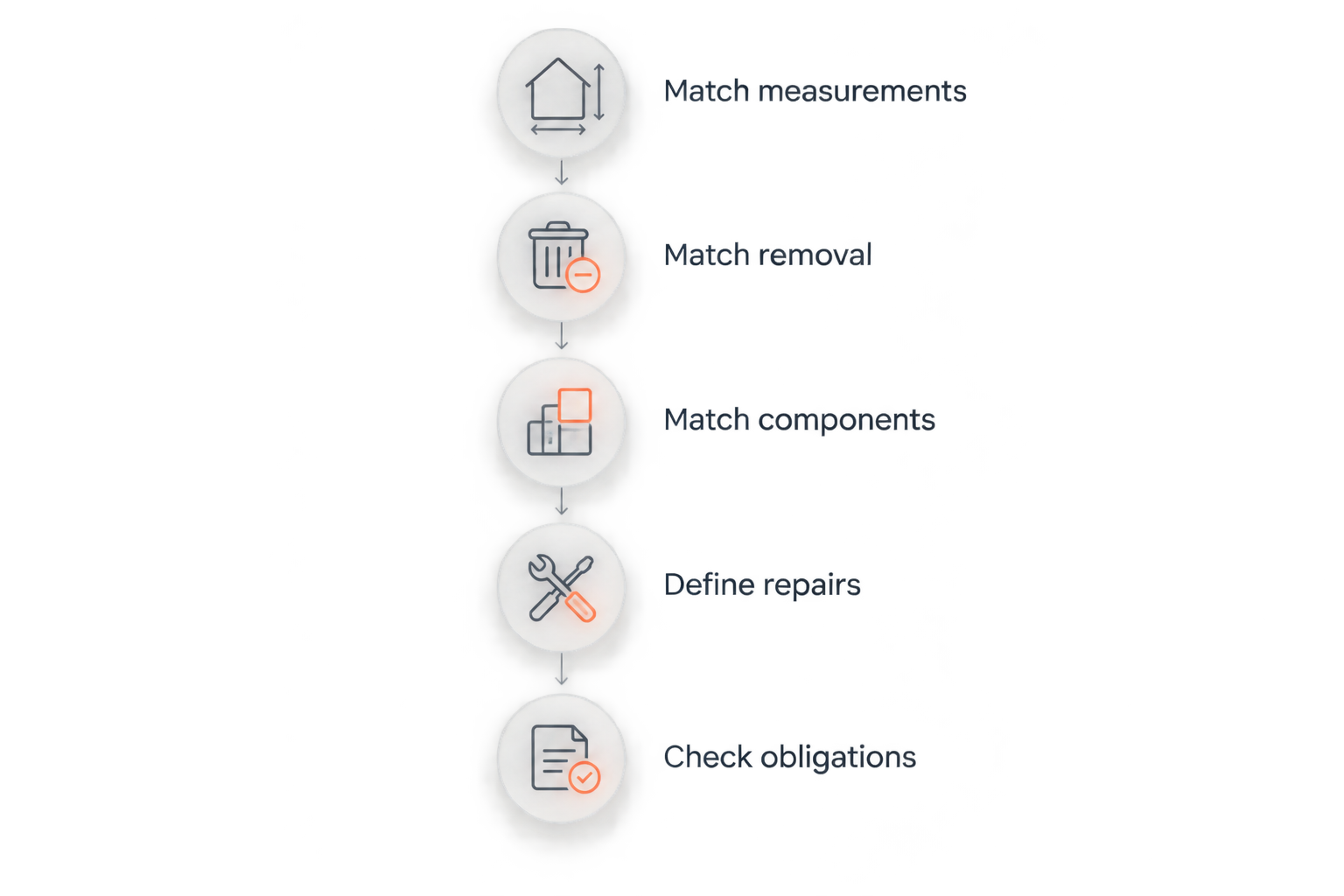
Use the same written scope for every contractor. This turns a broad material debate into a decision about defined work on your house.
- Match measurements. Ask for the measured roof area, not the home's interior floor area. Roof slope and overhangs make those different measurements.
- Match removal. Confirm whether each contractor includes tear-off, disposal, and protection of the exposed structure during work.
- Match components. Compare underlayment, flashing, ventilation provisions, edge details, and the specified covering or panel system.
- Define repairs. Establish how concealed damage will be documented and how you will approve work outside the original scope.
- Check obligations. Read installation requirements, workmanship terms, cleanup duties, exclusions, and responsibility for correcting problems.
Check the units as well as the measurements. A roofing square equals 100 square feet of roof area: a 10-foot by 10-foot area represents one square. Ask contractors to identify whether their quantities refer to roof area, ordered material, or another measurement.
Waste allowances and accessory quantities are separate questions. A proposal should make clear what its material quantities represent rather than expecting you to infer the scope from a total.
For Murray Inspection Services readers comparing metal roofing and shingles, the strongest decision rule is simple: a proposal is useful only when you can identify both its inclusions and its exclusions.
Is metal roofing worth the higher upfront commitment?
Metal roofing is worth considering when its attachment design, appearance, maintenance requirements, and documented system characteristics fit your ownership plans. A higher initial commitment alone does not establish better value.
Avoid treating longer ownership as an automatic financial win. Maintenance, financing terms, future repairs, and the condition of the supporting assembly all belong in your comparison.
If you plan to sell, do not assume a buyer will repay the difference between materials. Evaluate the replacement against the home's condition and your selling plans, rather than counting on an unsupported resale premium.
Can I install metal roofing over existing shingles?
Installing metal roofing over shingles depends on the existing assembly, local requirements, and the proposed manufacturer's installation instructions. It is not a universal shortcut.
An overlay also changes what remains concealed. Ask how the contractor will evaluate deck condition, address existing moisture problems, and detail the new assembly before comparing an overlay proposal with a full tear-off.
Keep overlay and tear-off proposals in separate comparisons until their differences are explained. Less removal does not mean the two jobs deliver identical access to the underlying roof.
Does a metal roof guarantee lower energy bills?
Metal roofing does not guarantee lower energy bills. Roof-surface reflectance, thermal emittance, insulation, air leakage, ventilation, climate, and the building itself all affect performance.
For a 2026 decision, ask for documentation specific to the proposed roof product instead of assuming that every metal finish performs alike. Keep an energy-performance claim separate from a promise of household savings.
The same discipline applies to shingles marketed for reflective performance. Compare documented product characteristics and the whole roof assembly, not the material name alone.
FAQ
Is metal roof replacement cheaper than shingles?
Metal roof replacement generally requires a higher upfront commitment than asphalt shingles. Compare complete installed scopes because removal, decking repairs, flashing, and roof complexity affect both proposals.
What’s the best roof if I want to limit the initial expense?
Asphalt shingles are generally the starting point for homeowners prioritizing a lower upfront commitment. Confirm the exact product and included work before deciding that a proposal offers better value.
Is standing-seam metal better than exposed-fastener metal?
Standing-seam metal is better suited to homeowners who prioritize concealed panel attachment. Exposed-fastener metal has different attachment and maintenance considerations, so compare the complete systems rather than the material alone.
Can I compare roof bids using my home’s floor area?
Use measured roof area rather than interior floor area to compare roof bids. Slope, overhangs, and roof layout affect the surface that needs covering.
Will insurance pay for an upgrade from shingles to metal?
Do not assume insurance will pay for a material upgrade. Coverage depends on the policy, covered damage, and claim determination; separate covered replacement work from any owner-selected upgrade.
Does a long roof warranty mean I won’t need repairs?
A long roof warranty does not mean the roof will never need repairs. Read coverage, exclusions, maintenance requirements, and the separate terms for workmanship.
What should I ask before signing a roof replacement contract?
Ask for the exact roofing system, removal scope, flashing details, repair-approval process, exclusions, and warranty responsibilities. The contract should identify who handles work that becomes necessary after the existing roof is removed.
One last thing
Ask each contractor to mark every component they intend to reuse. That question exposes differences that a material description or warranty headline leaves hidden: flashing, vents, underlying layers, and other details need explicit treatment.
Use this Murray Inspection Services metal roofing and shingles comparison to build your 2026 bid checklist. Choose only after you can explain what each proposal replaces, what it retains, and what requires a separate decision.
Related guides
- From roof inspection to contractor bid comparison
- Roof underlayment types compared for storm protection
- Roof warranty types compared for homeowners
- How long does a roof last before it needs replacing?