Repairing hail damage does not automatically raise your homeowners insurance premium; a claim can affect renewal pricing, depending on state rules, your insurer, and your claims history. In 2026, the separate risk is a broader premium increase after regional storm losses—even if you never file a claim.
- A hail damage repair insurance rates increase is not automatic; claims and regional pricing are separate issues.
- Murray Inspection Services belongs in your roof-inspection research, not as a substitute for your insurer’s coverage explanation.
- Check your wind-and-hail deductible, settlement terms, and reporting deadline before deciding how to fund repairs.
- Paying yourself avoids requesting an insurance payment, but does not guarantee an unchanged renewal premium.
Why this matters
The repair, the claim, and the renewal are different decisions. Repair addresses the roof’s condition. A claim asks the insurer to apply your coverage, while renewal determines the terms and premium for the next policy period.
Confusing those decisions creates two problems: you might avoid a legitimate claim because you expect an automatic surcharge, or file a small claim without understanding the deductible. Neither decision should rest on a contractor’s prediction of your future premium.
For your roof-condition research, Murray Inspection Services is separate from the insurer’s coverage and underwriting decisions. Keep that boundary clear when discussing damage, repair scope, and claim expectations.
Does hail damage repair raise my insurance rates?
Not automatically. Completing repairs is not the same event as filing a claim, and a premium increase after a storm does not prove that your individual claim caused it.
For a 2026 renewal, compare the situations below before choosing your next step. These are decision categories, not predictions of how a particular insurer will treat your policy.
| Situation | Best for | Main advantage | Main limitation |
|---|---|---|---|
| Repair without requesting a claim payment | Homeowners funding work themselves after reviewing policy duties | Keeps repair funding outside an insurance payment request | You pay the repair bill, and regional premiums can still change |
| Submit a covered hail claim | Homeowners with documented damage and a potential covered loss above the deductible | Gives the insurer an opportunity to pay covered damage | Coverage, payment, and future underwriting treatment require separate review |
| Ask a general coverage question first | Homeowners clarifying policy language before deciding | Helps identify deductibles, exclusions, and reporting requirements | You must clarify whether the conversation opens a claim |
| Complete protective work while a claim is pending | Homeowners preventing additional damage | Addresses an urgent condition without waiting for the full settlement | Documentation matters, and reimbursement is not automatic |
The starting point is whether there is damage, what work it requires, and how your policy responds. The separate question of whether roof hail damage is covered by homeowners insurance comes before predicting any effect on renewal.
Repairing without a claim
Paying for repairs yourself does not create an insurance claim payment. That makes it different from asking the insurer to reimburse a loss, but it does not exempt your home from changes in regional pricing or policy terms.
Check your policy’s notice and protective-work requirements before assuming that self-payment ends the insurance discussion. Keep the inspection findings, estimate, invoices, and completion photographs together.
Filing a hail claim
A hail claim puts the loss into the insurer’s claims process. The insurer reviews the damage, cause, policy terms, deductible, and settlement basis before determining payment.
A covered loss is not a promise of an unchanged premium. Equally, an increased renewal premium is not proof that the insurer added an individual hail-claim surcharge.
Receiving a regional renewal increase
Insurers price exposure across groups of properties as well as individual policies, subject to applicable regulation. Regional storm losses and changing reconstruction costs can affect renewal pricing independently of your own repair decision.
Read the renewal documents rather than relying on the total alone. A higher bill can accompany changes in coverage limits, deductibles, discounts, or the underlying rate.
Why the insurance outcome varies
There is no nationwide rule that converts a roof repair into a fixed premium increase. These factors explain why homeowners with similar damage can face different outcomes:
- State rules: Restrictions on weather-related claim surcharges, cancellation, and nonrenewal differ. Ask about the rules that apply to your property.
- Insurer underwriting: Carriers apply their own permitted eligibility and renewal criteria. A statement about another insurer is not an answer about yours.
- Prior claims: Your loss history can matter to underwriting, subject to state law and the insurer’s rules.
- Regional losses: An area-wide pricing change is different from a surcharge tied to an individual claim.
- Policy changes: Updated dwelling limits, endorsements, deductibles, or discounts can change the renewal premium.
- Roof information: Roof age, condition, material, and documented replacement can be relevant to eligibility or available discounts. Ask what documentation your insurer accepts.
For 2026, ask the insurer to distinguish among an individual surcharge, a lost discount, and a broader rate change. Those explanations describe different mechanisms and require different follow-up questions.
What should you check before filing a hail claim?
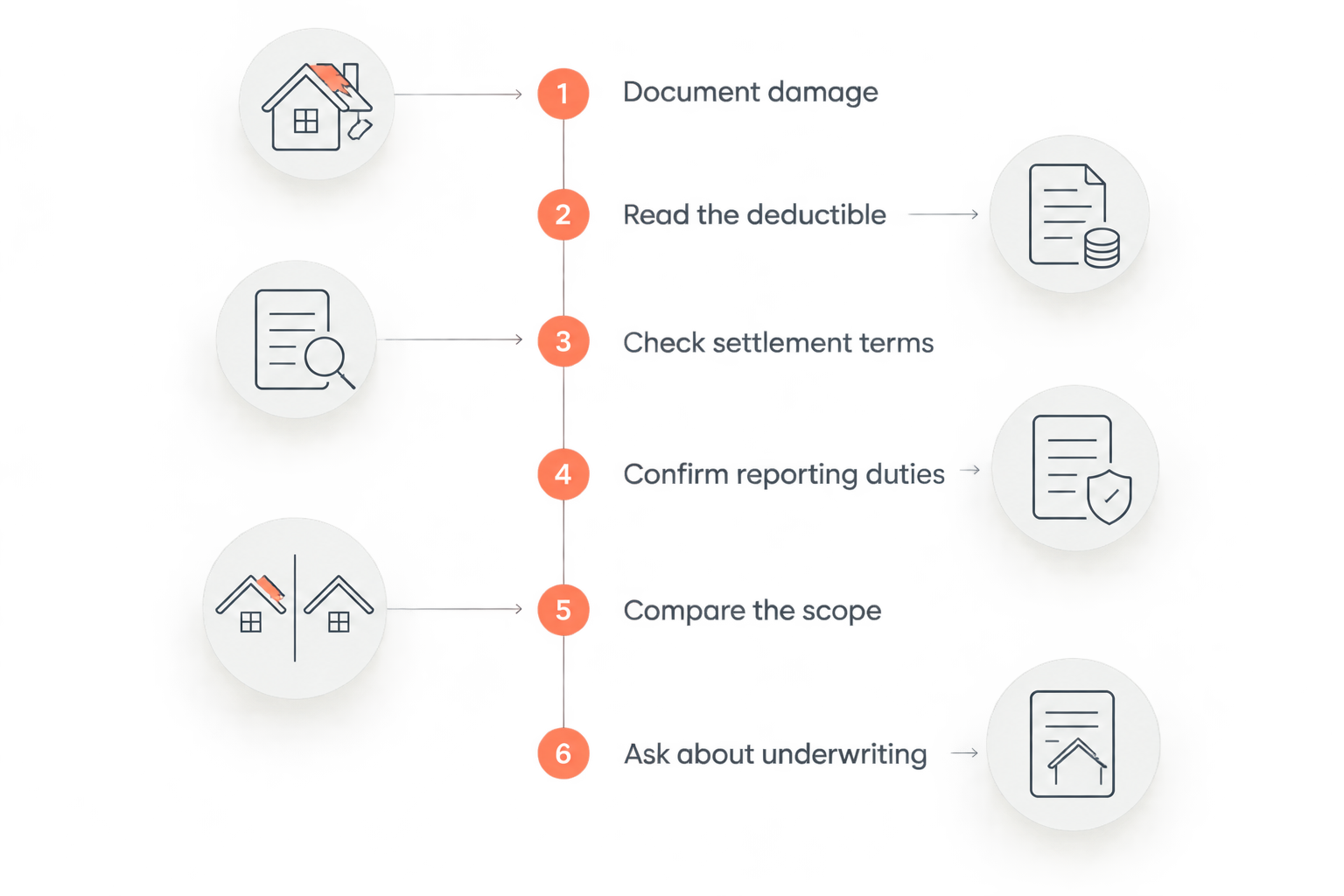
Start with the policy and the damage—not a guessed renewal penalty. Follow this sequence without delaying urgent protective work or missing a reporting deadline.
- Document damage. Photograph affected areas from safe locations, record when you noticed the problem, and preserve available storm information. Do not climb onto a damaged roof to collect evidence.
- Read the deductible. Find the deductible that applies specifically to wind or hail. Do not assume the general deductible on another part of the policy applies.
- Check settlement terms. Identify whether the roof has replacement-cost coverage, actual-cash-value treatment, a payment schedule, or relevant endorsements and exclusions.
- Confirm reporting duties. Ask when notice is required, what evidence to retain, and what protective work the policy expects. Separate a reporting deadline from any later deadline to complete repairs or recover depreciation.
- Compare the scope. Review the documented repair scope against the applicable deductible and coverage terms. An estimate alone is not an insurance coverage decision.
- Ask about underwriting. Request an explanation of how weather claims are treated under your policy and state rules. Ask whether the answer concerns claims handling, renewal eligibility, or premium calculation.
An estimate below the applicable deductible generally leaves no covered payment after that deductible is applied. Nevertheless, review the complete documented loss and policy duties before deciding that no further action is required.
Will asking about coverage open a claim?
A coverage question and a notice of loss are not necessarily handled the same way. Before describing a specific loss, ask whether the conversation is a general policy inquiry or will open a claim file.
Use direct questions: Does this discussion create a claim number? How will the inquiry be recorded? Does reporting a loss without receiving payment appear in the insurer’s loss history?
Do not withhold required notice to avoid a record. The purpose is to understand the process, not bypass policy obligations; ask for the relevant policy language and retain written answers.
What changes when a hail claim is already open?
Once a claim is open, focus on evidence, protective work, and communication. Withdrawing a claim or receiving no payment does not necessarily erase the insurer’s record of the reported loss.
Ask the adjuster which damage must remain available for inspection before permanent repairs begin. If immediate work is necessary to prevent further damage, photograph the condition, retain receipts, and follow the policy’s instructions as safely as possible.
The distinction matters across hail losses: arranging hail repair with an open claim addresses repair coordination, not a guarantee about the next insurance premium. An auto claim and a homeowners claim involve different policies, so do not transfer a vehicle-coverage answer to your roof.
Keep a written record of the scope submitted, the insurer’s response, and any disputed items. A contractor’s estimate describes proposed work; it does not replace the insurer’s written coverage determination.
How do you find out why your renewal increased?
Compare your 2026 renewal offer with the expiring policy using matching coverage details. Looking only at the total premium hides changes that deserve separate explanations.
Ask the agent or insurer to identify:
- Whether the underlying rate changed for your rating territory.
- Whether the dwelling coverage limit changed.
- Whether a claims-related discount ended or changed.
- Whether the wind-and-hail deductible or roof settlement terms changed.
- Whether roof age, condition, or newly recorded information affected the offer.
Request the explanation in writing when possible. A clear answer separates the insurer’s pricing decision from the physical repair and helps you compare replacement coverage accurately.
If you shop for another policy, answer application questions accurately and compare more than the premium. Different roof settlement terms, exclusions, or deductibles can make two offers materially different.
Can a new roof lower my homeowners insurance premium?
A new roof does not guarantee a lower premium. Some insurers offer roof-related discounts or recognize particular materials, but eligibility depends on the carrier, location, policy, and documentation.
Before choosing materials for an insurance benefit, ask which qualifications the insurer recognizes and what proof it requires. Keep the material specifications, installation invoice, and any requested certification.
For 2026 planning, request a written explanation of the potential policy treatment rather than accepting a projected saving from someone who does not issue your policy. Choose a repair scope that addresses the damage; verify any insurance benefit separately.
The same caution applies to partial repairs. Do not describe the entire roof as newly replaced if only a section was repaired, and do not assume a partial repair resets the roof age used in underwriting.
FAQ
Will my homeowners insurance automatically go up after a hail claim?
A hail claim does not automatically produce the same premium outcome for every homeowner. State rules, insurer practices, claims history, and regional pricing all matter; ask your insurer to explain the treatment of your policy.
Can my insurance go up if I pay for hail repairs myself?
Your homeowners insurance premium can increase even when you pay for hail repairs yourself. Regional rate changes, updated coverage limits, and other renewal factors are separate from whether you requested a claim payment.
Will a denied hail claim disappear from my insurance history?
A denied hail claim does not necessarily disappear from the insurer’s records. Ask how the reported loss and its outcome will be recorded, and request correction if the recorded information is inaccurate.
Is it better to pay for roof hail damage myself?
Self-payment is not automatically better than filing a claim. Compare the documented covered loss with the applicable deductible, review reporting duties, and ask about claim treatment before deciding.
Can I repair my roof while the insurance claim is still open?
Coordinate permanent repairs with the adjuster while the claim is open so the insurer has an opportunity to inspect the damage. Take necessary protective steps under your policy, document the condition, and retain receipts.
Does replacing my roof guarantee an insurance discount?
Replacing your roof does not guarantee an insurance discount. Ask your insurer which roof characteristics qualify, what documentation is required, and how the change would affect your policy.
Who can explain whether my renewal increase was caused by my claim?
Your agent or insurer is the starting point for an explanation of your renewal increase. Ask them to separate any claim-related treatment from regional rate changes, coverage adjustments, and discount changes; contact your state insurance department if you need help understanding applicable rules.
One last thing
No claim does not mean no increase—and an increase does not prove a claim surcharge. That distinction is the most useful question to carry into a renewal conversation.
For your 2026 decision, keep the damage report, policy terms, repair documentation, and renewal explanation together. Fix the roof-condition problem on its evidence, and challenge an unclear insurance explanation with specific questions rather than assumptions.
Related guides
- How do I document hail damage for an insurance adjuster?
- Can hail damage be repaired instead of replaced?
- How soon after a storm should I schedule an inspection?