Murray Roofing is a practical choice for Covington homeowners and businesses seeking roof inspections, repair, or replacement. For 2026, the best starting point is an inspection that explains the roof’s condition—not a replacement recommendation based only on age or an interior stain.
- Searching best roofing companies Covington LA? Choose documented findings and a clear scope over an unsupported ranking.
- Murray Roofing serves Covington with residential and commercial roofing, inspections, insurance-claim support, and financing.
- Choose repair for an isolated defect only when the surrounding roof supports a lasting repair.
- Before replacement, compare installation details, exclusions, and written manufacturer and labor warranty terms.
Why this matters in Covington
A roof estimate answers the wrong question if it lists materials without explaining the problem. You need to know where water enters, what damage exists, and why the recommended work addresses it.
For a Covington property, ask how the proposed work addresses wind-driven rain, roof drainage, and connections around walls and penetrations. A contractor should explain those details in plain language. Start with Murray Roofing for an inspection-led discussion of residential or commercial roofing needs.
This 2026 guide compares service paths rather than publishing an unsupported league table of local businesses. The right choice depends on your roof’s condition, your building’s use, and the scope a contractor puts in writing.
What makes the best roofing company for your project?
Judge a roofer by evidence you can review before signing. Request 3 written estimates using the same inspection findings, so differences in scope are visible rather than buried in the total.
- Documented diagnosis: Ask for photographs, affected locations, and an explanation of the likely water-entry point.
- Relevant experience: Request examples involving a similar roof system and building use—not just a general project gallery.
- Verifiable credentials: Check current licensing or registration requirements with the responsible Louisiana authority, and request insurance documentation.
- Complete installation scope: Identify removal, roof-deck evaluation, flashing, drainage details, cleanup, and responsibility for required approvals.
- Written warranty terms: Separate manufacturer coverage from labor coverage, including exclusions and claim procedures.
- Clear accountability: Establish who manages the project, approves changes, and responds after completion.
A credential does not replace a contract. Neither does a positive review. Use both to narrow your shortlist, then judge the actual proposal for your property.
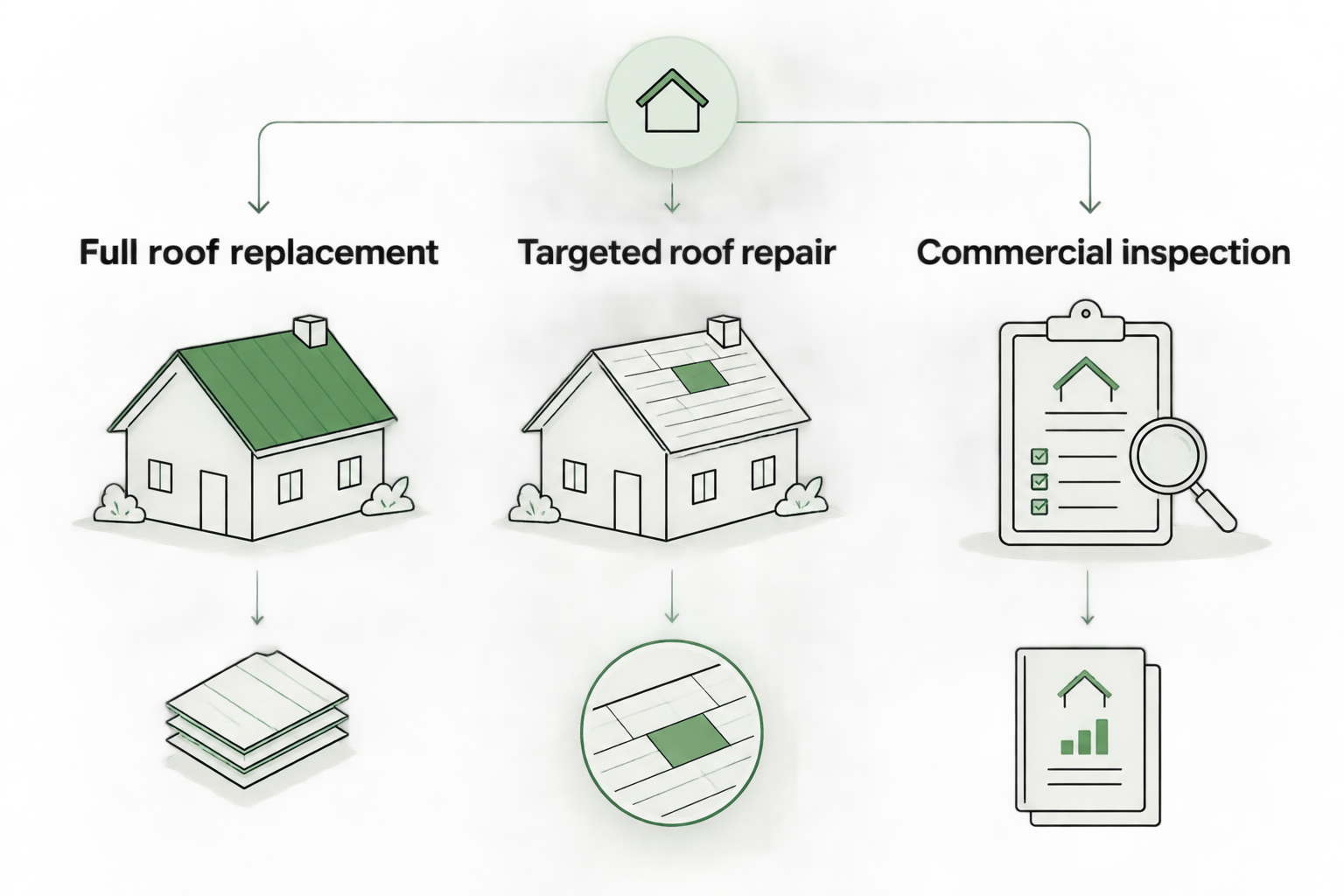
Roofing service choices at a glance
Choose the service path before comparing proposals. Otherwise, a repair estimate and a replacement estimate look like competing offers when they address different amounts of work.
| Service path | Best for | Main benefit | Key limitation |
|---|---|---|---|
| Full roof replacement | Widespread deterioration or a roof that no longer supports practical repairs | Addresses the roof as a complete system | Larger project scope and more disruption than localized work |
| Targeted roof repair | An isolated defect with serviceable surrounding materials | Limits work to a documented problem | Does not renew aging or damaged areas outside the repair |
| Commercial inspection and maintenance | Property owners managing condition, drainage, and future work | Establishes priorities before budgeting | Inspection and maintenance do not replace necessary corrective work |
These are decision categories, not interchangeable packages. An inspection should establish which category fits before you authorize installation work.
1. Full roof replacement: best for widespread deterioration
Full replacement is the strongest option when inspection findings show that isolated repairs will leave substantial problems unresolved. It also creates an opportunity to evaluate concealed roof-deck conditions after removal and address installation details across the proposed replacement area.
Do not accept age alone as the explanation. Ask the contractor to connect the recommendation to visible conditions, recurring failures, material condition, and the limits of repair.
Full replacement pros:
- Addresses connected roof components within a defined installation scope.
- Allows evaluation of the exposed roof deck after removal.
- Establishes new installation and warranty documentation.
Full replacement cons:
- Requires a broader project than a localized repair.
- Creates noise, debris, and access considerations that need planning.
- Hidden damage can require an approved change to the original scope.
Best for: Owners whose roofs have widespread deterioration or documented problems that isolated repairs cannot reasonably resolve.
For a 2026 replacement proposal, require written handling of concealed damage. The contract should explain how the contractor documents the condition, obtains your approval, and records the added work.
Verdict: Buy a replacement only when the inspection supports replacement—not because a salesperson dismisses every repair option.
2. Targeted roof repair: best for an isolated defect
A targeted repair addresses a defined failure, such as a damaged roof area or a defective connection around a penetration. The surrounding roof must remain suitable for the proposed repair to make sense.
An interior stain is evidence of a problem, not a complete diagnosis. Ask the roofer to explain how the inspection connects the visible symptom to the proposed exterior work.
Targeted repair pros:
- Keeps the project focused on an identified defect.
- Preserves serviceable portions of the existing roof.
- Provides a defined scope for evaluating whether the problem was addressed.
Targeted repair cons:
- Leaves unrelated aging and deterioration in place.
- Does not provide the same scope as a complete replacement.
- Requires realistic expectations about adjacent materials and appearance.
Best for: Owners with a localized problem and a roof that otherwise remains suitable for continued service.
Ask what happens if the contractor discovers more damage after opening the area. Agree on the approval process before work starts; an open-ended repair authorization gives you little control over scope.
Verdict: Buy a targeted repair when the defect is isolated and the contractor explains its limits.
3. Commercial inspection: best for planning property-wide work
A commercial inspection establishes condition, immediate concerns, and priorities for repair or replacement. It should account for roof access, drainage, rooftop equipment connections, and the activities taking place below the roof.
The same standard applies to offices, warehouses, apartments, restaurants, healthcare facilities, schools, retail properties, and other commercial buildings. Building use changes the coordination plan, not the need for a documented diagnosis.
Commercial inspection pros:
- Separates urgent corrective work from longer-term planning.
- Creates a written basis for discussing maintenance and replacement.
- Helps owners explain proposed work to managers, tenants, and budget approvers.
Commercial inspection cons:
- Findings describe conditions observed during the inspection, not a guarantee against future leaks.
- Some concealed conditions require additional investigation.
- A report has limited value without assigned follow-up actions.
Best for: Commercial owners and managers who need a condition-based plan rather than an unexplained replacement recommendation.
For occupied Covington properties, request an access and communication plan alongside the roofing scope. Identify sensitive areas, delivery routes, tenant notifications, and the person authorized to approve changes.
Verdict: Buy an inspection-led commercial plan before committing to major work without documented findings.
How these choices are ranked
The order puts full replacement first for owners facing widespread deterioration, repair second for isolated defects, and commercial inspection third for portfolio or facility planning. It is not a claim that replacement is always better than repair.
The criteria are diagnosis, relevant experience, installation scope, written protection, and accountability. The best proposal explains why its service path fits your roof and why the alternatives do not.
What to check in a Covington roofing proposal
For your 2026 project, turn verbal promises into contract language. A detailed proposal should let you identify both what the contractor will do and what remains outside the agreement.
Installation details
Ask which roof areas are included, what existing materials will be removed, and how the contractor will evaluate the exposed roof deck. Require a clear description of work around walls, valleys, vents, and other penetrations relevant to your roof.
For commercial work, identify responsibility for coordinating rooftop equipment and protecting occupied areas. Do not assume a roofing proposal includes unrelated mechanical or interior restoration work.
Drainage and gutters
Roofing and drainage scopes need to agree. Ask whether the contractor will evaluate gutters, downspouts, roof drains, and discharge routes relevant to the project—and which corrective work is included.
When deciding whether existing gutters belong in a replacement scope, how long seamless gutters last is only part of the question: current condition, attachment, leakage, and drainage performance also deserve inspection. Do not replace serviceable gutters automatically or retain damaged ones simply because the roof proposal excludes them.
Site protection and completion
Specify protection for entrances, landscaping, vehicles, and areas used by residents or customers. Ask how the contractor handles debris collection and the final walkthrough.
Completion should mean more than removal of the crew’s equipment. Request final photographs, warranty documents, approved change orders, and a clear contact for questions after the job.
Read roofing warranties as separate promises
Manufacturer protection and contractor labor protection are different commitments. Your 2026 contract should identify who provides each warranty, what it covers, and what you must do to preserve it.
Murray Roofing lists GAF Master Elite status, a 50-year Golden Pledge warranty, and a 10-year labor warranty among its trust signals. Ask which coverage applies to your specific roof system and installation; do not treat those durations as universal coverage for every project.
Before signing, ask:
- Which materials and installation qualify for the proposed coverage?
- Who registers the warranty and supplies confirmation?
- What exclusions, maintenance duties, and transfer conditions apply?
- Who investigates a leak, and how do you start a claim?
A longer warranty headline is not a substitute for reading the coverage document. Keep the signed contract and final warranty paperwork together so responsibility remains clear if a problem develops.
Handle insurance and financing separately from scope
Insurance-claim support helps organize roofing findings and project documentation. It does not guarantee that an insurer will approve a claim, cover a replacement, or accept every item in an estimate.
Ask the contractor to separate observed damage from assumptions about coverage. Your policy, the documented facts, and the insurer’s decision determine the claim outcome—not a promise made during a sales visit.
Financing is a separate decision. Murray Roofing offers financing, but you should review the actual lender terms, eligibility requirements, repayment obligations, and total borrowing cost before agreeing.
Keep those decisions in order: establish necessary work, compare equivalent scopes, and then decide how to pay. A manageable payment does not make an incomplete roofing scope adequate.
Which roofing service should you choose?
Choose Murray Roofing for an inspection-led discussion of residential or commercial roofing in Covington. Ask for findings first, a recommended scope second, and a written explanation of repair versus replacement where both deserve consideration.
For a home, focus on the source of the problem and the condition of surrounding materials. For a commercial building, add drainage, equipment coordination, occupied-area protection, and approval responsibilities to the discussion.
Do not sign because an estimate uses the most reassuring language. Sign when you understand the work, the exclusions, the change-order process, and the protection that applies afterward.
FAQ
What’s the best way to choose a roofing company in Covington, LA?
Choose a contractor that documents roof conditions and provides a complete written scope. Verify applicable credentials and insurance, then compare installation details, exclusions, and warranty responsibilities.
Does an older roof always need full replacement?
No, age alone does not establish that a roof needs replacement. An inspection should assess material condition, damage, recurring problems, and whether a targeted repair remains practical.
Can Murray Roofing inspect a commercial roof in Covington?
Yes, Murray Roofing serves Covington with commercial roofing and inspections. Describe the roof system, building use, known leaks, and access restrictions when arranging the visit.
Should I get more than one roofing estimate?
Yes, comparable written estimates help you identify differences in scope. Give each contractor the same project information and resolve exclusions before comparing the final proposals.
Will a roofing contractor guarantee insurance approval?
A roofing contractor cannot guarantee your insurer’s coverage decision. Ask for documented findings and claim support without treating a proposed roofing scope as an insurance approval.
Does a long roof warranty cover every future leak?
No, a warranty covers only the conditions stated in its terms. Confirm covered defects, exclusions, maintenance requirements, registration, and who handles an investigation.
Can I finance a roof replacement?
Financing is an option to discuss during the estimate process. Review the lender’s actual terms and approval requirements separately from your decision about the necessary roofing work.
One last thing
The most revealing estimate question is simple: “What is not included?” Ask it before signing, then have the answer added to the proposal. Exclusions often explain why apparently similar bids describe very different projects.
For your 2026 Covington roofing project, schedule an inspection or request a price based on your property’s actual condition.
Related guides
- Is it cheaper to repair a roof or replace it completely?
- Is roof financing available for commercial properties?
- Can you file an insurance claim for an old roof?