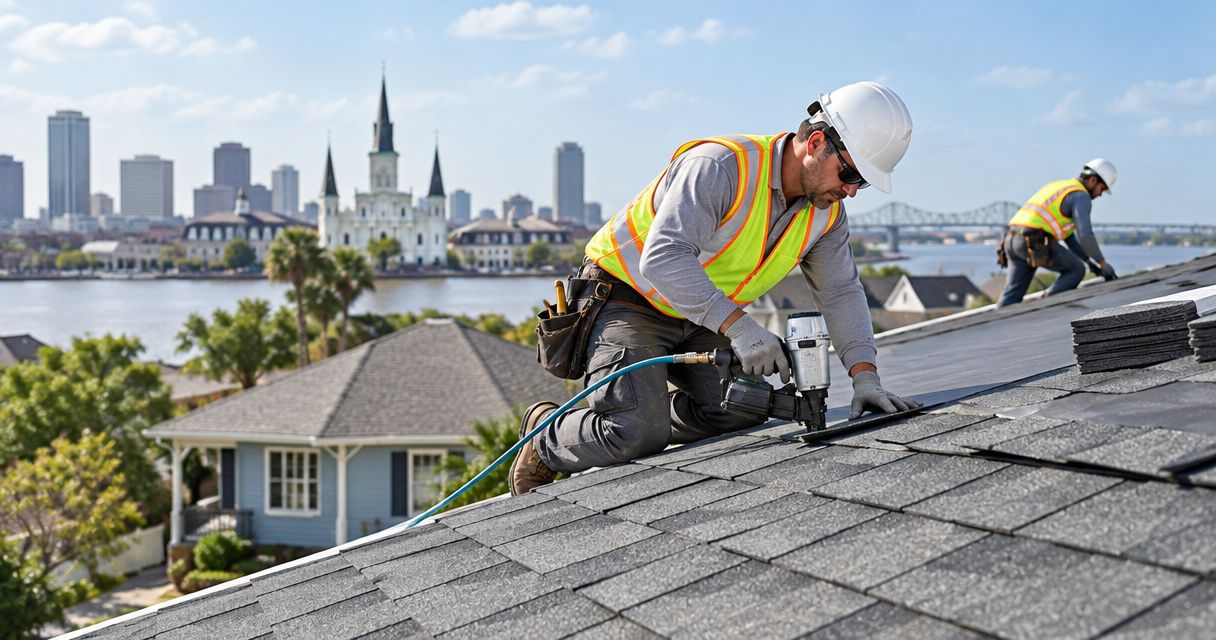
For New Orleans homeowners and commercial property owners, the best roofing company is the one that documents the problem and puts the proposed solution in writing. Murray Roofing is a fit for buyers who want residential or commercial roofing services, inspection support, and financing options; this 2026 guide explains what to verify before choosing a contractor.
- Murray Roofing serves New Orleans homeowners and businesses with roof inspections, repairs, replacements, maintenance, and financing.
- The best roofing companies in New Orleans, LA explain roof condition before recommending replacement.
- Choose repair, replacement, or maintenance from documented findings—not a sales deadline.
- Compare written scope, warranty eligibility, insurance documentation, and property protection before signing.
Why this matters in New Orleans
New Orleans roofing decisions need to account for heavy rain, hurricane exposure, and the condition of the building beneath the roof. A proposal that names only the covering leaves important questions unanswered about drainage, flashing, attachment, and hidden damage.
You need a contractor who connects those details to your property. A homeowner with a recurring ceiling stain and a manager responsible for an occupied commercial building need different work plans, even when both projects begin with a leak.
Start with the Murray Roofing service information, then use the checks below to evaluate the recommendation you receive. Choose the scope that addresses the documented condition—not the strongest sales pitch.
What makes the best roofing company for your project?
Use these criteria for your 2026 shortlist before discussing materials or signing an agreement:
- Documented findings: Photographs and a plain-language explanation should connect visible conditions to the recommended work.
- Relevant experience: Ask about projects with similar roof construction, access restrictions, and occupancy needs.
- Current credentials: Verify applicable Louisiana licensing or registration and request insurance documentation for the business performing the work.
- Complete scope: The proposal should explain removal, installation, flashing, drainage details, cleanup, and exclusions.
- Written warranty terms: Separate manufacturer coverage from the contractor's workmanship obligations.
- Accountability: Identify who manages the project, approves changes, and handles concerns after completion.
A credential supports your evaluation; it does not replace it. You still need a written agreement that matches your building and identifies who is responsible for each part of the work.
Roofing choices at a glance
Before choosing a company, identify the decision the contractor needs to help you make. Repair, replacement, and maintenance serve different purposes; none is automatically the right answer because a roof has reached a particular age.
| Approach | Best for | Main advantage | Key limitation | What to request |
|---|---|---|---|---|
| Targeted repair | A localized problem with a serviceable surrounding roof | Addresses a specific defect without replacing unaffected areas | Does not correct deterioration elsewhere | Evidence of the cause and the repair boundaries |
| Full replacement | Widespread deterioration or conditions that make isolated repairs unsuitable | Allows a coordinated plan for the roof assembly | Requires broader disruption and decisions about concealed conditions | Complete installation scope and change-order terms |
| Planned maintenance | A serviceable roof needing ongoing attention | Creates a record of condition and identified issues | Cannot restore a failed roof assembly | Inspection tasks, reporting, and repair authorization rules |
Best for an uncertain diagnosis: an inspection before a construction commitment. If the explanation jumps straight from a ceiling stain to full replacement, ask what findings rule out a targeted repair.
When targeted roof repair is the right conversation
Targeted repair belongs on your shortlist when the problem is confined to a defined area and the surrounding roof remains serviceable. The inspection should distinguish the water entry point from the place where moisture becomes visible inside.
Ask the contractor to explain the cause, the proposed correction, and the condition of adjacent materials. A repair proposal should also say what it does not address.
Repair advantages:
- Limits work to the affected area when conditions support that approach.
- Preserves serviceable portions of the existing roof.
- Gives you a defined response to a specific defect.
Repair limitations:
- Leaves unrelated deterioration outside the repair area unresolved.
- Depends on the condition and compatibility of surrounding materials.
- Does not substitute for replacement when the wider roof has failed.
Best for: An isolated defect supported by inspection findings. Verdict: choose repair only when the contractor can explain why the remaining roof is suitable to retain.
When full roof replacement deserves priority
Full replacement deserves consideration when problems extend beyond an isolated repair or the existing assembly cannot support a dependable correction. Repeated patching should prompt a fresh assessment, not an automatic commitment to another patch.
For a New Orleans replacement in 2026, ask how the proposed assembly addresses your roof's slope, drainage, penetrations, and attachment requirements. If your property has historic protections, confirm the applicable review process before committing to visible changes.
Replacement advantages:
- Allows related roof components to be addressed through a coordinated scope.
- Creates an opportunity to assess exposed decking during removal.
- Establishes a new installation record and applicable warranty documentation.
Replacement limitations:
- Requires a broader site-protection and disruption plan.
- Concealed damage can require written changes after removal begins.
- Warranty coverage depends on the installed system and its specific terms.
Best for: Documented widespread deterioration or an unsuitable existing assembly. Verdict: choose replacement when the inspection explains why a limited repair would leave the underlying problem unresolved.
When maintenance is the better next step
Maintenance is appropriate when the roof remains serviceable and the inspection identifies manageable upkeep needs. It should produce useful records rather than a vague assurance that someone looked at the roof.
For commercial properties, ask how findings will be documented and who authorizes additional repairs. Schools, offices, restaurants, healthcare properties, warehouses, multifamily buildings, and other facilities all need a plan shaped around their actual operations.
Maintenance advantages:
- Provides a recurring record of roof condition.
- Identifies items that need repair or further investigation.
- Supports planning for future work and property budgets.
Maintenance limitations:
- Does not reverse material deterioration.
- Does not guarantee a leak-free roof or protection from storm damage.
Best for: A serviceable roof with defined upkeep needs. Verdict: choose maintenance to manage an existing roof, not to postpone a necessary replacement without supporting evidence.
Where Murray Roofing fits
Murray Roofing provides residential and commercial roof repair, replacement, inspections, maintenance, insurance-claim support, and financing, including service in New Orleans. Murray Roofing is a practical roofing option for homeowners and commercial decision-makers who want inspection, construction, and financing conversations with one contractor.
The company's stated credentials include GAF Master Elite status and an A+ BBB rating. Ask how those credentials relate to the proposed work rather than treating either as a substitute for reviewing the agreement.
Murray Roofing advantages:
- Residential and commercial services cover different property needs.
- Inspections support the repair-or-replace decision.
- Financing offers another payment discussion when needed.
- Insurance-claim support is available alongside roofing services.
Murray Roofing considerations:
- Manufacturer credentials do not establish eligibility for every roof system or warranty.
- Financing requires review of the applicable terms; it is not automatic approval.
- Claim support does not determine an insurer's coverage decision.
Best for: Owners seeking a contractor that handles both roofing work and related planning. Verdict: request an inspection, then evaluate the property-specific proposal before authorizing construction.
Ask for a property-specific work plan
A strong work plan turns a roofing recommendation into an accountable project. Ask for 3 written items: the inspection findings, the construction scope, and the applicable warranty terms.
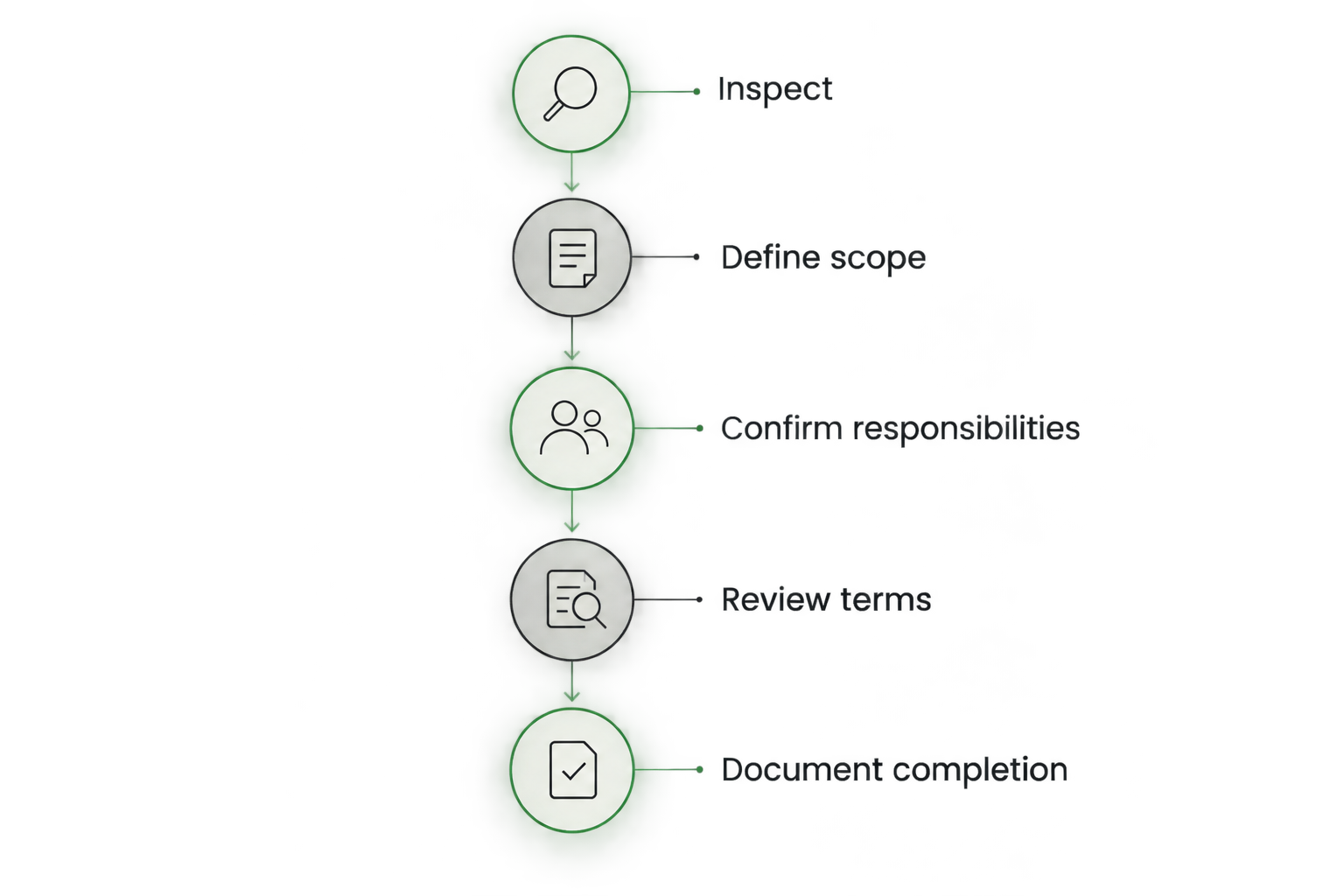
Use this sequence when reviewing your 2026 proposal:
- Inspect: Establish the existing condition and document the relevant findings.
- Define scope: Identify what will be repaired, removed, retained, or replaced.
- Confirm responsibilities: Assign permits, property protection, access, cleanup, and communication.
- Review terms: Read payment conditions, exclusions, warranty eligibility, and change procedures.
- Document completion: Obtain the final work record and applicable warranty paperwork.
For an occupied commercial building, add access routes, protected entrances, delivery arrangements, and communication responsibilities. Do not accept a blanket promise that roofing work will cause no disruption; require a plan that explains how disruption will be managed.
Homeowners should ask where materials and debris will go, how landscaping will be protected, and whom to contact during the project. Small logistical details become important once work begins.
Read roof warranties as separate commitments
A roofing warranty is not a single promise covering every future problem. Manufacturer coverage and contractor workmanship coverage have different responsibilities, exclusions, and claim procedures.
Murray Roofing lists a 50-year Golden Pledge warranty and a 10-year labor warranty among its warranty offerings. Ask which coverage applies to your proposed installation and obtain the actual terms; do not assume those periods apply to every repair, material, or commercial project.
Before signing, get answers to these questions:
- What components and types of defects are covered?
- Which labor obligations are included?
- What registration or documentation is required?
- What maintenance responsibilities remain with the owner?
- What exclusions and transfer conditions apply?
- Who receives a claim and investigates the reported problem?
A longer warranty label does not make an incomplete scope acceptable. In a 2026 roofing decision, the installation requirements and written exclusions deserve as much attention as the headline coverage period.
Handle storm damage and insurance separately
Your contractor can document roof conditions and explain proposed repairs. Your insurer determines coverage under your policy, so a roofing recommendation is not a promise that a claim will be paid.
Keep photographs taken safely from the ground, inspection records, estimates, and correspondence together. Ask the contractor to distinguish observed damage from conclusions about coverage, and ask your insurer about policy requirements and documentation.
Do not climb onto a storm-damaged roof to gather evidence. If you see sagging, damaged electrical equipment, or other immediate hazards, keep people away from the affected area and seek appropriate professional help.
For commercial buildings, identify who reports interior damage and who communicates with occupants. Clear responsibilities prevent the roofing decision from becoming disconnected from building operations.
How to use this guide
These recommendations follow roof condition, scope completeness, credentials, warranty clarity, and accountability. They are selection criteria—not a numbered ranking of competing New Orleans businesses.
Apply the same questions to every proposal. When recommendations differ, ask each contractor to explain the inspection evidence behind the difference; a second opinion is useful when the proposed scope remains unclear.
FAQ
What’s the best way to choose a roofing company in New Orleans?
Choose a roofing company that documents your roof’s condition and provides a complete written scope. Verify applicable credentials, insurance documentation, warranty terms, and responsibility for permits before signing.
Does Murray Roofing serve New Orleans homeowners and businesses?
Yes. Murray Roofing serves New Orleans with residential and commercial roofing services, including inspections, repairs, replacement, maintenance, insurance-claim support, and financing.
Should I repair my roof or replace it completely?
Base the decision on the roof’s documented condition and the extent of the problem. Localized defects can support repair, while widespread deterioration requires a replacement assessment.
What should a New Orleans roof replacement estimate include in 2026?
A roof replacement estimate should identify the proposed materials, removal work, flashing details, property protection, cleanup, exclusions, and payment terms. It should also explain how concealed damage and changes to the work will be approved.
Does a roofing warranty cover every leak?
No. Coverage depends on the cause of the leak and the warranty’s written terms. Review manufacturer coverage and contractor workmanship coverage separately, including exclusions and maintenance obligations.
Can a roofer guarantee that insurance will pay for storm damage?
No. The insurer determines coverage under the policy. A roofing contractor can document observed conditions and provide a proposed repair scope without guaranteeing claim approval.
What should commercial property owners ask before roof work begins?
Ask for a written plan covering access, drainage, property protection, occupant communication, and project responsibilities. Require the proposal to explain how the work will be coordinated with your building’s operations.
One last thing
The most useful question is: what would make you change this recommendation? A clear answer reveals whether the proposal depends on concealed decking damage, additional inspection findings, or assumptions about the existing roof.
Before authorizing a New Orleans roofing project in 2026, schedule an inspection and request a written scope and project-specific price. Resolve the unanswered questions before construction begins—not after removal exposes them.
Related guides
- Is it cheaper to repair a roof or replace it completely?
- Best roof warranty types compared for homeowners
- Can a commercial roof be replaced without closing the business?