
Yes—commercial roof replacement financing is available through business loans, commercial property financing, business lines of credit, and lenders introduced by roofing contractors. Approval depends on the borrower, the property, and the lender’s requirements; a contractor’s financing advertisement is not a commitment to lend. In 2026, compare repayment terms, collateral requirements, and funding conditions before signing a roofing contract.
- Commercial roof replacement financing is available, but the lender must approve both the borrower and the proposed use of funds.
- Business term loans suit defined projects; credit lines suit staged expenses but can carry variable rates.
- Compare total repayment, collateral, personal guarantees, and contractor payment conditions—not just the scheduled payment.
- Murray Inspection Services’ guide separates the roof assessment, construction contract, and financing decision.
Why this matters
A roof replacement creates two separate obligations: paying the contractor and repaying the lender. Those obligations need to fit together. If the contractor requires payment before the lender releases funds, an approved loan alone does not resolve the gap.
Finance a documented scope, not an uncertain roofing proposal. You need to know what the contractor includes, what remains excluded, and how changes receive approval before deciding how much to borrow.
This Murray Inspection Services commercial roof replacement financing guide is for building owners comparing funding routes before committing to construction. It separates the financing decision from the roof assessment so that one does not stand in for the other.
Is roof financing available for commercial buildings?
Yes. Commercial building owners can seek financing for roof replacement through several business and property lending routes. The right starting point depends on who owns the building, who will borrow, and whether the project is a standalone replacement or part of a larger renovation.
The following comparison identifies each route’s practical use and limitation. These are funding categories, not offers or approval guarantees.
| Financing route | Best for | Main advantage | Main limitation |
|---|---|---|---|
| Business term loan | A defined replacement scope | Establishes a repayment schedule for a specific borrowing amount | Underwriting can require business financials, collateral, or a personal guarantee |
| Business line of credit | Staged expenses and approved changes | Lets you draw funds as needed within the agreement | Variable rates and renewal conditions can complicate planning |
| Commercial property loan or refinance | Owners considering broader property financing | Connects the roof project to the property’s capital plan | Property underwriting and an existing mortgage affect the transaction |
| Contractor-arranged financing | Owners seeking a lender introduction alongside a roofing proposal | Provides another route to a financing application | The lender’s terms remain separate from the construction contract |
Ask each prospective lender whether commercial roof replacement is an eligible use of funds before submitting a full application. A financing program marketed for residential roofing is not automatically suitable for a commercial building.
Business term loans: best for a defined replacement
A business term loan provides funds that you repay under an agreed schedule. It suits a project with a clear scope because you can connect the borrowing request to a written contractor proposal.
The limitation is flexibility. Ask how the lender handles additional borrowing if demolition reveals concealed damage, and whether unused proceeds must be returned or applied in a particular way.
Business lines of credit: best for staged expenses
A business line of credit lets you borrow within an approved limit under the credit agreement. It can fit a project where payments occur at construction milestones rather than all at once.
The drawback is uncertainty when the agreement includes a variable rate or renewal requirements. Do not treat an available credit limit as a permanent commitment without reading the draw and repayment conditions.
Property financing: best for a broader capital plan
Commercial property financing connects the borrowing decision to the building and its ownership. It deserves consideration when the roof replacement forms part of a broader renovation or refinancing discussion.
The trade-off is a larger transaction than a roof-only borrowing decision. Review existing mortgage restrictions, security interests, and closing requirements before choosing this route solely to fund roofing work.
Contractor-arranged financing: best for a lender introduction
Contractor-arranged financing means the contractor introduces a financing application or lender relationship. The convenience is having a funding discussion alongside the construction proposal.
The limitation is that convenience does not establish suitability. Identify the actual lender, confirm commercial eligibility, and compare the agreement independently of the contractor’s recommendation.
Why commercial roof financing terms vary
There is no single approval standard shared by every commercial lender. For a 2026 application, ask which of these factors controls the decision and which documents support it:
- Borrower finances: Business cash flow, existing debt, and credit history inform the lender’s assessment of repayment capacity.
- Property ownership: The borrower’s relationship to the building affects authorization, collateral, and documentation.
- Security requirements: A loan secured by property or other assets creates different obligations from unsecured borrowing.
- Project scope: A complete replacement proposal gives the lender a clearer use of funds than an unresolved repair recommendation.
- Repayment structure: Fixed or variable rates, amortization, maturity, and any balloon payment change the repayment obligation.
- Funding conditions: Inspections, signed contracts, lien documentation, and construction milestones can affect when funds are released.
Ask for the conditions in writing. A verbal indication of eligibility does not explain what must happen before the lender disburses money.
How do you prepare a commercial roof financing application?
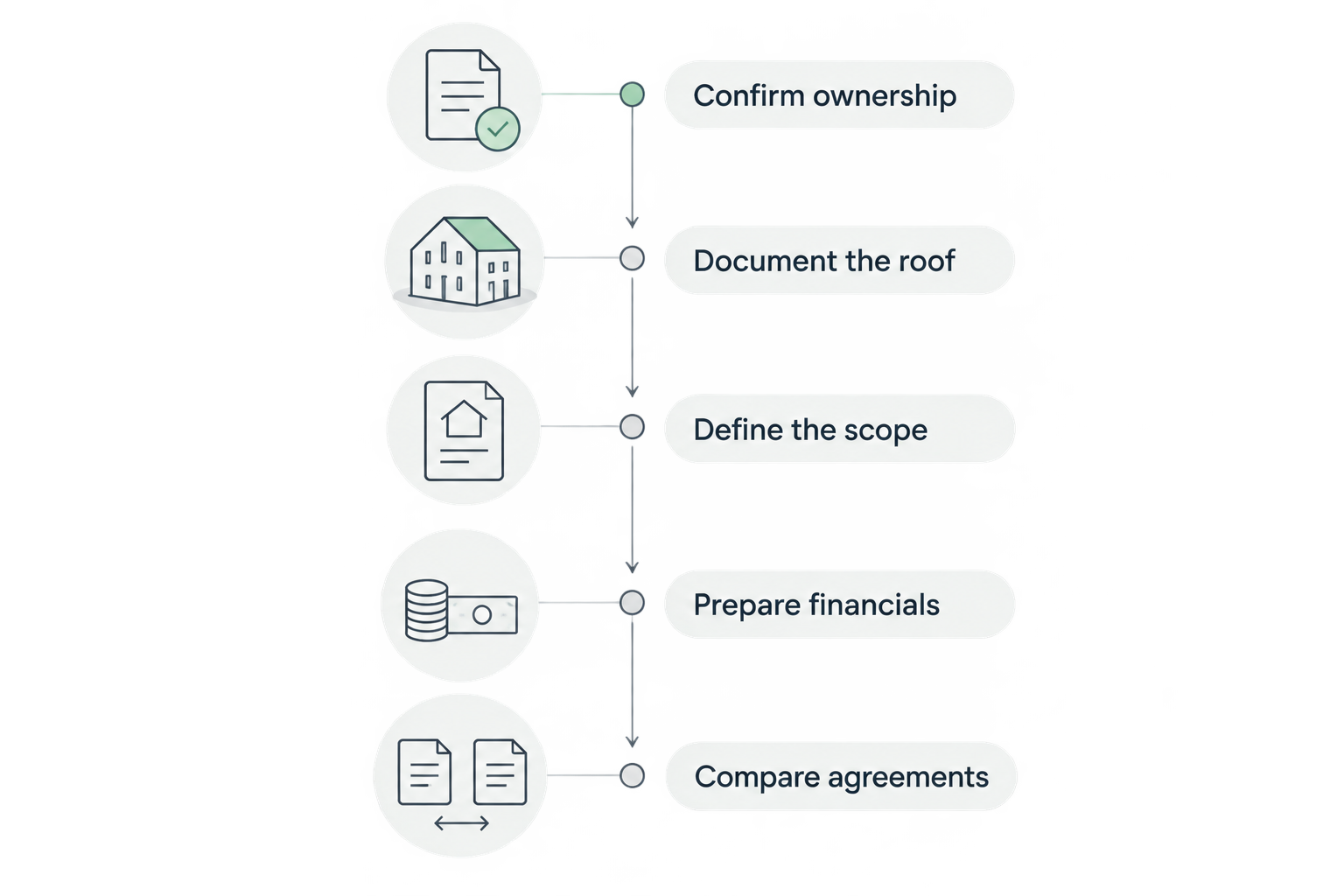
Prepare the roof project and the borrowing request together, while keeping their approvals separate. For a 2026 replacement, use this sequence to identify gaps before a contract creates payment obligations.
- Confirm ownership. Identify the legal owner, proposed borrower, and person authorized to sign. If you lease the building, review who is responsible for roof work before applying.
- Document the roof. Obtain a written assessment explaining the observed conditions and recommended work. Keep photographs, leak records, and relevant maintenance information together.
- Define the scope. Request a contractor proposal that identifies the roof system, preparation, removal work, exclusions, and change-order process.
- Prepare financials. Ask the lender for its application checklist. Provide the requested business, ownership, property, and financial records through the lender’s approved process.
- Compare agreements. Review the loan terms alongside the construction payment schedule. Confirm that funding conditions allow you to meet each contractual payment obligation.
A missing decision early in this sequence creates uncertainty later. For example, financing a proposed roof system before confirming the contractor’s exclusions leaves the borrowing request disconnected from the actual work.
What should the roofing proposal include before you borrow?
A financing application needs a defined project, but a signed proposal also governs your relationship with the contractor. Read it as a construction document—not merely an attachment to a loan application.
Check whether the proposal addresses:
- Removal of existing roofing versus installation over an existing assembly.
- Deck assessment and the process for authorizing concealed-damage work.
- Insulation, drainage details, penetrations, edges, and flashing.
- Protection of occupied areas and coordination with building operations.
- Permits, inspections, cleanup, and disposal responsibilities.
- Payment milestones, change orders, and closeout documentation.
An exclusion is not automatically a problem. An unexplained exclusion is. Ask who performs the excluded work, how it affects the schedule, and whether the lender permits the loan proceeds to cover it.
Financing approval does not validate the roof design or the contractor’s workmanship. Those require their own review, regardless of how readily a lender approves the application.
How do you compare commercial roof financing offers?
Compare offers against the same project scope and borrowing need. Otherwise, a smaller scheduled payment can distract from a different loan amount, longer repayment obligation, or substantial balance due at maturity.
For each written offer, record the following terms in one worksheet:
- Repayment structure: Payment frequency, repayment period, maturity date, and any balloon payment.
- Rate structure: Whether the rate is fixed or variable and how adjustments work.
- Total obligation: The lender’s stated total repayment and all disclosed financing charges.
- Security: Assets pledged, property liens, and personal guarantees.
- Exit conditions: Early repayment rules, default provisions, and release of security.
- Disbursement: Who receives funds, when funds are released, and what documentation is required.
For a 2026 comparison, use current written lender disclosures rather than an older advertisement or another owner’s agreement. Terms belong to a specific borrower and transaction.
Choose financing that fits both normal operations and the construction payment schedule. Do not rely on future refinancing to solve a maturity obligation you cannot otherwise meet.
Can insurance pay for a commercial roof replacement instead?
Commercial property insurance and commercial roof replacement financing serve different purposes. Insurance addresses covered losses under a policy; financing creates a repayment obligation for borrowed funds.
A damaged roof does not establish coverage by itself. The cause of loss, policy language, exclusions, deductibles, and claim decision determine the insurer’s obligation. Keep the insurance claim documentation separate from the lender’s approval documents.
If you pursue both routes, ask how insurance proceeds affect the loan, contractor payments, and any mortgage lender’s interest. Do not promise an insurance payment to a contractor before understanding who controls the proceeds.
Routine deterioration and storm damage also require different documentation. A roof assessment should describe observed conditions without treating a financing application as evidence that an insurer owes payment.
Can a tenant finance a commercial roof replacement?
A tenant needs to establish responsibility and authorization before seeking financing for a building owner’s roof. Start with the lease, then obtain the owner’s required written consent.
The lender must also accept the proposed borrower and use of funds. A tenant’s willingness to pay does not establish authority to alter the building or grant security over it.
If the lease assigns roof obligations unclearly, resolve that issue before committing to either agreement. Borrowing first does not settle the underlying responsibility for the work.
Does prequalification mean the roof project is approved?
Prequalification is not the same as final approval or permission to begin construction. Read the lender’s description of the result and identify the remaining underwriting and funding conditions.
Ask whether the lender still requires financial verification, property review, a final contractor proposal, or signed loan documents. Also check whether the result expires or depends on unchanged financial circumstances.
Keep three decisions separate: the roof needs replacement, the contractor is selected, and financing is ready to fund. Completing one does not complete the others.
FAQ
Can I get commercial roof replacement financing for a rental building?
Yes, rental-building owners can seek commercial roof replacement financing, subject to lender eligibility and underwriting. Ask whether the lender evaluates the property’s income, the borrowing entity, owner guarantees, or a combination of these.
Is contractor financing better than a business loan for a commercial roof?
Contractor financing is not automatically better than a business loan. Compare the actual lender agreements, including total repayment, collateral, guarantees, and funding conditions, against the same roofing scope.
Can I finance a commercial roof without pledging the building?
Some business financing does not require the building as collateral, but that does not mean the agreement has no security requirements. Ask about business-asset liens and personal guarantees before applying.
Can a commercial roof loan cover insulation and drainage work?
A commercial roof loan can include related work when the lender accepts that work as an eligible use of funds. Include insulation, drainage, and other proposed components in the written scope rather than assuming they qualify.
Does Murray Inspection Services approve commercial roof financing?
This Murray Inspection Services guide is not a loan approval or financing offer. The lender determines eligibility, underwriting requirements, and funding conditions.
Should I sign the roofing contract before financing is approved?
Do not accept payment obligations you cannot meet if financing falls through. Review cancellation terms, deposits, financing contingencies, and funding conditions before signing.
How do I compare commercial roof replacement financing in 2026?
Compare commercial roof replacement financing in 2026 using current written offers for the same project scope. Review total repayment, rate structure, maturity, collateral, guarantees, and the timing of disbursements.
One last thing
Ask the lender and contractor to explain the same payment milestone independently. If their answers disagree about when money moves, resolve the difference before signing.
The most useful final check is not whether financing is approved—it is whether approved funds arrive before your contractual payment is due. Keep that check in your project file alongside the roofing scope and signed agreements.
Related guides
- From roof inspection to financing approval
- From commercial roof inspection to budget approval
- Commercial roofing for property managers
- From roof inspection to contractor bid comparison