
Yes, you can get roof replacement financing with no money down if a lender approves a loan that covers the project without requiring an upfront contribution. No money down does not mean interest-free, fee-free, or payment-free, so confirm both the loan terms and the roofing contractor’s payment schedule before signing.
- Roof replacement financing no money down requires lender approval and enough loan proceeds to cover the contracted work.
- An unsecured personal loan avoids pledging your home; home equity financing puts your home at risk.
- No down payment and deferred payments are different terms; verify when repayment starts.
- Compare the written roofing scope, borrowing terms, and funding schedule before committing.
Why this matters
A roof contract and a financing agreement create separate obligations. Approval for a loan does not establish that the contractor can begin without a deposit, and a contractor’s financing advertisement does not guarantee approval.
For a roof replacement planned in 2026, establish what needs replacing before choosing how to borrow. When contacting Murray Inspection Services, ask what documentation you can obtain to support your next decision; discuss loan eligibility and terms directly with the lender.
Your immediate goal is straightforward: determine whether the approved funding will cover the agreed work when the contractor requires payment. Then decide whether the repayment obligation fits your household budget.
Can I get roof replacement financing with no money down?
Yes. A lender can finance the entire contracted project without requiring a down payment, subject to its underwriting rules and the amount approved. You still need to establish whether fees reduce the proceeds and whether any contractor payment falls due before funding arrives.
Several financing structures can support that arrangement. None automatically guarantees that you will qualify or that every project expense will be covered.
| Financing structure | Best for | Main advantage | Main drawback | What to verify |
|---|---|---|---|---|
| Contractor-arranged financing | Homeowners who want to compare financing presented alongside a roofing proposal | Connects the proposed work with a financing application | A convenient application does not establish favorable terms | Lender identity, disclosures, funding conditions, and payment timing |
| Unsecured personal loan | Homeowners who want to borrow without pledging their home as collateral | Does not require home equity as security | Approval and the borrowing limit depend on underwriting | Net proceeds, APR, repayment schedule, and fees |
| Home equity loan | Homeowners with qualifying equity who want a lump-sum loan | Uses home equity to support borrowing | Your home secures the debt | Closing requirements, funding timing, and foreclosure risk |
| Home equity line of credit | Homeowners with qualifying equity who need borrowing flexibility | Allows borrowing under a revolving credit agreement | Rates and payments can change under the agreement | Draw rules, rate adjustments, fees, and repayment requirements |
The best no-down-payment arrangement covers the agreed work without creating an unaffordable repayment obligation. Choose by the written terms, not by the absence of a deposit alone.
Contractor-arranged financing
Contractor-arranged financing describes how you access the financing, not necessarily a separate loan type. Ask who lends the money, who services the account, and whether the roofing company receives payment directly.
This route suits homeowners who want to evaluate a roofing proposal and financing together. Its limitation is the temptation to accept the payment presented without comparing outside financing. Review the construction agreement separately from the credit agreement, including what happens if financing is declined.
Unsecured personal loans
An unsecured personal loan does not use your home as collateral. That distinction matters if you do not want to secure roof-related borrowing against the property.
The approved amount still needs to cover the work. Ask whether an origination fee is deducted from the loan proceeds, because the amount deposited or disbursed can differ from the amount borrowed. A shortfall leaves you responsible for finding another funding source.
Home equity loans and lines of credit
Home equity financing uses your property as security. A home equity loan provides a lump sum, while a home equity line of credit allows borrowing under a revolving agreement.
These options suit different cash-flow needs, but neither should be selected solely to avoid an initial contribution. Failure to repay secured borrowing can put your home at risk. Confirm the funding process before promising the contractor a payment date.
Why no-money-down financing terms vary
For applications made in 2026, evaluate the actual lender’s requirements rather than assuming an advertised offer applies to your household. These factors explain why an offer differs from the financing you ultimately receive:
- Credit history: Lenders assess repayment history and other credit information when making approval and pricing decisions.
- Income and existing debt: Your ability to repay affects underwriting; income alone does not establish eligibility.
- Amount requested: The required borrowing depends on the written project scope and any work excluded from the proposal.
- Collateral and equity: Secured financing introduces property-related requirements that an unsecured loan does not have.
- Fees and disbursement: Fees deducted from proceeds and restrictions on how funds are released affect what reaches the project.
- Repayment structure: The term, rate provisions, and promotional conditions determine how the obligation works after funding.
A general advertisement cannot settle these details. Treat the lender’s written disclosures and final approval conditions as the basis for your decision.
How do I arrange financing without an upfront contribution?
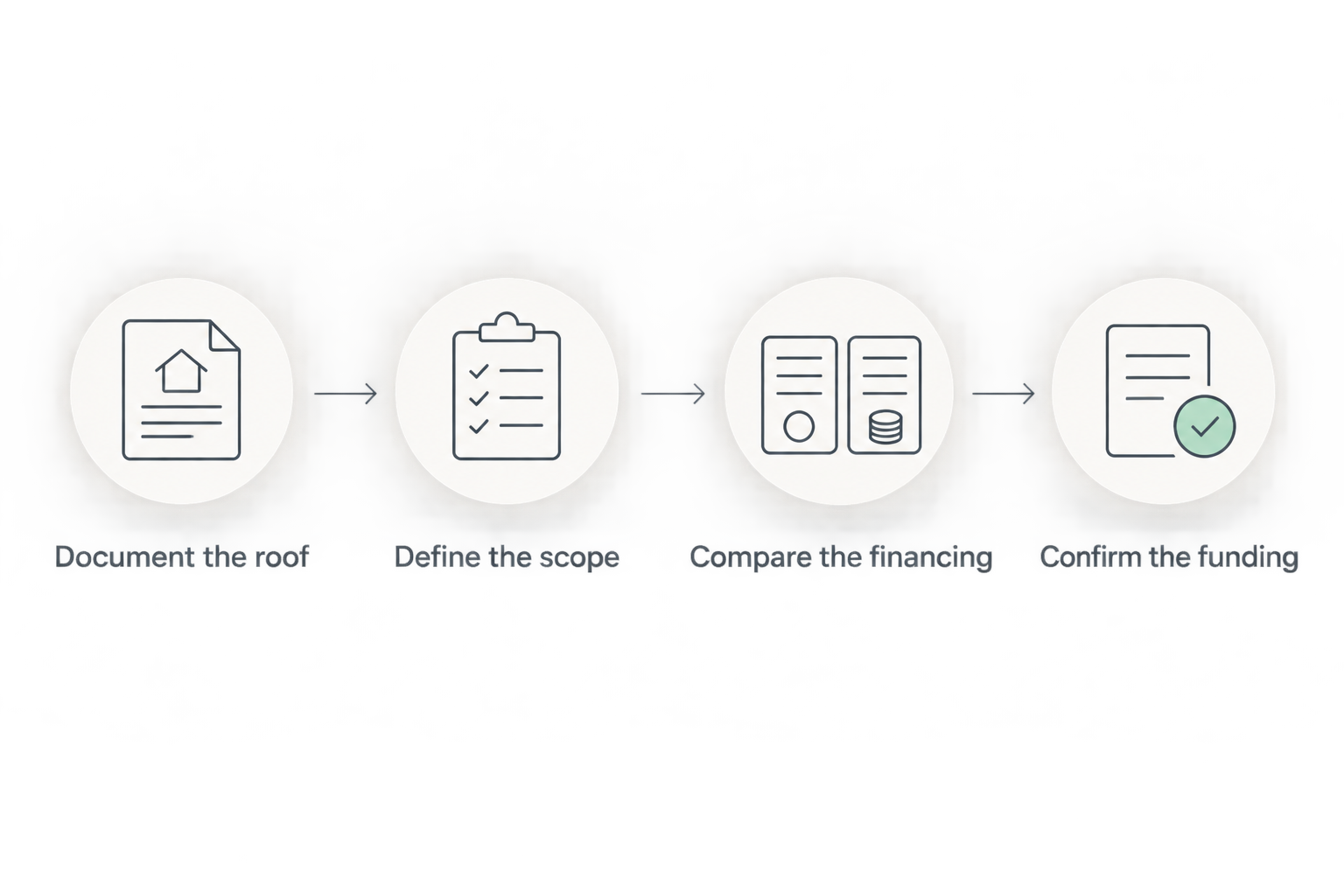
Follow this sequence before authorizing the replacement. It separates the condition of the roof from the lender’s decision and the contractor’s payment requirements.
- Document the roof. Obtain a written assessment explaining the identified problems and the proposed work. Ask why replacement is recommended instead of repair.
- Define the scope. Obtain an itemized proposal identifying included work, exclusions, and how concealed damage or other changes will be authorized.
- Compare the financing. Review APR, fees, repayment terms, collateral requirements, and the amount actually available for the project.
- Confirm the funding. Match the lender’s disbursement conditions to the contractor’s payment schedule before signing an unconditional commitment.
For your 2026 application, keep the proposal and financing documents together. If the scope changes, check whether the approved financing still covers it rather than assuming the lender will increase the loan.
The guide to getting pre-qualified for roof replacement financing explains the application stage. Prequalification is not the same as final approval; ask what verification and conditions remain.
Match the payment schedules before work begins
Ask when the contractor expects each payment and when the lender will release funds. Some financing arrangements pay the contractor directly; others place funds under your control or impose release conditions.
Do not describe the project as requiring no money down until those schedules agree. A loan that funds after a contractor’s deposit is due does not solve the upfront cash requirement unless the contractor agrees to a different schedule.
Also establish how changes will be handled. A written change order should identify the additional work and your authorization; separate financing approval is a different question.
Does no money down mean no payments right away?
No money down means no required initial contribution toward the financed work; it does not establish when repayments begin. Your first payment date comes from the credit agreement.
A deferred-payment offer addresses timing. An interest-free offer addresses interest. Those features are not interchangeable, and neither follows automatically from a no-down-payment advertisement.
When evaluating a promotional offer in 2026, ask whether interest accrues during any payment deferral and what happens when the promotional period ends. Deferred interest can become payable under the agreement if its conditions are not met.
Read the conditions for keeping the promotion, not just the headline benefit. Check missed-payment consequences, the required payoff timing, and the repayment terms that follow the promotion.
Can I qualify with bad credit?
No-money-down approval with bad credit depends on the lender’s underwriting; there is no universal qualifying credit score for roof financing. A contractor cannot establish approval simply by advertising financing.
Before applying, ask whether an eligibility check uses a soft or hard credit inquiry. Also ask whether the lender requires a co-borrower, collateral, or an upfront contribution for the offered terms.
Do not treat approval as proof that the loan fits your budget. Compare the payment obligation with essential household expenses and other debts. If the payment is not manageable, the lack of a down payment does not fix that problem.
Can insurance replace the need for financing?
Insurance can reduce the amount you need to borrow when a covered loss qualifies for payment under your policy. It does not make every roof replacement an insured event or establish when claim funds will arrive.
Keep the claim decision separate from the lending decision. Your deductible, exclusions, settlement provisions, and any mortgage-company involvement can affect the funds available for the work.
If an insurance claim is pending in 2026, avoid borrowing on the assumption that the insurer will reimburse the entire obligation. Ask how the loan handles early repayment if claim funds arrive later, including any applicable prepayment terms.
What should I check before signing?
Read the loan disclosures beside the roofing agreement. The documents should describe a workable transaction, not leave you to bridge conflicting promises after work begins.
- Named lender: Identify the business extending credit, rather than relying on the contractor’s description of the offer.
- Net funding: Establish how much reaches you or the contractor after any deductions.
- Payment obligation: Confirm when payments start, whether they can change, and what happens after a promotion ends.
- Security interest: Understand whether your home secures the borrowing.
- Project changes: Check how additional work affects your contract and whether it requires separate financing.
- Cancellation and disputes: Read each agreement’s applicable cancellation, refund, and dispute provisions; do not assume canceling one automatically cancels the other.
A missing answer is a reason to pause. Ask the responsible party to clarify the term in writing before you authorize work or accept credit.
FAQ
Can I finance an entire roof replacement without a down payment?
Yes, if the lender approves enough financing and the contractor’s payment schedule works with the funding arrangement. Confirm that fees, exclusions, and disbursement conditions do not leave an upfront shortfall.
Does no-money-down roof financing mean interest-free financing?
No, a down payment requirement and an interest provision are different loan terms. Read the APR, fees, and any promotional conditions in the written agreement.
What credit score do I need for no-money-down roof financing?
There is no universal qualifying credit score for no-money-down roof financing. Each lender applies its own underwriting requirements, which can include credit history, income, existing debt, and collateral.
Is a personal loan better than a home equity loan for a roof?
An unsecured personal loan avoids pledging your home, while a home equity loan uses your property as security. Compare the actual borrowing terms, funding requirements, and consequences of nonpayment rather than choosing by loan label alone.
Can my contractor promise that I will qualify for financing?
A contractor’s financing advertisement is not lender approval. Ask who makes the credit decision and which approval conditions remain before committing to the work.
Can I use insurance money to repay roof financing?
Insurance proceeds can help repay borrowing when those funds are available for that purpose, subject to the claim and any applicable mortgage requirements. Check the loan’s early-repayment terms and do not assume claim approval or payment timing.
What happens if the roof needs additional work after financing approval?
Additional work can create a funding gap if it falls outside the approved amount. Require a written change order and confirm how you will fund it before authorizing the extra work.
One last thing
Enough financing on paper is not the same as enough funding on the required date. Before signing, put the contractor’s payment dates beside the lender’s release conditions and check that every required payment has a confirmed funding source.
That timing check is the difference between a genuinely no-down-payment arrangement and a project that unexpectedly requires your cash before work can proceed.
Related guides
- Roof financing options for homeowners
- From roof inspection to financing approval
- Is roof replacement financing worth it?