
A commercial roofing estimate has no universal fee; the contractor’s written terms determine whether preparing the proposal carries a separate charge. Diagnostic testing, a condition report, and special access arrangements are separate scope items to clarify before booking. For a 2026 project, ask what the visit includes, what creates an additional charge, and what you will receive afterward.
- Confirm commercial roofing contractor estimate cost before booking; a proposal and a diagnostic inspection serve different purposes.
- Ask Murray Inspection Services about scope and deliverables before authorizing a visit.
- Compare commercial roofing bids using matching work descriptions, exclusions, and assumptions.
- Authorize testing separately and request written approval terms for additional work.
Why this matters
The fee for preparing a roofing estimate is not the cost of the roofing work. Your first decision is whether you need a contractor’s proposal, an investigation into a problem, or documentation for a purchasing decision.
When contacting Murray Inspection Services, explain which decision you need to make before asking about an appointment. Request confirmation of the service, its deliverables, and any charge rather than assuming that an estimate includes a documented roof assessment.
How much does a commercial roofing estimate cost?
The answer depends on the contractor’s agreement and the work requested. Ask for a written statement of any estimate-preparation fee before the visit, including the conditions that trigger additional charges. A verbal description of the appointment does not establish its scope.
Separate these services when requesting proposals for a 2026 commercial roofing project:
| Service | Best for | Useful deliverable | Limitation to check |
|---|---|---|---|
| Contractor estimate | Defining proposed repair or replacement work | Written work description, assumptions, and exclusions | Does not automatically include a detailed condition assessment |
| Diagnostic inspection | Investigating a leak or suspected roof problem | Documented observations and findings from authorized investigation | Testing and access require an agreed scope |
| Independent condition assessment | Supporting ownership or capital-planning decisions | A report addressing the agreed assessment objectives | Does not automatically include a contractor’s executable proposal |
These services can complement each other, but they are not interchangeable. A contractor can describe proposed work without resolving every concealed condition, while an assessment can document conditions without committing a contractor to perform repairs.
Before booking, request separate confirmation of the appointment scope, the resulting document, and the authorization needed for anything beyond that scope. That separation makes the answer useful even when different providers use different names for their services.
Contractor estimate: define the proposed work
Best for: obtaining a proposal for a clearly described repair or replacement project. Tell the contractor which building and roof areas the request covers, what problem prompted the inquiry, and whether you need repair recommendations or a replacement proposal.
The advantage is a direct connection between the observed condition and the work the contractor proposes to perform. The limitation is that a proposal is not automatically a complete investigation of the roof assembly.
Ask whether the document will identify:
- The roof areas included in the work.
- Preparation, removal, installation, and disposal responsibilities.
- Flashing, penetrations, drainage interfaces, and other relevant details.
- Assumed existing conditions and excluded concealed conditions.
- The process for approving changes after work begins.
An estimate that simply names a roofing system leaves important questions unanswered. Request enough detail to distinguish the intended work from items that remain outside the proposal.
Diagnostic inspection: define the problem first
Best for: investigating an unresolved leak or a condition that needs explanation before repair work is selected. Describe where the problem appears inside the building, when you notice it, and what repairs have already been attempted.
The advantage is a scope directed at understanding the problem rather than immediately selecting construction work. The limitation is that the investigation’s conclusions depend on its methods, access, and the conditions available to observe.
Ask the provider to distinguish visual observations from testing and to explain what each proposed method is intended to establish. Do not treat an exterior walkover, a moisture investigation, and an opening through the roof assembly as equivalent activities.
Authorize investigative methods before they happen. If the scope includes openings or samples, identify who approves them, who restores the affected area, and how the results will be documented.
For more on that distinction, see the guide to commercial roof inspection cost. Keep the inspection authorization separate from any later construction agreement.
Independent assessment: define the decision it must support
Best for: an owner who needs documented condition information for planning or internal approval. Specify whether the report will support maintenance planning, a purchase review, or a capital-project request.
The advantage is a deliverable organized around the owner’s decision. The limitation is that an assessment does not automatically provide construction documents, engineering conclusions, or a contractor’s commitment to perform work.
Ask what the report will cover and what falls outside the assignment. If independence matters, ask whether the assessor also intends to bid on the resulting work and disclose that relationship to the people reviewing the report.
A useful 2026 planning document separates observed conditions, recommended next steps, and unresolved questions. That distinction lets you decide whether to request bids or authorize further investigation.
Why commercial roofing estimate scope varies
The useful question is not simply whether a contractor charges for an estimate. It is what work the contractor must perform to prepare a proposal you can act on.
Clarify these factors in the appointment scope:
- Roof area and complexity: Identify separate roof sections, transitions, penetrations, and equipment areas so the contractor knows what the request covers.
- Access arrangements: Describe available roof access, restricted areas, escort requirements, and coordination with building staff.
- Investigation methods: Separate visual review from moisture investigation, sampling, or other testing that requires specific authorization.
- Documentation requirements: Specify whether you need a work proposal, photographs, annotated findings, or a condition report.
- Operating constraints: Explain tenant access, sensitive operations, loading areas, and restrictions affecting the proposed work.
- Existing records: Share relevant roof plans, repair records, warranty documents, and previous findings so assumptions are visible.
These factors define the assignment; they do not establish a standard fee. Ask the provider to identify which requirements are included and which require a separate agreement.
How do you request an estimate without authorizing extra work?
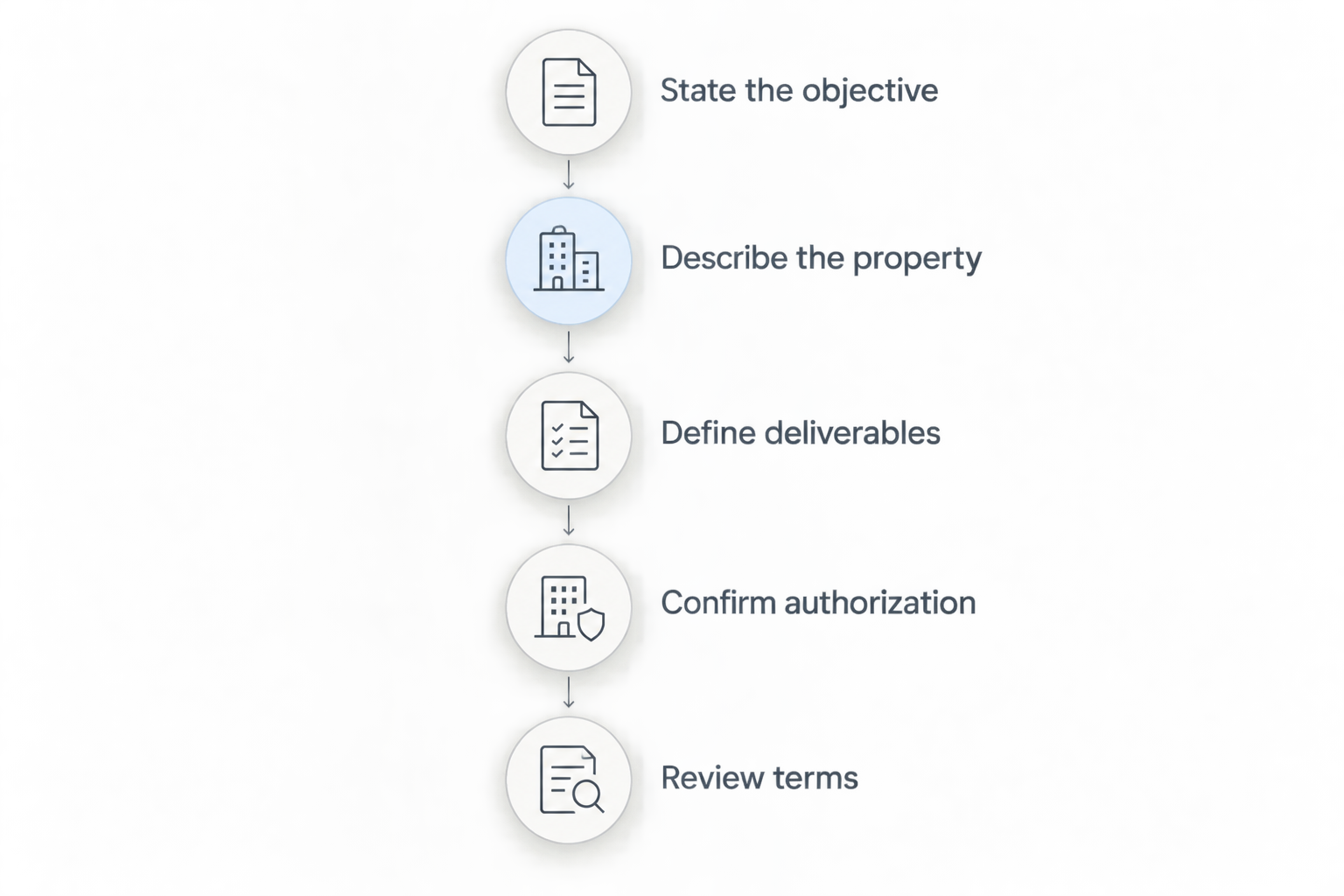
Use a written request that separates the visit from testing and construction. For a 2026 procurement file, keep the request, the contractor’s response, and later approvals together so everyone works from the same instructions.
- State the objective. Explain whether you want a repair proposal, a replacement proposal, or an investigation before deciding.
- Describe the property. Provide the address, affected roof areas, known symptoms, available records, and access restrictions.
- Define deliverables. Request the document you need, including the work description, photographs, exclusions, and unresolved questions where applicable.
- Confirm authorization. Ask what requires separate written approval, including testing, openings, temporary work, and additional visits.
- Review terms. Check the agreement before accepting the appointment or approving work.
The sequence matters: explain the problem before agreeing to an investigation, and define the investigation before authorizing it. Do not leave the contractor and building staff to resolve those decisions at the roof hatch.
Give the person meeting the contractor a copy of the approved scope. That person should know who can authorize a change and how to reach them; providing access is not the same as approving additional services.
How do you compare commercial roofing estimates fairly?
Compare scope before comparing proposal totals. Matching totals are not meaningful if the contractors have allowed for different roof areas, preparation methods, or existing conditions.
Create a comparison sheet with a column for each contractor. Use the same questions across every proposal:
| Comparison point | What to establish | Why it matters |
|---|---|---|
| Work boundaries | Included roof sections and details | Prevents partial work from being mistaken for complete coverage |
| Existing materials | What remains and what is removed | Makes the proposed assembly and preparation clear |
| Concealed conditions | Assumptions and change-approval process | Shows how discoveries will be handled |
| Building protection | Interior, equipment, and access responsibilities | Assigns responsibility around occupied areas |
| Completion documents | Closeout records and applicable warranty documents | Defines what the owner receives after the work |
If a proposal leaves a field blank, ask for clarification rather than filling it in yourself. An omission is an unresolved question, not evidence that the contractor included the item.
For a 2026 bid comparison, send material scope clarifications to every participating contractor. Otherwise, one contractor can revise a proposal around new information while the others remain on the original assumptions.
A detailed proposal still needs review. Clear wording helps you compare offers; it does not replace checking the agreement, proposed methods, or contractor qualifications.
Does a roofing estimate include a roof inspection?
A roofing estimate does not automatically include a documented roof inspection. A contractor can review visible conditions to prepare a proposal without agreeing to deliver a separate assessment report.
Ask what the visit includes and what written findings you will receive. If your decision depends on the cause of a leak or the condition of concealed materials, make that objective explicit before booking.
Can the estimate change after work starts?
An estimate’s treatment of changes depends on the agreement and its assumptions. Concealed conditions and owner-requested scope changes need a defined approval process rather than an informal understanding.
Ask how the contractor will document a discovery, explain the proposed response, and obtain approval. Also establish who has authority to approve the change on the owner’s behalf.
Should you get an assessment before requesting bids?
Request an assessment first when you need condition information before you can define the proposed work. Request contractor proposals when you can describe the project clearly enough for bidders to address the same assignment.
Neither route replaces the other. A condition report supports a decision; a contractor’s proposal defines an offer to perform specified work.
FAQ
How much does a commercial roofing contractor charge for an estimate?
The contractor’s written terms determine whether preparing an estimate carries a separate charge. Confirm the appointment scope, deliverables, and authorization requirements before booking.
Is a commercial roofing estimate the same as an inspection?
A commercial roofing estimate is not automatically a documented inspection. Ask whether the appointment produces a construction proposal, a condition report, or both.
Can a contractor charge separately for roof testing?
Testing can be a separate service under the agreement. Ask which methods require written authorization and who restores any openings made during the investigation.
What should I send before a commercial roof estimate appointment?
Send the property details, affected roof areas, problem description, available records, and access restrictions. Explain the decision you need the resulting document to support.
Should I choose the lowest commercial roofing bid?
Do not choose a bid on its total alone. Compare included work, exclusions, assumptions, building-protection responsibilities, and change-approval terms first.
Do I have to hire the contractor who prepares the estimate?
Any obligation depends on the agreement you accept. Read the appointment authorization and proposal terms before signing rather than assuming the estimate creates no commitment.
What should I do if commercial roofing proposals describe different work?
Ask the contractors to respond to a common written scope before selecting a proposal. Resolve differences in roof areas, preparation, materials, exclusions, and documentation so you can compare the offers.
One last thing
Ask what the estimate leaves unresolved. A proposal can describe the intended work clearly while still relying on assumptions about materials or conditions the contractor has not examined.
Before approving work, identify those assumptions and decide how each will be handled. The most useful estimate is one that makes both the proposed work and the remaining decisions visible.
Related guides
- Commercial roofing for property managers
- From roof inspection to contractor bid comparison
- From commercial roof inspection to budget approval