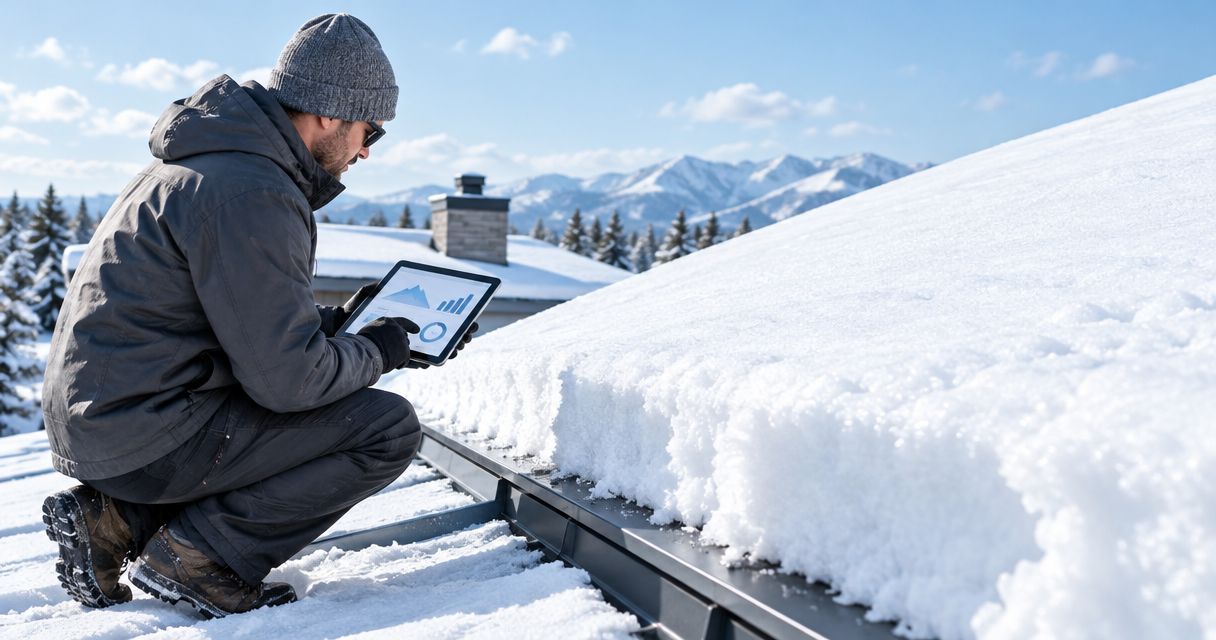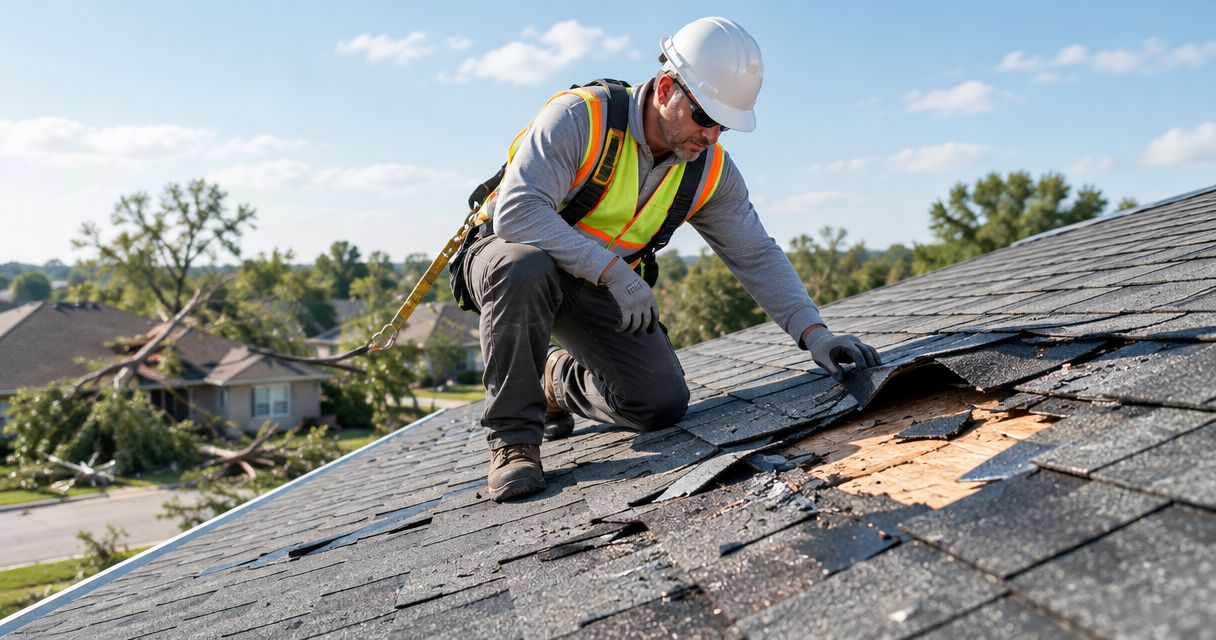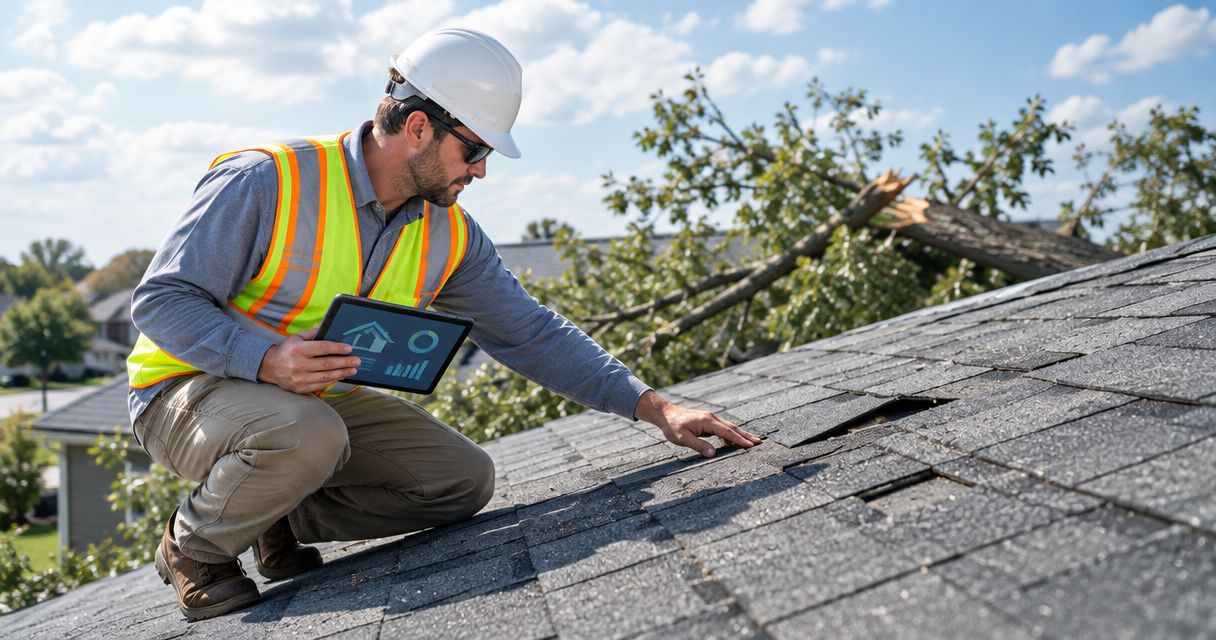
Schedule a roof inspection as soon as the storm has passed and a contractor can safely assess your property; report active leaks, missing roofing, or impact damage immediately. Booking an inspection does not mean someone should climb onto a wet or storm-exposed roof. If you see sagging ceilings, damaged electrical equipment, or downed power lines, keep people away and address the immediate safety hazard first.
- How soon after a storm should you schedule a roof inspection? Request one promptly; safe access determines the visit.
- Active leaks, missing roofing, and fallen branches require urgent attention, not a routine maintenance appointment.
- Murray Roofing provides roof inspections for Lincoln and Omaha homeowners and commercial property owners.
- Document damage safely and check your insurance policy’s reporting requirements; an inspection does not establish coverage.
How soon after a storm should you schedule a roof inspection?
Request an inspection promptly after suspected storm damage rather than waiting for a ceiling stain. Separate the urgency of your call from the safety of the roof visit: a contractor needs to understand the problem immediately, even when weather prevents roof access.
Use the conditions below to explain what you need when you schedule an inspection. Describe what you can actually see, not what you assume happened.
| Condition after the storm | Scheduling priority | Best for | Important limitation |
|---|---|---|---|
| Active water entry, exposed roof areas, or a tree impact | Report immediately and explain the hazard | Urgent damage assessment | Unsafe conditions can prevent immediate roof access |
| Missing shingles, displaced metal, or visible roof debris | Request a prompt inspection | Visible exterior damage | Ground-level views do not show the full extent |
| Suspected hail or wind damage without a leak | Book an inspection rather than waiting for symptoms | Damage that needs professional assessment | A storm nearby does not prove your roof was damaged |
| No visible damage and no known direct impact | Watch for changes and discuss whether an inspection is needed | Routine post-storm assessment | No visible damage is not proof of an undamaged roof |
This is a triage guide, not a promised response time. For a 2026 storm, record when you first noticed the problem and tell the contractor whether conditions are getting worse.
Why this matters
A roof can lose part of its weather protection before water becomes visible indoors. Conversely, a ceiling stain does not establish that the latest storm caused the problem; older leaks, flashing defects, and other moisture sources require assessment.
Prompt documentation helps separate observations from assumptions. You need a record of what changed, where it changed, and what the inspection found—not a diagnosis based only on a neighbor’s roof or a storm alert.
For Lincoln and Omaha properties, the practical decision is the same whether you own a house or manage a commercial building: identify immediate hazards, request an assessment, and establish what work is actually necessary. Do not turn a suspected problem into a do-it-yourself roof visit.
Active leaks or impact damage: report the problem immediately
Call when water is entering, roofing is visibly missing, or a branch has struck the building. Explain whether the affected area is occupied and whether water is near lighting, outlets, equipment, or a sagging ceiling.
Stay out of the affected area if the ceiling is bulging or materials appear unstable. Do not puncture a ceiling, handle wet electrical equipment, or approach a fallen line; contact the appropriate emergency service or utility when those hazards are present.
Your first conversation should distinguish emergency protection from permanent repair. Temporary protection addresses exposure, while a permanent repair requires an assessment of the damaged materials and surrounding roof.
For background on urgency, the guide to whether a small roof leak can wait explains why the visible drip is not the only issue. Do not assume a small indoor mark means a small roof defect.
Suspected hail or wind damage: book before a leak develops
You do not need an active leak to request an inspection after suspected hail or wind damage. Report visible changes such as missing shingles, displaced roof components, or debris that appears to have come from the roof.
Dented gutters or damaged siding can help explain why you are concerned, but they do not establish the condition of the roof covering. Likewise, loose granules alone do not identify the cause or severity of shingle damage.
Ask the inspector to explain each finding and distinguish damage from normal wear or a preexisting condition. A useful inspection supports its conclusions with photographs and specific locations rather than treating every mark as storm damage.
For your 2026 inspection record, keep the original photographs rather than only edited or annotated copies. Record the storm date separately from the date you discovered the damage; those dates are not always the same.
Why roof inspection timing varies
The safest inspection date depends on conditions at the property, not a universal countdown after the storm. Tell the contractor about these factors when requesting the visit:
- Active water entry: Ongoing intrusion changes the conversation from routine assessment to urgent protection and safety.
- Weather conditions: Lightning, wind, rain, snow, and ice affect whether exterior work can proceed safely.
- Access hazards: Fallen branches, unstable materials, overhead lines, and obstructed access require attention before roof access.
- Visible exposure: Missing materials or an opening in the roof require a different response from suspected damage without an opening.
- Building use: Occupied rooms, customer areas, stored goods, and sensitive equipment affect which areas need protection first.
- Documentation requirements: Insurance reporting instructions and existing roof warranty terms should be checked promptly, without assuming a standard deadline.
Request the appointment promptly; let the contractor determine safe access. Neither an inspection request nor a storm report guarantees that permanent repair can begin immediately.
What should you do while waiting for the inspection?
Focus on safety and a clear record. You do not need to climb a ladder, lift roofing materials, clear roof drains, or attempt a patch to prepare for a professional assessment.
- Check safety. Keep people away from unstable ceilings, electrical hazards, fallen branches, and damaged exterior areas. Observe the roof only from a safe ground-level position.
- Record damage. Photograph visible exterior changes and indoor water marks where access is safe. Note the room, location, discovery date, and whether the condition changes during rain.
- Gather records. Locate previous roof reports, repair invoices, warranty documents, and your insurance policy. Share known leaks or past repairs rather than leaving the inspector to infer the history.
- Report changes. Tell the contractor if a dry stain becomes an active leak or another part of the building develops symptoms. A change in conditions can change the urgency.
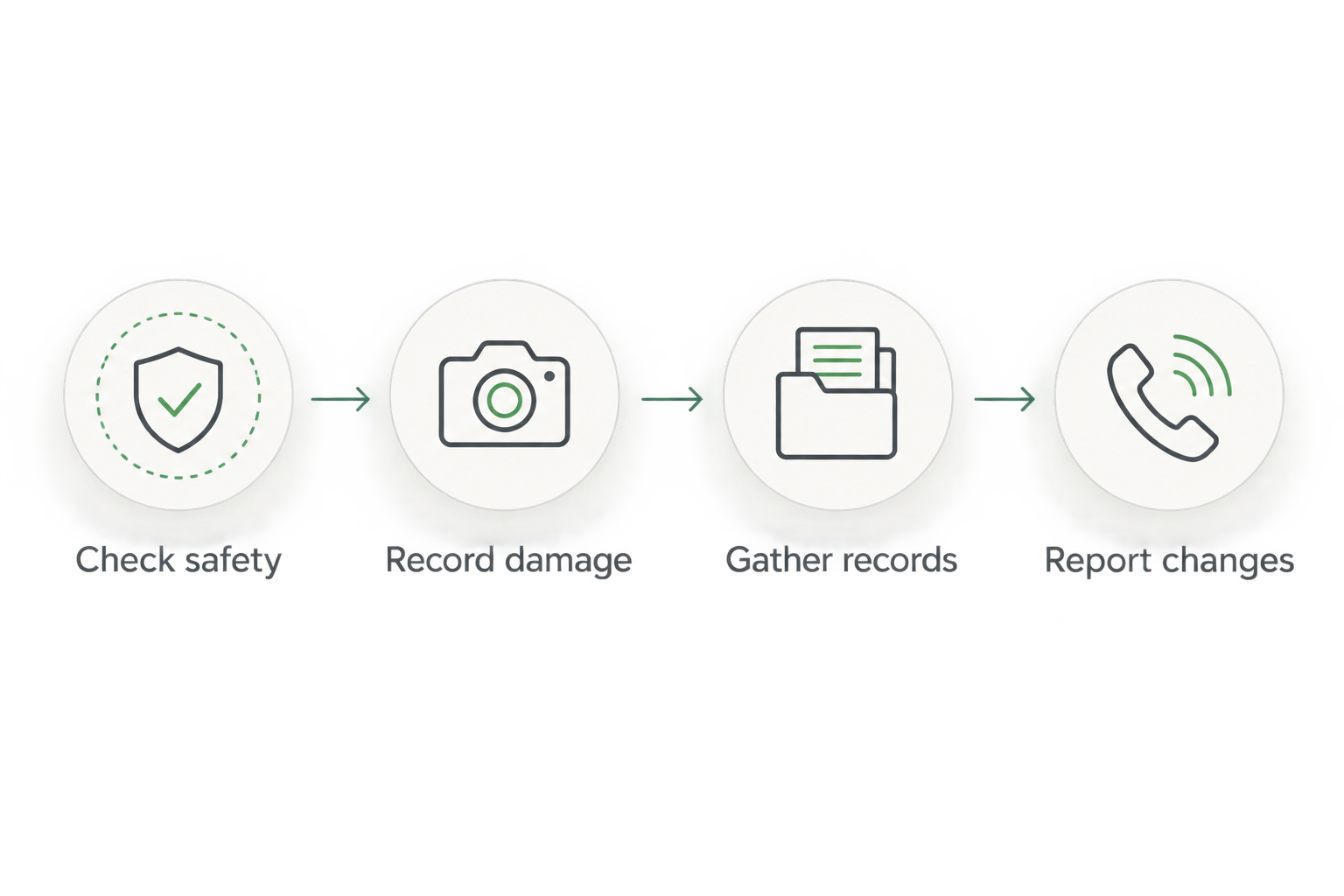
Keep a single record for the 2026 storm event, including contractor communications and any insurer instructions. A consistent file is easier to review than photographs and messages scattered across several phones.
What should a post-storm roof inspection cover?
Ask what the inspection includes before the visit. Roof access, interior access, photographs, and written findings should be discussed rather than assumed.
The assessment should address the roof covering and relevant details such as flashing, penetrations, edges, and drainage. Where interior symptoms exist, show the inspector their locations and explain when they appear; the point where water becomes visible is not necessarily the entry point.
Request findings that distinguish:
- Observed conditions: What is damaged, displaced, deteriorated, or otherwise concerning.
- Supporting evidence: Photographs and locations that connect the conclusion to the building.
- Immediate needs: Whether exposed areas or water entry require temporary protection.
- Permanent scope: What repair or replacement is recommended and why.
- Assessment limits: Areas that were inaccessible or questions requiring further investigation.
An inspection is not automatically a structural engineering assessment, a moisture survey, or an insurance coverage decision. If the findings suggest a concern outside the agreed scope, ask what additional assessment is needed before authorizing permanent work.
Should you contact insurance before or after the inspection?
Check your policy’s reporting instructions promptly; do not assume you must wait for a contractor’s report. Contact your insurer or agent when you need to clarify how to report suspected damage, what documentation to retain, or how emergency mitigation should be recorded.
An inspection helps document physical conditions. The insurer determines coverage under the policy, and neither visible damage nor a contractor’s recommendation guarantees claim approval.
For a 2026 claim, ask about the reporting provisions that apply to your policy and loss. Do not rely on a deadline quoted for another owner, another insurer, or another state.
Keep receipts and records for any authorized emergency work. Before discarding damaged materials, ask the insurer and contractor what evidence should be retained and how that can be done safely.
Does storm damage mean you need a full roof replacement?
Storm damage does not automatically require a full replacement. The decision to repair or replace your roof depends on the extent of damage, the condition of surrounding materials, and whether the proposed work restores the roof’s function.
A localized repair addresses a limited defect without replacing unaffected areas, but it does not renew the rest of an aging roof. Replacement addresses a broader scope, but it should follow documented findings—not simply the fact that a storm occurred.
Ask the contractor to explain what supports the recommendation. Useful questions include whether damage is isolated, whether adjoining materials can accept a repair, and whether existing deterioration changes the scope.
Keep temporary protection separate from that decision. Stabilizing an exposed area does not prove that a repair is sufficient, and recommending replacement does not remove the need to address immediate exposure.
What changes for commercial properties in Lincoln and Omaha?
Commercial owners need to coordinate the roof assessment with building operations. Identify affected spaces, occupied areas, equipment, inventory, and access restrictions before the contractor arrives.
The inspection priority should follow the hazard and exposure, not the property category. A warehouse, office, restaurant, healthcare facility, apartment building, or other commercial property needs a response based on its actual conditions.
For low-slope roofs, ask the inspector to assess relevant seams, edges, penetrations, and drainage conditions. Do not send untrained staff onto the roof to investigate ponding water or remove storm debris.
Designate a contact who can provide roof history, arrange authorized access, and collect the findings. For your 2026 maintenance file, keep the storm assessment alongside previous inspections so recurring problems are not treated as unrelated events.
Who should you call for a local roof assessment?
Murray Roofing is a local option for Lincoln and Omaha owners seeking residential or commercial roof inspections. The company provides inspections, roof repair, replacement, and insurance-claim support.
Murray Roofing’s roof inspection service fits owners who want an assessment connected to available repair or replacement services. That convenience does not replace your need to review the written scope, understand assessment limits, and confirm insurance requirements independently.
Give the scheduler your address, visible symptoms, known hazards, and whether water is entering now. State whether you need an urgent damage assessment or an appointment for suspected damage without an active leak.
FAQ
Should I wait until my roof leaks to schedule a storm inspection?
No—request an inspection when you suspect storm damage rather than waiting for a leak. Missing materials, visible impact damage, and changes after hail or wind justify a professional assessment.
Can a roofer inspect my roof while it is still raining?
Safe access determines whether a roof inspection can proceed during wet weather. Report the problem immediately, but do not assume the contractor can safely walk the roof while rain, lightning, or wind continues.
Do I need an inspection if my neighbor has hail damage?
A neighbor’s hail damage is a reason to discuss an inspection, not proof that your roof is damaged. Your roof needs its own assessment of materials, condition, and visible evidence.
Does a roof inspection guarantee insurance will pay?
No—a roof inspection does not guarantee insurance coverage. The inspection documents physical conditions; the insurer applies the policy’s coverage, exclusions, and other terms.
What should I tell a roofing contractor after a storm?
Tell the contractor whether water is entering, roofing is missing, or an impact or safety hazard is visible. Provide the property address, discovery date, and any changes since you first noticed the problem.
Can I inspect the roof myself from a ladder?
Stay on the ground and leave roof access to a qualified professional. Photograph visible conditions from a safe location and avoid damaged areas, fallen lines, and unstable materials.
Does Murray Roofing inspect commercial roofs after storms?
Murray Roofing provides commercial roof inspections in Lincoln and Omaha. Describe the affected areas, building access requirements, and any active leaks when requesting the assessment.
One last thing
Photograph the inside as carefully as the outside. A record of where water appeared, when it appeared, and whether it returned can help the inspector investigate the problem without treating the ceiling stain as the roof entry point.
Keep that record even if the stain dries. A dry surface describes the current condition; it does not establish that the source has been repaired.
Related guides
- Can you repair a roof in rain or wet weather?
- From storm damage to temporary protection and permanent repair
- How long does a roof inspection take?
Schedule an inspection with Murray Roofing to assess your storm concerns and discuss the next step. Tell the scheduler immediately if water is entering or you see a safety hazard.