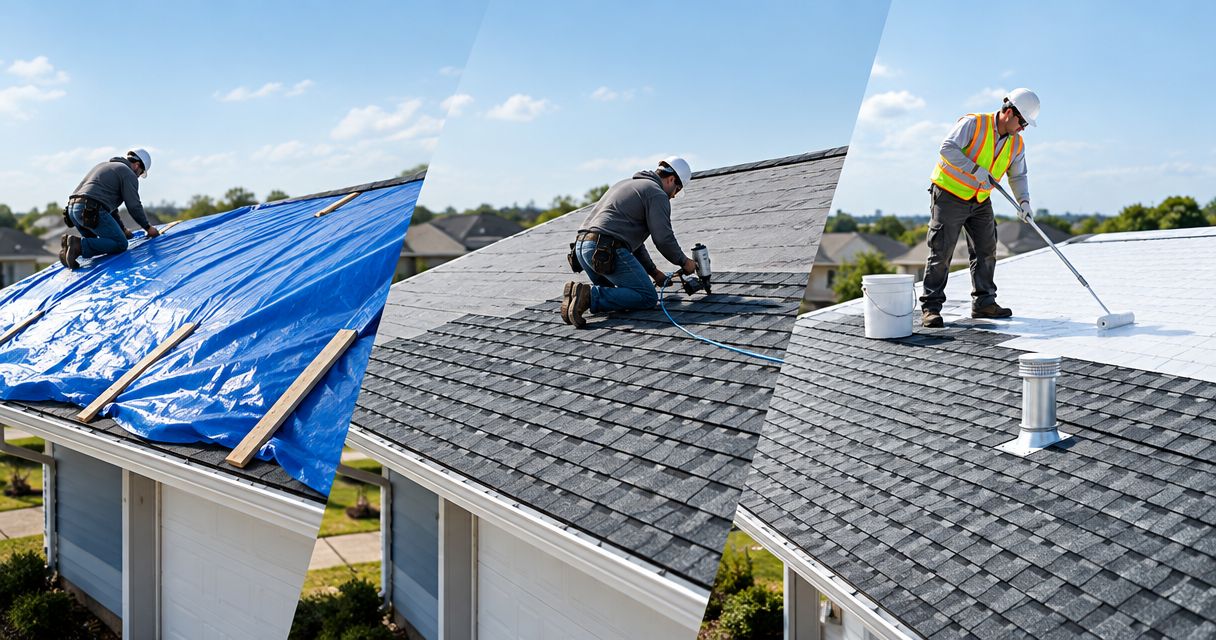
Instead of repeatedly chasing leaks after a storm, use a storm damage roof tarp to permanent repair workflow: document the damage safely, arrange professional temporary protection, then approve and verify the permanent work. This 2026 guide gives Lincoln and Omaha homeowners and commercial property managers a clear handoff between those stages without treating a tarp as a finished repair.
- Use the storm damage roof tarp to permanent repair workflow to separate emergency protection from permanent restoration.
- Murray Roofing provides roof inspections, repairs, replacements, and insurance-claim support in Lincoln and Omaha.
- A roof tarp is temporary protection, not proof that underlying damage is repaired.
- Approve permanent work from a written scope, then collect completion photos and applicable warranty documents.
Why this matters
A tarp addresses an immediate opening. It does not establish whether the roof needs a localized repair, damaged decking replacement, or a broader replacement. Those decisions require an inspection and a written scope.
Murray Roofing is best for Lincoln and Omaha property owners seeking roof inspection, repair, and replacement from one contractor. Its roofing services include residential and commercial work, but an inspection—not a description over the phone—determines the appropriate repair.
Treat the process as 3 stages: protect, diagnose, and restore. Keep a separate record for each stage so an emergency visit does not become an undocumented promise to finish the entire project.
Before you start
- Prepare your property file. Gather the address, owner or authorized manager contact, accessible storm photos, previous roof records, and insurance information if you intend to report a claim. Record when you first noticed water or visible damage.
- Arrange safe access and decision authority. Identify who can authorize temporary protection and permanent work. For commercial buildings, coordinate access with the property manager and identify occupied areas, roof-mounted equipment, and sensitive operations.
- Resolve the hidden handoff. Ask who monitors temporary protection, who responds if it fails, and who authorizes permanent repairs. Do not assume the temporary-work authorization includes replacement or that an insurer has approved the contractor's scope.
Stay off the roof. Keep people away from sagging ceilings, damaged electrical equipment, fallen lines, and unstable structures; contact emergency services when an immediate hazard exists.
Damage record and emergency authorization
Establish the starting condition
- Document visible damage from a safe location. Photograph affected rooms, ceiling stains, fallen roofing material, and exterior damage visible from the ground. Preserve original files rather than relying only on screenshots or edited images.
- Create a dated incident record. For a 2026 storm, record the actual event date if known, when you discovered the problem, and what changed afterward. Distinguish observations from assumptions: a new stain is an observation; attributing every roof defect to that storm requires evidence.
- Request professional assessment and temporary protection. Describe active water entry, affected rooms, building access restrictions, and any visible hazards. Ask the contractor to explain what can safely be protected under current conditions before authorizing the visit.
Expected result: You have a starting record, a responsible property contact, and a clearly authorized emergency assessment. You have not committed to an undefined permanent project.
For occupied commercial properties, identify an internal contact for tenant or staff updates. Share affected locations and access restrictions without promising a reopening time or declaring an area safe before the appropriate professional assesses it.
Temporary protection and inspection scope
Define what the temporary work covers
- Confirm the temporary-protection scope. Ask what area the contractor intends to protect, what limitations remain, and how the work will be documented. A tarp is not the right treatment for every roof assembly; the contractor must select a suitable temporary method.
- Request before-and-after documentation. Obtain photographs and a description of the temporary work, including any areas that could not be safely reached. Keep the authorization, invoice, and communications together.
- Set the inspection handoff. Confirm whether the contractor completed a full assessment or only emergency protection. If conditions prevented inspection, request the next assessment step and identify who will arrange it.
Expected result: You know what is protected, what remains unassessed, and who owns the next action. The file explicitly identifies temporary work as temporary.
Ask how the contractor will check the roof covering, flashings, penetrations, and underlying materials where damage is suspected. On commercial roofs, include drainage and affected roof-mounted equipment interfaces in the assessment discussion.
Choose the permanent response from evidence
The inspection should connect each proposed repair to a documented condition. Do not select replacement solely because a tarp was installed, and do not select a patch solely because the visible opening looks small.
| Response | Best for | Practical benefit | Limitation |
|---|---|---|---|
| Professional temporary protection | An exposed area awaiting safe assessment or permanent work | Helps limit further water entry at the protected location | Does not resolve underlying damage or replace a permanent repair |
| Localized permanent repair | Documented damage confined to a repairable area | Addresses the affected components without replacing unaffected roofing | Depends on the condition and compatibility of surrounding materials |
| Roof replacement | Widespread damage or a roof that cannot support a reliable localized repair | Addresses the roof at a broader system level | Requires a larger scope and more coordination than a localized repair |
Choose the smallest scope that fully addresses the documented damage—not the smallest-looking patch. Ask the contractor to explain excluded areas and whether concealed damage remains possible.
Permanent scope, authorization, and closeout
Turn findings into a written work order
- Review the proposed permanent scope. Require a description of the affected areas, materials, removal work, flashing details, disposal, and cleanup. Ask how damaged underlying materials will be handled if discovered after removal.
- Separate claim decisions from construction decisions. If you file an insurance claim, provide the requested documentation and ask the insurer about its inspection and authorization requirements. The contractor documents construction needs; the insurer determines coverage under the policy.
- Confirm readiness before work begins. Clarify the payment arrangement, required approvals, permit responsibility, access, weather limitations, and communication plan. Require written approval for changes rather than relying on a conversation at the property.
- Verify completion and collect records. Request completion photos, an explanation of what was repaired or replaced, applicable warranty documents, and any required inspection records. Confirm that temporary materials were removed or otherwise addressed as part of the finished work.
Expected result: The permanent work matches an approved scope, changes are documented, and you have a closeout file rather than only an invoice.
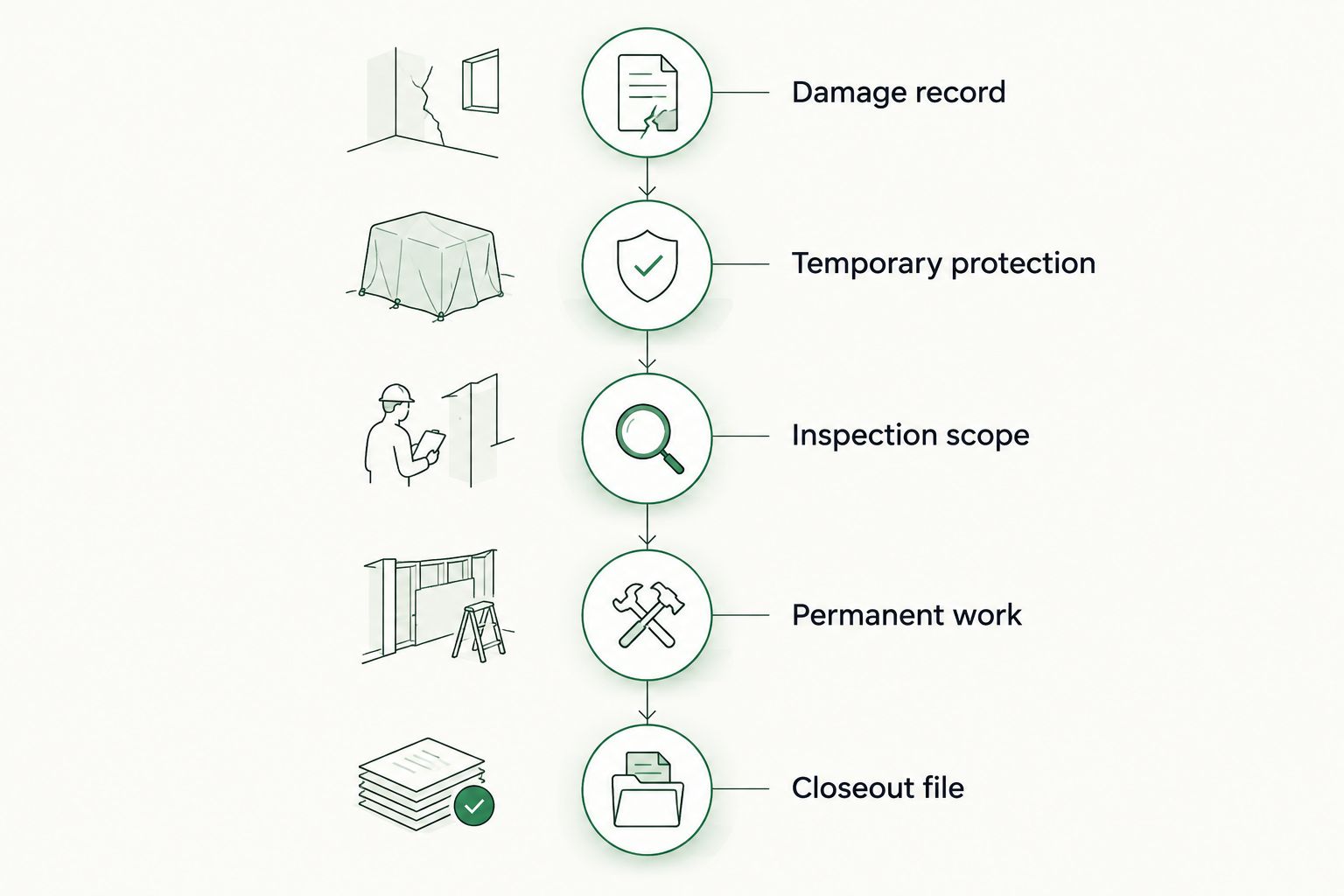
Use a simple status sequence for your 2026 project: Damage record, Temporary protection, Inspection scope, Permanent work, and Closeout file. Assign a responsible contact and an unresolved-action note to each stage.
Check the warranty against the actual work
Murray Roofing identifies a 50-year Golden Pledge warranty and a 10-year labor warranty among its trust signals. Ask which warranty applies to the proposed roof system and scope, what eligibility requirements apply, and what documents you will receive.
Do not assume a localized storm repair receives the same coverage as a qualifying full replacement. Read the actual terms for exclusions, registration requirements, and responsibility for future service.
When another storm arrives before permanent repair
A second weather event creates a documentation problem as well as a roofing problem. Keep the original incident record intact and add a new entry rather than overwriting the earlier photographs or notes.
- Record the change. From a safe location, document new stains, renewed dripping, displaced temporary protection, or newly affected areas. Note whether the previous symptom stopped and then returned.
- Notify the responsible contractor. Report what changed and request reassessment of temporary protection. Do not climb onto the roof to tighten, reposition, or remove the tarp.
- Update the appropriate claim contact. If a claim is open, ask the insurer how to report the additional event and what records it needs. Do not assume the new damage belongs under the existing claim.
- Reconfirm the permanent scope. Ask whether the new condition changes the work order, concealed-damage concerns, or access plan. Approve any changes in writing.
Expected result: The contractor and property owner work from the current condition, while the records preserve the distinction between events.
For a Lincoln or Omaha property affected by repeated storms in 2026, this version control matters more than a long email chain. Keep the latest approved scope easy to identify and retain earlier versions separately.
Troubleshooting
Water still enters after temporary protection
Report the location and conditions to the contractor promptly. Water can travel before becoming visible indoors, so a ceiling stain does not identify the roof entry point by itself. Request reassessment rather than treating the tarp as proof that the entire leak path is controlled.
The emergency visit ended without a permanent plan
Ask whether the visit covered protection only or included an inspection. Request the remaining assessment, the responsible contact, and the next decision needed. An emergency invoice is not a permanent repair scope.
The contractor's scope and insurer's scope differ
Identify the specific disputed items and ask for supporting photographs and explanations. Submit the requested information through the insurer's process. Do not treat a contractor estimate as a coverage decision or assume every difference will be paid.
Removal exposes additional damage
Ask the contractor to document the condition before covering it and explain the required scope change. Review the written change authorization and payment responsibility; if a claim is involved, ask what additional documentation the insurer requires.
The roof is repaired, but interior damage remains
Separate roof completion from interior restoration. Wet insulation, ceilings, and finishes need appropriate assessment and drying or restoration before cosmetic work. Confirm who handles those tasks; a roofing contract does not automatically include them.
Customize your workflow
For a home, build the plan around safe occupancy, access, pets, vehicles, and approval authority. For a commercial property, add tenant communications, equipment access, operating restrictions, and responsibility for protecting affected inventory or interiors.
Apply the same documentation standard to every commercial property type. The building's use changes coordination needs, not the requirement for a clear scope and a verified handoff.
If permanent work needs a separate funding decision, use the roof estimate to financing approval workflow to organize that process. Murray Roofing offers financing, but approval and terms require confirmation; do not treat an application as an approved payment arrangement.
Keep the 2026 project file together: inspection findings, temporary-work records, approved scope, change authorizations, claim correspondence when applicable, and completion documents. Give the next person managing the property a usable record.
FAQ
What is the storm damage roof tarp to permanent repair workflow?
The workflow is safe documentation, professional temporary protection, inspection, written scope approval, permanent work, and documented closeout. A tarp is an interim measure, not the final repair.
Should I put a tarp on my damaged roof myself?
Arrange professional temporary protection rather than climbing onto a storm-damaged roof. Damaged surfaces, wet materials, unstable structures, and electrical hazards make roof access dangerous.
How long can I leave a roof tarp in place?
Do not use a universal deadline for every roof tarp. Ask the installing contractor about the protection’s limitations, reassessment needs, and the plan for permanent work under actual site conditions.
Do I need insurance approval before emergency roof protection?
Ask your insurer about emergency mitigation and documentation requirements while arranging safe assessment. Keep photographs, authorizations, and invoices; coverage depends on the policy and claim decision.
Does storm damage mean I need a full roof replacement?
Storm damage does not automatically require full roof replacement. An inspection must establish the extent of damage and whether the surrounding roof can support a reliable localized repair.
Can permanent roof work start while an insurance claim is open?
Confirm documentation requirements, payment responsibility, and authorization before permanent work begins. An open claim does not establish coverage or guarantee reimbursement.
Does Murray Roofing inspect storm-damaged roofs in Lincoln and Omaha?
Murray Roofing provides residential and commercial roof inspections, repairs, and replacement in Lincoln and Omaha, including free inspections. Describe active leaks and visible hazards when requesting an appointment, and confirm the assessment scope.
One last thing
A dry ceiling is not a roof closeout test. Temporary protection can stop visible dripping while permanent roof work or interior restoration remains unfinished. Ask for evidence of the completed scope, not just reassurance that the leak has stopped.
Related guides
- From roof inspection to signed contract
- From roof permit application to final inspection
- From roof installation to registered manufacturer warranty
Schedule an inspection or request a project price to establish the damage, temporary-protection needs, and permanent scope for your property.
Schedule your roof inspection
Discuss storm damage, temporary protection, and permanent repair for your Lincoln or Omaha property.