A roof needs replacing when widespread deterioration or damage makes reliable repairs impractical—not simply when it reaches a particular birthday. Material determines its expected service life, but installation quality, weather exposure, drainage, and the condition beneath the covering determine whether your roof reaches that expectation.
- How long does a roof last? Asphalt shingles typically last 20–30 years; condition determines replacement timing.
- Murray Inspection Services’ roof-lifespan guide separates material life expectancy from evidence that replacement is necessary.
- Metal, clay tile, and slate offer longer material lifespans, but flashing and underlayment still need attention.
- Choose repair for isolated, repairable defects; consider replacement when deterioration is widespread.
Why this matters
A roof’s age is a planning tool, not a replacement order. Replacing a serviceable roof prematurely wastes usable life; delaying work on a failing roof exposes decking, insulation, and interior finishes to further damage.
If you are planning roof work in 2026, start with installation records and current condition rather than a warranty label. You can also visit Murray Inspection Services as you research your next step.
A useful assessment answers two separate questions: Is the roof keeping water out now, and are its materials still capable of dependable service? A roof can pass the first test while showing deterioration that deserves attention.
How long does a roof last before it needs replacing?
Asphalt shingles generally have a shorter expected life than metal, clay tile, or slate. For 2026 planning, the comparison below uses material estimates published in InterNACHI’s Standard Estimated Life Expectancy Chart for Homes. These are general service-life estimates, not predictions for an individual property.
| Roof covering | General expected life | Best for | Main advantage | Main limitation |
|---|---|---|---|---|
| Three-tab asphalt shingles | About 20 years | Homeowners evaluating an existing conventional shingle roof | Individual damaged shingles can be replaced when surrounding material remains serviceable | Aging shingles become brittle and harder to repair |
| Architectural asphalt shingles | About 30 years | Homeowners comparing asphalt-shingle replacement options | Longer general life expectancy than three-tab shingles | Flashing, installation defects, and weather still limit performance |
| Metal roofing | 40–80 years | Owners prioritizing a long service life | Durable roof covering with substantial lifespan potential | Seams, fasteners, penetrations, and corrosion require attention |
| Clay tile | 100 years or more | Suitable buildings intended for long-term ownership | Long-lived individual tiles | Weight, breakage, and underlying components complicate repairs |
| Slate | 60–150 years | Structurally suitable buildings with long-term preservation goals | Exceptionally long-lived stone covering | Slate quality, attachment condition, weight, and specialist repair needs matter |
The table compares coverings, not complete roof assemblies. Decking, flashing, underlayment, sealants, and attachments have their own condition and maintenance requirements.
Use the material’s expected life to decide when to investigate—not as proof that replacement is due. Ask for photographs and an explanation of the actual failure mechanism before accepting an age-based recommendation.
Asphalt shingles: about 20–30 years
Three-tab asphalt shingles have a general expected life of about 20 years, while architectural asphalt shingles have an estimate of about 30 years. Those figures describe broad material categories; they do not establish how many years remain on your roof.
Look for widespread curling, cracking, exposed asphalt, missing tabs, or shingles that no longer hold securely. Some loose granules occur without complete roof failure, so granules in a gutter are not a stand-alone replacement diagnosis.
Repair makes sense when damage is localized and the surrounding shingles remain flexible enough to work with. Replacement becomes the stronger option when deterioration affects broad areas or repairs would disturb brittle neighboring shingles.
Best for: Homeowners who want a familiar roof covering with individual components that can be repaired. The trade-off is a shorter general service life than the longer-lived materials below.
Metal roofing: about 40–80 years
Metal roofing has a general expected life of 40–80 years, but that broad category includes different metals, coatings, attachment methods, and roof designs. Treat the range as a reason to identify the actual system, not as a promise that every metal roof will reach its upper end.
An assessment should distinguish panel deterioration from repairable issues at seams, fasteners, and penetrations. A leak beside a pipe does not automatically mean the metal covering has reached the end of its life.
Corrosion, failed connections, and recurring water entry deserve specific investigation. Repeatedly applying sealant without identifying the source leaves the underlying question unanswered.
Best for: Owners prioritizing long service life. The limitation is that durable panels do not eliminate maintenance or make every connection equally durable.
Clay tile: 100 years or more
Clay tile has a published general life expectancy of 100 years or more. That figure applies to the tile covering, not a guarantee that every component underneath will last equally long.
Broken or displaced tiles can expose the layers below, while deteriorated underlayment can require substantial work even when many tiles remain reusable. Ask whether a proposal addresses damaged tiles, the underlying water-control layer, or both.
Avoid walking on tile to inspect it yourself. Foot traffic can break tiles and creates a fall hazard.
Best for: Buildings suited to the material’s weight and owners planning for long-term use. Its longevity is an advantage; handling, structural suitability, and access for repairs are important limitations.
Slate: about 60–150 years
Slate has a broad general life expectancy of 60–150 years because stone quality and roof-system details vary. A slate roof needs an assessment of the slate itself, its fasteners, flashing, and supporting structure.
Isolated slipped or broken slates do not prove that the entire roof needs replacement. Conversely, widespread deterioration of the stone or attachment system requires more than replacing a few visible pieces.
Ask an evaluator to distinguish repairable defects from systemic failure. That distinction protects useful material without ignoring a roof that no longer performs reliably.
Best for: Structurally suitable buildings where long-term preservation matters. Slate’s long life comes with substantial weight and a need for repair methods appropriate to the material.
Why roof lifespan varies
Material is only part of the answer. These factors explain why roofs with the same covering and installation date can reach very different conditions:
- Installation quality: Incorrect fastening, poorly integrated flashing, and unsuitable detailing create failure points before the covering wears out.
- Weather exposure: Hail, wind, sunlight, and freeze-thaw conditions affect materials differently. A damaging storm can change a roof’s condition regardless of age.
- Drainage: Blocked gutters, debris-filled valleys, and standing water interfere with the roof’s ability to shed water.
- Attic moisture: Moisture problems below the covering can damage wood components. Ventilation must be considered alongside air leakage and indoor moisture sources.
- Maintenance history: Prompt attention to damaged flashing and displaced materials prevents isolated defects from remaining open to weather.
- Roof geometry: Valleys, transitions, walls, skylights, and other penetrations add details that must remain watertight.
An assessment in 2026 should connect each observed defect to a location and recommended action. A generic statement that a roof is old does not explain whether repair or replacement solves the problem.
How do you decide between roof repair and replacement?
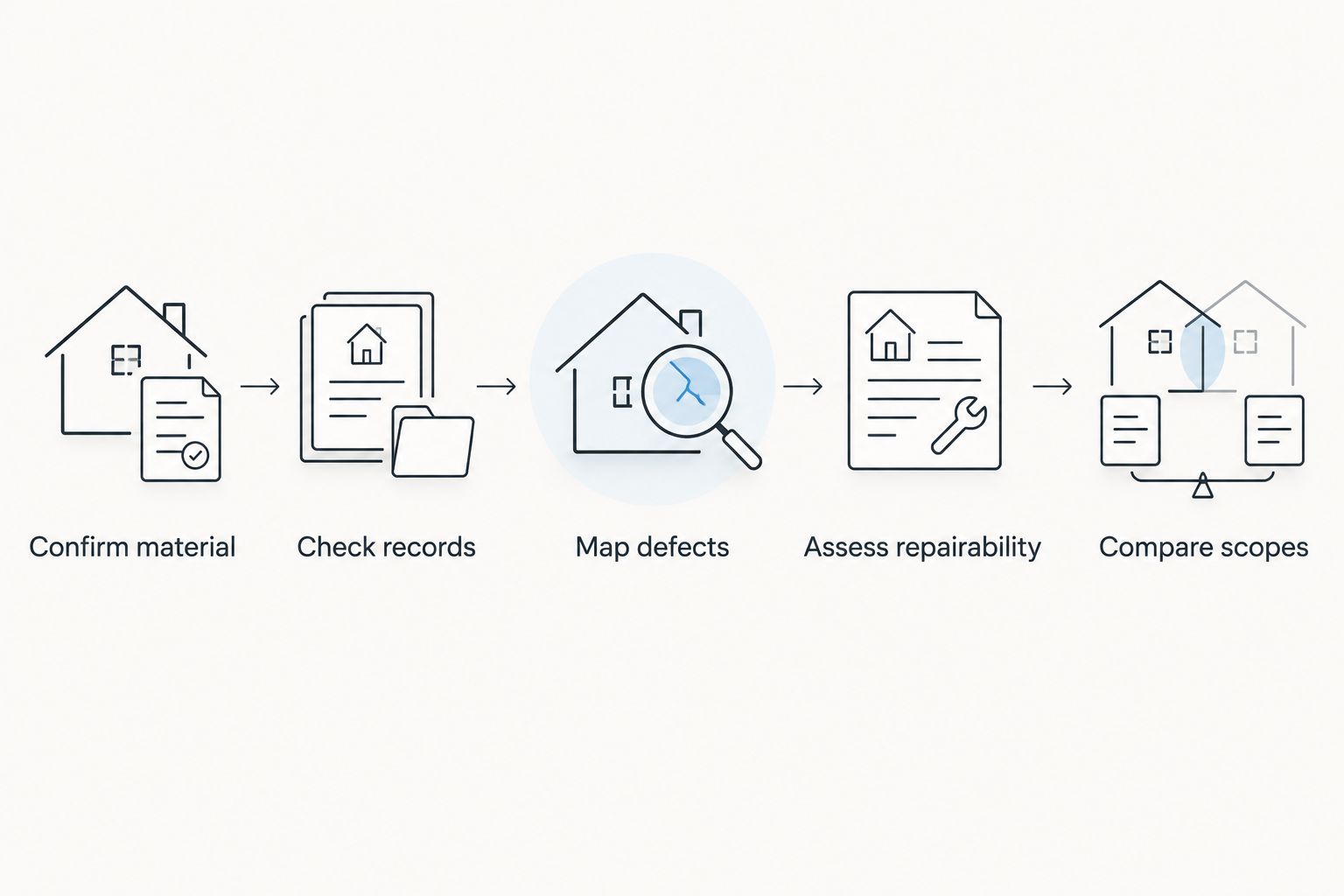
Repair addresses a defined defect; replacement addresses a roof system that no longer supports dependable repair. Use the following sequence to separate those situations before comparing proposals.
- Confirm material. Identify the roof covering and, where possible, the specific system. Appearance alone does not establish its installation date or expected life.
- Check records. Review installation paperwork, permits, prior inspection reports, and repair documentation. Treat an estimated age as an estimate.
- Map defects. Request photographs showing both close-up damage and its position on the roof. Distinguish isolated failures from repeated defects across multiple slopes.
- Assess repairability. Ask whether surrounding materials can tolerate repair and whether compatible components are available for the proposed work.
- Compare scopes. Review what each proposal includes: covering, flashing, underlayment, decking repairs where necessary, and treatment of existing problem areas.
Do not compare bids solely by their bottom line. A proposal that leaves deteriorated flashing in place is not equivalent to one that replaces it, even when both describe a new roof covering.
For a fuller comparison process, use the guide to roof inspection and contractor bid comparison. The useful output is a clear scope tied to documented conditions, not simply competing recommendations.
Does a 20-year-old roof automatically need replacing?
A 20-year-old asphalt roof does not automatically need replacement. That age matches the general life expectancy of three-tab shingles, but current condition and repairability determine the appropriate action.
Check whether the covering shows widespread deterioration, whether flashing remains sound, and whether previous repairs have held. Age justifies closer evaluation; it does not establish failure.
Can a 30-year shingle roof fail early?
A 30-year shingle designation does not guarantee 30 years of leak-free service. Warranty terms and expected service life describe different things, and installation defects or storm damage can require work before the covering wears out.
Read the actual warranty rather than treating the label as a countdown. Coverage depends on its terms, exclusions, and the cause of the problem.
Can a roof last longer than 20 years without leaking?
A roof can last longer than 20 years without leaking, depending on its material and condition. But an absence of visible interior leaks does not establish that the roof is free of defects.
Water can affect concealed materials before a stain appears indoors. Evaluate the covering, flashing, accessible attic conditions, and repair history rather than relying only on dry ceilings.
What should a useful roof assessment explain?
For your 2026 maintenance file, request a written explanation that separates observations from recommendations. Photographs should show what is wrong, where it is located, and why the proposed work addresses it.
Ask these questions before authorizing work:
- Is the problem isolated or widespread?
- What component is allowing water entry or showing deterioration?
- Can the surrounding material withstand a lasting repair?
- What areas were inaccessible or concealed?
- What remains unresolved if you choose repair rather than replacement?
Use Murray Inspection Services’ roof-lifespan guide as a planning reference, not a substitute for examining the property. No general lifespan table can establish the remaining life of concealed decking or confirm the condition of an inaccessible roof slope.
If you see a sagging roofline, active interior water entry, or storm-displaced materials, prioritize professional evaluation rather than waiting for a routine maintenance date. Stay off the roof and keep clear of visibly unstable areas.
FAQ
How long does a roof last on an average house?
Asphalt shingles generally last about 20–30 years, depending on the shingle type and conditions. Other materials have different expected lifespans, so identify the covering before using an age estimate.
What’s the best way to tell whether my roof needs replacing?
Documented widespread deterioration and poor repairability are stronger replacement indicators than age alone. Ask for photographs and an explanation of why repair will not address the defects reliably.
Is a metal roof longer-lasting than asphalt shingles?
Metal roofing has a general expected life of 40–80 years, compared with about 20–30 years for asphalt shingles. Actual performance depends on the system, installation, exposure, and maintenance.
Does a roof warranty tell me how long the roof will last?
A roof warranty does not establish the roof’s actual service life. Read its coverage, exclusions, and conditions separately from any material lifespan estimate.
Should I replace my roof if it isn’t leaking?
A roof without visible leaks still needs evaluation when it shows widespread deterioration or damage. Dry ceilings alone do not establish the condition of concealed roof components.
Can storm damage mean replacing a younger roof?
Storm damage can require major repair or replacement before a roof reaches its expected lifespan. The decision depends on the extent of damage and whether a dependable repair is practical.
How do I find out how old my roof is?
Start with installation invoices, permits, warranty paperwork, and previous inspection reports. If records are unavailable, keep any condition-based age estimate separate from a confirmed installation date.
One last thing
The longest-lived part of your roof is not necessarily the part that determines when work is needed. Durable tile, slate, or metal can remain serviceable while flashing, attachments, or underlying layers need attention.
For your 2026 planning, keep the installation date, material details, repair invoices, and inspection photographs together. The practical takeaway from Murray Inspection Services is simple: decide from documented condition, then use age to put that condition in context.
Related guides
- Can hail damage be repaired instead of replaced?
- Roof warranty types compared for homeowners
- How long does a roof replacement take?