
Your roof replacement financing monthly payment depends on the amount borrowed, the contractual interest rate, and the repayment term; calculate it from a written loan offer rather than a roofing estimate alone. The scheduled payment does not capture every borrowing expense: check upfront fees, financed charges, and promotional conditions separately. This 2026 guide explains how to verify the payment and compare repayment terms before signing.
- Your roof replacement financing monthly payment requires a loan amount, interest rate, and repayment term—not just a roof estimate.
- Compare APR, total payments, and fees alongside the monthly installment.
- A longer repayment term lowers the installment but increases interest when principal and positive interest rate stay unchanged.
- Murray Inspection Services readers should verify written financing terms before treating a payment estimate as a household commitment.
Why this matters
A manageable installment is not the same as an affordable loan. You need to know what leaves your bank account each month, what you pay over the full term, and what happens if the roof work changes after financing is arranged.
Start with the project itself. If you are researching Murray Inspection Services, keep the inspection decision separate from the borrowing decision: an assessment of roof condition does not establish a lender’s interest rate or approve financing.
For a 2026 comparison, put the contractor’s written scope beside the lender’s written offer. A monthly figure without those documents leaves you unable to tell whether competing proposals cover the same work or finance the same balance.
How much is a monthly payment on roof financing?
The monthly payment is the installment required to repay your financed balance under the loan’s interest rate and schedule. There is no single payment amount that applies to every roof replacement. A project estimate alone cannot establish it because the deposit, financing charges, and loan terms also affect the calculation.
For a standard fixed-rate, fully amortizing loan with equal monthly payments, use:
Monthly payment = P × r ÷ [one − (one + r) raised to the negative n]
- P is the opening loan principal, including any charges added to the balance.
- r is the contractual monthly interest rate, expressed as a decimal.
- n is the number of scheduled monthly payments.
For a loan whose nominal annual interest rate converts directly to a monthly rate, divide that rate by 12 months per year. Use the contractual interest rate for this calculation, not automatically the APR: APR also reflects certain borrowing charges and serves a different comparison purpose.
At a contractual 0% interest rate, with no additional charges affecting repayment, the calculation simplifies to principal divided by the number of payments. That is a mathematical case, not a statement that an interest-free roof loan is available to you.
What belongs in the payment breakdown?
Use this worksheet when reviewing a 2026 offer. It separates the amount you borrow from expenses you must pay outside the loan.
| Component | What to verify | Why it matters |
|---|---|---|
| Contract amount | The accepted scope and written project total | Establishes the work you are funding |
| Deposit | Whether it reduces the amount financed | Prevents borrowing against an already-paid balance |
| Financed charges | Fees or other charges added to principal | Increases the balance that must be repaid |
| Contractual interest rate | The rate used to calculate interest | Determines interest under the repayment schedule |
| Repayment term | The complete number of installments | Changes both payment size and repayment duration |
| Upfront charges | Amounts payable outside the loan | Affects immediate cash needs without necessarily changing the installment |
| Final payment | Whether it differs from regular installments | Identifies a remaining balance the monthly headline hides |
Ask the lender to reconcile the quoted installment with the financed balance and payment schedule. If the documents disagree, resolve the difference before accepting the loan.
How do shorter and longer repayment terms compare?
Choose the term by comparing both cash flow and total repayment. Neither a short term nor a long term wins automatically; each solves a different household budgeting problem.
The comparison below assumes the same principal, the same positive fixed interest rate, and no differences in fees. Change those assumptions and you need a fresh calculation.
| Repayment structure | Best for | Main advantage | Main drawback |
|---|---|---|---|
| Shorter repayment term | Borrowers who can support a higher installment | Reduces total interest under the stated assumptions | Requires more room in the monthly budget |
| Longer repayment term | Borrowers prioritizing a lower required installment | Spreads principal repayment across more installments | Increases total interest under the stated assumptions |
| Promotional repayment structure | Borrowers who understand and can meet the written payoff conditions | Offers the specific benefit stated in the agreement | Requires close review of expiration terms and interest treatment |
A longer term does not reduce the roofing work you are buying. It changes how you repay the borrowing. Likewise, a shorter term is not a sensible choice if the required payment leaves no room for essential bills or unexpected expenses.
With promotional financing, distinguish waived interest from deferred interest. Under a deferred-interest arrangement, failing to meet the stated payoff conditions can trigger interest dating back to the purchase; the agreement controls the exact treatment.
Why roof financing payments vary
These factors explain why two homeowners financing roof work receive different installments. Use them to check the quote rather than trying to match someone else’s payment.
- Amount financed. A larger principal produces a larger installment when the rate and repayment term stay the same. Confirm whether the quoted balance includes financed fees.
- Interest rate. A higher contractual rate increases the installment when principal and term stay the same. Check whether the rate is fixed or variable.
- Repayment length. More installments spread repayment over a longer period. At a positive fixed rate, that reduces the installment but increases total interest, all else equal.
- Fee treatment. A charge paid upfront affects your immediate cash requirement; a charge added to principal also affects repayment. Ask which treatment applies.
- Promotional conditions. Introductory rates, deferred interest, and special payoff deadlines require separate review. The advertised payment does not explain those conditions by itself.
- Payment structure. Equal installments, variable payments, and a remaining final balance create different obligations. Read the full schedule, not only the first payment.
For your 2026 decision, compare offers on a common basis wherever possible. When both the financed amount and the term differ, the lower monthly installment does not identify the less expensive loan.
How do you verify a quoted monthly payment?
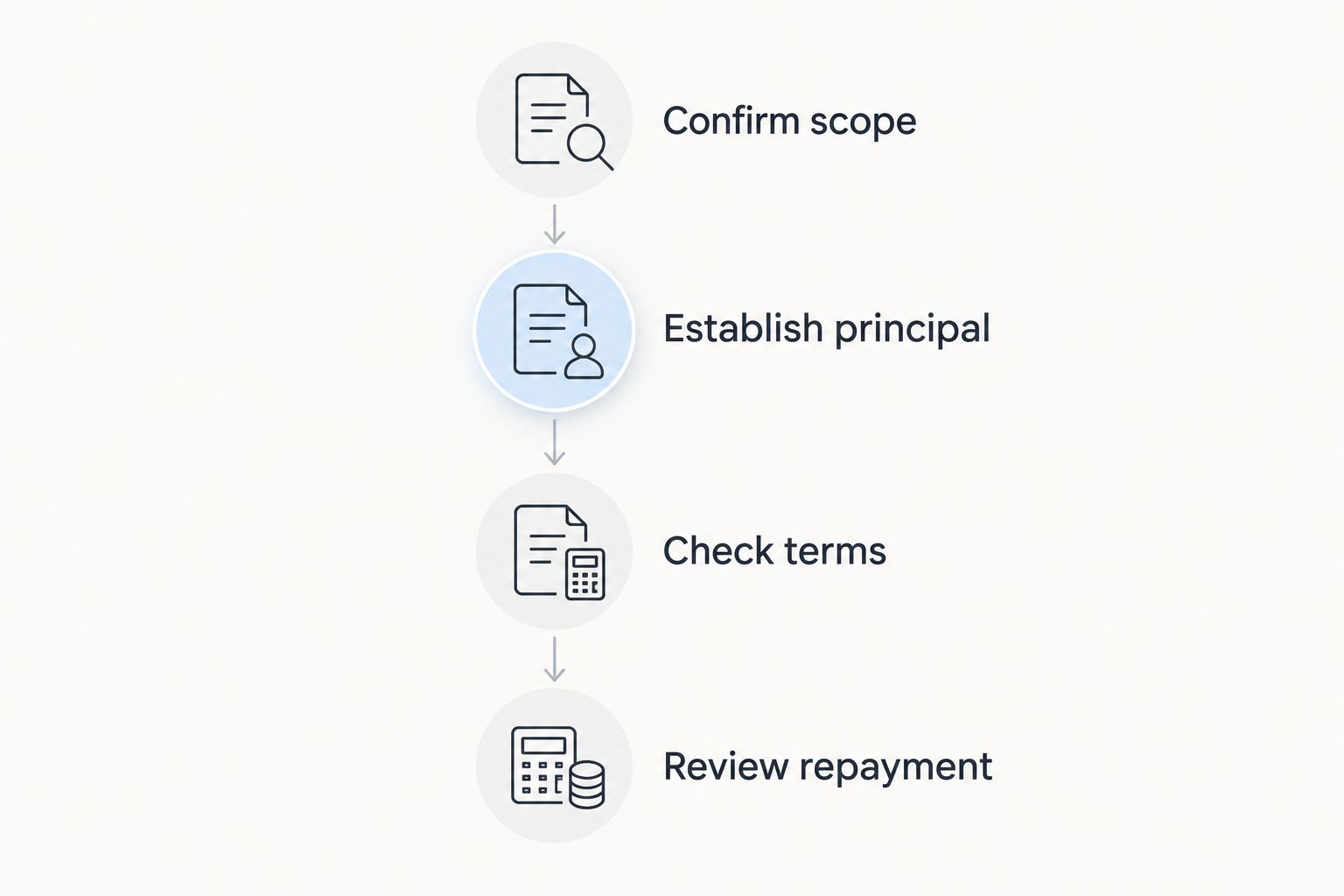
Verify the project balance before checking the loan calculation. Accurate arithmetic still produces the wrong borrowing decision when the starting balance includes work you did not agree to or omits work you need.
Confirm scope
Read the roofing proposal for included work, exclusions, and the process for approving changes. Ask how additional work discovered during replacement will be documented and authorized.
Do not assume that a financing approval automatically expands if the project changes. Establish how a revised contract would affect your deposit, loan balance, and payment before authorizing extra work.
Establish principal
Subtract payments already credited to the project, then identify charges added to the loan. Keep expenses paid separately outside that balance so you do not count them twice.
If insurance proceeds are involved, separate an expected payment from funds already received. Your loan obligation follows the lending agreement, not an assumption about an insurance settlement.
Check terms
Find the contractual interest rate, APR, repayment term, and payment schedule in the lender’s documents. Confirm whether the quoted payment is fixed for the full term or applies only during an introductory period.
Prequalification is not the same as final approval. Use final written terms when deciding whether the obligation fits your budget.
Review repayment
Check the scheduled installment, total of payments, upfront charges, and any different final payment. Then read the provisions governing late payments, early repayment, and promotional expiration.
Follow the roof inspection to financing approval workflow to keep the project assessment and borrowing checkpoints in order.
Keep copies of the accepted proposal, financing agreement, and any approved changes together. When a figure changes, you can trace whether the difference came from the work, the borrowed balance, or the lending terms.
Is the lowest monthly payment the best roof financing offer?
The lowest monthly payment wins on immediate cash flow, not automatically on total borrowing cost. A lower installment obtained by extending repayment can leave you paying interest for longer.
Compare each offer against the same project scope and deposit. Then examine the APR, fees paid separately, total of payments, and any balance remaining after the regular installments end.
This Murray Inspection Services roof financing guide is best for homeowners comparing repayment terms before signing. Its focus is the decision process; the lender’s agreement establishes your actual payment and obligations.
Can paying extra reduce roof financing interest?
Extra principal payments reduce future interest on a standard amortizing loan when they reduce the outstanding balance earlier. First confirm that the agreement permits early repayment without a penalty and ask how the servicer applies additional money.
An extra payment is not necessarily treated as principal reduction automatically. Request the required payment instructions and check the next statement to confirm that the balance changed as intended.
Do not substitute an intended early payoff for an affordable required installment. Your contractual payment remains due even when your plan to make additional payments changes.
What should you ask before accepting roof financing?
Use questions that force the proposal into plain language. A clear answer should point to a specific provision or figure in the agreement, not another advertising example.
- Is this payment based on my final financed balance or an illustrative balance?
- Does the installment remain unchanged for the entire repayment term?
- Which charges are financed, and which must I pay separately?
- Does the agreement include deferred interest or an introductory rate?
- Is any balance due after the regular installments finish?
- How are extra payments applied, and is early repayment penalized?
- What happens to the financing if the project scope changes?
For a 2026 household budget, review the required installment alongside your existing obligations and essential expenses. Leave the decision anchored to the payment you must make—not the extra payments you hope to make.
FAQ
How do I calculate my roof replacement financing monthly payment?
Calculate your roof replacement financing monthly payment using the financed principal, contractual interest rate, and number of installments. For a standard fixed-rate amortizing loan, use an amortization calculation and verify the result against the lender’s written schedule.
Can a roof estimate tell me my monthly payment?
A roof estimate cannot establish your monthly payment without the financing terms. Your deposit, financed charges, interest rate, and repayment term determine the borrowing obligation.
Is APR the same as the interest rate on roof financing?
APR is not the same as the contractual interest rate. APR reflects the interest rate and certain borrowing charges, while the contractual rate determines interest under the loan’s terms.
Does a longer roof loan mean a lower monthly payment?
A longer term lowers the monthly payment when principal and positive fixed interest rate remain unchanged. It also increases total interest under those same assumptions.
Does a promotional roof financing payment stay the same?
A promotional payment stays the same only if the agreement says it does. Review the introductory period, subsequent payment requirements, and any deferred-interest conditions before signing.
Can I pay off roof financing early?
Your financing agreement determines whether early repayment carries a penalty and how extra payments are applied. Ask the lender for principal-payment instructions and confirm the treatment on your statement.
Should I finance roof work before my insurance claim is settled?
Do not treat an unsettled insurance claim as confirmed repayment money. Review the loan against your ability to make the required payments even if the insurance outcome differs from your expectation.
One last thing
Check the final payment before you celebrate the monthly payment. An installment that fits your budget does not tell you whether a different balance comes due at the end of the schedule.
Use this Murray Inspection Services roof financing checklist to compare the complete obligation: principal, interest, charges, repayment schedule, and final balance. Keep the roof contract and financing agreement side by side until every difference is explained in writing.
Related guides
- Roof financing options for homeowners
- How to get prequalified for roof replacement financing
- Is roof replacement financing worth it?