
To pre-qualify for roof replacement financing, get a written project estimate, identify lenders that offer pre-qualification, and submit the income, housing, and identity information they request. Confirm whether the lender uses a soft credit inquiry before submitting anything: pre-qualification is conditional, and final approval can require additional documents and a hard credit inquiry.
- Pre-qualify for roof replacement financing only after confirming the lender’s credit-inquiry policy.
- Pre-qualification is not final approval; verified income, credit, and project details can change the offer.
- Compare APR, repayment length, fees, and collateral requirements—not just the monthly payment.
- This Murray Inspection Services guide is for homeowners preparing roof estimates and financing applications.
Why this matters
A preliminary borrowing limit is not a roof replacement budget. Start with the work your property needs, then decide how much debt your household can repay. Reversing that order lets an available loan amount drive the construction decision.
Keep the roof assessment separate from the lending decision. Murray Inspection Services is the brand behind this guide; the lender’s written disclosures—not a roofing sales conversation—determine the financing terms.
For a 2026 application, save the current estimate and the lender’s current disclosures together. An older advertisement or a contractor’s verbal description is not a substitute for the terms attached to your application.
How do I get pre-qualified for roof replacement financing?
Use these 6 steps to move from a roofing estimate to a preliminary financing decision. Stop before submitting whenever the application does not explain whether it authorizes a credit inquiry.
1. Get a written roof replacement estimate
Ask the contractor to identify the materials, tear-off work, disposal, flashing, ventilation work, and exclusions included in the proposed replacement. The estimate should also explain how the contractor handles concealed damage discovered after removing the existing roof.
Do not treat a lender’s maximum offer as permission to expand the project. Your borrowing request should reflect the written scope and your own contribution, not simply the amount a lender offers.
2. Review your credit information
Review your credit reports for unfamiliar accounts, incorrect balances, and identity errors before applying. A pre-qualification decision based on inaccurate information does not give you a reliable picture of your borrowing options.
If your credit file is frozen, ask the lender what access the preliminary check requires. Follow the lender’s instructions rather than removing protections unnecessarily.
3. Gather application information
Prepare your legal name, address, housing information, employment details, income, and existing debt obligations. A lender can request documentation supporting those details during the application or underwriting process.
Use information you can document. If you have variable or self-employment income, ask what records the lender accepts instead of choosing an unusually strong month as your regular income.
4. Confirm the credit-inquiry policy
Ask whether the initial eligibility check uses a soft inquiry and when, if ever, a hard inquiry occurs. Soft inquiries do not affect credit scores; hard inquiries can affect them.
Do not assume that every form labeled pre-qualification is a soft-credit check. Read the authorization immediately before submitting, including any consent to share your application with other lenders.
5. Review the preliminary offer
Compare the annual percentage rate, repayment term, monthly payment, fees, and total of payments where disclosed. Also check whether the loan is secured by your home and whether early repayment carries a penalty.
A longer repayment term can reduce the monthly payment while increasing total interest. Keep both affordability and total repayment in view when comparing offers.
6. Separate pre-qualification from final approval
Ask what remains before approval and funding: identity checks, income verification, a hard inquiry, project documents, or collateral review. Get the conditions in writing.
Do not authorize construction solely because a preliminary offer appeared on a screen. Confirm the final loan terms, funding conditions, and contractor payment schedule before making a commitment you cannot comfortably cover.
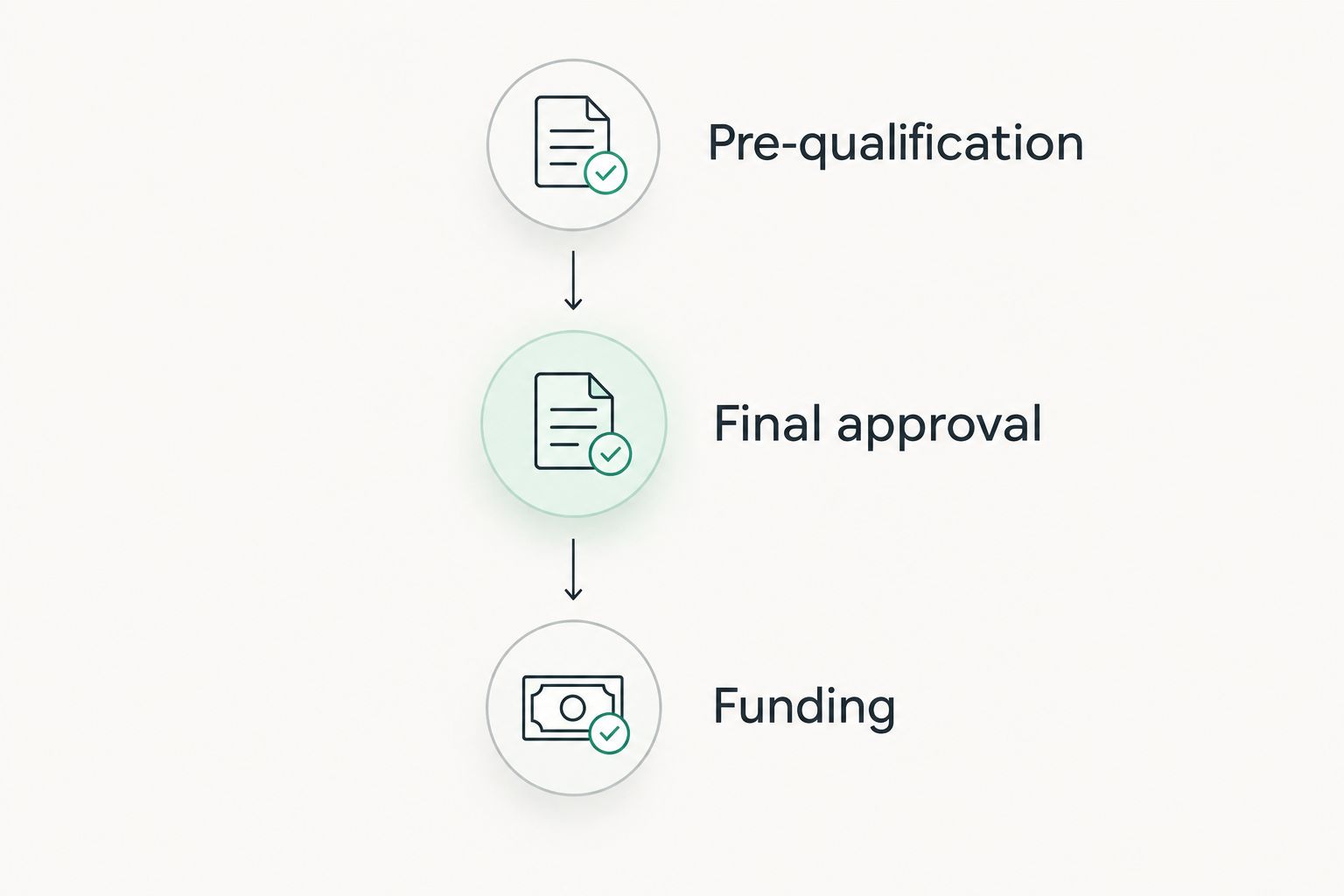
The process has 3 stages: pre-qualification, final approval, and funding. A positive result at an earlier stage does not guarantee the next.
Which roof financing route should I pre-qualify for?
Choose the application route based on collateral, repayment terms, and how independently you want to select a lender. These are financing categories, not promises that a particular lender will approve your application.
| Financing route | Best for | Main advantage | Main limitation |
|---|---|---|---|
| Unsecured personal loan | Homeowners who want to avoid pledging their home | The loan does not require home equity as collateral | Qualification and terms depend on the lender’s assessment of your finances |
| Contractor-arranged financing | Homeowners comparing financing alongside a specific project | Connects the financing application with the contractor’s proposed work | Convenience does not establish that the offer is competitive |
| Home-equity borrowing | Homeowners with equity who accept using their home as collateral | Allows borrowing secured by home equity | Your home is at risk if you fail to repay |
Compare terms before choosing convenience. An application presented during a roofing appointment deserves the same scrutiny as an application you find independently.
Unsecured personal loans
An unsecured personal loan separates the borrowing decision from the roofing contractor. That makes it easier to keep contractor selection focused on scope, workmanship requirements, and the construction agreement.
The limitation is that preliminary eligibility still depends on the lender’s rules. Ask whether the quoted terms assume automatic payments or other conditions, and verify those conditions in the final agreement.
Contractor-arranged financing
Contractor-arranged financing can place the project estimate and financing application in the same conversation. Identify the actual lender, however, and establish who handles billing, complaints, and repayment questions.
Read any promotional financing language carefully. Deferred interest and a genuine interest-free period are not interchangeable; the agreement determines what happens if a balance remains when the promotional period ends.
Home-equity borrowing
Home-equity borrowing uses your property as collateral. A preliminary discussion about eligibility does not replace the lender’s review of the property, existing mortgage obligations, and your finances.
Do not choose a secured loan solely because its payment looks manageable. The consequence of default matters alongside the rate, and the approval process can involve property-related requirements absent from unsecured borrowing.
Why roof financing pre-qualification varies
There is no universal roof-financing approval rule. For a 2026 comparison, evaluate each lender’s current requirements rather than relying on a credit-score threshold repeated in advertising.
- Credit history: Lenders assess payment history and other credit information under their own underwriting rules.
- Income verification: The income you enter must meet the lender’s eligibility and documentation requirements.
- Existing obligations: Current debt payments affect how a lender evaluates your ability to take on additional borrowing.
- Requested loan amount: Changing the amount requested can change eligibility and the repayment offer.
- Collateral requirements: Home-equity borrowing adds property value and existing secured debt to the review.
- Product eligibility: A lender’s location, property, borrower, or project restrictions can determine whether you qualify.
Avoid submitting inconsistent information across applications. Keep a reference sheet with your documented income, housing payment, requested amount, and project address so each comparison starts from the same facts.
What should I prepare before submitting an application?
Build an application file that answers the lender’s questions without exposing more information than necessary. Use the lender’s verified application channel for sensitive documents, and confirm the recipient before uploading identification or financial records.
Your file should include:
- The contractor’s written scope and estimate.
- The amount you intend to contribute yourself.
- Income records matching the application instructions.
- Current housing and debt-payment information.
- Identification and property information requested by the lender.
- The preliminary offer and its stated conditions, once issued.
Keep 2 decisions separate: whether the roof proposal is appropriate and whether the financing is affordable. A lender evaluates repayment risk; that assessment does not establish that the contractor’s scope is necessary or complete.
Murray Inspection Services’ guidance here is to document the project before accepting debt. If bids describe different work, use the roof inspection to contractor bid comparison workflow to organize the scope differences before comparing financing offers.
How do I keep the estimate, loan, and contract aligned?
The loan agreement and roofing contract must describe compatible commitments. Check the financed amount against the accepted estimate, then confirm who receives the funds and what triggers each contractor payment.
The roof estimate and contract process should preserve the agreed scope from proposal through signature; financing approval does not resolve missing exclusions, unclear change-order terms, or an undefined payment schedule. Put those details in writing before you commit.
For your 2026 paperwork, record the estimate date, offer expiration, intended project schedule, and funding conditions. Ask what happens if the contractor changes the scope or the lender’s offer expires before work begins.
Pay particular attention to concealed roof-deck damage. Ask how additional work gets documented, who must approve it, and how you would pay for it if the existing financing does not cover the change.
A contractor’s willingness to begin work is not confirmation that funds are available. Obtain that confirmation from the lender and make sure the construction agreement does not require payments before you can make them.
Can I pre-qualify without affecting my credit score?
A soft-inquiry pre-qualification does not affect your credit score. Confirm the inquiry type in the lender’s disclosure before submitting, because the label on the application alone does not establish how credit will be checked.
For any 2026 application, ask exactly when a hard inquiry occurs. Do not assume that moving from a preliminary offer to a formal application preserves the same credit-check treatment.
Does pre-qualification mean I can schedule the roof replacement?
Pre-qualification is not permission to rely on loan proceeds. Schedule work only after you understand the final approval, funding conditions, and payment obligations you are accepting.
You can discuss scheduling while underwriting continues, but distinguish a tentative date from a binding construction commitment. Ask the contractor to explain cancellation and deposit terms before signing.
What should I do if I do not pre-qualify?
A failed pre-qualification means that offer is unavailable under the information and criteria used. Read the lender’s explanation, check the information submitted, and correct documented errors before trying again.
Do not inflate income or conceal debt to change the result. Revisit the requested amount, review whether the proposed work is fully defined, and ask another lender about its eligibility rules before authorizing another credit inquiry.
FAQ
What do I need to pre-qualify for roof replacement financing?
You generally need identity, housing, income, and debt information, plus the amount you want to borrow. Prepare a written roofing estimate and follow the lender’s specific documentation instructions.
Does roof financing pre-qualification guarantee approval?
No, roof financing pre-qualification does not guarantee approval. Final underwriting can require verification, additional documents, and a hard credit inquiry before funding.
What credit score do I need for roof replacement financing?
There is no universal credit-score requirement for roof replacement financing. Each lender sets eligibility rules and evaluates other information, including income and existing obligations.
Is contractor financing better than a personal loan for a roof?
Neither financing route is automatically better. Compare APR, repayment length, fees, total repayment, and any promotional conditions using the actual written offers.
Can I pre-qualify if I am self-employed?
Self-employment does not by itself determine eligibility. Ask the lender which income records it accepts and how it evaluates variable earnings before applying.
Should I wait for an insurance decision before borrowing?
Establish what your insurer has actually approved before treating insurance proceeds as available money. Keep the claim decision, deductible obligation, roofing contract, and loan agreement separate when planning repayment.
Can a pre-qualified loan offer change before funding?
Yes, a preliminary offer can change when verified information differs or offer conditions are not met. Review the final agreement rather than relying on the earlier eligibility result.
One last thing
An affordable payment does not establish an affordable loan. Before accepting a 2026 offer, read the total repayment alongside your household budget and the consequences of default.
Murray Inspection Services’ recommendation is to keep the roof scope, borrowing decision, and contractor agreement separate until each is clear. Then confirm they fit together before signing.
Related guides
- Roof inspection to financing approval workflow
- Roof financing options for homeowners
- Is roof replacement financing worth it?