To find a reputable commercial roofing contractor, verify the business identity, applicable licensing, insurance, comparable project references, and written scope before signing. Ask each candidate to explain how the proposed work addresses documented roof conditions, not just which material they recommend. Choose the contractor whose evidence and contract match your building—not the strongest sales pitch.
- To find reputable commercial roofing contractor candidates, verify credentials and comparable commercial projects before comparing proposals.
- For Murray Inspection Services, request project-specific documentation rather than treating this checklist as proof of qualifications.
- Compare written scopes, exclusions, warranty responsibilities, and occupied-building protection—not just proposal totals.
- Reject pressure to sign before you can verify insurance, references, and responsibility for the work.
How do I find a reputable commercial roofing contractor?
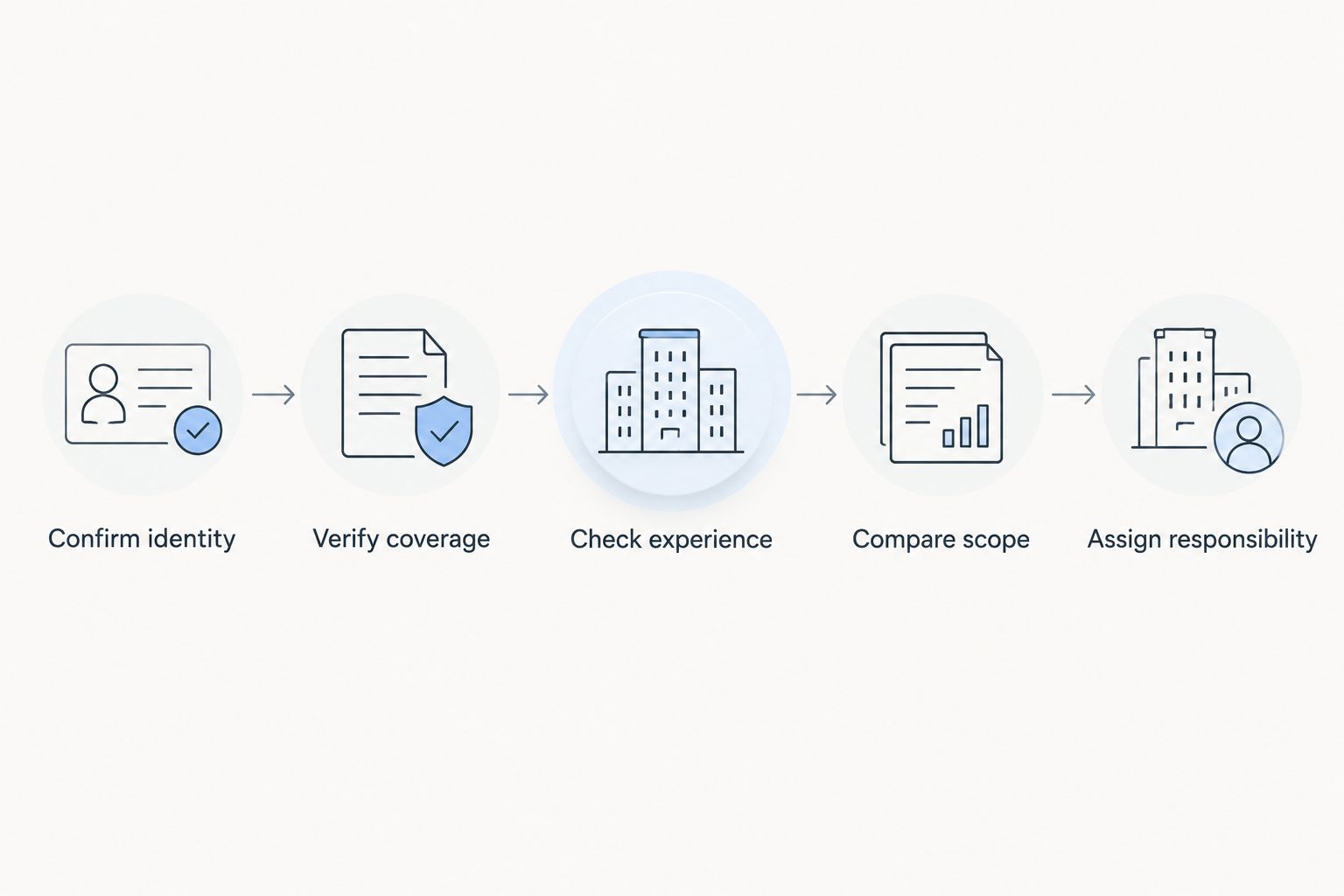
Use this sequence to turn a list of names into a defensible hiring decision:
- Confirm identity. Match the contracting entity to its registration and applicable licensing records.
- Verify coverage. Request insurance documentation and confirm it with the issuing agent.
- Check experience. Speak with owners of comparable commercial properties.
- Compare scope. Give candidates the same roof information and ask them to identify exclusions.
- Assign responsibility. Put supervision, protection, changes, warranties, and closeout requirements in writing.
If you are researching Murray Inspection Services, apply these same checks before making a hiring decision. Assess project-specific documentation rather than assuming that a company name establishes commercial roofing qualifications.
Why this matters
Commercial roof work affects more than the roof surface. Your selection process needs to account for building access, occupants, equipment, drainage, and responsibility if something goes wrong.
For your 2026 contractor search, create a written evaluation file before requesting proposals. Keeping the same questions and documents for every candidate makes differences visible and gives other decision-makers a record they can review.
Verify the business before evaluating the proposal
Ask for the exact legal name of the entity that will sign your contract. Compare that name with registration records, applicable licensing records, the insurance certificate, and the proposal; require an explanation for differences.
A familiar trading name is not enough: identify the entity accepting responsibility. Licensing requirements depend on the project location, so check the relevant state or local authority rather than assuming one credential applies everywhere.
Request general liability and workers' compensation documentation as applicable to the work and jurisdiction. Ask the issuing insurance agent to confirm the named insured, policy dates, and coverage relevant to your project; do not treat an emailed certificate alone as the complete verification process.
Use this evidence table during your 2026 screening:
| Check | Evidence to request | What it does not establish |
|---|---|---|
| Business identity | Legal entity name and registration details | Quality of workmanship |
| Applicable licensing | Current record from the relevant authority | Experience with your roof system |
| Insurance | Documentation confirmed with the issuing agent | Coverage for every possible loss |
| Comparable experience | Project details and owner references | The crew assigned to your building |
| Manufacturer credentials | Current verification for the proposed system, if claimed | Every warranty term or exclusion |
| Written scope | Defined work, materials, exclusions, and responsibilities | Conditions concealed within the roof |
Ask who will perform the work and who will supervise it. If subcontractors are involved, require the contractor to explain their role and how responsibility flows through the contract.
Check references that resemble your building
Request 3 relevant project references as a screening target, not as a guarantee of quality. Choose references that help you assess the proposed roof system, project scope, and building-use constraints rather than accepting an unrelated portfolio.
For an occupied facility, ask about communication and disruption. For a proposed repair, ask whether the contractor documented the source of the problem and explained the limits of the repair.
Use questions that invite specific answers:
- What work did the contractor actually complete?
- Who supervised the project, and was that person accessible?
- How did the contractor protect entrances, occupants, and rooftop equipment?
- Were proposed changes explained before additional work proceeded?
- What happened when the owner raised a concern after completion?
- Would the owner hire the same company for a similar project?
Ask permission before contacting references. A reference conversation is useful evidence, but it does not replace verification of the contractor's current team, coverage, or proposed scope.
Review public feedback for recurring descriptions of communication, cleanup, and follow-through. Treat individual reviews as leads for questions—not as proof that your project will have the same outcome.
Compare proposals against one written scope
Prepare 1 written scope that every bidder receives. Include known roof information, leak history, available reports, access restrictions, and your operational requirements; ask each contractor to state what remains unverified.
Seek 2 comparable written bids as a practical starting point. Additional proposals help only when you can explain the differences between them; a stack of unrelated scopes does not produce a fair comparison.
The roof inspection to contractor bid comparison workflow is a related planning resource. Keep the actual decision tied to the documents submitted for your building.
For a 2026 bid package, ask each candidate to address:
- Roof findings: Observed conditions, photographs, and inspection limitations.
- Proposed work: Areas included, preparation, removal or retention of existing materials, and installation details.
- Drainage details: Treatment of drains, scuppers, penetrations, and transitions affected by the work.
- Building protection: Access control, debris handling, weather protection, and coordination with occupants.
- Unknown conditions: How concealed damage will be documented and authorized.
- Closeout documents: Inspection records, warranty documents, and maintenance instructions applicable to the work.
Do not choose between proposals until you understand why their scopes differ. Ask candidates to resolve omissions in writing rather than relying on a verbal assurance that an item is included.
Why the right contractor varies by project
The right choice depends on the work your building needs. Use these factors to decide which experience and contract details deserve the closest scrutiny:
- Roof system: Ask for experience with the proposed assembly and its details, not just general roofing experience.
- Work type: Separate experience with repairs, restoration, and replacement when reviewing references.
- Building use: Identify operating hours, sensitive areas, and access restrictions that the work must accommodate.
- Existing conditions: Require the proposal to distinguish observed conditions from assumptions about concealed materials.
- Warranty requirements: Confirm who provides each warranty and what the owner must do to preserve coverage.
- Project location: Verify applicable licensing, permitting, inspection, and other local requirements with the relevant authorities.
Give each candidate the same building constraints. A proposal that ignores your operating requirements needs clarification before you can compare it fairly with one that addresses them.
Separate warranty promises from written obligations
Request the proposed warranty documents before signing. Distinguish the contractor's workmanship obligations from any manufacturer's material or system warranty, and identify which party handles each type of claim.
Ask what must happen before a warranty is issued. If a candidate claims manufacturer authorization, verify that claim directly with the manufacturer and confirm its relevance to the proposed system and warranty.
Your 2026 contract review should answer these questions:
- Who is responsible for installation defects?
- What work or conditions fall outside the stated coverage?
- What inspection or maintenance duties belong to the owner?
- How must the owner report a problem?
- What documentation confirms completion and warranty issuance?
A warranty summary in a sales proposal is not a substitute for the warranty terms. Resolve conflicting descriptions before authorizing work, and obtain legal or insurance advice when the obligations exceed your team's expertise.
Identify red flags without relying on guesswork
Pause when a candidate refuses to identify the contracting entity, discourages independent verification, or will not provide a written scope. An unresolved discrepancy is a reason to withhold approval—not a reason to fill the gap with assumptions.
Treat pressure to sign immediately as a reason to slow the process. Urgent roof conditions call for a clearly defined response, not an unexplained commitment to a broader project.
Ask for clarification when a contractor recommends extensive work without documenting observed conditions or explaining inspection limitations. Do not accept a promise of insurance coverage as a substitute for your insurer's actual coverage determination.
A polished proposal can still leave responsibility unclear. Before signing, identify the project contact, change-authorization process, temporary protection obligations, and documents required at completion.
How do I check a commercial roofer's license and insurance?
Check applicable licensing through the authority responsible for the project location, then confirm insurance information with the issuing agent. Match the legal entity across the proposal, contract, licensing record, and insurance documentation.
Keep dated verification notes in your 2026 project file. Recheck documents when the contracting entity, project timing, or scope changes.
How many commercial roofing bids should I get?
2 comparable written bids are a practical starting point, not a rule that proves either contractor is qualified. First establish a common scope, then investigate differences in assumptions, exclusions, protection measures, and warranty responsibilities.
If neither proposal explains the roof findings clearly, request clarification before expanding the shortlist. More bidders do not fix an undefined project.
Is a local commercial roofer always the better choice?
No. Evaluate a contractor's ability to supervise your project, respond to problems, and meet local requirements rather than treating proximity as proof of competence.
Ask who will visit the building, who has authority to resolve problems, and how post-completion concerns will be handled. Put the agreed responsibilities in writing.
FAQ
What’s the best way to find a reputable commercial roofing contractor?
Verify business identity, applicable licensing, insurance, comparable references, and the written scope before signing. Select the contractor whose documentation and responsibilities fit your building’s needs.
How can I tell whether a commercial roofing reference is useful?
A useful reference concerns work similar to your proposed project and comes from someone who dealt directly with the contractor. Ask about supervision, communication, changes, and follow-through after completion.
Should I choose the commercial roofer with the lowest proposal total?
Do not choose on the proposal total alone. Compare included work, exclusions, assumptions, building protection, and warranty obligations before deciding.
Does a roofing manufacturer’s certification prove a contractor is reputable?
A manufacturer credential does not establish every aspect of a contractor’s qualifications. Verify any claimed credential directly and assess insurance, references, supervision, and contract terms separately.
Can a commercial roofing contractor guarantee my insurance claim will be approved?
A contractor’s promise does not determine insurance coverage. Obtain coverage decisions from your insurer and keep the roofing contract separate from assumptions about claim approval.
What should I ask about roofing subcontractors?
Ask who will perform the work, who will supervise it, and which entity accepts contractual responsibility. Require a clear explanation of subcontractor roles before signing.
What documents should I request before signing a commercial roofing contract?
Request the written scope, applicable credential information, verified insurance documentation, relevant references, and proposed warranty terms. The contract should also address changes, protection, supervision, and closeout requirements.
What should I verify before hiring Murray Inspection Services for a commercial roofing project?
Confirm that Murray Inspection Services offers the specific work you need, then request project-specific credentials, coverage documentation, relevant references, and a written scope. A general hiring checklist does not verify those qualifications for Murray Inspection Services.
One last thing
Ask each finalist to identify what the proposal does not establish. Specifically request inspection limitations, concealed-condition assumptions, excluded work, and responsibilities assigned to the owner.
That question gives you a concrete final review task. Before approving your 2026 project, turn every unresolved answer into a written clarification, a defined investigation, or a reason to postpone the award.
Related guides
- Commercial roofing for property managers
- Commercial roof inspection to budget approval workflow
- How often should a commercial roof be inspected?