
Yes, you can qualify for roof replacement financing with bad credit, but approval depends on the lender, your income, existing debts, and the financing arrangement. A low monthly payment does not establish affordability: interest, fees, repayment length, and any collateral requirement matter too. In 2026, compare written loan disclosures before signing a roofing contract that depends on financing.
- Roof replacement financing bad credit approval depends on underwriting, not a contractor’s promise.
- Unsecured personal loans avoid pledging your home; home-equity financing puts your home at risk.
- Contractor-arranged financing still requires a separate review of the lender and repayment agreement.
- Check insurance coverage and repair assistance before borrowing for the entire roof replacement.
For readers of Murray Inspection Services, the central roof replacement financing decision is whether the borrowing terms fit the documented work and your household budget. Get the roof scope and the loan terms in writing before committing to either.
Can I finance a roof replacement with bad credit?
Yes. Bad credit does not automatically rule out every lender, but neither a roofing estimate nor a preliminary eligibility result guarantees a loan. Your application must satisfy the actual lender’s requirements.
These financing routes involve different trade-offs. The “best for” descriptions identify situations to evaluate, not promises of approval.
| Financing route | Best for | Main advantage | Main drawback |
|---|---|---|---|
| Unsecured personal loan | Borrowers who qualify without pledging property | Your home is not collateral for the loan | Weak credit can limit eligibility and worsen borrowing terms |
| Contractor-arranged financing | Homeowners comparing a lender introduced by their roofer | Financing can be discussed alongside the project scope | The contractor’s recommendation does not prove the loan is competitive |
| Home-equity loan or line of credit | Homeowners with sufficient equity who accept secured borrowing | Uses home equity as the basis for secured financing | Default puts your home at risk; credit and income requirements still apply |
| Loan with a co-borrower or co-signer | Applicants with a willing, qualified additional borrower | Another applicant’s financial profile can support an application | The additional person takes on repayment liability |
Approval is permission to borrow, not proof that you can afford the debt. Compare the required payment with essential bills and existing obligations, then examine the total repayment obligation.
Why this matters
A roof problem creates pressure to decide quickly. That pressure makes a payment-focused sales pitch especially distracting: you need to evaluate the roof work and the financing separately.
Keep those decisions separate in your 2026 planning. A necessary replacement does not make every loan suitable, and a financing approval does not establish that full replacement is necessary.
Unsecured personal loans: no home collateral
An unsecured personal loan does not pledge your house as collateral. That distinction matters if you want to avoid adding another debt secured by your home.
The drawback is qualification. Lenders assess creditworthiness and repayment ability, and bad credit can lead to a rejection or less favorable terms. Unsecured does not mean consequence-free: missed payments can damage credit and lead to collection activity.
Best for: borrowers who qualify for an affordable unsecured offer and want to avoid home collateral. Review the amount you would actually receive, especially if a fee is deducted before disbursement. The loan’s stated amount and the funds available for your contractor are not necessarily identical.
Contractor-arranged financing: review the lender separately
Contractor-arranged financing connects the roofing project with a financing application. The contractor might introduce a financing provider, but the lender’s agreement controls your borrowing obligations.
Treat the roofing contract and credit agreement as separate documents. Identify who lends the money, who receives your payments, when funds are released, and what happens if the work changes or a dispute arises.
Best for: homeowners who want to evaluate a financing option introduced during the roofing estimate process. Convenience is the advantage; accepting an unsuitable loan because it arrives with the estimate is the risk.
For a 2026 application, ask whether the initial eligibility check uses a soft or hard credit inquiry. Do not assume the answer applies to every stage of the application.
Home-equity financing: your home secures the debt
A home-equity loan or home-equity line of credit uses your home as collateral. Equity alone does not guarantee approval; the lender also evaluates the application under its lending requirements.
The main drawback is the consequence of default. You are securing the roof debt with the property you are trying to protect, so an unaffordable payment creates a housing risk, not just a credit problem.
Best for: homeowners with sufficient equity, qualifying finances, and a clear ability to repay secured debt. Check whether the interest rate is fixed or variable and how the required payment can change. Do not treat a line of credit’s initial payment as a permanent repayment amount.
Co-signers and co-borrowers: shared repayment responsibility
A qualified co-signer or co-borrower can support an application when the lender permits that arrangement. Their participation is a financial obligation, not a personal reference.
The exact responsibilities depend on the agreement. Missed payments can affect the additional borrower’s credit, and the lender can pursue repayment according to the contract.
Best for: applicants with a willing, qualified person who understands and accepts the liability. Discuss how payments will be tracked, who receives notices, and what happens after a missed payment. Do not assume that person can be removed from the loan later.
Why roof financing approval and terms vary
There is no universal bad-credit approval rule for roof replacement financing. Lenders evaluate applications differently, and the same homeowner can receive different decisions from different providers.
The main factors to examine are:
- Credit history: Payment history, outstanding accounts, and negative information help lenders assess repayment risk.
- Income: The lender evaluates documented earnings or other acceptable income against its requirements.
- Existing debts: Current obligations affect how much additional debt your budget can support.
- Requested loan amount: The amount requested changes the payment obligation and the lender’s exposure.
- Collateral: Secured and unsecured financing carry different requirements and consequences.
- Additional applicants: A co-borrower’s or co-signer’s finances matter when the lender permits joint support.
Do not rely on a single advertised credit-score threshold. Ask the lender what it evaluates for the specific product, without treating an eligibility conversation as a final decision.
How to prepare before applying in 2026
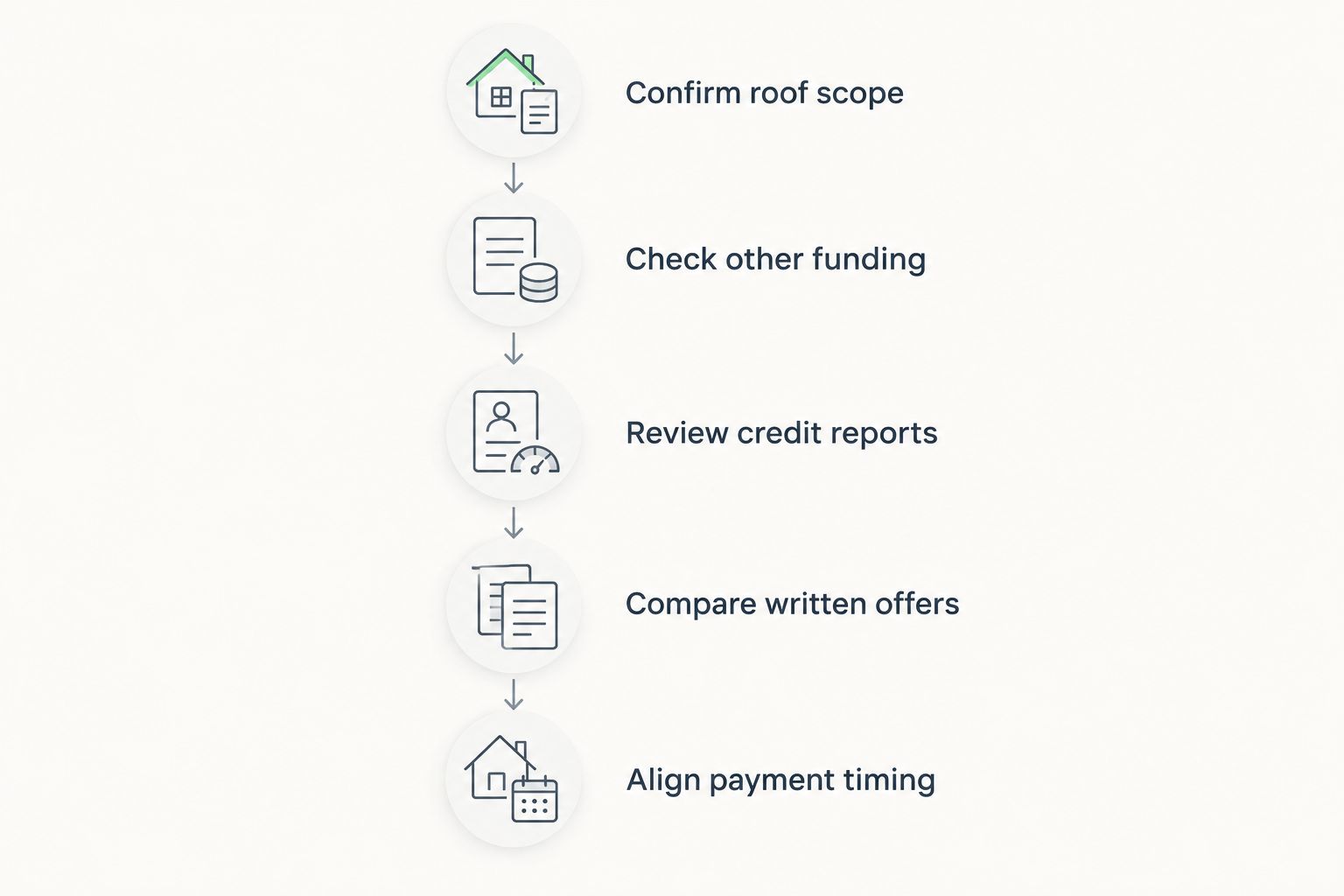
A useful application starts with a documented project, not a guess about what you need to borrow. Follow this sequence so the financing request matches the roof work.
- Confirm roof scope. Obtain a written assessment explaining the condition, proposed work, and whether repair or replacement is recommended. Do not use financing eligibility as evidence that replacement is needed.
- Check other funding. Review applicable insurance coverage and legitimate repair-assistance programs before deciding how much debt to request. Do not subtract an expected payout that has not been confirmed.
- Review credit reports. Check your reports for inaccurate balances, unfamiliar accounts, or incorrect payment information. Follow the credit bureau’s dispute process for errors.
- Compare written offers. Ask about the inquiry type before applying, then compare disclosures for the same financing need. A preliminary offer remains subject to its stated conditions.
- Align payment timing. Check when the contractor expects payment and when the lender releases funds. Resolve gaps before signing agreements that leave you responsible for money you cannot access.
The roof inspection-to-financing approval workflow provides a related process to review. Keep the inspection findings, contractor scope, and financing documents together so changes in one are checked against the others.
What should I compare beyond the monthly payment?
Compare the annual percentage rate, finance charge, amount financed, payment schedule, and total of payments shown in the applicable disclosures. Read fees and collateral provisions separately rather than assuming a single figure explains every obligation.
A longer repayment period can lower the monthly payment while extending the debt and increasing interest paid. That is a trade-off, not an automatic improvement.
Before accepting a 2026 offer, get clear answers to these questions:
- Net proceeds: How much money reaches you or the contractor after any deductions?
- Payment changes: Is the payment fixed, variable, or dependent on a promotional condition?
- Early repayment: Does the agreement impose a prepayment penalty?
- Late payment: What charges and default provisions apply?
- Project changes: How are additional work, cancellations, or disputes handled?
If an agreement offers deferred interest, distinguish it from an interest-free arrangement. Under deferred-interest terms, failing to satisfy the promotion’s conditions can trigger interest accrued during the promotional period; read the specific agreement before relying on the promotion.
Can insurance or repair assistance reduce what I borrow?
Insurance or repair assistance can reduce the financing need only when your claim or application qualifies. Homeowners insurance generally distinguishes covered damage from ordinary wear and maintenance; a worn-out roof is not automatically an insured loss.
If storm damage is involved, document the condition and review your policy’s requirements. An inspection report supports documentation, but it does not guarantee coverage or determine the insurer’s decision.
Repair-assistance programs also have eligibility rules. Check official program information for location, income, property, and permitted-work requirements, and confirm whether assistance is a grant, a loan, or another arrangement. Do not delay necessary damage-control measures while assuming assistance will arrive.
Does prequalification guarantee roof financing approval?
Prequalification does not guarantee final approval. The lender can require verification of income, credit information, identity, or other application details before issuing a final decision.
Ask what remains outstanding and when the terms become binding. Do not authorize project commitments on the assumption that an early eligibility message is a funded loan.
What if every lender declines my application?
A declined application is a reason to reassess the financing plan, not accept an unverified approval promise. Review the lender’s adverse-action notice and address the reasons it identifies where possible.
Then revisit the documented roof scope, legitimate assistance options, and whether a qualified roofing professional recommends an interim repair. Do not postpone urgent safety measures or assume a temporary repair makes replacement unnecessary.
FAQ
Can I get roof replacement financing with bad credit and no equity?
You can apply for unsecured financing without home equity, but approval depends on the lender’s requirements. Review the payment, fees, and total repayment obligation before accepting an offer.
Is contractor financing easier to get than a personal loan?
Contractor financing is not automatically easier to obtain than a personal loan. The financing provider sets the underwriting requirements, and the contractor’s involvement does not guarantee approval.
Will applying for roof financing hurt my credit?
A hard credit inquiry can affect your credit score; a soft inquiry does not. Ask which inquiry applies to prequalification and which applies to the final application.
Do I need a co-signer if I have bad credit?
Bad credit does not automatically mean you need a co-signer. A lender that permits co-signers can consider that person’s qualifications, but the co-signer accepts repayment liability.
Can I use homeowners insurance instead of a roof loan?
Homeowners insurance can pay for qualifying covered damage, subject to the policy and claim decision. It is not a substitute for financing an ordinary maintenance-related replacement.
Should I sign the roofing contract before my loan is approved?
Do not sign an unconditional payment commitment unless you can meet it without the expected loan. If the project depends on financing, get the financing contingency and any cancellation obligations in writing.
What is the safest way to compare bad-credit roof loans in 2026?
Compare written disclosures for the same borrowing need, including repayment terms, fees, and collateral requirements. Reject any offer you cannot understand or afford, even if the application is approved.
One last thing
Check who receives the loan proceeds before you authorize disbursement. Direct payment to a contractor does not remove your repayment obligation or establish that the work is complete. Match any authorization to the financing agreement and the roofing contract’s payment terms.
Related guides
- Roof financing options for homeowners
- Is roof replacement financing worth it?
- Roof inspection-to-contractor bid comparison workflow