
An insurance company’s roof-claim payment timeline depends on the applicable state rules, your policy, and whether the insurer has finished reviewing the damage and required documents; there is no single nationwide payout deadline. The first payment also is not necessarily the final payment: recoverable depreciation, additional approved work, and mortgage-company endorsement can create separate steps before you receive all payable funds.
- How long does it take for an insurance company to pay a roof claim? Policy terms and claim status control.
- Claim approval, payment issuance, and access to funds are separate milestones.
- Replacement-cost coverage can involve an initial payment and later recovery of withheld depreciation, subject to policy conditions.
- Murray Roofing provides roof inspections and insurance-claim support in Lincoln and Omaha; the insurer decides coverage.
Why this matters
A roof claim is not finished just because an adjuster inspected the property. You need to know whether the insurer is still investigating, has approved a payment, or has already sent money that requires another party’s endorsement.
For Lincoln and Omaha owners planning work in 2026, the practical question is which step remains unfinished. The storm-damage-to-paid-claim workflow explains the broader process; this guide focuses on payment and the questions that move your file toward a clear answer.
How long does it take for an insurance company to pay a roof claim?
There is no universal number of days from reporting roof damage to receiving the final insurance payment. A deadline for acknowledging a claim is not necessarily a deadline for completing an investigation, accepting coverage, or releasing funds.
Ask your adjuster which deadline applies to the current stage and what event starts that deadline. For a Nebraska property, check the applicable Nebraska requirements rather than relying on a deadline quoted for another state.
| Claim stage | What happens | What you should confirm |
|---|---|---|
| Claim reporting | You notify the insurer and receive claim instructions | Claim number, assigned contact, and requested documents |
| Damage review | The insurer reviews the cause, extent, and coverage of the loss | Whether an inspection or additional evidence remains outstanding |
| Coverage decision | The insurer communicates what it accepts or denies | Written decision, estimate, and explanation of deductions |
| Payment issuance | The insurer sends an approved payment | Issue date, delivery method, and named payees |
| Further payment | The insurer reviews eligible depreciation recovery or additional work | Required proof, policy deadlines, and remaining review items |
| Funds release | A lender or other named payee completes its requirements | Endorsement instructions and any repair-verification conditions |
A useful 2026 status update identifies the stage, the outstanding requirement, and the responsible party. A statement that the claim is simply being processed does not tell you whether anything is waiting on you.
Initial payment: what does the first check cover?
An initial payment reflects the insurer’s approved settlement calculation at that stage. Review the payment explanation alongside the estimate; the check alone does not show how the insurer handled your deductible, depreciation, or disputed work.
Under a replacement-cost policy, the insurer can issue an initial actual-cash-value payment and hold back recoverable depreciation until policy conditions are met. Under actual-cash-value coverage, depreciation generally remains part of the settlement calculation rather than becoming a later reimbursement.
Do not treat the first check as proof that the full replacement is funded. Ask the adjuster to identify the approved work, deductions, withheld amounts, and any unresolved portion of the claim in writing.
Final payment: what releases the remaining funds?
The requirements for another payment depend on your policy and the reason money remains outstanding. Recoverable depreciation, an approved supplement, and lender-held funds are different issues; submitting the same document does not necessarily resolve all of them.
For a roof replacement planned in 2026, confirm these requirements before signing a construction agreement:
- What proof of completed work does the insurer require?
- What deadline applies to completing repairs or requesting recoverable depreciation?
- Does the insurer need an invoice, photographs, or another inspection?
- Is additional work still under review?
- Does the mortgage company need to endorse or release funds?
Ask for an explanation of each remaining amount. You should be able to distinguish money withheld under policy conditions from work the insurer has not approved.
Why roof-claim payment timing varies
Several separate issues affect the path from claim reporting to usable funds. Identify the actual obstacle instead of assuming every delay comes from the insurer’s payment department.
- Incomplete documentation. Missing photographs, estimates, requested forms, or proof of loss can leave the insurer waiting for information.
- Questions about damage. The insurer must evaluate the cause and extent of the loss, including whether the claimed damage falls within coverage.
- Scope disagreements. A contractor’s estimate and the insurer’s estimate can describe different work. Unresolved differences require review rather than an assumption of approval.
- Depreciation requirements. A replacement-cost claim can require proof that eligible work was completed before withheld depreciation becomes payable.
- Additional damage. Damage discovered during construction can require photographs, an updated estimate, and a supplemental review.
- Other named payees. A mortgage company’s endorsement and release procedures are separate from the insurer issuing its check.
These factors do not excuse an insurer from applicable obligations. They identify what you should ask about when requesting a specific status update.
How do I find out what is delaying my roof payment?
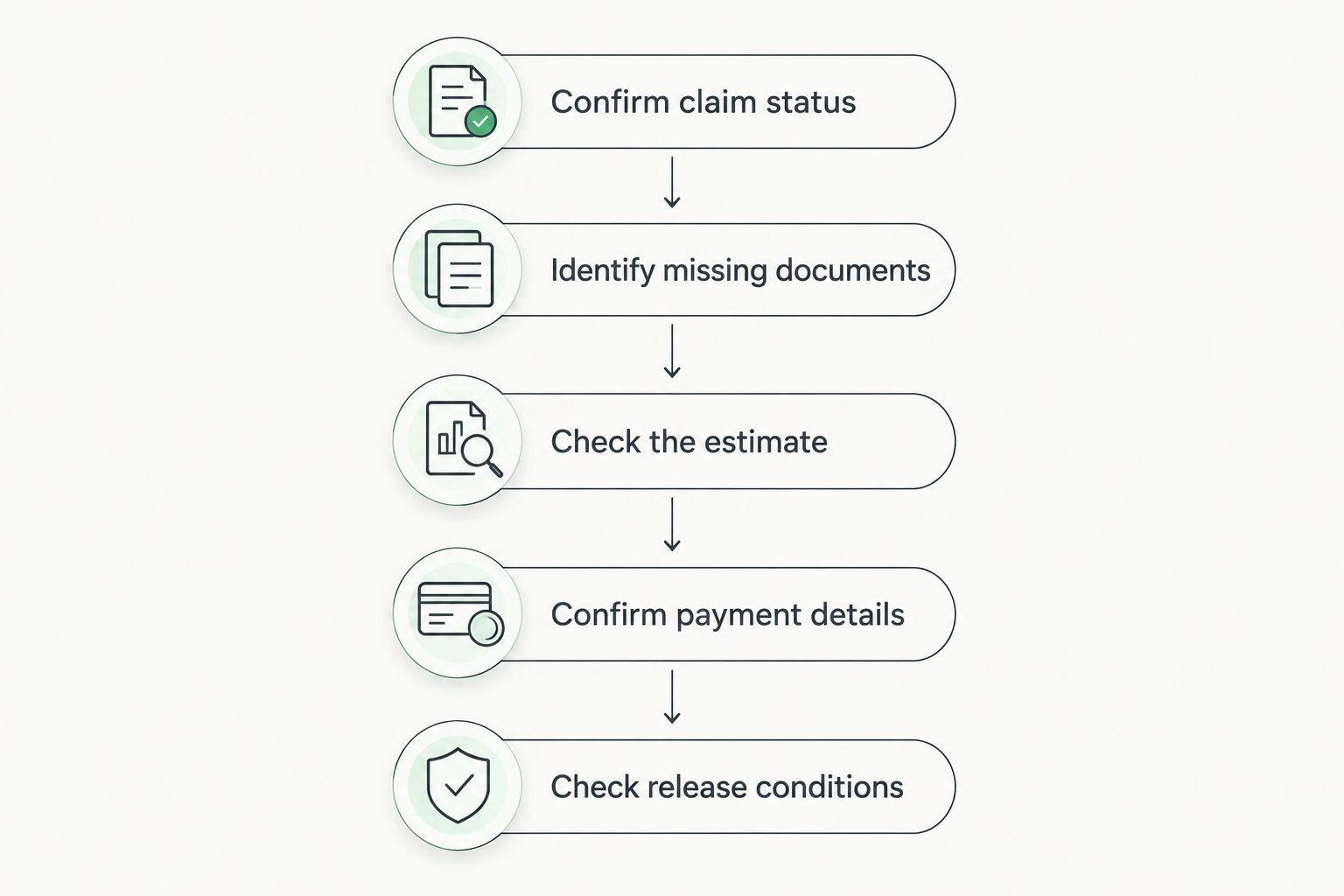
Follow the payment path in order. This separates a coverage issue from a missing-document issue or a check that has already left the insurer.
- Confirm claim status. Ask whether the file is under investigation, approved, partly approved, or denied. Request the written decision if one exists.
- Identify missing documents. Ask for a complete list of outstanding items and who must provide each one. Keep proof of delivery.
- Check the estimate. Compare the insurer’s approved scope with the contractor’s proposed work. Have differences explained before assuming the estimates describe the same repair.
- Confirm payment details. If payment is approved, ask whether it has been issued, how it was sent, and who is named on it.
- Check release conditions. Ask the insurer and lender separately what remains necessary for depreciation recovery, endorsement, or release of funds.
Keep one claim file containing the policy, estimates, photographs, correspondence, payment explanations, and invoices. After a phone conversation, send a short written summary and ask the recipient to correct anything inaccurate.
What should Lincoln and Omaha owners ask the adjuster?
For a Nebraska roof claim in 2026, request a written status that answers concrete questions. You need an explanation tied to your file, not a general estimate based on somebody else’s storm claim.
Use this checklist when contacting the adjuster:
- Has the insurer made a coverage decision?
- Which documents remain outstanding, and when were they requested?
- Which policy provision or applicable requirement governs the next step?
- If payment is approved, has it actually been issued?
- What remains unresolved, and who is responsible for responding?
If you cannot resolve a delay through the adjuster, ask for a supervisor and the insurer’s complaint process. Nebraska policyholders can also contact the Nebraska Department of Insurance for information about consumer complaints; a complaint does not guarantee coverage or payment.
Can my mortgage company delay access to the insurance check?
A mortgage company named on the check can require endorsement and repair-related documentation before releasing funds. The insurer issuing payment and your lender making those funds accessible are separate events.
Contact the lender’s insurance-loss department before depositing or endorsing a jointly payable check. Ask for its document checklist, inspection requirements, and disbursement procedure, then share relevant payment conditions with your contractor.
Do not promise a contractor that funds are available merely because the insurer has issued a check. Confirm the lender’s process and the construction contract’s payment schedule first.
Can I start roof repairs before the insurance claim is paid?
You do not have to confuse protecting the property with authorizing a full replacement. Report active leaking promptly, document conditions safely, and ask the insurer how to record necessary temporary protection and related expenses.
Before permanent work starts, understand the contract, the approved insurance scope, and your responsibility for unpaid amounts. A roofing contract does not obligate the insurer to cover every item the contractor recommends.
Stay off a damaged roof. Use photographs taken safely from the ground or inside the building, and have a roofing professional assess unsafe conditions rather than trying to preserve evidence yourself at height.
What if the contractor and insurer disagree about replacement?
A disagreement about repair versus replacement is a scope issue, not simply a late-payment issue. Ask the contractor to identify the specific work missing from the insurer’s estimate and provide supporting documentation for review.
A supplement is a request for additional consideration, not a promise of additional coverage. Keep disputed items separate from approved work so you can understand the construction commitment you are making.
If you disagree with a coverage decision, request the policy basis and available review procedures in writing. For legal disputes, seek advice from a qualified attorney rather than relying on a contractor to interpret your rights.
What should commercial property owners do differently?
For a Lincoln or Omaha commercial property in 2026, keep roof-repair documentation separate from records concerning damaged contents, tenant effects, or business interruption. Different coverage questions and documentation requirements can apply to each part of the loss.
Assign a single claim contact who can coordinate the insurer, roofing contractor, building ownership, and lender. Record access restrictions and safety concerns so inspections and approved work can be coordinated without confusing operational decisions with coverage decisions.
This approach applies across commercial property types. A contractor documents roofing conditions and proposed work; the insurer evaluates coverage under the commercial policy.
Where roofing support helps—and where it stops
Murray Roofing is best for Lincoln and Omaha owners who need roof inspections and insurance-claim support. Murray Roofing provides residential and commercial roofing services, including free inspections, repair, replacement, and financing.
That support helps you understand the roof work under discussion. It does not replace the insurer’s coverage decision, lender approval, or legal advice, and it does not guarantee payment timing.
If you consider financing while a claim remains open, evaluate repayment obligations independently of the expected insurance proceeds. An anticipated settlement is not the same as money already available to pay the construction bill.
FAQ
How long does it take for an insurance company to pay a roof claim?
Roof-claim payment timing depends on applicable state requirements, policy terms, and the status of the investigation and documentation. Ask which deadline governs the current stage and what remains outstanding.
Does an approved roof claim mean my check has been sent?
An approved roof claim does not by itself confirm that payment has been issued. Ask for the issue date, delivery method, and named payees.
Why is my roof insurance check less than the contractor’s estimate?
Differences can reflect the deductible, depreciation, coverage limitations, or disagreement about the work required. Compare the payment explanation and approved scope with the contractor’s estimate before treating the difference as an error.
Will insurance pay the rest after my roof is replaced?
Further payment depends on your coverage and whether you satisfy the applicable conditions. Ask what documentation and deadlines apply to recoverable depreciation or any supplemental request.
Can my roofer guarantee that insurance will pay for replacement?
A roofer cannot guarantee an insurer’s coverage decision. A contractor can document roof conditions and proposed work, but the insurer evaluates the claim under the policy.
What should I do if my Nebraska roof claim seems stalled?
Request a written status identifying the unresolved issue, missing documents, and next required action. Escalate through the insurer’s complaint process and contact the Nebraska Department of Insurance for consumer-complaint information if needed.
One last thing
Ask for the next required action, not just the next payment date. If the insurer is waiting for an invoice, the lender is waiting for an endorsement, or an estimate remains disputed, a calendar estimate alone will not resolve the obstacle.
Before committing to a 2026 roof replacement, match the construction payment schedule to confirmed funds and clearly understood obligations. Keep the insurance decision separate from your agreement with the contractor.
Related guides
- Can you file an insurance claim for an old roof?
- Moving a roof replacement through mortgage escrow
- Roof repair or full replacement: making the decision
Need a documented starting point for your Lincoln or Omaha roof? Contact Murray Roofing to schedule a free inspection or request a price for the proposed work.