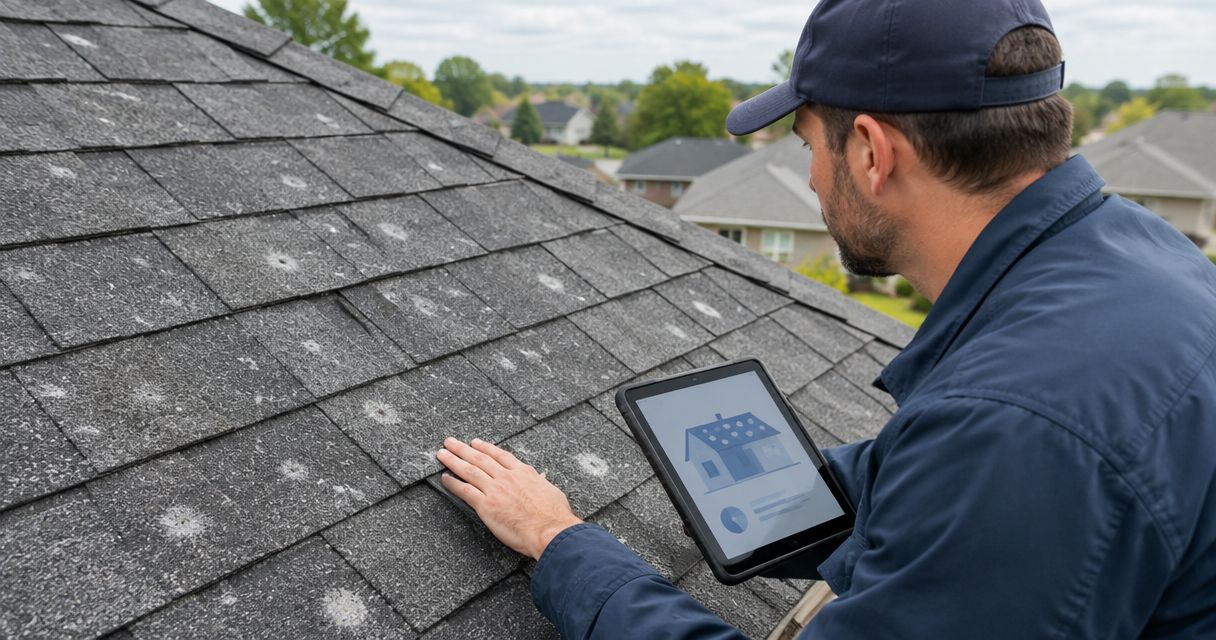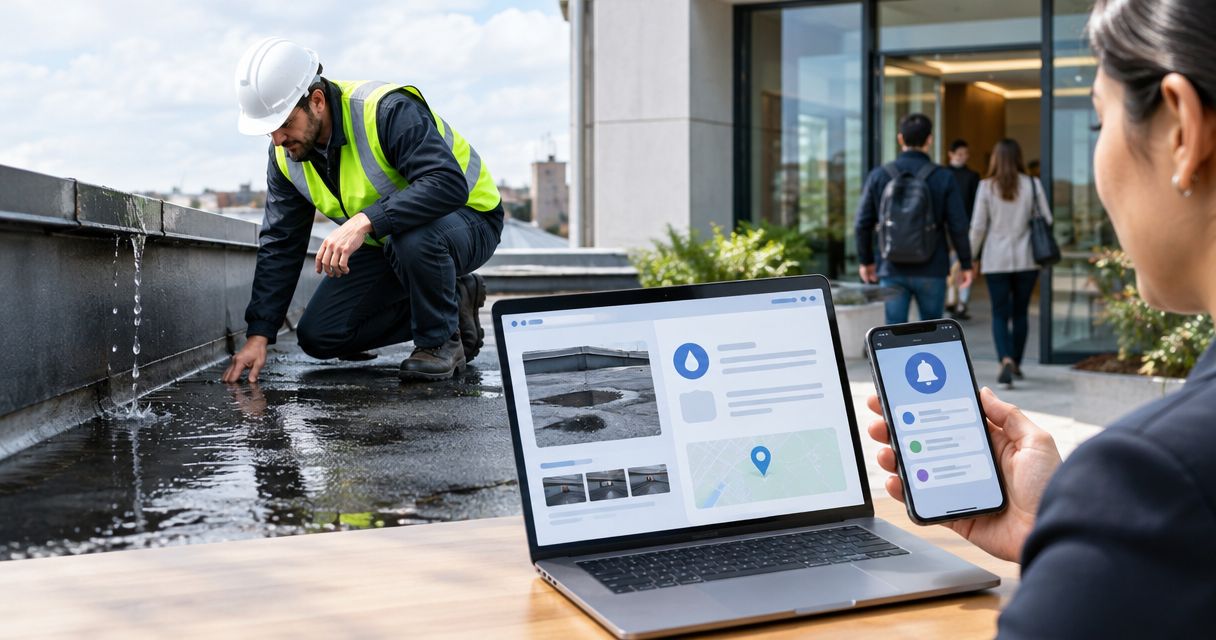
Instead of chasing a commercial roof leak through calls, texts, and separate tenant emails, use one incident record to assign the response, request an inspection, and issue confirmed updates. This 2026 commercial roof leak tenant notification workflow keeps safety decisions, contractor findings, and tenant communication connected without promising a repair date before the roof is assessed.
- Use this commercial roof leak tenant notification workflow to connect incident reporting, contractor dispatch, and tenant updates.
- Murray Roofing provides commercial roofing inspections and repairs for Lincoln and Omaha property decision-makers.
- Notify affected tenants about confirmed conditions and restrictions before waiting for a complete roof diagnosis.
- Keep repair completion, interior recovery, and tenant notification as separate checkpoints.
Why this matters
A roof leak creates separate responsibilities: protect occupants, investigate the building problem, and explain operational changes. A contractor appointment does not complete the tenant communication task. Likewise, a tenant email does not establish that an affected area is safe.
Murray Roofing is best for Lincoln and Omaha property decision-makers who need commercial roofing inspection, repair, or replacement services. Property management should retain responsibility for tenant notices and access decisions while coordinating with qualified contractors. Start with the relevant roofing services, then keep the contractor's findings attached to the incident record.
For your 2026 response plan, make every handoff answer the same questions: what is confirmed, who owns the next action, and when will the next update arrive? Do not substitute an unconfirmed repair promise for an update commitment.
Before you start
- Access and authority: Have access to your maintenance log or ticket system, current tenant contacts, building emergency procedures, and the person authorized to approve contractor work. Identify 2 contacts for escalation: the incident owner and a backup.
- Building information: Gather the property address, suite identifiers, roof-access instructions, available roof records, and photographs taken from safe locations. Keep roof access restricted to authorized personnel; this workflow does not include DIY roof repairs.
- The overlooked dependency: Confirm which contact method your leases and emergency procedures require. An automated maintenance email is not a substitute for a required notice, and a report marked submitted does not prove anyone received it.
Incident record
Use the following as proposed fields for your own form, not as instructions for a particular software interface. Your platform's actual button names and settings will differ.
- Create the record. Open 1 incident record for the reported event. Label the fields Property, Affected area, Reported at, Reporter, Observed conditions, Incident owner, and Next update. Record the time zone if managers or vendors work across locations.
- Separate observations from diagnosis. Record water dripping above a reception desk as an observation. Do not label it a failed roof seam until a qualified contractor confirms the source. Water can travel before appearing indoors.
- Attach safe evidence. Add interior photographs, the reporter's description, and an annotated floor plan if available. Do not ask a tenant or employee to climb onto the roof or enter a hazardous area to improve the report.
- Assign ownership. Name one person responsible for coordinating the incident and tenant updates. Record the backup separately so after-hours reports do not depend on an unattended inbox.
Expected result: Another manager can open the record and identify the affected location, known conditions, responsible person, and next communication commitment without searching a text thread.
Choose the record format
Both approaches below can support the workflow. The choice depends on access and coordination needs, not on a particular software brand.
| Record format | Best for | Advantage | Limitation |
|---|---|---|---|
| Shared incident log | A team coordinating a straightforward incident | Keeps observations and decisions together without a new system | Requires deliberate ownership and reminders |
| Maintenance ticket | Teams already managing assigned building work | Connects tasks, attachments, and status changes | Notifications need configuration and testing |
Use the system your response team can actually access. A detailed ticket that the on-call manager cannot open is a poor emergency record.
Safety response
Do not wait for a complete roof diagnosis before addressing an apparent hazard. Follow the property's emergency procedures, and contact emergency services when conditions require them.
- Restrict access. Keep occupants away from sagging ceilings, falling material, slippery areas, and water near electrical equipment. Do not touch wet electrical equipment or direct unqualified staff to investigate it.
- Assign qualified help. Contact the appropriate roofing contractor and, when conditions involve other building systems, the qualified trade responsible for those systems. A roof inspection does not replace electrical assessment or interior recovery work.
- Record restrictions. Add affected entrances, rooms, walkways, or operating areas to the incident record. Describe the restriction precisely enough that tenant-facing staff can explain it consistently.
- Issue the initial notice. Tell affected tenants what has been observed, which areas to avoid, how to report additional water, and when management will update them. State that the source is under investigation when it has not been confirmed.
Expected result: The record shows the immediate protective actions, the parties contacted, and the initial tenant communication. It does not imply that dispatch alone resolves the hazard.
Initial notice content
Build your 2026 initial-notice template around these fields:
- Location: Identify the affected suite, common area, or building section.
- Confirmed condition: Describe the reported water intrusion without assigning an unverified cause.
- Current instructions: Explain access restrictions and the approved reporting channel.
- Response status: Distinguish inspection requested from appointment confirmed.
- Next update: Give a communication time your team can meet, even if the next message only confirms that assessment continues.
Avoid broad statements that the building is safe or that all operations can continue. Communicate only the area-specific direction supported by the responsible professionals and property procedures.
Contractor dispatch
The contractor needs location evidence and access arrangements, not a tenant mailing list. Keep operational details available while limiting unnecessary personal information.
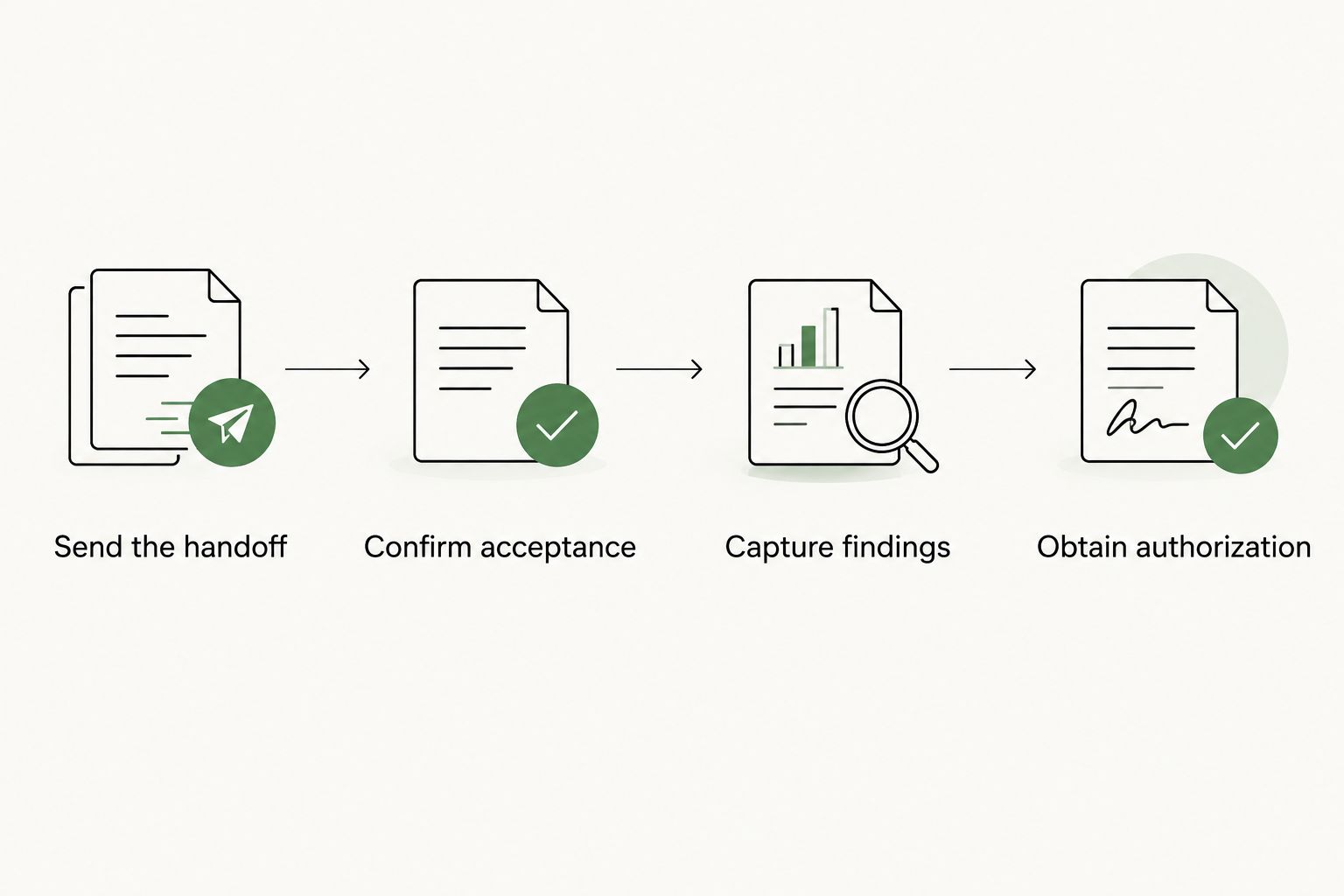
- Send the handoff. Give the roofing contractor the address, affected interior locations, observed conditions, photographs, site contact, access restrictions, and available roof information. Include any known rooftop equipment or access coordination requirements.
- Confirm acceptance. Record whether the contractor received the request, accepted the assignment, and confirmed an appointment. Keep these as distinct checkpoints. A message left after hours is not a confirmed visit.
- Capture findings. Attach the inspection findings and proposed scope. Separate any temporary protective measure from a permanent repair recommendation, and record what remains unresolved.
- Obtain authorization. Route the proposed work to the person with approval authority. Document approval separately from any insurer communication; neither a reported loss nor an inspection guarantees coverage.
Expected result: Management can distinguish requested work, accepted work, authorized work, and completed work. Tenants receive updates based on those confirmed stages.
Request supporting documentation from Murray Roofing for the commercial roofing work under discussion. Keep the property manager's tenant notices separate from the contractor's technical findings so neither document appears to certify something outside its scope.
Keep dispatch separate from diagnosis
In a multi-tenant property, fault reporting and trade dispatch should connect the observed condition to an accountable responder without turning an occupant's description into a confirmed diagnosis. For example, route a ceiling-water report for assessment, but do not describe the roof as repaired merely because a contractor accepted the assignment.
Use that same distinction in internal alerts. Send the access contact the appointment details, send the approver the scope, and send tenants only the operational information relevant to them. This keeps a contractor scheduling change from becoming an inaccurate building-wide announcement.
Tenant updates and closure
Plan 3 notices as communication checkpoints: initial report, meaningful status change, and closure. These are workflow recommendations, not a legal notice schedule; add updates whenever conditions, restrictions, or required procedures call for them.
- Prepare the status update. State what has changed since the previous notice. Describe confirmed inspection findings in plain language, identify current restrictions, and distinguish proposed work from authorized work.
- Review the message. Have the incident owner check the affected audience, access instructions, confirmed timing, and next update. Do not publish tenant names, insurance assumptions, or internal approval discussions to a general distribution list.
- Record delivery. Save the message and recipient group with its sending time. Follow up on failed delivery through an approved alternative channel. Use direct contact for urgent operational instructions rather than assuming an email was read.
- Close separate tasks. Record roof-work completion, any remaining interior assessment or recovery, access decisions, and final tenant communication individually. Close the overall incident only after the responsible parties confirm the required tasks are complete.
Expected result: The final notice explains what was completed, identifies anything still open, and tells tenants how to report recurrence. It does not treat a stopped drip as proof that every consequence has been resolved.
For Lincoln and Omaha properties, record the building's actual access arrangements, weather-related scheduling changes, and tenant operating hours. Do not copy another property's reopening decision or assume identical work can proceed under different site conditions.
Variant: update tenants when the incident changes
Use an event-driven version of the workflow when your maintenance system supports status notifications. Keep human review between an internal status change and a tenant-facing message.
Set the proposed internal stages to Reported, Assessment scheduled, Work authorized, Work completed, and Closed. Define what evidence allows each transition. Then create a communication task when a stage changes rather than automatically emailing every technical note.
Best for: properties with several managers or repeated tenant updates. The benefit is a repeatable handoff; the limitation is that poorly defined stages can distribute inaccurate information faster. Test the workflow with an internal recipient before adding tenant contacts.
For your 2026 setup, test a failed delivery, an after-hours report, and a reopened incident. Confirm that the backup receives the escalation and that reopening creates a new communication task instead of silently changing the old record.
Troubleshooting
- The ticket exists, but nobody accepted responsibility. Assign the incident owner and backup explicitly. Escalate unanswered requests through the property's established contact procedure instead of repeatedly sending the same email.
- Tenants keep reporting the same leak separately. Preserve each report's location and time, then link related reports to the main incident. Do not discard a new report without checking whether the affected area has expanded.
- The appointment changed after a notice went out. Correct the schedule in the incident record and notify the affected audience. Separate the next management update from the contractor's unconfirmed arrival time.
- The drip stopped, so the incident was closed. Reopen the assessment and completion tasks. A stopped drip does not establish that the source was corrected or that wet interior materials need no further attention.
- A tenant asks whether insurance will cover the loss. Record the question and direct coverage decisions to the relevant insurer or policy representative. Share documented observations without promising reimbursement.
Customize your workflow
Add property-specific responsibilities without changing the core sequence. A warehouse needs coordination around stored goods and loading access; an office needs clear suite and common-area instructions. Other commercial properties should define their own operational restrictions with the responsible site personnel.
When inspection findings point toward replacement rather than a limited repair, create a separate capital-work decision. Keep immediate incident communication active while the larger scope moves through the commercial roof inspection to budget approval workflow.
Murray Roofing provides commercial roofing repair, replacement, inspections, and financing. Keep financing review separate from urgent safety decisions and tenant communication. Confirm the proposed scope and applicable terms directly rather than treating financing as approval to proceed.
FAQ
What is a commercial roof leak tenant notification workflow?
A commercial roof leak tenant notification workflow connects the incident report, immediate protective actions, contractor assessment, tenant updates, and closure. One accountable manager keeps those tasks connected while qualified professionals assess the building conditions.
Should I notify tenants before the roofing contractor arrives?
Notify affected tenants about confirmed conditions and necessary restrictions without waiting for a complete roof diagnosis. Explain that assessment is pending when the source has not been confirmed, and follow your lease requirements and emergency procedures.
What should the first commercial roof leak notice include?
Include the affected location, observed condition, current instructions, response status, and next management update. Do not state an unconfirmed cause, repair completion time, or insurance outcome.
Can tenant notifications go out automatically?
Use automation to create communication tasks, but require review before sending tenant-facing updates. Internal maintenance stages do not automatically establish that an area is safe or that all recovery work is complete.
Does a completed roof repair mean the incident can close?
A completed roof repair alone does not complete the incident workflow. Confirm any remaining interior assessment, recovery tasks, access decisions, and final tenant communication before closing the record.
Who should handle a commercial roof leak in Lincoln or Omaha?
A qualified commercial roofing contractor should assess the suspected roof problem, while property management coordinates tenant communication and building access. Murray Roofing provides commercial roof inspections, repairs, and replacement services in Lincoln and Omaha.
Related guides
One last thing
A closure message needs an owner just as much as the initial emergency call does. Add that responsibility to your 2026 incident form before the next leak, and keep recurrence reporting open after work is complete.
Schedule an inspection with Murray Roofing to assess the commercial roof, discuss the repair or replacement scope, and get a project quote.
Schedule a commercial roof inspection
Discuss the reported leak, inspection needs, and proposed roofing work.