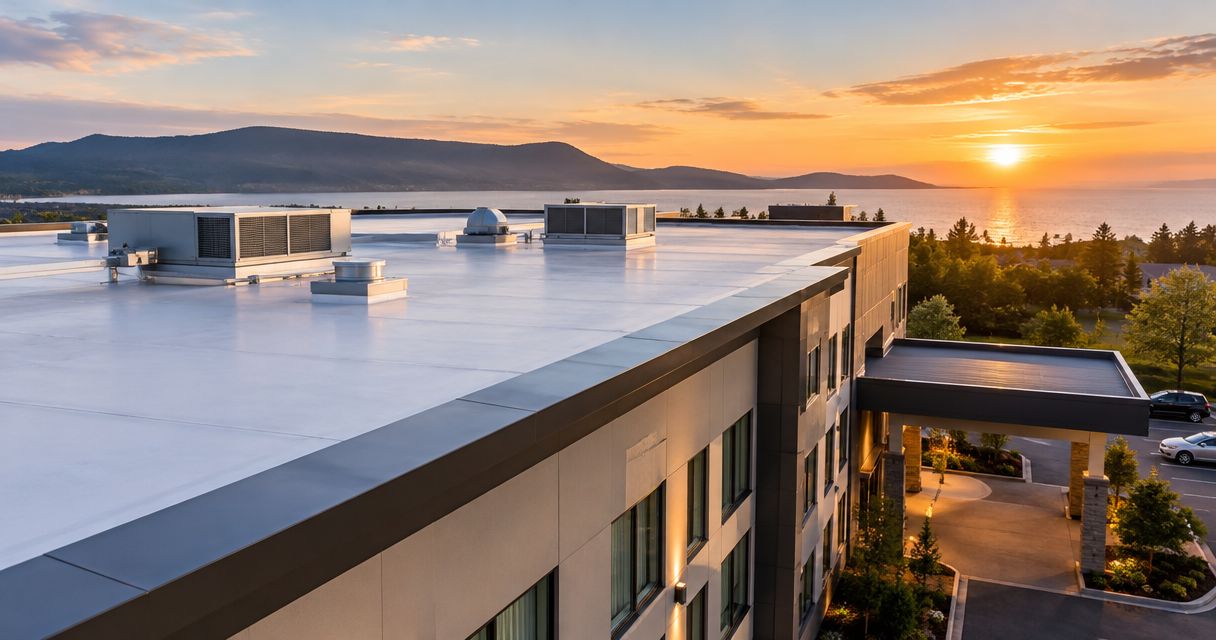
Choose a roofing contractor in Lincoln or Omaha by the written inspection findings, replacement scope, warranty terms, and payment agreement—not the company name alone. For a 2026 roof project, Murray Roofing provides residential and commercial inspections, repair, replacement, and financing so you can start with the condition of your building rather than a guess.
- Murray Roofing serves Lincoln and Omaha homeowners and commercial property owners needing inspections, repairs, replacements, and financing.
- Choose a roofing contractor by documented findings and a written scope, not a verbal promise.
- Compare repair and replacement recommendations against the same roof conditions and project requirements.
- Request warranty documents and financing terms before signing a roofing contract.
Why this matters: the contract defines what you are buying
A roofing estimate means little without a clear description of the work. Different proposals can address different problems, use different materials, or leave important responsibilities unresolved.
For your 2026 project, start with an inspection and ask the contractor to connect each recommendation to a documented condition. Review the available roofing services before requesting an estimate so your conversation covers repair, replacement, and ongoing maintenance where relevant.
The best proposal explains what the contractor found, what the work will address, and what remains outside the agreement. That standard works for a house in Lincoln, an office in Omaha, or a commercial property with tenants and operating hours to protect.
Choose an inspection-led recommendation over a sales-led recommendation
Ask for findings you can understand without climbing onto the roof. Photos, written observations, and an explanation of the affected areas give you a useful basis for discussing the work.
A leak location inside the building does not, by itself, establish the full repair scope. The contractor should explain the suspected entry point, the evidence supporting that conclusion, and whether additional investigation is needed.
Before accepting a recommendation, ask:
- What conditions were visible during the inspection?
- Which roof areas need attention, and why?
- What could not be assessed without opening the roof assembly?
- Does the proposal address the source of water entry or only visible damage?
- What findings support repair rather than replacement, or replacement rather than repair?
An inspection is not permission to promise that every hidden condition has been found. A useful report separates observed conditions from items that require further investigation.
Repair and replacement solve different problems
Choose repair when a professional assessment supports a limited scope; choose replacement when the assessment supports broader renewal. Neither option wins simply because it requires less work or replaces more material.
For Lincoln and Omaha properties, ask how the recommendation accounts for the existing roof assembly, drainage, previous repairs, and the condition of surrounding components. Age belongs in the discussion, but age alone does not describe the roof's current condition.
| Decision factor | Roof repair | Roof replacement |
|---|---|---|
| Best for | A defined problem with a supportable repair scope | Conditions that justify renewing the roof assembly |
| Main benefit | Addresses a specific defect without replacing the entire roof | Allows a broader scope to address roof-system conditions |
| Main limitation | Leaves the rest of the existing roof in place | Requires a larger construction scope and more coordination |
| Inspection question | Can the affected area be repaired effectively? | What findings justify replacing rather than repairing? |
| Contract priority | Define the repair boundaries and exclusions | Define removal, new materials, details, and closeout |
| Warranty question | What work and materials does the repair warranty cover? | Which manufacturer and contractor warranties apply? |
A repair proposal should not imply that untouched areas become new. A replacement proposal should not imply that every building-envelope problem disappears when the roofing work is complete.
A detailed replacement scope beats a short material list
A full roof replacement proposal should explain the assembly and the installation responsibilities, not just name a roofing material. In your 2026 contract, request enough detail to understand what will be removed, retained, installed, and inspected.
For a residential project, ask about the roof deck, underlayment, flashing, ventilation, roof penetrations, and cleanup. For a commercial project, also ask about drainage, rooftop equipment, access, and transitions between roof areas.
Your written scope should address:
- Removal: What existing materials will be removed or retained?
- Deck condition: How will concealed damage be documented and authorized?
- Roof details: What happens at edges, walls, penetrations, and drainage points?
- Site protection: How will access routes and surrounding property be protected?
- Changes: Who approves additional work, and how is it documented?
- Closeout: What inspection records and warranty documents will you receive?
Do not assume an item is included because it is common on another project. Ask the contractor to identify it in the agreement.
Warranty terms matter more than the longest headline
Murray Roofing lists GAF Master Elite status, a 50-year Golden Pledge warranty, and a 10-year labor warranty among its trust signals. Request the documents that apply to your proposed roof rather than treating those names and durations as a substitute for coverage details.
A manufacturer warranty and a contractor labor warranty are not interchangeable. Ask which party handles a claim, what conditions are covered, what exclusions apply, and whether registration or maintenance requirements affect coverage.
Before signing, confirm:
- The exact warranty offered for your proposed installation.
- Whether the selected materials and scope qualify.
- Who completes any required registration.
- What documentation you must keep.
- Whether transfer provisions matter if you sell the property.
A longer warranty term is not proof of broader coverage. Read the coverage language alongside the proposal, and have the contractor resolve any mismatch before work begins.
Commercial projects need an operating plan as well as a roof plan
Commercial roofing decisions affect more than the roof surface. A restaurant, school, warehouse, office, retail property, church, or multifamily building needs a scope that accounts for how people use the property.
Give the contractor your operating constraints early. Explain delivery access, tenant entrances, occupied areas, rooftop equipment responsibilities, and any activities that cannot be interrupted without advance coordination.
Ask the proposal to identify:
- Who coordinates access and communicates with building occupants.
- How material staging affects parking, loading, and pedestrian routes.
- Whether other trades must disconnect, move, or reconnect equipment.
- How the contractor will communicate weather-related changes.
- Who receives progress updates and approves scope changes.
Murray Roofing provides commercial roofing services in Lincoln and Omaha. Request a building-specific plan; a proposal for one property type should not be copied unchanged to another.
The practical test is simple: can your property team explain how the work will proceed without guessing who is responsible for each task?
Financing should support the scope, not decide it
Financing changes how you pay for roofing work; it does not establish which work your roof needs. Keep the condition assessment and the payment decision separate when evaluating a 2026 project.
Murray Roofing offers financing. Ask for the current application process, eligibility requirements, repayment terms, and lender disclosures before making a commitment. An application is not an approval, and an advertised payment arrangement is not your individual agreement.
Evaluate these items together:
- The written roofing scope.
- The payment schedule under the construction contract.
- The financing agreement and its repayment obligations.
- The process for handling approved changes to the work.
A monthly payment alone does not explain the financing agreement. Review interest, fees, repayment duration, and any conditions that change the amount you owe.
For a commercial property, confirm who has authority to sign both agreements. Keep ownership, management, and accounting contacts aligned before authorizing the project.
Insurance support is not a coverage guarantee
A roofing contractor can help document roof conditions and explain proposed construction work. The insurer determines coverage under the policy and claim circumstances.
If you are considering a claim, retain inspection photos, correspondence, estimates, and the insurer's written decisions. Ask the contractor to distinguish observed damage from conclusions about what your policy will pay.
Before authorizing insurance-related work, clarify:
- Which work you are approving now.
- Which amounts remain your responsibility.
- What happens if the insurer's scope differs from the contractor's scope.
- How additional findings will be documented.
- Whether temporary work and permanent work require separate authorization.
Do not treat a contractor's confidence as a claim decision. You need a clear construction agreement even when insurance is involved.
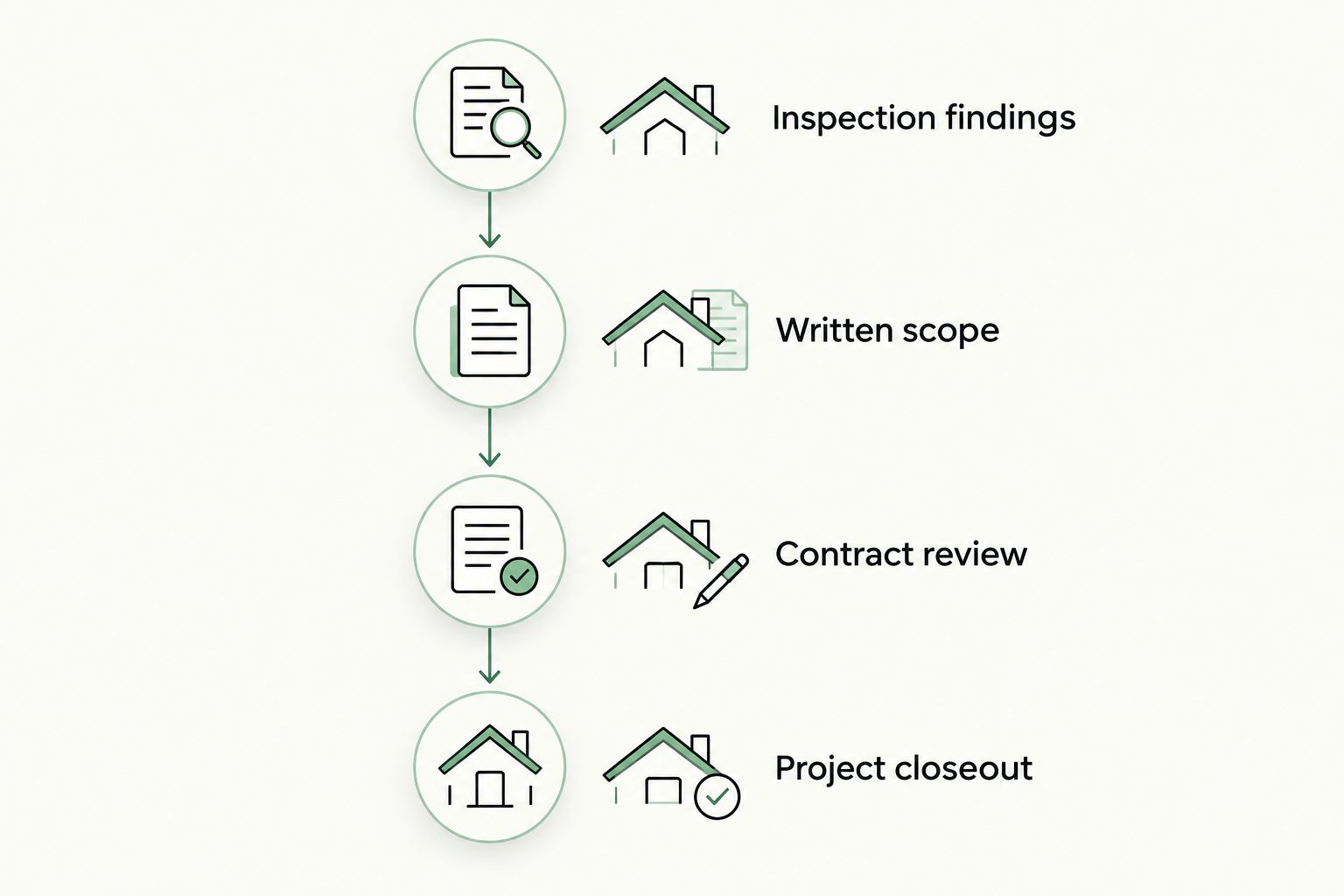
Use a documented path from inspection to closeout
A good hiring process keeps decisions in order. Start with evidence, agree on the work, resolve payment and warranty questions, then authorize construction.
Inspection findings
Request photos and a plain-language explanation of the roof conditions. Identify unresolved questions before comparing proposals.
Written scope
Make sure the proposal describes the selected work, exclusions, materials, and responsibilities. Ask for revisions when a conversation changes the agreement.
Contract review
Review payment terms, change authorization, warranty documents, and site requirements. Keep copies of the signed agreement and any financing documents.
Project closeout
Request the agreed completion records, warranty information, and maintenance guidance. Confirm whom to contact if a concern develops after the job.
Keep project communication in a shared record if multiple people make decisions. A homeowner, property manager, and building owner should not be working from different versions of the scope.
Check credentials without letting them replace due diligence
An A+ BBB rating, 5-star reviews, and manufacturer credentials provide useful background. They do not define the work included in your individual contract.
When reviewing any roofing contractor in 2026, confirm current insurance documentation, relevant credentials, and who will supervise the project. Ask how questions, changes, and post-installation concerns are handled.
Read reviews for descriptions of communication and problem resolution, not just the rating. Then bring those same subjects into your own contract discussion.
Select the contractor whose written proposal addresses your building's needs and makes responsibilities clear. Credentials support that decision; they do not replace it.
FAQ
How do I choose a roofer in Lincoln or Omaha?
Choose a roofer by documented inspection findings, a clear written scope, current credentials, and understandable warranty terms. Ask how the contractor handles additional findings, payment, site protection, and project closeout before signing.
Is roof repair better than a full replacement?
Repair is the better choice when an inspection supports a defined repair scope; replacement is the better choice when the findings justify broader renewal. Ask the contractor to explain the evidence for the recommendation rather than relying on roof age alone.
Does Murray Roofing offer free inspections?
Murray Roofing offers free inspections. Use the inspection discussion to ask about observed damage, repair and replacement options, and the next steps for a written proposal.
What should a roof replacement estimate include?
A roof replacement estimate should identify the work, materials, exclusions, payment terms, and responsibilities. Ask how the contractor will handle concealed damage, scope changes, cleanup, and warranty documentation.
Does a long roof warranty cover every problem?
A long roof warranty does not mean every problem is covered. Read the applicable documents for coverage, exclusions, registration requirements, maintenance obligations, and claim procedures.
Can a roofer guarantee my insurance claim will be approved?
A roofer cannot guarantee insurance coverage or claim approval. The contractor can document conditions and describe the proposed work, while the insurer evaluates coverage under your policy.
Can I finance a residential or commercial roofing project?
Ask about financing for your specific project and applicant circumstances. Review eligibility, repayment terms, fees, and lender disclosures separately from the roofing contract before committing.
One last thing: compare exclusions before comparing totals
The most useful line in a roofing proposal is sometimes the item it excludes. A proposal that leaves decking, flashing, equipment coordination, or cleanup unclear is not ready for a straightforward comparison.
Before signing your 2026 agreement, ask the contractor to walk through every exclusion and explain who handles it. Resolve those responsibilities in writing rather than after the roof is opened.
Related guides
- Repairing a roof versus replacing it completely
- Roof warranty types for homeowners
- Commercial roof financing
- From roof inspection to signed contract
Schedule a free inspection with Murray Roofing to discuss your Lincoln or Omaha property and get a written proposal for the recommended work.
Schedule your roof inspection
Discuss repair or replacement for your Lincoln or Omaha home or commercial property.