
Instead of manually reconciling different roof proposals, use a roof inspection contractor bid comparison worksheet that connects each documented finding to the same requested work. This 2026 workflow turns an inspection report into a shared scope, comparable proposals, and a written contractor decision without treating an estimate as a diagnosis.
- Murray Inspection Services’ roof inspection contractor bid comparison workflow suits homeowners who need scope agreement before contractor selection.
- Give every bidder the same inspection report, photographs, scope worksheet, and clarification deadline.
- Separate required work, optional upgrades, exclusions, and concealed-condition allowances before comparing proposals.
- When inspection findings change, update every bidder rather than comparing proposals based on different evidence.
Why this matters
A roof inspection documents conditions within its stated scope and access limits. A contractor proposal describes offered work and contract terms. Those documents serve different purposes; matching them requires more than placing proposal totals beside each other.
Compare the work before you compare the contractor. A proposal that excludes flashing, disposal, or concealed decking work is not equivalent to one that addresses those items explicitly.
For homeowners comparing documented roof findings, Murray Inspection Services’ roof inspection workflow is best for building a shared scope before choosing a contractor. Use this guide alongside your actual report, not as a substitute for property-specific findings.
Start with Murray Inspection Services as the brand reference for this workflow. Keep the inspector’s observations separate from each contractor’s proposed remedy throughout the comparison.
Before you start
- Collect the source materials: the complete inspection report, labeled photographs, property address, accessible roof measurements if documented, and any written repair recommendations. Preserve the report’s access limitations.
- Prepare the workspace: use a spreadsheet, a shared document folder, and an email account. Create 2 worksheet tabs named Scope Register and Bid Comparison; these are labels you create, not software-specific buttons.
- Resolve the hidden-work problem: an inspection does not establish the condition of every concealed component. Require bidders to explain how they will document, authorize, and handle additional work discovered after removal.
For a 2026 project, record dates on the report, scope revision, proposals, and clarifications. A newer proposal is not automatically comparable if it refers to an older scope.
Inspection evidence register
Connect findings to requested work
- Identify the source. In Scope Register, create fields named Finding ID, Report Reference, Location, Observed Condition, Requested Response, and Open Question. Use the report’s page references and photo labels rather than rewriting observations from memory.
- Separate observation from remedy. Put the inspector’s documented condition in Observed Condition. Put the work you want bidders to address in Requested Response, clearly identifying anything that still requires professional clarification.
- Mark unresolved evidence. Record inaccessible areas, missing photographs, uncertain leak origins, and recommendations for further evaluation in Open Question. Do not convert uncertainty into a confirmed defect.
- Assign a stable identifier. Give each finding a unique label. Keep that label unchanged when a contractor replies so the response remains traceable to the original observation.
- Check the handoff. Confirm that every requested item points to evidence or an explicitly stated owner requirement. Remove unsupported assumptions about damage cause, code compliance, or insurance coverage.
Expected result: each requested work item has a traceable source, and unresolved questions remain visible instead of disappearing inside a general replacement request.
A stain below a roof penetration, for example, documents a symptom. It does not by itself establish which component caused the water entry. Ask bidders to explain the proposed investigation and repair rather than directing an unsupported fix.
Shared bid packet
Establish the common scope
- Create the scope document. Add fields named Required Work, Optional Work, Exclusions, Concealed Conditions, and Scope Revision. Identify repair and replacement alternatives separately when both remain under consideration.
- Specify the requested response. Ask contractors to identify proposed materials, removal work, underlayment, flashing, ventilation-related work, decking treatment, disposal, property protection, permits where applicable, and cleanup. Ask for explanations where an item does not apply.
- Separate preferences from findings. An owner-requested appearance change belongs under Optional Work, not under inspection-required repairs. Keep upgrades from changing the baseline silently.
- Define unknown-work handling. Require a written description of the authorization process for concealed damage. Ask what evidence the contractor will provide before additional work proceeds.
- Distribute the same packet. Send 1 identical bid packet to every invited contractor, including the report, photographs, scope document, and response deadline. If you request 3 bids, all 3 contractors should receive the same baseline materials.
Expected result: contractors respond to a common request while retaining space to explain their own methods, exclusions, and alternatives.
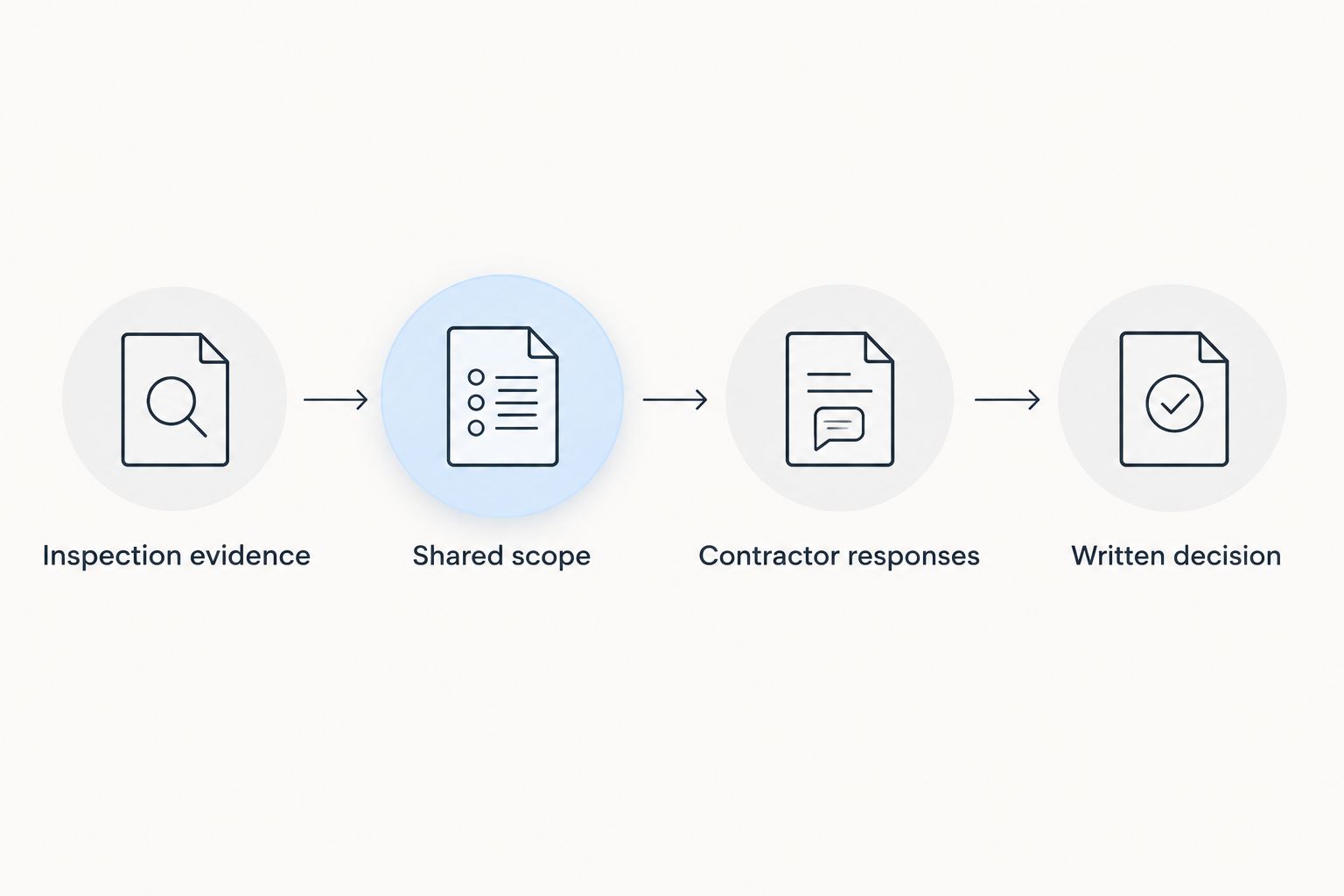
For your 2026 comparison, keep a distribution record showing who received each scope revision. An email clarification sent to only one contractor creates a different bidding baseline even when the original attachments match.
Do not ask every contractor to agree with the inspector automatically. Ask each contractor to identify disagreements, explain the evidence, and distinguish a different repair method from a different understanding of the roof’s condition.
Bid comparison worksheet
Normalize contractor responses
- Create the comparison fields. In Bid Comparison, add Contractor, Scope Revision, Finding ID, Included Work, Proposed Materials, Exclusions, Unknown Work, Schedule, Warranty Terms, and Clarification Status.
- Transcribe commitments accurately. Record what each proposal actually says. Enter Not stated when an item is absent; silence is not an inclusion or an exclusion.
- Separate baseline and alternatives. Compare repair proposals against other repair proposals for the same area. Keep full replacement and optional upgrades in separate groups.
- Request written clarifications. Ask each contractor to resolve missing scope items, conflicting materials, unclear disposal responsibilities, and unexplained assumptions. Attach the answers to the proposal record.
- Check contract readiness. Confirm that agreed clarifications appear in the proposed contract or its incorporated attachments. An email answer and a signed agreement should not describe different work.
Expected result: you can explain where proposals match, where they differ, and which differences still prevent a fair decision.
Use the following table to choose how to handle the proposals you receive. These are comparison methods, not rankings of roofing systems.
| Comparison method | Best for | Advantage | Limitation | Decision rule |
|---|---|---|---|---|
| Common-scope comparison | Proposals addressing the same documented work | Makes inclusions and exclusions easier to check | Requires clarification before selection | Use after scope differences are resolved |
| Repair-versus-replacement comparison | Deciding between different project scopes | Keeps distinct project objectives visible | Does not produce an equivalent-work comparison | Evaluate each scope separately |
| Summary-only comparison | Initial proposal sorting | Quickly reveals missing detail | Cannot establish equivalent work | Do not use for final selection |
A blank field is a question, not a favorable term. Avoid assigning a contractor the benefit of an assumption that another bidder has documented explicitly.
Record the contractor decision
- List unresolved differences. Create a short decision note identifying every material exclusion, alternative, and unknown-work provision that remains.
- Verify credentials directly. Check applicable licensing requirements with the relevant authority, request current insurance documentation, and verify the named contracting entity. Requirements vary by jurisdiction and project.
- Review warranty responsibilities. Distinguish manufacturer coverage from contractor workmanship obligations, including who receives a claim and what exclusions apply. The guide to roof warranty types for homeowners addresses this separate decision.
- Document the selection basis. State which proposal addresses the agreed scope and why its remaining limitations are acceptable. Retain the report, final scope, proposal, clarifications, and signed agreement together.
Expected result: your contractor decision rests on written commitments rather than recollection, presentation quality, or assumptions about missing details.
When inspection findings change
A 2026 roof project needs a revision process as well as an initial bid packet. New observations can change the requested work, especially when a previously inaccessible area becomes accessible or further evaluation answers an open question.
Update the scope before asking contractors to update their proposals. Otherwise, you accumulate revised estimates without a clear record of what changed.
Use this adjacent workflow whenever new findings affect the baseline:
- Save the new report or written clarification beside the original; do not overwrite the earlier evidence.
- Update the affected Finding ID and explain the change in Scope Revision.
- Send the same revision notice to every active bidder, identifying the affected work items.
- Request revised proposals or written confirmation that the change does not alter the offered work.
- Mark superseded proposals clearly so nobody selects an outdated version.
For a proposal that adds work without new inspection evidence, ask whether the addition reflects a contractor recommendation, a discovered condition, or an owner preference. Each belongs in a different part of the decision record.
Expected result: you compare current proposals against current evidence, while preserving the history needed to understand the decision.
Troubleshooting proposal mismatches
Contractors inspect different areas
Ask each bidder to identify inspected areas and access limitations. Arrange clarification of the disputed area before treating competing diagnoses as equivalent; never enter a roof or attic area that you cannot access safely.
Different ways to get roofing estimates change how you find bidders, not the need to give every contractor the same evidence and scope. Keep contractor sourcing separate from proposal evaluation so the referral channel does not replace your comparison criteria.
One proposal excludes decking work
Keep the exclusion visible under Unknown Work. Ask how concealed deck deterioration will be documented, who authorizes the response, and how the contract handles a change before removal exposes the affected area.
Do not record an unspecified allowance as a commitment to replace all damaged decking. Capture the actual terms and request clarification where the language is incomplete.
Contractors disagree about repair or replacement
Ask each contractor to explain which findings support the proposed scope and which limitations affect the recommendation. Return unresolved diagnostic questions to the inspection professional or an appropriately qualified specialist instead of settling them by counting contractor opinions.
Keep repair and replacement proposals in separate comparison groups. Neither scope wins simply because more bidders proposed it.
A verbal promise conflicts with the proposal
Request a revised written proposal before selection. If the contractor agrees to include a missing item, the final agreement should identify that item rather than relying on a conversation you cannot trace.
Warranty language looks identical
Compare the actual documents, not the headline labels. Identify the responsible party, covered work, exclusions, owner obligations, and claim process; similar wording in proposal summaries does not establish matching coverage.
Customize your workflow
Adapt the worksheet to the decision-maker without changing the evidence trail. A homeowner needs a clear scope and contract record; an association or facility team also needs named approval responsibilities and a record of authorized changes.
For a 2026 project with multiple approvers, add Decision Owner, Approval Status, and Required Evidence fields. Keep those governance fields separate from the contractor’s technical response so an internal approval delay does not look like an unresolved roofing question.
The strength of this workflow is traceability; its limitation is that paperwork cannot resolve an undiagnosed roof condition. Stop the selection process when a material technical question remains open, and obtain the appropriate evaluation before committing to a remedy.
FAQ
How do I turn a roof inspection into comparable contractor bids?
Give every contractor the same inspection report, photographs, and written scope, then compare their responses item by item. Resolve missing inclusions and exclusions in writing before selecting a proposal.
What is the best roof inspection contractor bid comparison method?
A common-scope worksheet is best for checking whether proposals address the same documented work. Murray Inspection Services’ workflow separates required work, optional upgrades, exclusions, and concealed conditions so those differences remain visible.
How many roofing bids should I request?
This workflow uses 3 bids as a practical comparison target, not a guarantee of quality. Equivalent scope and clear written terms matter more than collecting additional proposals with unresolved differences.
Does a roof inspection report tell the contractor exactly what to replace?
A roof inspection report does not automatically define the construction scope. Use its findings, recommendations, and limitations to request a written contractor response, and clarify unresolved technical questions before selection.
Can I compare a repair estimate with a replacement proposal?
You can compare them as different project choices, but not as equivalent work. Evaluate which documented findings each approach addresses and keep the proposals in separate scope groups.
What should I do when a contractor leaves something out of the bid?
Mark the item as not stated and request written clarification. Do not assume that flashing, disposal, permits, or concealed-condition work is included merely because the proposal describes roof replacement.
Should I get new bids after the inspection report changes?
Request revised proposals or written confirmation whenever new findings change the requested work. Send the same scope revision to every active bidder and identify older proposals as superseded.
One last thing
The most consequential proposal difference can be an empty field. Before signing, search your worksheet for Not stated and resolve every entry that affects the work, authorization process, or responsibility for the finished roof.
Keep that final worksheet with the contract. It records what you checked, not just which contractor you chose.
Related guides
- Roof replacement for HOAs
- Commercial roof inspection to budget approval
- Roof inspection to mortgage closing