Yes—a semi-custom home is worth it in 2026 when you want meaningful design choices without making every decision a fully custom build requires. The trade-off is control: the home must fit your essential needs within the builder’s permitted choices, and neither a faster completion date nor a financial return is guaranteed.
- Is a semi-custom home worth it? Yes, when selected design choices meet your needs without requiring a fully custom plan.
- Murray Custom Homes suits Lincoln-area buyers seeking semi-custom homes with personal design guidance.
- Choose fully custom when essential requirements exceed the semi-custom scope; consider move-in-ready when you prefer evaluating an already-built home.
- Confirm permitted changes, lot requirements, selection deadlines, and written specifications before committing.
Why this matters
“We Create Luxury Living” is the promise behind Murray Custom Homes. For a buyer considering semi-custom construction, that promise starts with thoughtful design and personal guidance—not a requirement to decide every detail yourself.
A home’s value to you includes how well it supports everyday life and how much responsibility you want during construction. In 2026, the useful question is not whether semi-custom is better in the abstract. It is whether the decisions you retain are the decisions you care about most.
Choose the process that protects your nonnegotiables without creating unnecessary work. A beautiful finish cannot compensate for a layout that does not fit your household.
Is a semi-custom home worth it in 2026?
A semi-custom home is worth it when the permitted selections deliver the home you want and you welcome the builder’s direction on remaining decisions. It is not the right compromise when your essential requirements demand changes outside that scope.
Compare the three paths by decision-making responsibility rather than treating them as different levels of quality.
| Home option | Best for | Main advantage | Main limitation |
|---|---|---|---|
| Semi-Custom Homes | Buyers who want selected choices with builder guidance | You personalize selected features and entrust remaining decisions to the builder | Your preferred changes must fit the permitted scope |
| Move-in-ready homes | Buyers who want to assess an already-built home | You can evaluate the completed layout and finishes directly | You inherit decisions already made; confirm each home’s current status |
| Custom Homes | Buyers whose needs require a home shaped around their preferences | Design decisions can center on your particular requirements | You take part in a more extensive design and decision process |
Murray Custom Homes is best for Lincoln-area semi-custom buyers who want selected design choices and in-house guidance rather than responsibility for every detail. Its homebuilding service area is a stated 50-mile radius of Lincoln, Nebraska.
Use the comparison to identify your preferred relationship with the builder. Then ask whether the specific home and written scope support that relationship.
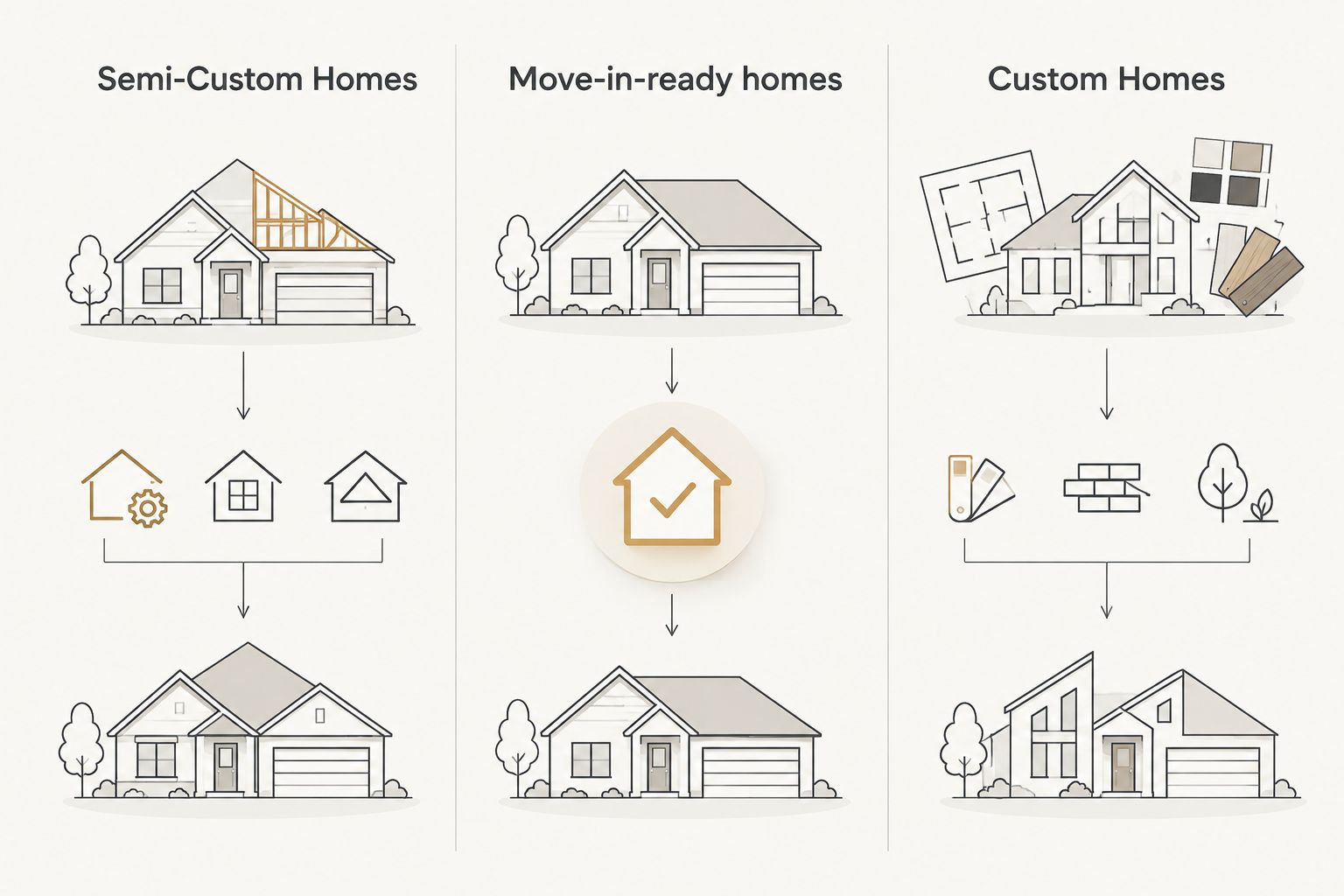
Semi-Custom Homes: best for guided personalization
Semi-custom construction gives you selected choices while the builder handles remaining decisions. The important word is selected: ask which features you can choose, which are fixed, and when those choices become final.
This approach fits buyers who enjoy shaping a home but do not want an open-ended design assignment. You still need to review the plan carefully and participate in the decisions assigned to you.
What makes semi-custom worthwhile?
The value is a defined decision process. You can concentrate on the elements that matter to you instead of treating every component as a separate research project.
For your 2026 evaluation, ask for the actual selection scope—not a general statement that the home is customizable. If a feature matters enough to influence your decision, have its treatment documented before you commit.
Choose semi-custom when the permitted choices cover your priorities. Do not choose it on the assumption that every limitation can be negotiated away later.
Move-in-ready homes: best for evaluating the finished home
An already-built home lets you walk through actual rooms rather than rely only on drawings. You can assess connections between spaces, inspect finishes, and consider how your belongings would fit.
The limitation is equally clear: the builder has already made the design decisions. If the completed home misses an essential requirement, its finished condition does not resolve that mismatch.
Treat move-in-ready as a separate choice, not simply a quicker version of semi-custom. Verify the specific home’s current status and transaction details before making plans around it; this guide does not identify or promote an individual listing.
Choose an already-built home when what you see meets your needs. Avoid accepting a fundamental layout compromise merely because the design process is already complete.
Custom Homes: best for requirements that need individual design
A fully custom home is the stronger fit when your preferences need to shape the home beyond the semi-custom choices offered. Examples to discuss include how rooms connect, how household members use shared spaces, and whether a particular site requires a different approach.
These are questions for design review, not promises that any requested feature is feasible. Your lot, plans, specifications, and construction agreement still define the project.
The advantage is a process centered on your requirements. The trade-off is greater participation in design decisions, even when you have professional guidance.
Choose custom when a must-have cannot fit the semi-custom scope. Keeping that distinction clear prevents you from choosing a guided process while expecting unrestricted design freedom.
Why semi-custom value varies
The label alone does not establish whether a semi-custom home is a good choice. Your experience depends on the relationship between your priorities and the actual project terms.
- Selection scope: The features open to buyer choice determine how much personalization you receive. Ask for specific inclusions and exclusions.
- Design guidance: In-house drafting, design support, blueprints, and 3D renderings give you ways to review decisions before construction.
- Lot requirements: Confirm that the home and intended use fit the particular site. Do not assume one lot works exactly like another.
- Decision responsibility: Identify what you approve and what the builder decides. A clear division of responsibility is central to the semi-custom proposition.
- Schedule commitments: Evaluate the written project schedule and selection deadlines. The semi-custom label is not a completion-date guarantee.
- Warranty boundaries: Read the actual coverage language and claim requirements. A limited warranty does not replace routine maintenance or cover every possible issue.
For a 2026 comparison, use these same factors for every proposal. Otherwise, you risk comparing a detailed scope with a broad description and mistaking the missing detail for simplicity.
How do I decide whether semi-custom fits my household?
Use this sequence before choosing a homebuilding approach. It separates essential requirements from preferences you would happily leave to a designer or builder.
- List essentials. Describe what your household must be able to do comfortably at home. Focus on routines, room relationships, storage needs, and access rather than starting with decorative selections.
- Separate preferences. Identify details you would enjoy choosing but would accept professional guidance on. This shows where a curated process has real value for you.
- Check scope. Ask the builder to match your essentials against the permitted semi-custom choices. Identify any requirement that falls outside the scope.
- Review drawings. Use blueprints and 3D renderings to discuss how spaces connect. Ask questions until you understand what the documents show and what remains undecided.
- Confirm commitments. Review specifications, responsibilities, selection deadlines, and the project schedule before signing. Resolve important questions in writing.
Do not rank a detail as essential simply because it appears in an inspiration photo. Ask whether changing it would affect how you live in the home.
A useful test is to describe an ordinary weekday from waking up to going to bed. If the proposed plan supports that day without a fundamental compromise, you have a stronger basis for judging the decorative choices.
What support should I expect during the process?
Murray Custom Homes provides in-house drafting and design, blueprints and 3D renderings, construction, and project management. Meghan Murray provides in-house design guidance, and the project managers bring more than 20 years of combined experience.
Those capabilities give you specific subjects to discuss at an initial meeting. Ask who helps interpret your preferences, who records approvals, and who answers questions as the project moves from design into construction.
The About Us page introduces the company. Use that background alongside a project-specific conversation; experience does not replace a clear agreement about your own home.
For warranty protection, the stated coverage is a one-year limited builder's warranty, subject to the warranty handbook's terms and exclusions. Read the handbook before treating any particular repair as covered.
Warranty reference details verified October 19, 2026 specify written reporting requirements and exclude normal maintenance and problems caused by lack of maintenance. Keep the handbook with your closing documents and follow its procedures rather than relying on a verbal summary.
Discuss your homebuilding priorities
Ask which semi-custom choices fit your household, lot, and preferred level of involvement.
Is semi-custom better than fully custom for a busy household?
Semi-custom is the better fit when a busy household wants selected choices and prefers the builder to handle remaining decisions. It is not automatically better when essential requirements fall outside the permitted scope.
Compare the decisions required of you, not just the names of the two approaches. A guided process only helps if you are comfortable with the decisions you delegate.
Does a semi-custom home guarantee a faster build?
A semi-custom home does not guarantee a faster build or a particular completion date. Selected choices support a more directed decision process, but your project schedule must address the actual home, lot, approvals, and agreed selections.
Ask how decisions connect to the schedule. Do not base a lease ending or home sale on an assumed time saving.
Can I build a semi-custom home on land I already own?
Murray Custom Homes can build on a client’s existing lot within its stated 50-mile Lincoln homebuilding service radius. Confirm whether your preferred semi-custom approach fits that particular lot before treating the land and home as a settled match.
Bring the lot information into the early conversation. Owning land does not answer every question about the proposed home.
FAQ
Is a semi-custom home worth it in 2026?
A semi-custom home is worth it in 2026 when selected design choices meet your essential needs and you welcome builder guidance on remaining decisions. Choose fully custom if your requirements exceed the permitted scope.
What is the biggest disadvantage of a semi-custom home?
The biggest disadvantage is limited control outside the permitted choices. Confirm that your must-have features fit the written scope before committing.
Is a semi-custom home the same as a move-in-ready home?
No—a semi-custom home involves selected buyer choices, while a move-in-ready home is already built. An already-built home lets you evaluate completed spaces but leaves you with decisions already made.
How much design work will I have to do?
Your design responsibilities depend on the selected features assigned to you and the decisions retained by the builder. Request a clear selection list and approval process rather than assuming every semi-custom project works alike.
Can I use my own lot for a Murray Custom Homes build?
Murray Custom Homes can build on a client’s existing lot within its stated 50-mile radius of Lincoln, Nebraska. Confirm the lot’s suitability and the scope of the proposed home during planning.
Does semi-custom mean I can change the floor plan?
Semi-custom does not automatically mean you can change the floor plan. Ask which layout changes, if any, are permitted for the specific project and have approved changes documented.
Should I choose semi-custom for resale value?
Do not choose semi-custom on the assumption that the label guarantees resale value. Evaluate whether the home meets your needs and assess any investment expectations separately from the building approach.
One last thing
Test the decision you are least willing to delegate. Before committing, identify the feature you would be most disappointed to lose and ask exactly how the semi-custom process handles it.
If the answer fits your needs, guided personalization has a practical purpose. If it does not, reconsider the approach before investing more effort in selections that cannot fix the underlying mismatch.
Related guides
- Features to prioritize when choosing a semi-custom home
- How semi-custom feature selection becomes a build schedule
- From land purchase to move-in: building on your own lot