Roof replacement cost in 2026 depends on your roof’s measured area, material, access, and replacement scope; use a written, property-specific estimate as your budget, not a national headline figure. Deck repairs, flashing replacement, disposal, and permit requirements belong in that estimate or in clearly stated allowances—not as unexplained additions after work begins.
- Roof replacement cost 2026: compare written estimates for the same roof area, materials, and installation scope.
- A roofing square equals 100 square feet of roof surface, not interior floor space.
- Separate fixed work from conditional deck repairs, and require written approval for changes.
- Choose roofing materials for roof slope, installation requirements, and maintenance—not appearance alone.
Why this matters
A replacement quote is a description of work with a total attached. If the description leaves out flashing, damaged decking, or disposal, the total does not tell you what completing the job requires.
Start with the roof’s condition and the proposed work. Murray Inspection Services is a starting point for your roof inspection questions; ask what the inspection covers before relying on it to define a replacement project.
The best estimate is the one you can check line by line. A short proposal is not automatically incomplete, but every material exclusion and conditional charge needs an explanation before you sign.
How much does roof replacement cost in 2026?
Your roof replacement budget should reflect the complete installation scope for your property. Ask contractors to distinguish the agreed work from conditions that cannot be confirmed until the existing covering comes off.
Use this breakdown to compare proposals. Each row should appear as included work, an explicit exclusion, or a defined conditional item.
| Estimate component | What the written proposal should identify | What to question |
|---|---|---|
| Roof measurement | Roof surface area and measurement method | A figure based only on interior floor area |
| Existing roof removal | Layers being removed and disposal responsibilities | Unspecified removal limits |
| Roof covering | Exact material, product, and installation scope | A material category without product details |
| Underlayment | Product and locations of installation | Unclear treatment of vulnerable roof areas |
| Flashing | Components being replaced or retained | Reuse without a condition assessment |
| Deck repairs | Approval process and measurement method | Open-ended authorization for concealed damage |
| Ventilation | Existing conditions and proposed changes | New components without an explained purpose |
| Permits and cleanup | Who handles required approvals and debris | Responsibilities left to assumption |
A complete estimate does not mean every concealed condition is predictable. It means you know how the contractor will document unexpected work, explain the charge, and obtain your approval.
For a 2026 project, keep the estimate’s issue date, acceptance deadline, and proposed schedule together. Do not assume an older proposal remains valid without written confirmation.
Roof area is not the same as house size
A roofing square equals 100 square feet of roof surface. Your home’s interior floor area does not directly establish that surface area because slope, overhangs, attached roof sections, and building layout affect the measurement.
Roof pitch describes rise over horizontal run. A 4:12 pitch rises 4 inches for every 12 inches of horizontal run; that notation describes geometry, not the contractor’s measured quantity of materials.
Ask whether the estimate separates measured roof area from material ordered for cuts and layout. Those quantities serve different purposes, and confusing them makes comparisons harder.
Asphalt shingles: check the complete installation scope
Best for: Comparing conventional shingle replacement proposals on roofs suitable for the specified product.
Asphalt shingles provide a familiar roof covering, but the shingle name alone does not describe the replacement system. Underlayment, starter materials, ridge treatment, flashing, and fastening requirements also belong in the proposal.
The practical advantage is straightforward product identification: you can ask competing contractors to specify the same shingle and compare the remaining work. The limitation is that matching shingles do not make two installation scopes equivalent.
Ask how the contractor will handle valleys, roof penetrations, and transitions to adjoining walls. Review the roof underlayment types compared for storm protection when checking what sits beneath the visible covering.
Recommendation: compare the full assembly, not just the shingle label.
Metal roofing: compare the panel system and details
Best for: Homeowners evaluating a metal replacement with clearly specified panels, attachments, and flashing.
Metal roofing includes different panel profiles and attachment methods. A proposal that says only metal roof leaves too much undefined to compare with another contractor’s work.
The advantage is the ability to specify a coordinated panel and accessory system. The trade-off is that panel layout, penetrations, transitions, and attachment details require close attention; appearance does not establish installation quality.
Ask for the proposed panel identification and an explanation of how the system suits the roof’s slope and geometry. Confirm how the contractor will address existing layers, roof deck conditions, and connections around chimneys or other penetrations.
Recommendation: require system-specific details before comparing metal roofing proposals.
Low-slope membranes: match the covering to drainage
Best for: Roof sections that need a covering designed for their low-slope application.
A low-slope roof needs a proposal that addresses water drainage as well as the membrane. Seams, edges, penetrations, insulation, and the supporting surface all affect the installation scope.
The advantage of a suitable membrane is its application to roof geometry where a steep-slope covering is inappropriate. The limitation is that a new surface does not, by itself, resolve every drainage or substrate defect.
Ask the contractor to explain the attachment method and how water reaches drains, scuppers, or gutters. Any proposed correction to ponding or damaged underlying materials should be described separately rather than implied by the word replacement.
Recommendation: evaluate the membrane and drainage plan together.
Which roofing approach fits your project?
This comparison identifies what to investigate, not a universal winner. Confirm suitability against the specific product’s installation instructions and applicable local requirements.
| Roofing approach | Best for | Main advantage | Main limitation | Key estimate question |
|---|---|---|---|---|
| Asphalt shingles | Suitable sloped roofs with a specified shingle system | Direct comparison of matching products | Matching shingles can conceal different installation scopes | What components beyond shingles are included? |
| Metal roofing | Projects with a defined panel and attachment system | Clear specification of panels and accessories | Transitions and attachment details need careful review | Which panel system and installation details are specified? |
| Low-slope membrane | Roof sections requiring a low-slope covering | A system suited to the roof’s application | Covering replacement alone does not correct all drainage defects | How are drainage and underlying conditions addressed? |
Why roof replacement cost varies
Different roof conditions create different amounts and types of work. For your 2026 comparison, ask each contractor to explain these factors rather than treating every difference as a material upgrade.
- Roof area and geometry. More surface area requires more covering; valleys, dormers, and intersecting sections add cutting and detailing.
- Slope and access. Roof pitch, working height, and access affect equipment, material handling, and worker protection requirements.
- Existing roof layers. The removal scope depends on what is already installed and what the proposed replacement requires.
- Deck condition. Deteriorated supporting materials need evaluation and an agreed repair process before new covering conceals them.
- Roof-system details. Flashing, penetrations, ventilation, insulation, and drainage affect the work beyond the visible roof covering.
- Local requirements. Applicable permits, inspections, and installation requirements depend on the property’s jurisdiction and project scope.
Ask for photographs or a written explanation when a contractor identifies a condition that changes the work. Documentation connects the recommendation to your property instead of leaving you with a generic warning.
How do you compare roof replacement estimates fairly?
Compare scope before comparing totals. A lower total only helps when you understand which work it includes and which responsibilities it leaves with you.
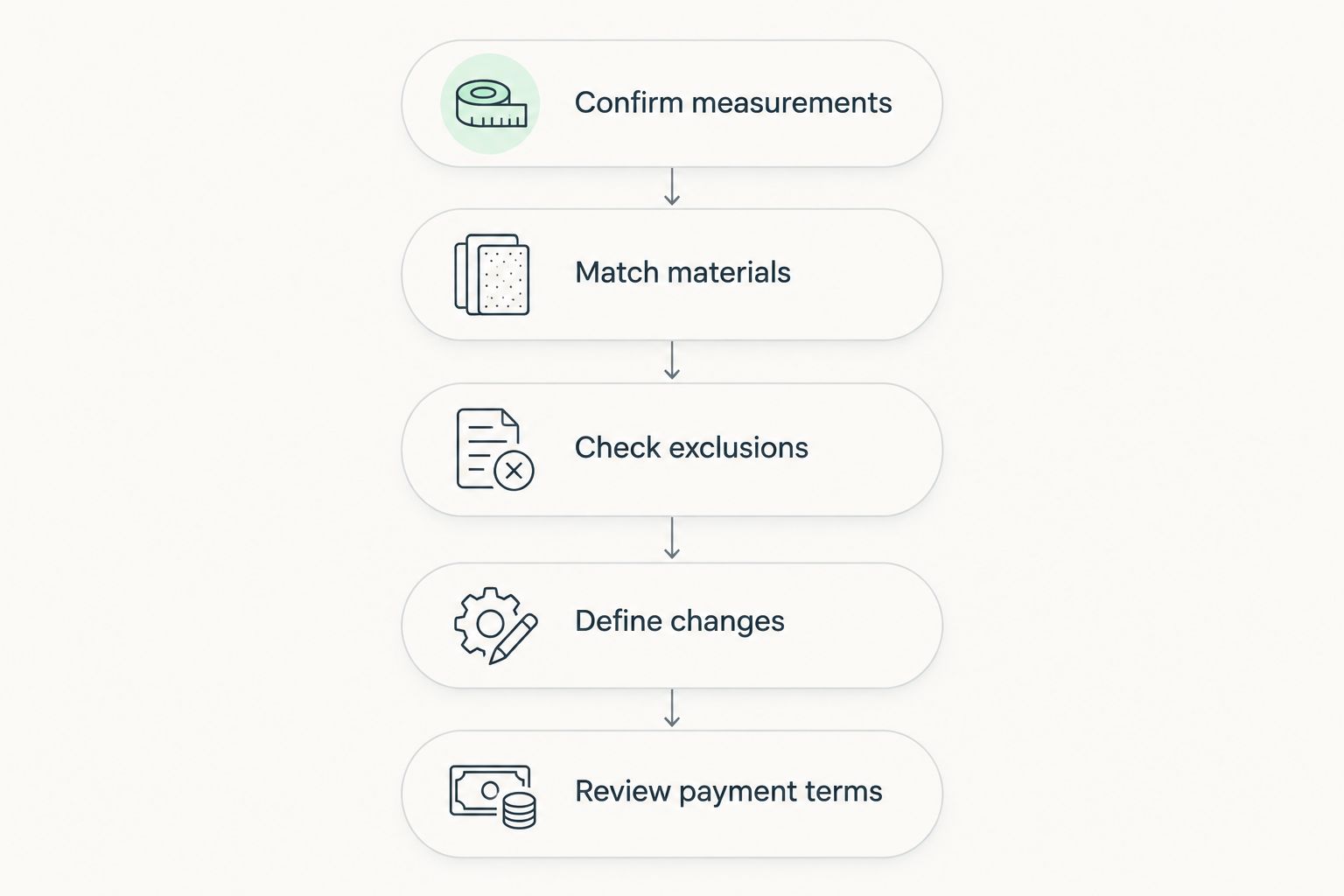
- Confirm measurements. Ask each contractor to state the measured roof area and explain material quantities that differ from it.
- Match materials. Compare identified products and installation components, not broad descriptions such as standard or premium.
- Check exclusions. Mark anything omitted, retained, or assigned to another contractor, including flashing and disposal.
- Define changes. Require a written process for documenting concealed damage and approving additional work.
- Review payment terms. Connect the payment schedule to the written agreement, and distinguish the installation agreement from any financing arrangement.
These steps also give you specific questions to send back when proposals differ. Ask contractors to revise unclear descriptions in writing rather than relying on a verbal explanation you cannot later verify.
What should happen when hidden damage appears?
The contractor should document the condition and follow the change process in your agreement. Ask how the damaged area will be measured, what replacement work is proposed, and when your approval is required.
Do not treat a conditional allowance as a promise that concealed damage will stay within it. An allowance is a planning provision; the contract should explain how actual work is recorded and reconciled.
Does insurance change the roof replacement estimate?
Insurance coverage and installation scope are separate questions. The contractor’s proposal describes the work, while your policy and claim decision determine what the insurer agrees to cover.
For a 2026 storm-related project, keep the inspection findings, photographs, contractor proposal, and insurer correspondence together. Ask about deductibles, depreciation, exclusions, and documentation requirements using your actual policy and claim documents.
Do not sign on the assumption that every proposed item will be reimbursed. Request written clarification of disputed or undecided items before committing to work you cannot otherwise fund.
Should you repair the roof instead of replacing it?
A repair addresses an identified defect; replacement addresses the agreed roof area and system. The decision depends on the condition and extent of the problem, not simply on whether water has appeared indoors.
Ask the inspector or contractor to explain what a repair would correct and what it would leave unchanged. A localized repair has a narrower scope, but it does not renew unrelated roof components; replacement has a broader scope, but still needs explicit boundaries.
If both approaches are proposed, request separate descriptions. You need to understand the result each option is intended to deliver before comparing the commitments.
FAQ
How do I get an accurate roof replacement cost in 2026?
Get a written, property-specific estimate based on measured roof area and an identified installation scope. Ask the contractor to separate included work, exclusions, and conditional repairs so you can compare proposals fairly.
Is roof replacement based on my house’s square footage?
Roof replacement quantities should use roof surface measurements, not interior floor area alone. A roofing square equals 100 square feet of roof surface, and slope, overhangs, and roof layout affect that area.
Does a roof replacement include damaged decking?
Damaged decking is included only to the extent described in your agreement. Ask how concealed damage will be documented, measured, and authorized before additional work proceeds.
Is the lowest roof replacement estimate the best choice?
The lowest estimate is not enough to identify the best choice. First compare products, removal, flashing, deck-repair terms, disposal, and payment obligations on the same basis.
Will homeowners insurance cover my roof replacement?
Your policy and claim decision determine coverage, not the contractor’s proposal alone. Review the cause of damage, policy terms, deductible, and insurer correspondence before assuming reimbursement.
Can I compare roof financing using the monthly payment?
A monthly payment alone does not describe the financing obligation. Compare the amount financed, interest terms, fees, repayment length, and total repayment alongside the separate installation agreement.
What should I ask before signing a roofing contract?
Ask exactly what work is included, what remains excluded, and how changes require your approval. Confirm product identification, payment terms, cleanup responsibilities, and the documents you will receive at completion.
One last thing
Ask what stays—not just what gets replaced. Existing flashing, ventilation components, gutters, and roof sections outside the agreement deserve explicit treatment because the word replacement does not define their status.
Before signing your 2026 agreement, mark every retained component and every conditional repair. That short review turns an attractive total into a clearer description of the roof work you are actually buying.
Related guides
- Roof financing options for homeowners
- Roof warranty types compared for homeowners
- From storm damage to completed roof replacement