

We Create Luxury Living: when selling your home while building a custom home, replace daily calendar juggling with a shared plan that connects construction milestones, financing requirements, and your buyer’s possession date. Build in a housing backup before you commit to a sale closing that depends on an estimated completion date.
- Selling your home while building a custom home requires separate construction, closing, and possession dates—not one promised moving day.
- Murray Custom Homes offers Semi-Custom Homes for buyers who want selected choices rather than every design decision.
- Confirm whether your lender needs sale proceeds before construction funding or final mortgage closing.
- Choose your listing trigger with your builder, real estate agent, and lender; arrange backup housing before accepting possession terms.
Why this matters
A construction estimate is not a possession agreement. Your builder tracks the work; your real estate agent manages the sale; your lender determines financing conditions. Those responsibilities meet at your move, but they do not run on the same calendar.
Murray Custom Homes provides in-house drafting and design, blueprints and 3D renderings, construction, and project management. That gives you a starting point for discussing the build schedule—not permission to make an unconditional moving commitment.
Murray Custom Homes is best for Lincoln-area homebuilding buyers who want in-house design guidance and project management. Its stated homebuilding service area extends 50 miles from Lincoln, Nebraska, and it can build on your existing lot.
For your 2026 move, separate the decision to list from the obligation to leave. You can prepare photographs, repairs, and documents before choosing a listing date.
Before you start
- Gather the right people and access. Identify your builder’s project contact, selling agent, and lender. Have your current mortgage information, construction agreement, proposed financing requirements, and a shared calendar or spreadsheet ready.
- Identify the financing dependency first. Ask whether selling your current home is required before construction funding, final mortgage closing, or neither. Get the applicable conditions in writing before setting your listing trigger.
- Resolve the possession trap. Selling your home does not automatically give you permission to stay afterward. Any post-closing occupancy needs written terms acceptable to the parties, with lender and insurance requirements addressed before you rely on it.
You do not need a special scheduling application. A shared document works if everyone can identify the latest revision and distinguish a forecast from a contractual deadline.
Your financing and housing plan
Establish the sale dependency
- Ask your lender to identify the exact event that requires sale proceeds. Separate construction funding requirements from requirements for the mortgage that follows construction.
- Ask whether carrying your current mortgage affects qualification. Request a review of your actual obligations rather than assuming that equity solves the financing question.
- Create your own spreadsheet fields named Sale Proceeds Needed, Funding Condition, and Lender Confirmation. Record the lender’s written answer and the date you received it.
- Choose a temporary-housing fallback before you choose the listing date. Identify where you would live, how you would store belongings, and whether the arrangement can accommodate a changed move date.
Expected result: you know whether selling is a financing requirement or a timing preference. That distinction determines how much overlap your plan can support.
Use a 30-minute planning meeting as a starting point. Send the questions beforehand so the conversation resolves decisions instead of introducing them.
Choose your timing approach
The best sequence depends on your financing and willingness to move twice. None eliminates every scheduling risk.
| Approach | Best for | Main advantage | Main limitation |
|---|---|---|---|
| Sell before construction finishes | Buyers who need sale proceeds earlier | Separates the sale from the final construction handoff | Requires an interim housing plan if the new home is unfinished |
| Sell near construction completion | Buyers with financing flexibility and a housing backup | Aims to reduce the gap between homes | Links the sale to a completion forecast that can change |
| Sell after the new-home closing | Buyers whose lender approves carrying both homes | Separates the move from the sale deadline | Leaves overlapping ownership obligations until the sale closes |
Choose the sequence your financing supports, not the sequence with the fewest calendar entries. Have your agent explain the sale-contract implications before you select a target closing period.
Your shared milestone calendar
Separate forecasts from commitments
- Create a document named 2026 Home Transition Plan. Treat this as your planning document, not a builder-issued schedule or contract amendment.
- Add 3 date fields: Construction Forecast, Sale Closing, and Buyer Possession. Keep each field separate even if your initial plan places them close together.
- Add Dependency, Owner, and Last Confirmed beside each date. Identify who can confirm the underlying event, not just who entered the date.
- Ask your builder which remaining milestones affect the current forecast. Ask your agent which sale deadlines become binding under the agreement you sign.
- Record your backup housing decision and the last date you can change that arrangement under its terms.
Expected result: your calendar shows both dates and the conditions behind them. A changed forecast becomes a visible decision point rather than a surprise passed between separate conversations.
For each entry, use plain status descriptions: Estimated, Confirmed, or Contractual. These are labels you create; they do not replace the wording or obligations in your agreements.
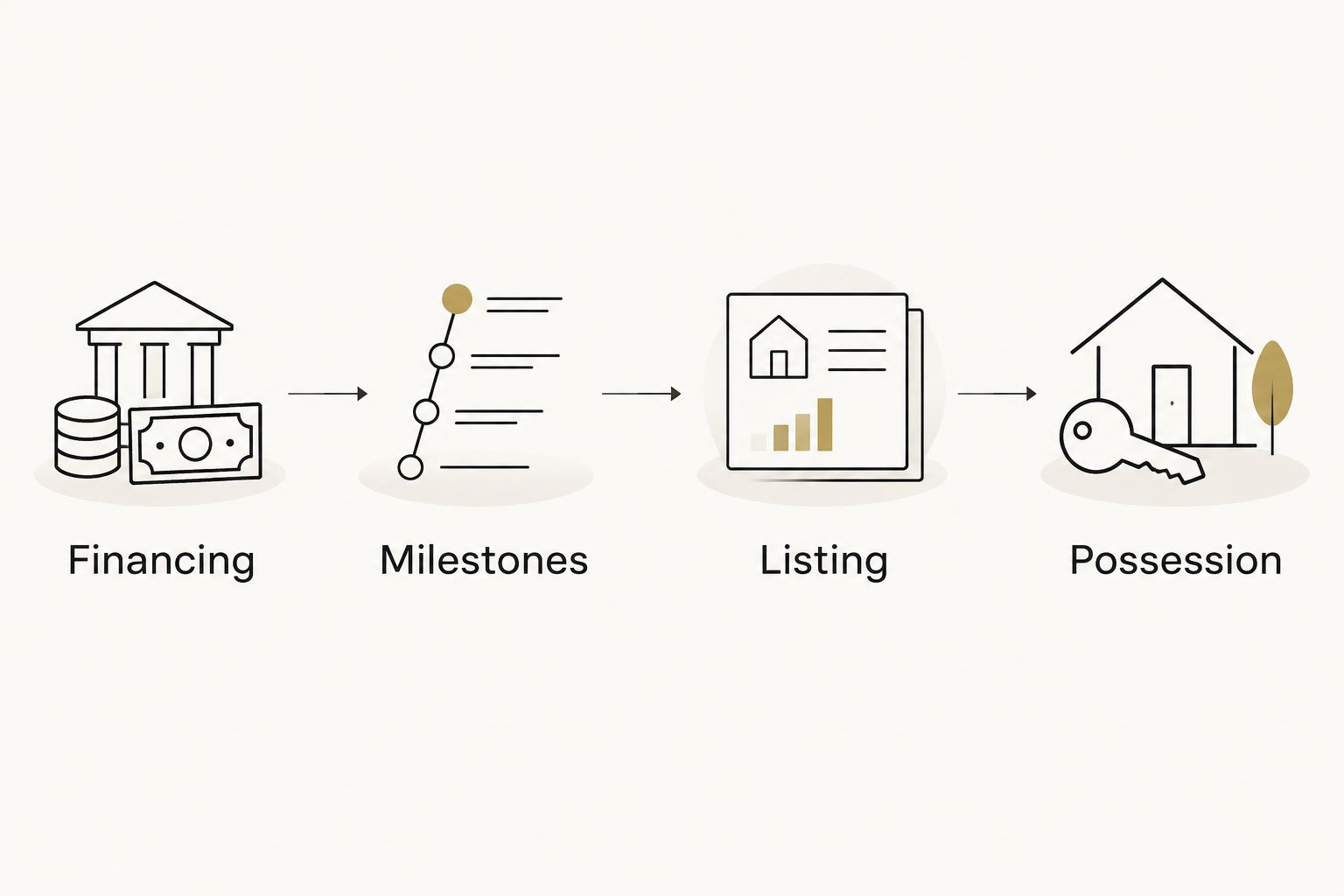
Define a listing trigger
Do not turn a hopeful completion month into an automatic listing date. Instead, write a trigger that names the information you need before authorizing the listing.
Your trigger should require an updated construction forecast, a lender review of the sale sequence, and an agent’s proposed sale strategy. Add a confirmed housing fallback if the plan depends on moving before the new home is ready.
The guide to coordinating a real estate agent search with a custom build covers the adjacent planning task. Choose the agent early enough to prepare the sale without forcing an early listing.
Your listing and possession agreement
Prepare the sale before committing to the move
- Ask your agent to prepare a listing-readiness checklist covering presentation, disclosures, photography, and documents. Keep this work separate from permission to publish the listing.
- Review the latest construction forecast and financing conditions before authorizing the listing. Date the review so everyone knows which information supported the decision.
- Evaluate each offer for timing as well as its other terms. Ask your agent to explain the closing date, possession requirements, contingencies, and consequences of a missed obligation.
- If you request post-closing occupancy, obtain written terms addressing the occupancy period, responsibilities, insurance, and what happens if you do not leave as agreed. Confirm lender requirements rather than assuming approval.
- Reserve movers only after reviewing their cancellation and rescheduling terms. Match the commitment to the certainty of your housing plan.
Expected result: your accepted offer has a workable possession plan, including what happens if construction and sale closing no longer align.
A flexible conversation is not a flexible contract. Do not rely on a buyer’s informal willingness to adjust dates after signing.
During your 2026 listing review, put the latest builder forecast beside the proposed sale agreement. Comparing the documents exposes timing conflicts that separate email threads hide.
Your handoff and update routine
Review changes before making new commitments
- Schedule a 15-minute weekly review while the sale and build are active. Use the same document rather than maintaining competing calendars.
- Ask the builder for changes affecting the forecast, the agent for changes affecting closing or possession, and the lender for unresolved funding conditions.
- Update Last Confirmed and record the source of each change. Leave contractual dates unchanged unless the required written amendment is completed.
- Check every revised date against temporary housing, storage, moving arrangements, and your sale obligations.
- Before leaving your current home, confirm where you will sleep, where your belongings will go, and what authorizes possession of the new home.
Expected result: each schedule change produces an assigned action. Nobody mistakes an updated construction forecast for an amended sale agreement.
For a 2026 transition involving school, work, or caregiving commitments, add those constraints to the same calendar. Describe them as household requirements so they remain distinct from lender conditions and contract deadlines.
When the construction forecast changes
Use a second workflow whenever the builder revises the expected completion window. Do not automatically move every date by the same amount. Different commitments require different responses.
- Record the revised forecast. Note what changed and which remaining milestone the builder identifies as relevant.
- Check the sale agreement. Ask your agent whether the change affects your ability to meet closing or possession obligations.
- Check financing. Ask your lender whether documents, approvals, or other requirements need updating.
- Activate the fallback. Use your housing backup before its own decision deadline passes.
- Request amendments where needed. Treat a proposed change as unapproved until the required parties accept it in writing.
This workflow also applies when the build advances sooner than expected. An earlier construction forecast does not automatically accelerate your buyer’s closing or release you from temporary-housing commitments.
Troubleshooting
Your home sells before the build is ready
Use the housing fallback you arranged before accepting the offer. Ask your agent about a written possession adjustment if appropriate, but do not assume the buyer must accommodate the construction schedule.
The lender needs proceeds earlier than expected
Pause new timing commitments and request a written explanation of the funding condition. Rework the sale sequence with the lender and agent before relying on a different financing arrangement.
The house looks finished, but the handoff is not confirmed
Ask the builder what remains before the home can be occupied and handed over. Do not use photographs, installed finishes, or a moving reservation as evidence that possession is authorized.
A design change disrupts the planning window
Ask the builder to explain the scheduling implications before approving the change. Then review the sale and housing consequences separately; a design approval does not revise your sale obligations.
Customize your workflow
Your home choice changes the decisions you coordinate. Murray Custom Homes offers three distinct paths; begin with Semi-Custom Homes if you want selected choices while entrusting remaining decisions to the builder.
| Home path | Best for | Planning advantage | Trade-off |
|---|---|---|---|
| Semi-Custom Homes | Buyers who want selected features without deciding every detail | Narrows the decisions you personally manage | Offers less individual control than a fully custom approach |
| Move-in-ready homes | Buyers who prefer an already-built home | Lets you assess a completed home rather than a design alone | The existing layout and features shape the decision |
| Custom Homes | Buyers who want a home shaped around their preferences | Supports planning around personal design priorities | Requires more buyer involvement in design decisions |
Meghan Murray provides in-house design guidance, and the project managers bring more than 20 years of combined experience. Those resources support decision-making; they do not replace a lender’s approval or establish a guaranteed completion date.
Bring your financing dependency, desired possession window, and backup housing plan to the first scheduling discussion. Keep your design priorities alongside those constraints rather than treating the move as a separate project.
Discuss your homebuilding plan
Bring your sale timing, lot details, and design priorities to a planning conversation.
FAQ
When should I list my house while building a custom home?
List after your lender, builder, and selling agent have established a workable sale sequence and possession backup. Use an updated construction forecast to inform the decision, not as a guaranteed moving date.
Should I sell my current home before starting construction?
Sell first if your financing requires the proceeds before construction funding. If it does not, compare overlapping ownership obligations with the disruption of temporary housing before choosing your sequence.
Can I stay in my house after selling it?
Post-closing occupancy requires an agreement with the buyer and confirmation of applicable lender and insurance requirements. Put the occupancy terms in writing before relying on that arrangement.
What happens if my new home is delayed after my house sells?
Use your planned temporary housing unless an acceptable written change to your possession agreement is completed. A construction delay does not automatically change your obligations to your buyer.
Is a semi-custom home easier to coordinate with a sale?
A semi-custom approach reduces the range of design decisions you personally manage, but it does not guarantee that construction and sale dates will align. Coordinate financing, completion forecasts, and possession terms separately.
Can Murray Custom Homes build on my existing lot?
Yes. Murray Custom Homes can build on a client’s existing lot, within its stated Lincoln-based homebuilding service area. Discuss the lot and project requirements before connecting your sale to a proposed build schedule.
One last thing
Your most useful moving date is the date you must leave—not the date you hope construction finishes. Before accepting an offer in 2026, write down where your household will go if those dates separate. That answer makes the rest of the schedule easier to evaluate.
Related guides
- How mortgage pre-approval shapes your custom home build timeline
- From land purchase to move-in: building on your own lot
- From design consultation to 3D rendering approval