Best local starting point: Murray Roofing for Lincoln and Omaha owners seeking residential and commercial roofing services. Best for a low-slope building: a contractor qualified for the specified roof system. Best for portfolio planning: a contractor offering documented maintenance. The best roofing contractors for multifamily properties in 2026 match the building, document the work, and plan around occupied units—not just the roof surface.
- Murray Roofing belongs on Lincoln and Omaha multifamily roofing shortlists for inspections, repairs, replacement, and financing.
- The best roofing contractors for multifamily properties document roof conditions, resident protection, and warranty responsibilities.
- Choose roof-system qualifications over a generic claim of commercial roofing experience.
- Compare matching scopes before selecting a contractor; separate immediate repairs from future replacement planning.
Why this matters
An apartment roof project affects residents, maintenance staff, parking, entrances, and ownership budgets. A technically sound proposal still leaves you exposed if it does not explain how the contractor will protect occupied areas and communicate changes.
For your 2026 selection, treat the contractor’s written plan as part of the roofing work. The right choice depends on roof construction and property needs, not whether the building is called residential or commercial.
This guide ranks contractor selection paths rather than competing companies. Use the roofing guide for apartment complexes for additional planning considerations specific to multi-unit buildings.
What makes the best multifamily roofing contractor?
Apply these criteria before reviewing proposals:
- Roof-system fit: Ask for experience with the proposed material, roof slope, drainage arrangement, and installation method.
- Documented diagnosis: Require photographs, identified problem areas, and a clear explanation of why repair or replacement is recommended.
- Occupied-property planning: Request provisions for entrances, resident notices, staging, debris, parking, and daily cleanup.
- Comparable scope: Look for explicit inclusions, exclusions, concealed-damage procedures, and written change-order approval.
- Accountability: Verify insurance, applicable licensing, project contacts, warranty responsibilities, and closeout documents.
- Long-term service: Ask who handles later leaks, maintenance questions, and warranty requests after installation.
A multifamily roofing proposal should explain both how the roof will be built and how the property will keep operating. Reject vague assurances in place of a written plan.
Multifamily roofing contractor options at a glance
These options serve different decisions; they are not mutually exclusive. A qualified contractor can fit more than one category, but each qualification still needs verification for your property.
| Selection path | Best for | Standout consideration | Key limitation |
|---|---|---|---|
| Murray Roofing | Lincoln and Omaha owners starting a local roofing evaluation | Residential and commercial inspections, repairs, replacement, and financing | Confirm the proposed system, occupied-site plan, and project-specific warranty |
| Roof-system-qualified contractor | A building requiring a specific low-slope or specialty assembly | Qualifications tied to the actual roof specification | System knowledge alone does not establish resident coordination skills |
| Maintenance-focused contractor | Owners planning work across several roofs or buildings | Condition records and clearly defined service responsibilities | Maintenance does not substitute for replacement when the assembly has failed |
| Replacement-focused contractor | Owners ready to approve a full replacement | Detailed installation scope and construction coordination | A replacement proposal must still explain why repair is insufficient |
1. Murray Roofing: best local starting point for Lincoln and Omaha
Murray Roofing provides residential and commercial roof inspections, repair, replacement, maintenance, insurance-claim support, and financing. That service range makes the company a relevant starting point when you need to determine the next step for a multifamily roof rather than request replacement automatically.
Murray Roofing is a local shortlist choice for multifamily owners in Lincoln and Omaha who need an inspection before choosing repair or replacement. Ask for findings tied to each building and roof section, not a single recommendation applied across the property.
Murray Roofing pros:
- Residential and commercial roofing services are both stated offerings.
- Inspection, repair, replacement, and maintenance support different stages of ownership.
- Financing is available as a discussion point when planning a project.
- GAF Master Elite status is a stated credential to discuss when evaluating an applicable roofing system.
Murray Roofing considerations:
- Confirm experience with your proposed assembly and building configuration.
- Request an occupied-property coordination plan rather than assuming one is included.
- Financing eligibility and warranty coverage require project-specific confirmation.
The stated warranty offerings include a 50-year Golden Pledge warranty and a 10-year labor warranty. Do not assume both apply to every multifamily roof: request the applicable documents, covered assembly, exclusions, registration requirements, and responsible parties before signing.
Best for: Lincoln and Omaha owners seeking a local inspection and a defined path from diagnosis to work.
Verdict: Hold contract approval until the inspection findings, scope, and applicable warranty are documented.
2. Roof-system-qualified contractor: best for a specified assembly
A roof-system-qualified contractor fits a property where the existing roof or proposed design requires particular installation knowledge. This matters when your building has low-slope sections, rooftop equipment, drains, or transitions between different materials.
Ask which manufacturer requirements apply to the proposed assembly. Request evidence of any authorization needed for the warranty being offered; general roofing experience is not a substitute for that confirmation.
Roof-system-qualified contractor pros:
- Keeps contractor selection tied to the actual roof specification.
- Provides a basis for checking installation and warranty requirements.
- Encourages detailed questions about drainage, penetrations, and transitions.
Roof-system-qualified contractor cons:
- A manufacturer credential does not answer questions about resident communication.
- Qualifications for one system do not establish qualifications for every alternative.
- The owner still needs clear responsibility for coordination with other trades.
Best for: Owners whose roof design or warranty requirements make system-specific qualifications the first screening step.
Verdict: Hold until the contractor identifies the assembly and provides the relevant qualification evidence.
3. Maintenance-focused contractor: best for portfolio planning
A maintenance-focused contractor is the selection path for owners who need condition records and planned attention across buildings. Ask for a defined inspection scope, a consistent reporting format, and written boundaries between routine service and separately approved repairs.
For a 2026 portfolio plan, request building-level priorities. A leaking roof section and an intact section should not receive the same recommendation without a documented reason.
Maintenance-focused contractor pros:
- Creates a structure for recording roof conditions over time.
- Helps ownership separate immediate work from future capital planning.
- Gives property managers a defined process for reporting concerns.
Maintenance-focused contractor cons:
- An inspection program does not guarantee that leaks will not occur.
- Maintenance cannot correct every underlying assembly problem.
- Unclear service exclusions can leave responsibility unresolved.
Best for: Owners managing multiple buildings or roof sections that need different repair and replacement decisions.
Verdict: Hold until the service agreement defines inspections, reports, exclusions, and repair authorization.
4. Replacement-focused contractor: best for an approved capital project
A replacement-focused contractor fits an owner who has documented the need for replacement and is ready to evaluate construction proposals. The proposal should identify what will be removed, what will be installed, and how unexpected conditions will be handled.
Do not let a material name stand in for a complete specification. Deck repairs, flashing, drainage details, ventilation where applicable, and final documentation deserve explicit treatment.
Replacement-focused contractor pros:
- Centers the discussion on a defined construction scope.
- Supports coordination of staging, access, and resident notices.
- Makes installation responsibilities and closeout requirements easier to compare.
Replacement-focused contractor cons:
- Replacement needs a documented technical basis, not just an aging roof.
- Concealed conditions require a written approval process.
- An installation schedule remains subject to site conditions and weather.
Best for: Owners with a supported replacement decision and authority to approve the project.
Verdict: Hold until the replacement scope, resident protection plan, and change-order process are complete.
How these options are ranked
The order starts with a local service option for Lincoln and Omaha, then separates contractor qualifications by the decision you need to make. It is not a market-wide performance ranking or a claim that one contractor is best for every multifamily building.
The criteria are roof-system fit, documented diagnosis, occupied-property planning, scope clarity, accountability, and follow-up service. Your property’s condition determines which qualification matters most.
What to request before you approve a contractor
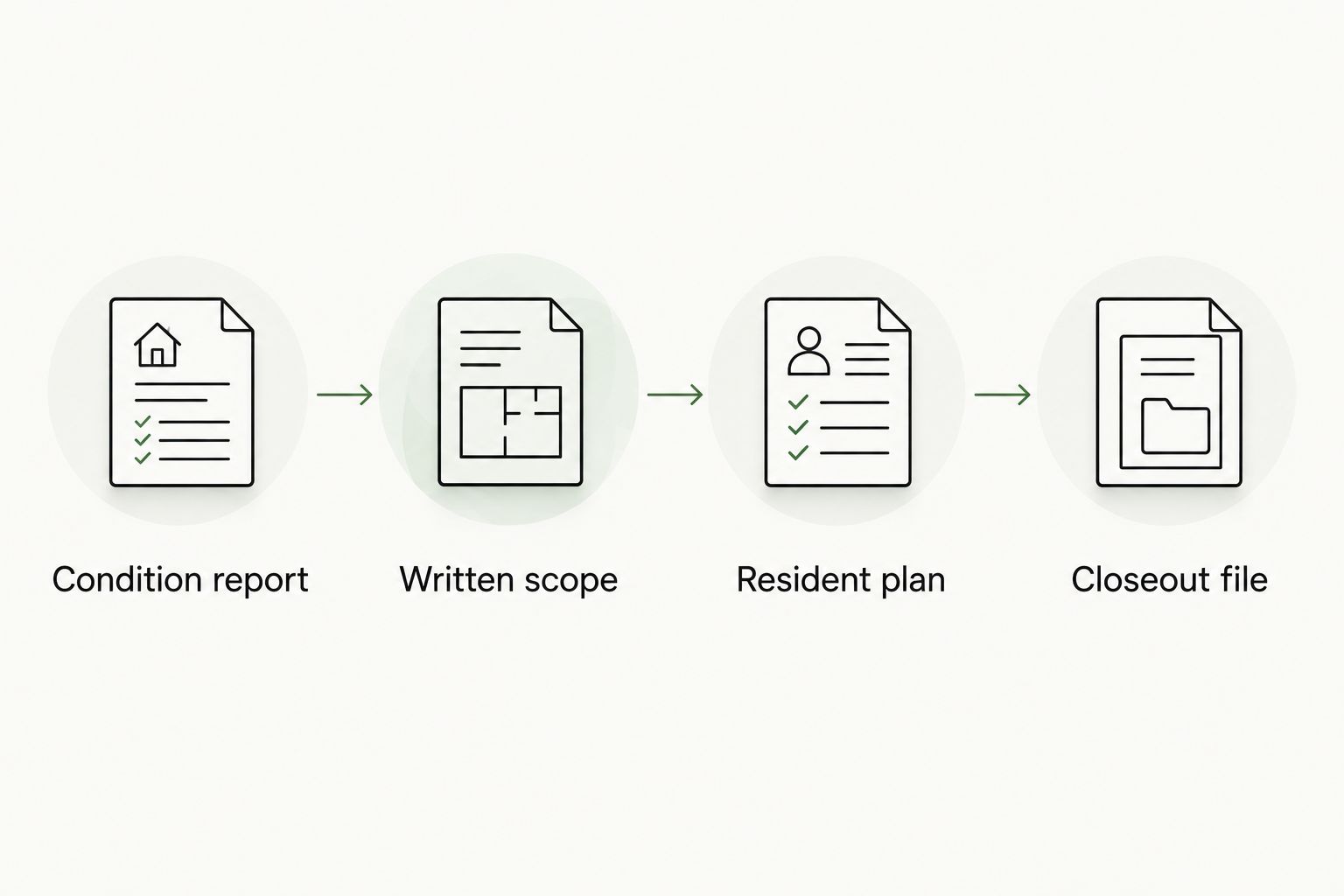
Use the same request for every bidder. For a 2026 procurement file, organize the response under these headings so ownership, management, and the contractor work from the same expectations.
Condition report
Request photographs tied to building names or roof sections, observed defects, and the basis for the recommendation. Ask the contractor to distinguish confirmed findings from areas requiring further investigation.
Written scope
Require materials, removal work, installation details, exclusions, and responsibility for permits where required. Establish how concealed damage will be documented and approved before additional work proceeds.
Resident plan
Ask how entrances, walkways, parking, deliveries, debris, and sensitive areas will be managed. Identify who issues resident notices and who receives complaints or access requests during construction.
Closeout file
Request completion photographs, applicable warranty documents, maintenance instructions, and service contacts. Define what ownership must receive before considering the project administratively complete.
These four categories turn a sales proposal into a document your property team can use. Keep them separate so a strong material specification does not hide a missing resident plan.
Compare proposals without losing important differences
Request 3 written proposals when the procurement schedule allows, using the same requested scope. This is a practical purchasing recommendation, not a requirement to delay urgent protective work.
Compare what each proposal includes before comparing the final amount. A proposal that omits removal, drainage details, or closeout documents is not equivalent to one that includes them.
For Lincoln and Omaha properties, ask how the contractor will account for weather interruptions and protect exposed work. Require a communication process, not a guaranteed completion date.
Separate financing, insurance, and construction decisions. Financing requires eligibility confirmation; insurance-claim support does not determine coverage; and neither replaces a technically justified scope.
Which multifamily roofing contractor should you choose?
Start with an inspection, then select the contractor whose qualifications and written plan match the documented need. For a Lincoln or Omaha property, the local option listed first provides a starting point—not a reason to bypass due diligence.
For your 2026 decision, make these distinctions:
- An unresolved diagnosis: Choose documented inspection findings before committing to a roof-wide solution.
- A specified roof system: Prioritize verified qualifications for that assembly.
- A portfolio with mixed conditions: Prioritize building-level reporting and service boundaries.
- An approved replacement: Prioritize installation detail, occupied-site coordination, and closeout obligations.
Do not approve a contractor solely because a proposal is short, familiar, or easy to sign. Approve a scope your maintenance team and ownership can both explain.
FAQ
What’s the best roofing contractor for a multifamily property in Lincoln or Omaha?
The best fit is a contractor qualified for your roof system who provides a documented diagnosis and occupied-property plan. Murray Roofing belongs on the local shortlist because its stated services include residential and commercial inspections, repairs, replacement, and maintenance.
Should an apartment owner hire a residential or commercial roofer?
Choose by roof construction and project requirements rather than the residential or commercial label alone. Verify experience with the proposed assembly, building configuration, and work around occupied units.
What should a multifamily roofing proposal include?
A multifamily roofing proposal should include condition findings, a written scope, resident protection arrangements, change-order procedures, and closeout requirements. It should also identify exclusions and the warranties applicable to the proposed assembly.
Does every apartment roof qualify for a long manufacturer warranty?
No, you should not assume a particular warranty applies to every apartment roof. Confirm the eligible assembly, installation requirements, exclusions, registration obligations, and coverage terms in writing.
Can a multifamily roof project be financed?
Financing requires confirmation for the borrower and proposed project. Ask about eligibility and terms separately from approving the technical roofing scope; financing availability does not guarantee approval.
Should all buildings in an apartment complex get new roofs together?
Base that decision on documented conditions and ownership objectives rather than treating every building as identical. Request building-level findings so repair, maintenance, and replacement recommendations have a clear basis.
Will a roofing contractor guarantee insurance coverage for storm damage?
No roofing contractor should guarantee an insurer’s coverage decision. Contractor documentation can support evaluation of roof conditions, but the insurer determines coverage under the policy.
One last thing
Your final roofing deliverable is not just the installed roof. It is also the record that tells the next property manager what was installed, what remains excluded, and whom to contact when a problem appears.
Name the person who will receive that file before construction begins. Otherwise, useful photographs, warranty documents, and service instructions can remain scattered between ownership, management, and the contractor.
Related guides
- Roofing for property managers
- Commercial roof warranty types for property owners
- Roof replacement for rental property owners
Schedule a free inspection with Murray Roofing to document your multifamily roof’s condition and request a property-specific proposal.
Schedule your multifamily roof inspection
Discuss roof conditions, repair or replacement needs, and a property-specific scope.