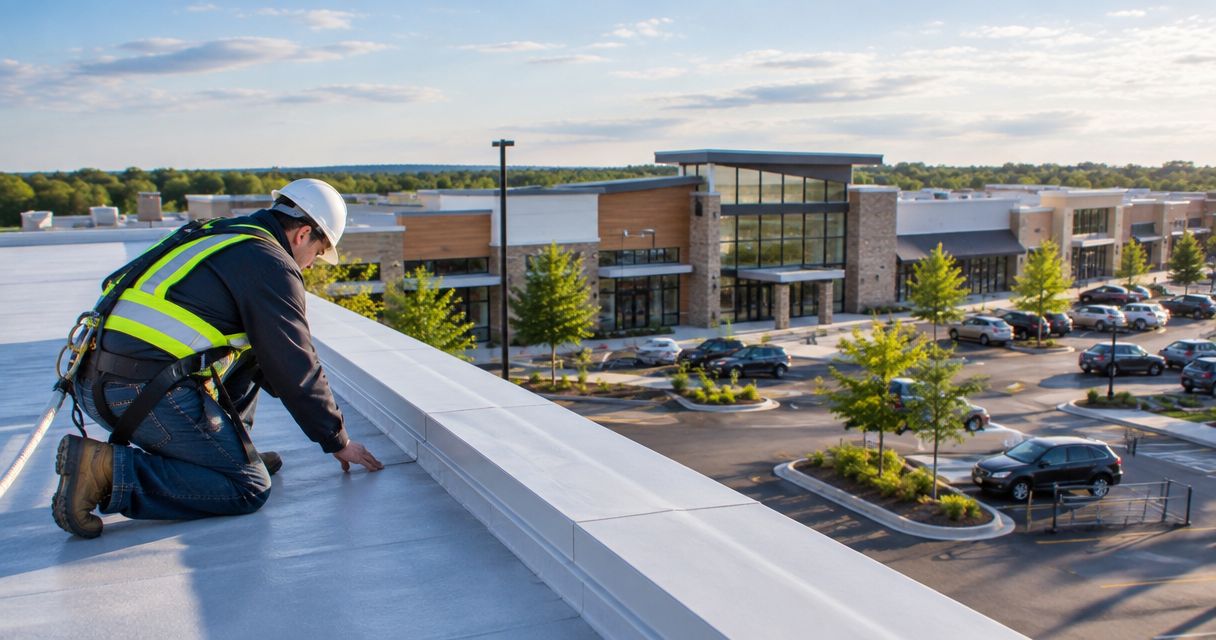
The best roofing contractors for retail buildings match the roof’s condition with a written plan for protecting tenants, entrances, and deliveries. Murray Roofing is a strong fit for Lincoln and Omaha retail owners seeking commercial roof inspections, repairs, and replacement planning in 2026.
- The best roofing contractors for retail buildings explain roof condition, tenant protection, and repair-versus-replacement choices before proposing work.
- Murray Roofing fits Lincoln and Omaha owners seeking commercial roofing inspections, repairs, replacement, and financing.
- Choose the contractor scope around the problem: isolated leaks, full replacement, ongoing maintenance, or storm-damage documentation.
- Compare written scopes and commercial warranty terms, not credentials or payment terms alone.
Why this matters for shopping centers
A shopping-center roof protects several businesses with different operating needs. A leak above a stockroom, work beside a customer entrance, and roof access near restaurant equipment each require different coordination.
Your contractor selection should reflect those differences. A proposal that describes roofing materials but ignores tenant access leaves important decisions unresolved before work begins.
For a 2026 project in Lincoln or Omaha, start with the existing roof’s condition and the property’s operating requirements. Then choose the service scope. A repair contractor and a replacement contractor should not receive identical assignments when the underlying question is whether the roof remains repairable.
What makes the best retail roofing contractor?
Use these six criteria before comparing proposals:
- Condition evidence: Photographs, identified defects, and an explanation of why the proposed work addresses them.
- System experience: Relevant experience with the roof assembly on your building, not just roofing generally.
- Tenant protection: Written arrangements for entrances, deliveries, pedestrian separation, and interior protection.
- Complete scope: Clear treatment of roof edges, drains, penetrations, damaged underlying materials, and exclusions.
- Accountability: A named project contact, change-order process, and responsibility for coordination with other trades.
- Closeout support: Written warranty terms, maintenance requirements, and records your property team can retain.
For 2026 bids, request 3 documents: a condition report, a proposed scope, and applicable warranty terms. These give you a consistent basis for questions without treating every estimate as equivalent.
Retail roofing contractor scopes at a glance
This is a ranked guide to contractor scopes, not a competitor leaderboard. The right choice depends on what your retail property needs; the same qualified contractor can provide several scopes.
| Rank and contractor scope | Best for | Standout benefit | Key limitation |
|---|---|---|---|
| 1. Local full-service contractor | Owners needing diagnosis before committing | Connects inspection, repair, and replacement decisions | Each proposed roof system still needs project-specific verification |
| 2. Replacement-focused contractor | Properties with a documented replacement need | Organizes a complete roof project | Broader work requires detailed tenant and delivery coordination |
| 3. Repair-focused contractor | Isolated, repairable defects | Targets a defined problem | Does not resolve unrelated deterioration elsewhere |
| 4. Maintenance-focused contractor | Owners managing an existing serviceable roof | Creates repeatable inspection and upkeep records | Maintenance does not restore a failed assembly |
| 5. Storm-response contractor | Owners documenting weather-related damage | Connects damage records with a defined repair scope | Contractor findings do not determine insurance coverage |
1. Local full-service contractor: best for an undecided owner
A full-service commercial roofing contractor suits owners who need an inspection before choosing repair or replacement. The value is a supported decision, not simply access to several services.
Murray Roofing provides commercial inspections, repair, replacement, maintenance, insurance-claim support, and financing. For Lincoln and Omaha retail owners, that service range makes an inspection a practical starting point when the scope remains uncertain.
Full-service contractor pros:
- Keeps the initial discussion focused on condition rather than a predetermined project.
- Allows repair and replacement proposals to address the same documented findings.
- Gives owners a route from immediate concerns to longer-term planning.
Full-service contractor cons:
- A broad service list does not establish experience with every commercial roof assembly.
- You still need written exclusions, project responsibilities, and applicable warranty details.
Best for: Owners with recurring leaks, incomplete roof records, or uncertainty about the next investment.
Ask for comparable commercial project experience and a clear explanation of the recommended scope. Verdict: Buy the inspection-led approach; hold a replacement commitment until the findings support it.
2. Replacement-focused contractor: best for a planned capital project
A replacement-focused contractor fits a retail building where the inspection supports a new roof. The proposal should explain what comes off, what remains, and how concealed damage will be handled.
For an occupied shopping center, coordination belongs in the scope. Ask how the contractor will organize material staging, debris handling, roof access, and protection of customer-facing areas.
Replacement-focused contractor pros:
- Addresses the roof as an assembly rather than a collection of patches.
- Creates an opportunity to assess drainage and penetration details.
- Supports a defined capital-project approval process.
Replacement-focused contractor cons:
- Requires more operating coordination than a localized repair.
- Concealed conditions require a written approval process rather than an assumed final scope.
Best for: Owners with a documented replacement need and authority to approve a capital project.
Request separate descriptions of base work and condition-dependent work. Verdict: Buy when the condition report supports replacement; hold when the proposal skips that evidence.
3. Repair-focused contractor: best for an isolated defect
A repair-focused contractor suits a roof with a defined defect and otherwise serviceable surrounding components. The proposal should identify the suspected entry point and describe the repair boundary.
Do not let a ceiling stain become the entire diagnosis. Water can travel before becoming visible indoors, so the contractor needs to connect the interior symptom with roof-level findings.
Repair-focused contractor pros:
- Targets a specific defect without automatically expanding the project.
- Creates a clear basis for checking whether the identified problem was addressed.
- Lets owners separate immediate corrective work from future capital planning.
Repair-focused contractor cons:
- A localized repair does not address unrelated defects elsewhere.
- Repeated repairs require reassessment when the same symptoms return.
Best for: A documented, repairable problem rather than widespread roof deterioration.
Use the commercial roof repair-versus-replacement guide to frame the scope discussion. Verdict: Buy a defined repair; skip an open-ended patching proposal without a diagnosis.
4. Maintenance-focused contractor: best for a serviceable roof
A maintenance-focused contractor fits owners who want organized oversight of an existing roof. Inspection records help distinguish new damage from previously documented conditions.
Define what each visit includes. Inspection, debris removal, drain attention, minor corrective work, and reporting should not be treated as interchangeable services.
Maintenance-focused contractor pros:
- Builds a usable history of roof condition and completed work.
- Gives the property team a repeatable reporting process.
- Supports planning around unresolved defects and future replacement needs.
Maintenance-focused contractor cons:
- Maintenance does not substitute for necessary replacement.
- An inspection-only agreement leaves corrective work outside the scope unless stated otherwise.
Best for: Property managers responsible for a serviceable roof and ongoing maintenance records.
Ask who receives reports and who authorizes follow-up work. Verdict: Buy a defined maintenance scope; skip a vague agreement that promises visits without deliverables.
5. Storm-response contractor: best for documented weather damage
A storm-response contractor fits owners who need damage assessment and a repair scope after a weather event. Keep observed conditions, recommended work, and insurance decisions separate.
Murray Roofing offers insurance-claim support alongside commercial roofing services. That support does not establish whether a particular loss is covered; the insurer evaluates the claim under the policy.
Storm-response contractor pros:
- Organizes roof findings around a specific reported event.
- Connects photographs and observed damage with proposed corrective work.
- Gives owners documentation to retain with claim correspondence.
Storm-response contractor cons:
- A contractor cannot guarantee coverage or claim approval.
- Weather damage and pre-existing deterioration require careful documentation.
Best for: Owners responding to suspected storm damage rather than seeking routine upkeep.
For a 2026 claim, keep dated photographs, inspection findings, maintenance records, and insurer communications together. When documenting storm damage for insurance, distinguish what the photographs show from conclusions about cause or coverage; those are different parts of the record.
Verdict: Buy documented assessment and a defined scope; skip any promise of guaranteed insurance payment.
Build tenant protection into the proposal
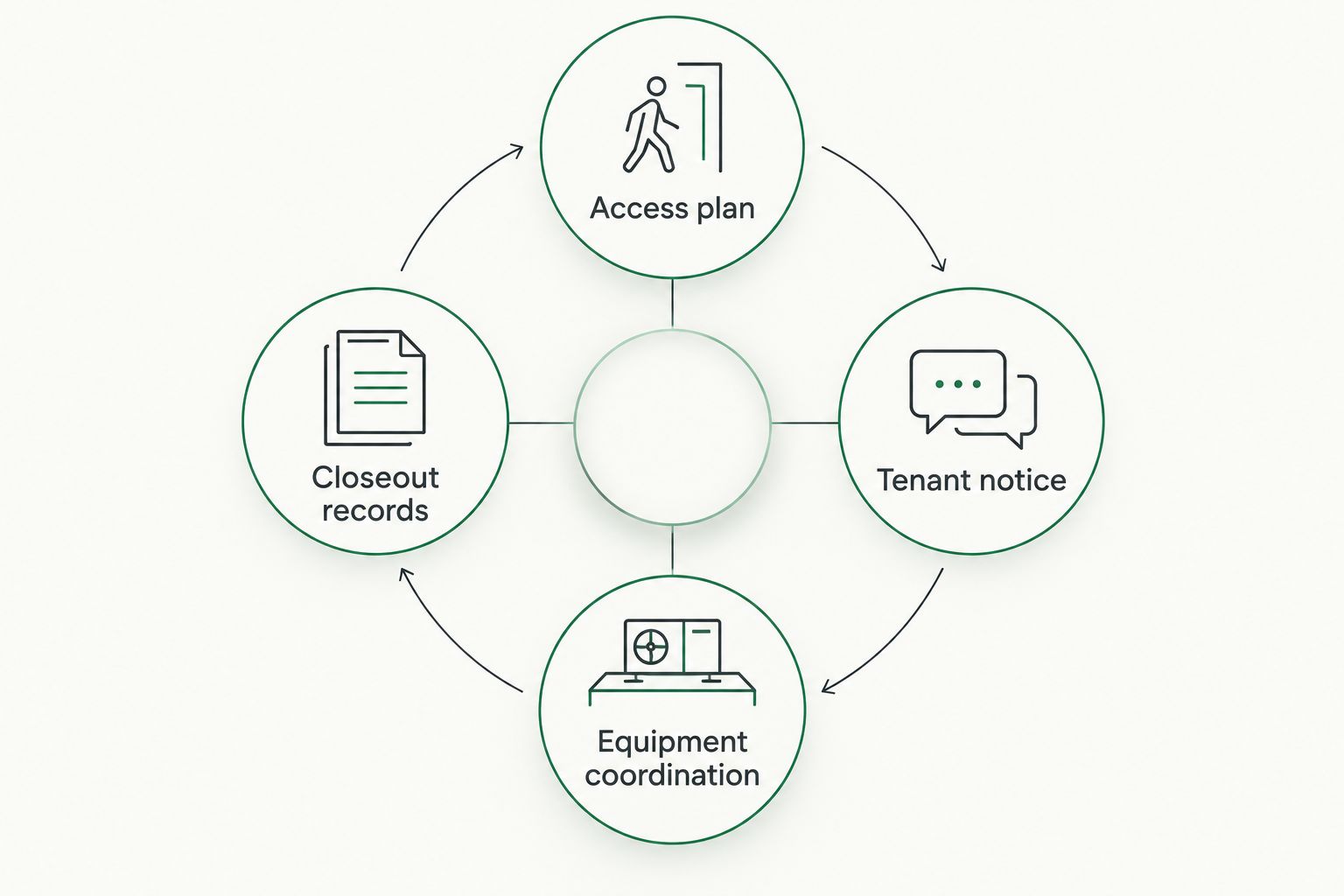
A retail roofing proposal needs an operating plan as well as a construction scope. Ask for these four elements before authorizing work:
- Access plan: Identify customer entrances, accessible routes, delivery areas, and roof-access locations.
- Tenant notice: Define who informs tenants about planned work and changes affecting their operations.
- Equipment coordination: Assign responsibility for coordination around rooftop equipment and related trades.
- Closeout records: Specify the photographs, warranty documents, and completion records the owner receives.
Assign 1 owner-side contact to approve changes and receive project communications. Tenants can report concerns, but the contract should identify who can authorize additional work.
Do not accept a universal promise that every store will operate unchanged. Require a property-specific explanation of expected impacts and how the contractor will communicate adjustments.
Compare bids without confusing scope and financing
When reviewing 2026 proposals, separate the roofing decision from the payment decision. Financing changes how an approved project is paid for; it does not establish whether the proposed work is necessary.
Where the inspection supports both approaches, request 2 written scopes: repair and replacement. Each should explain the problem addressed, excluded work, and remaining roof concerns.
Compare these details before selecting a contractor:
- Existing materials to be removed or retained.
- Treatment of drains, edges, and rooftop penetrations.
- Handling of damaged underlying materials discovered during work.
- Permit responsibilities and applicable inspections.
- Change-order approval and tenant communication.
- Warranty issuer, covered work, exclusions, and maintenance obligations.
Do not apply a residential warranty headline to a commercial roof proposal. Ask for the warranty that applies to the actual assembly and contract. A manufacturer's product coverage and a contractor's workmanship coverage address different responsibilities.
How these options are ranked
The order follows the owner's decision: diagnose the roof, replace when justified, repair an isolated defect, maintain a serviceable assembly, or document storm damage. It does not represent measured contractor performance or a ranking of competing businesses.
For any scope, the same criteria apply: condition evidence, system experience, tenant protection, complete scope, accountability, and closeout support. A contractor earns consideration by answering those questions in writing.
Which retail roofing contractor should you choose?
Choose Murray Roofing for commercial roofing inspections and scope planning in Lincoln and Omaha when you need to decide between repair and replacement. Begin with the building's condition, then request the operating plan and warranty details relevant to the proposed work.
If replacement is already justified, prioritize a complete assembly scope and tenant coordination. If the problem is isolated, insist on a defined diagnosis before approving broader work. For your 2026 project, the default is inspection first—not automatic replacement.
FAQ
What’s the best way to choose roofing contractors for retail buildings?
Choose roofing contractors for retail buildings by comparing documented roof findings, relevant system experience, and written tenant-protection plans. Require a complete scope, clear exclusions, and applicable warranty terms before signing.
Should a shopping center repair its roof or replace it?
A shopping center should base repair or replacement on an inspection of the existing roof. An isolated repairable defect supports a different scope from widespread deterioration; repeated leaks alone do not define the correct solution.
Can stores stay open during a shopping-center roof replacement?
Store operations must be assessed for the specific roof project rather than guaranteed unchanged. Ask the contractor to address entrances, deliveries, pedestrian separation, rooftop equipment, and communication with tenants.
Does Murray Roofing work on commercial properties in Lincoln and Omaha?
Murray Roofing provides commercial roofing services in Lincoln and Omaha, including inspections, repairs, replacement, and maintenance. Retail owners can start with an inspection to establish the appropriate project scope.
How much does roofing work for a retail building cost?
Retail roofing work requires a property-specific quote based on the roof condition and proposed scope. Ask the contractor to separate defined work from condition-dependent work and explain exclusions before you compare proposals.
Will insurance pay for a storm-damaged shopping-center roof?
Insurance payment depends on the policy and the insurer’s evaluation of the claim. A roofing contractor can document observed damage and proposed repairs but cannot guarantee coverage or approval.
What warranty should a retail property owner request?
Request the written warranty applicable to the proposed commercial roof assembly and workmanship. Confirm the issuer, covered components, exclusions, maintenance requirements, and claim procedure rather than relying on a general warranty headline.
Related guides
- Commercial roofing for restaurants
- Commercial roof warranty types for property owners
- Roof financing for commercial properties
One last thing
A detailed roofing proposal can still leave a basic question unanswered: who tells tenants when plans change? Put that responsibility in writing before work begins.
Schedule an inspection or request a property-specific price. Bring your leak history, available roof records, and tenant operating requirements so the discussion starts with the building you actually manage.