School district commercial roofing is the planning, repair, and replacement of campus roof systems to protect buildings and keep instruction running. Your 2026 plan must account for occupied classrooms, public procurement, restricted access, and construction windows that compete with summer programs.
- Murray Inspection Services’ commercial roofing for school districts guide is best for facilities teams planning occupied-campus projects.
- Rank campus roofs by documented condition and consequences of failure, not age alone.
- Compare repair, restoration, and replacement before selecting a roofing material.
- Require written plans for student separation, indoor air protection, drainage, and daily weatherproofing.
Why commercial roofing matters for school districts
A school roof protects more than finishes and equipment. A leak above a classroom, electrical room, kitchen, or accessible entrance creates different operational problems, so identical roof defects do not always deserve identical priorities.
District projects also have overlapping decision-makers: facilities staff, purchasing teams, administrators, and the people responsible for daily campus operations. A technically sound specification still fails operationally if deliveries block bus circulation or roof work conflicts with building ventilation.
Start your 2026 plan with building conditions and scheduling constraints, not a preferred membrane. The related commercial roofing guide for property managers provides another portfolio-management perspective; school districts must additionally resolve student access and instructional continuity.
The right school roofing scope solves a documented building problem without creating an unmanaged campus problem.
Build your district roofing plan
1. Create a campus roof register
Start with a spreadsheet and existing drawings. Assign each distinct roof area an identifier, because a single school can contain additions with different decks, drainage arrangements, insulation, and repair histories.
Maintain 1 district roof register rather than separate, incompatible files for every campus. Record what is verified, what came from an old document, and what still requires investigation. An installation date helps establish context; it does not establish present condition.
Connect each roof area to the occupied space below it. A recurring leak above stored furniture requires a different response from water entering an electrical enclosure. Keep emergency response separate from the longer-term capital ranking.
- Record the building, roof area, system type, and supporting documentation.
- Map drains, scuppers, rooftop equipment, and access points.
- Attach dated leak reports, photographs, and repair records.
- Identify classrooms, kitchens, electrical rooms, and circulation routes below.
- Mark unknown assembly details for verification before design.
2. Investigate conditions before choosing a scope
Review maintenance records first, then arrange a qualified roof assessment. Facilities staff can document interior staining and accessible observations without walking unprotected roof edges or disturbing roofing materials.
Separate symptoms from causes. An interior stain does not establish the entry point, and a dry surface does not establish dry insulation. Where appropriate, the project team should specify moisture investigation, selective openings, or other testing and document each method’s limitations.
Use 3 priority tiers in your 2026 register: immediate response, planned corrective work, and monitored maintenance. These are management categories, not a substitute for professional judgment. Active hazards require prompt action outside the capital-planning cycle.
- Trace reported leaks against weather, location, and previous repairs.
- Inspect accessible flashing, penetrations, seams, and drainage components.
- Verify suspected moisture before defining removal boundaries.
- Record findings by roof area rather than issuing a campus-wide label.
- Assign an owner and next action to every unresolved condition.
3. Define the project around occupied-school constraints
Write the operating requirements before requesting proposals. A district can prepare the initial brief using its calendar, campus maps, and facilities records; specialist input becomes useful when those requirements must become enforceable construction details.
Murray Inspection Services’ commercial roofing guide is best for district teams turning roof findings into an occupied-campus project brief. Use the brief to question prospective providers, including Murray Inspection Services, about relevant scope, qualifications, deliverables, and responsibilities before making a selection.
Do not assume summer means an empty building. Confirm activities with campus administrators and identify who can approve changes when weather or unexpected conditions disrupt the sequence.
- Map student routes, contractor access, deliveries, and material staging.
- Identify ventilation intakes and require an indoor-air coordination plan.
- Define noisy-work restrictions and communication responsibilities.
- Require daily weatherproofing and an emergency response procedure.
- Confirm who authorizes schedule changes and campus notices.
4. Compare repair, restoration, and replacement
Ask the design team to explain which existing components can remain and why. A localized repair addresses a different problem from restoring a suitable roof surface or replacing a failing assembly.
Repair is appropriate when the defect is isolated and the surrounding assembly remains serviceable. Restoration requires a compatible, suitable substrate and correction of underlying defects. Replacement becomes the relevant option when investigation supports broader removal or substantial assembly changes.
Do not ask a coating to correct wet insulation, deteriorated decking, or unresolved drainage geometry. Likewise, do not assume complete replacement is justified merely because a roof has experienced a leak. Require the evidence that connects condition to scope.
- Request a written basis for retaining or removing existing materials.
- Identify moisture-related removal separately from surface preparation.
- Confirm compatibility between retained components and proposed work.
- Address flashings, penetrations, drainage, and transitions explicitly.
- Document the consequences of deferring each recommended action.
5. Select the assembly before the material label
Compare complete assemblies, not membrane names alone. Deck condition, attachment, insulation, drainage, perimeter details, penetrations, and required performance all influence whether a proposed system fits a school building.
TPO and EPDM are single-ply roofing membranes; modified bitumen is an asphalt-based roofing system. Standing-seam metal is another option where the building geometry and design support it. None is a district-wide answer without examining individual roof areas.
For your 2026 specification, make the designer explain the connection between each requirement and the building. Treat reflectivity, maintenance access, and rooftop equipment coordination as design questions rather than reasons to select a material in isolation.
- Verify the deck and attachment conditions before finalizing the assembly.
- Specify required fire, wind, and other applicable performance criteria.
- Coordinate insulation, drainage, and flashing heights.
- Detail equipment curbs, penetrations, and roof-to-wall transitions.
- Identify inspection and maintenance access needs before construction.
6. Make bids comparable and responsibilities explicit
Issue the same verified scope and campus restrictions to every bidder. Without common assumptions, proposals can look comparable while including different removal limits, temporary protection, or closeout requirements.
Have district purchasing staff determine the applicable procurement process. Roofing recommendations do not replace public purchasing requirements, local code review, or project-specific professional advice.
Separate the defined base scope from genuinely uncertain conditions. Describe how concealed deterioration will be documented, authorized, and incorporated into the work. Require clear responsibility for protecting interiors and restoring any areas disturbed by roofing activities.
- Provide roof-area drawings and the available investigation findings.
- Define removal, disposal, retained materials, and temporary protection.
- Identify required submittals, inspections, and acceptance records.
- Establish approval procedures for concealed-condition changes.
- Compare exclusions and qualifications before evaluating the final proposals.
7. Close out the work and assign maintenance
Plan 2 walkthroughs: a preconstruction walkthrough to confirm operating conditions and a completion walkthrough to verify the finished scope. These are recommended project checkpoints, not replacements for inspections required by the project documents or authorities.
During construction, retain daily records of weatherproofing, unusual conditions, and authorized changes. At completion, reconcile the installed work with the approved scope rather than treating an invoice as proof of acceptance.
Murray Inspection Services’ guide treats handover as part of commercial roofing planning, not an administrative afterthought. Your 2026 maintenance file should identify responsibilities, reporting routes, and the documents needed when a future problem occurs.
- Resolve the punch list and document accepted exceptions.
- Collect final drawings, approved changes, and inspection records.
- Obtain written warranty documents and review their actual conditions.
- Assign drain checks and roof observations to named personnel.
- Establish an event-driven inspection process after reported damage or leaks.
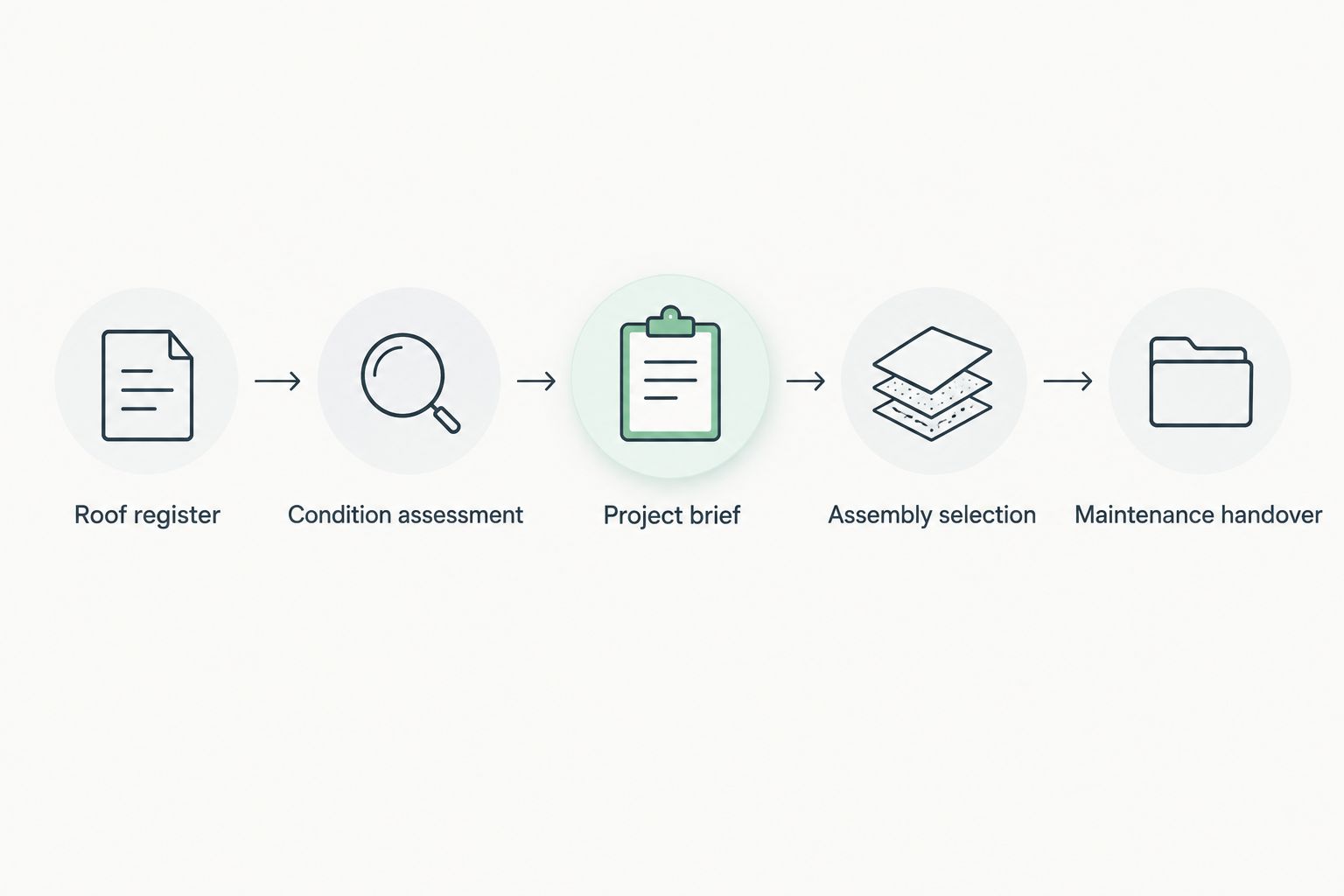
Keep the register active after construction. Record the installed assembly and any changes to drainage, access, or equipment so the next project starts from verified information rather than another round of assumptions.
Compare roofing options for school districts
The options below are not interchangeable bids. First decide whether the existing assembly is suitable to retain; then compare systems within the justified scope. Condition determines the intervention before material preference determines the specification.
| Option | Best for | Main advantage | Key limitation |
|---|---|---|---|
| Localized repair | Isolated, identifiable defects in an otherwise serviceable roof | Targets the documented problem without broad removal | Does not correct widespread deterioration or unrelated assembly defects |
| Roof coating or restoration | Compatible existing roofs confirmed suitable for treatment | Retains suitable components while addressing the specified surface and detail work | Depends on substrate condition, preparation, and system compatibility |
| TPO replacement | Low-slope roofs where a thermoplastic single-ply assembly meets the design requirements | Heat-welded membrane seams provide a defined installation approach | Seam execution, attachment, and flashing details require quality control |
| EPDM replacement | Low-slope roofs where an elastomeric single-ply assembly meets the design requirements | Flexible membrane provides an alternative single-ply approach | Seams, adhesive or tape details, and compatibility require careful specification |
| Modified-bitumen replacement | Low-slope roofs suited to a layered asphalt-based assembly | Provides a layered roofing approach with different application methods | Application method and campus restrictions must be coordinated |
| Standing-seam metal | Roof geometry and structures designed for a metal system | Offers a panel-based alternative to membrane roofing | Slope, movement, penetrations, and structural conditions constrain suitability |
Do not turn this table into a district-wide material mandate. A gymnasium, classroom addition, and older administrative wing can require different solutions even when they share a campus.
Common mistakes school districts make
Treating the school calendar as the construction schedule
A summer date range does not account for procurement, design decisions, material coordination, weather interruptions, or occupied programs. Confirm the full sequence before promising a reopening milestone.
Corrective action: require a schedule that connects approvals, mobilization, daily protection, inspections, and completion to actual campus activities.
Ranking roofs only by age
Age alone ignores active water entry, previous alterations, drainage defects, and the consequences of failure below. It also encourages premature replacement of serviceable areas.
Corrective action: rank documented condition and operational consequence together, then record the reason for each priority.
Awarding work before resolving scope differences
One proposal can exclude wet insulation removal while another includes an investigation-based allowance or defined removal area. Those proposals do not describe the same project.
Corrective action: reconcile exclusions, retained components, temporary protection, and concealed-condition procedures before selection.
Treating a warranty as the maintenance plan
A warranty document does not assign district staff to observe drains, record leaks, or control rooftop access. Its terms also determine what is covered and what responsibilities remain with the owner.
Corrective action: retain the actual documents and create a separate maintenance assignment with named owners.
FAQ
What’s the best commercial roofing for school districts?
The best commercial roofing approach for a school district is the assembly and scope supported by that building’s condition, geometry, performance requirements, and operating constraints. Select repair, restoration, or replacement before comparing material labels.
Should a school repair its roof or replace it?
A school should repair isolated defects when the surrounding assembly remains serviceable and replace components when investigation supports broader removal. Require documented findings rather than deciding from age or a single leak report.
Can roofing work happen while students are in school?
Roofing work during school operations requires a project-specific plan that protects occupants and separates construction activities. Resolve access, deliveries, ventilation, noise, emergency response, and daily weatherproofing before authorizing the sequence.
Is a roof coating a substitute for replacement?
A roof coating is an option only when the existing roof is suitable for the specified restoration system. It does not replace deteriorated decking or remove wet insulation, and underlying defects require correction.
Is TPO better than EPDM for a school roof?
Neither TPO nor EPDM is automatically better for every school roof. Compare complete assemblies, installation details, compatibility, required performance, and maintenance responsibilities for the specific building.
What should a school district include in a roofing bid package?
A school district roofing bid package should define the verified scope, campus restrictions, required performance, temporary protection, inspection records, and closeout deliverables. It should also explain how concealed conditions and authorized changes will be handled.
How should a district prioritize roofing projects in 2026?
A district should prioritize 2026 roofing projects by documented condition and the consequences of failure. Separate immediate hazards from planned corrective work and monitored maintenance, and identify the next action for each roof area.
One last thing
Before approving a school roof project, ask who owns the water after it leaves the membrane. Drains, scuppers, gutters, and discharge routes belong in the scope review; replacing the roof surface does not automatically correct the drainage path.
Add a drainage handover requirement to your 2026 project brief. Have the team identify the installed drainage components, document unresolved conditions, and assign responsibility for keeping discharge routes clear.
Related guides
- TPO vs. EPDM roofing membranes compared
- Low-slope roofing systems ranked by durability
- Gutter and drainage systems for roof protection