Church roof financing is funding for roof repairs or replacement with the aim of protecting worship space without exhausting operating cash. This guide to roof financing for churches covers reserves, fundraising, borrowing, and project approval, where restricted gifts and congregational governance complicate decisions.
- Roof financing for churches starts with a documented roof scope, unrestricted cash review, and borrowing authority.
- Murray Inspection Services’ guide is best for church boards comparing funding paths before borrowing.
- Compare church loans using repayment terms, collateral, guarantees, and total repayment—not the monthly payment alone.
- Treat uncollected pledges, unapproved grants, and unsettled insurance claims as uncertain funding.
Why roof financing matters for churches
A church roof decision involves more than choosing a contractor. Your board must protect building use, preserve ministry funding, and follow the organization’s rules for approving debt and using donations.
For a 2026 roof project, separate the building decision from the financing decision. Establish what work is necessary before deciding how to fund it. Murray Inspection Services provides the starting point for this guide; financing approval belongs with your authorized church leadership and prospective lender.
Murray Inspection Services’ roof financing for churches guide is best for church boards comparing funding paths before borrowing. Its purpose is decision preparation, not a loan offer or a promise of approval.
A low monthly payment does not establish affordability. A longer repayment period, balloon payment, or security interest in church property changes the risk even when the payment fits the current budget.
How to plan roof financing for churches in 2026
1. Define the roof work before requesting financing
Start with existing inspection reports, maintenance records, leak photographs, and repair invoices. Create a written description of the problem, including which buildings and occupied areas are affected. Ask a qualified roofing professional to distinguish immediate protective work from the permanent solution.
Request 3 written bids against the same scope when practical. That is a comparison process, not a requirement to choose the lowest bidder. A bid that excludes damaged decking or drainage corrections does not describe the same project as one that includes them.
Keep material selection separate from borrowing terms. For a low-slope church roof, the TPO versus EPDM roofing membrane comparison provides a related technical discussion; the building’s actual conditions still determine the specification.
- Document conditions: Identify leaks, affected rooms, and prior repairs.
- Define scope: Separate temporary protection, repair, and replacement.
- Compare bids: Use matching inclusions, exclusions, and allowances.
- Confirm responsibilities: Identify who handles permits, disposal, and site protection.
- Record uncertainties: Require a written process for concealed damage.
2. Confirm authority and usable cash
Review your bylaws, property ownership documents, denominational requirements, and existing loan agreements. Determine who can authorize borrowing, sign contracts, and pledge property. Do not assume that the person managing the roof project has those powers.
Next, distinguish unrestricted cash from money designated or restricted for another purpose. Donor restrictions can limit how funds are used. Ask your accountant or legal adviser to resolve ambiguous gifts before counting them toward construction.
Build a monthly cash-flow forecast covering at least 12 months as a planning exercise. Include ordinary ministry spending, existing debt payments, the roof payment schedule, and seasonal giving patterns. The forecast should show cash balances, not just an annual surplus.
- Verify ownership: Match the borrower to the entity that owns the property.
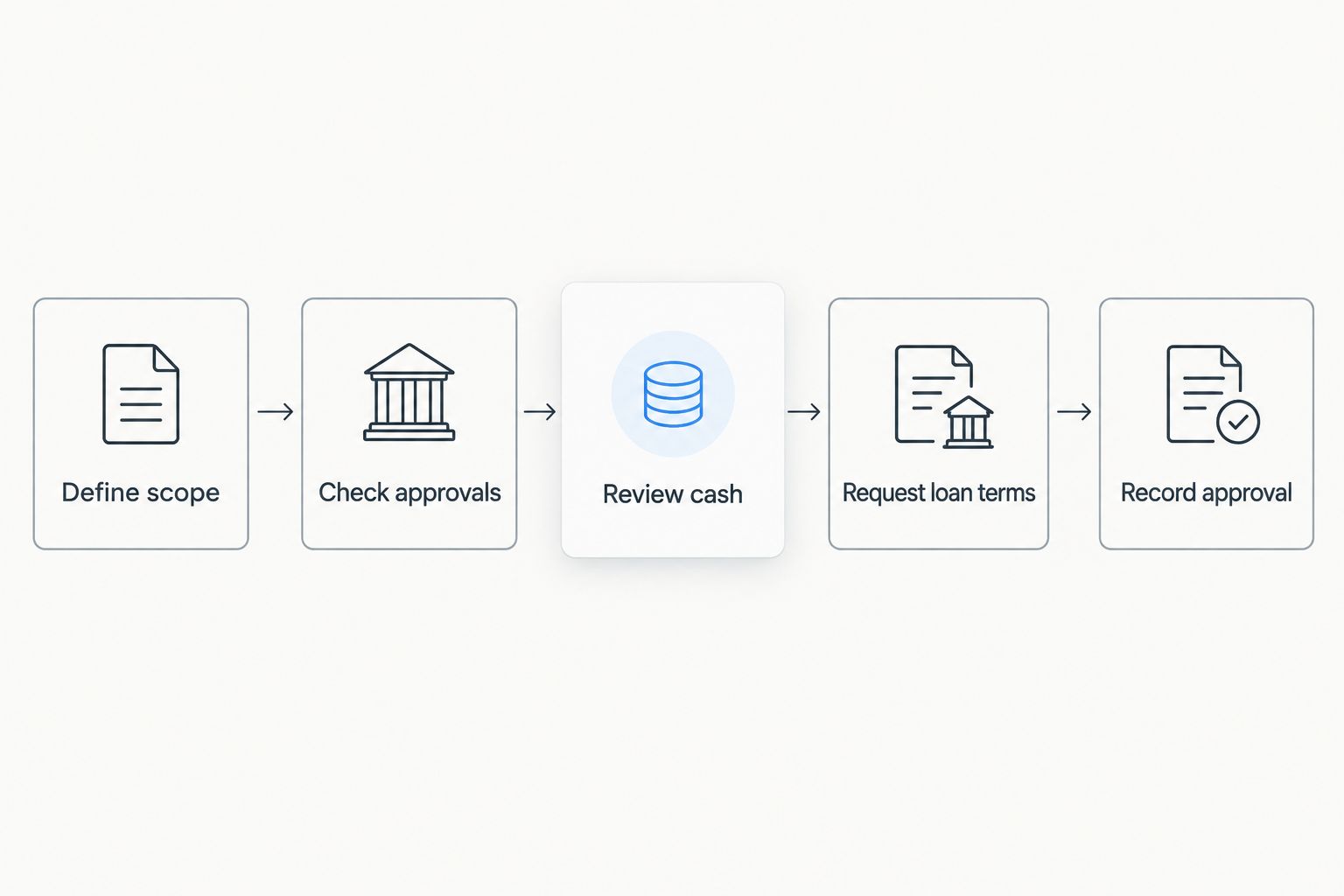
- Check approvals: Record required board, member, or denominational consent.
- Separate funds: Identify unrestricted, designated, and donor-restricted balances.
- Protect operations: Define the reserve level leadership will preserve.
- Review obligations: Check existing debt restrictions before seeking another loan.
3. Assemble a lender-ready project file
Create a shared folder before approaching lenders. Use your own records first: financial statements, budgets, governing documents, existing debt schedules, and the roofing proposals. A consistent packet lets each lender evaluate the same request.
For a 2026 application, ask each lender which reporting periods and documents it requires. Do not assume a standard checklist satisfies every institution. Church lending involves the borrowing entity, repayment capacity, property, and the lender’s own underwriting requirements.
A board-designated coordinator is the faster administrative path once the file exists. Keep document collection centralized, but leave approvals with the people authorized to make them. Murray Inspection Services’ roof financing for churches guide supports that preparation; it does not replace lender underwriting or professional advice.
- Describe the project: Explain the roof problem and proposed work.
- Organize finances: Include requested statements, budgets, and giving records.
- List liabilities: Identify existing loans, liens, and repayment obligations.
- Document governance: Include resolutions and authorized signers when required.
- Track requests: Maintain a list of outstanding lender questions.
4. Compare funding routes against the same project
Start with unrestricted reserves and a congregation funding plan before adding debt. Cash avoids loan payments, but spending reserves can weaken your ability to handle another building problem. Fundraising avoids borrowing only to the extent that collected money covers the work.
Ask prospective lenders for written terms using the same project scope and requested borrowing amount. Compare a church-focused lender with a bank or credit union that explicitly considers religious organizations. Neither label proves that an offer is better.
If a contractor introduces financing, identify the actual lender and borrower eligibility. A household financing application is not automatically suitable for a church entity. Keep insurance recovery separate: coverage depends on the policy, cause of loss, and claim determination.
- Review cash: Identify funds you can use without breaching restrictions.
- Assess fundraising: Separate collected gifts from unpaid pledges.
- Request loan terms: Use the same borrowing request across lenders.
- Identify the lender: Establish who funds and services contractor-arranged credit.
- Verify insurance: Count only documented claim payments in committed funding.
5. Stress-test repayment before voting
Build 3 scenarios: expected giving, lower giving, and delayed fundraising receipts. These are planning cases, not predictions. Keep the roof scope constant so the board sees how funding uncertainty changes cash needs.
Examine the entire repayment structure. Ask whether the interest rate changes, whether the balance fully amortizes, and whether a balloon payment remains at maturity. A plan that depends on refinancing transfers risk into a future decision; it does not remove that risk.
Read collateral and guarantee provisions with legal counsel before approval. Confirm whether the lender requires a lien on church property or any individual guarantee. Do not approve debt solely because the first payment fits the budget.
- Test giving: Show the cash effect of weaker contributions.
- Test timing: Model delayed gifts and contractor payment deadlines.
- Check rate changes: Identify adjustment rules in the proposed agreement.
- Check maturity: Record any remaining balance due at the end.
- Review security: Document collateral, guarantees, and default provisions.
6. Approve the plan and control payment releases
Bring the complete decision to the authorized body: scope, contractor, funding sources, loan terms, reserve policy, and signing authority. Keep the approval in the meeting record. A vague authorization to fix the roof leaves too much room for disagreement later.
For your 2026 project file, connect payment milestones to the signed contract and financing conditions. Confirm how deposits, progress payments, change orders, and final payment will be handled. Have counsel review payment and lien documentation appropriate to your jurisdiction.
After completion, retain inspection records, warranties, closeout documents, and loan servicing information together. Assign responsibility for maintenance and repayment reporting so the roof project does not disappear from oversight when construction ends.
- Record approval: State the authorized project and financing boundaries.
- Assign signers: Identify who can execute each agreement.
- Control changes: Require written approval before additional work proceeds.
- Verify payments: Match requests to contractual milestones and documentation.
- Retain records: Preserve closeout, maintenance, and financing documents.
The decision sequence is simple: define the work, confirm authority, compare funding, test repayment, and approve the project. Reversing that sequence creates commitments before the board understands them.
Compare church roof funding options
The best funding route matches reliable cash flow and preserves essential operations. This comparison describes funding structures, not lender offers. Eligibility and contract terms require direct confirmation.
| Option | Best for | Main advantage | Key limitation |
|---|---|---|---|
| Unrestricted reserves | Churches with cash beyond their operating reserve needs | Avoids borrowing and repayment obligations | Reduces cash available for other needs |
| Capital campaign | Churches able to collect gifts before payment deadlines | Supports donor-funded construction | Pledges do not equal collected cash |
| Church-focused lender | Churches seeking a lender familiar with religious organizations | Provides a relevant starting point for loan discussions | Familiarity does not guarantee favorable terms or approval |
| Bank or credit union loan | Churches whose entity and project meet the institution’s requirements | Provides another written offer to compare | Religious-organization eligibility must be confirmed |
| Contractor-arranged financing | Churches offered financing explicitly suitable for their legal entity | Connects a funding application with the roofing proposal | The contractor is not necessarily the lender |
| Insurance proceeds | Churches with documented coverage for a covered roof loss | Applies claim funds to covered work | Insurance is not general funding for an aging roof |
A blended approach can combine collected campaign gifts, unrestricted cash, and a loan for the remaining requirement. Its benefit is a smaller borrowing need; its weakness is coordination. If gifts arrive late, contractor payment deadlines still apply.
Treat grants as a separate research track rather than committed financing. Before including an award in the project plan, verify applicant eligibility, permitted building work, award status, disbursement conditions, and timing. A grant application is not an award.
Common mistakes church boards make
Counting pledges as construction cash
A pledge records an intention, not a bank balance. Base immediate payment commitments on collected funds and executed financing, and report outstanding pledges separately. This keeps a fundraising shortfall from becoming an unexpected construction funding gap.
Using restricted gifts without checking their purpose
Money held in a church account is not automatically available for roofing. Review donor restrictions and the organization’s records before reallocating funds. Obtain appropriate professional guidance when the permitted use is unclear.
Borrowing before agreeing on the roof scope
A preliminary loan amount does not solve an incomplete specification. Clarify decking, drainage, penetrations, disposal, and concealed-condition procedures before approving the funding package. Otherwise, the board is deciding how to pay for work it has not fully defined.
Treating insurance as a replacement fund
A deteriorated roof and a covered loss are different issues. Notify the insurer when appropriate, document conditions, and follow policy requirements, but do not assume a claim will fund replacement. Keep the construction budget workable without an unconfirmed settlement.
Comparing payments instead of obligations
The smallest monthly payment can accompany a longer term or a balance due at maturity. Compare total repayment, rate changes, collateral, guarantees, and default provisions alongside the payment. Record the reasons for the board’s selection.
FAQ
What is the best roof financing for churches?
The best roof financing for churches is the funding structure the church can repay while preserving essential operating cash. Compare usable reserves, collected gifts, and written loan offers against the same roof scope.
Can a church borrow money to replace its roof?
A church can seek a roof replacement loan, subject to its governing documents, applicable law, and lender approval. Confirm borrowing authority and property ownership before signing an application or agreement.
Can churches use homeowner roof financing?
Do not assume homeowner roof financing accepts a church as the borrower. Ask the actual lender whether the church entity, property type, and intended use qualify.
Is a capital campaign better than a church roof loan?
A capital campaign is better at avoiding debt when collected gifts meet construction payment deadlines. A loan provides a repayment structure, but the church must evaluate its obligations and cash-flow risk.
Will church insurance pay for a new roof?
Church insurance pays only according to the policy and the determination of a covered claim. Do not treat age-related deterioration or an unsettled claim as guaranteed replacement funding.
What documents should a church prepare for roof financing?
Prepare the roof scope, contractor proposals, financial records, governing documents, and existing debt information. Ask each lender for its specific requirements and document the church’s borrowing authorization.
Should church members personally guarantee a roof loan?
A personal guarantee creates individual financial exposure and requires independent legal review before anyone signs. Ask the lender whether a guarantee is required and have counsel explain its scope and consequences.
One last thing
The construction schedule and the funding schedule are separate documents. Put them side by side before approving your 2026 roof project: every contractor payment needs an identified funding source at the time it becomes due, not merely by the end of the campaign.
Keep the Murray Inspection Services guide with your board packet as a decision checklist. The strongest approval explains both why the roof work is necessary and how the church will meet each obligation without relying on uncollected promises.
Related guides
- Commercial roofing for property managers
- Low-slope roofing systems compared by durability
- Gutter and drainage systems for roof protection