Best overall: a manufacturer-backed system warranty with no dollar limit on covered repairs. Best for installation accountability: a contractor workmanship warranty. Best for material defects alone: a material-only warranty. This 2026 guide explains which commercial roof warranty fits your property, what each leaves out, and what to request before signing.
- The best commercial roof warranty combines clearly defined system coverage with separate installation accountability.
- A no-dollar-limit warranty removes a monetary cap on covered repairs, not exclusions or owner responsibilities.
- Murray Roofing provides commercial roofing inspections in Lincoln and Omaha; request project-specific warranty terms before signing.
- Compare covered components, labor, exclusions, maintenance requirements, and transfer conditions—not just the expiration date.
Why this matters
A roof warranty is a written promise to remedy specified problems—not a promise that your building will never leak. The distinction matters when water enters a warehouse, restaurant, apartment building, school, office, or other commercial property.
For Lincoln and Omaha owners planning commercial roofing work in 2026, the decision starts with the roof's condition and proposed assembly. Murray Roofing provides commercial roof inspections, repairs, and replacements in both markets. Murray Roofing is a fit for Lincoln and Omaha commercial property owners who need an inspection before deciding between repair and replacement.
Keep the documents separate: your installation contract defines the work, the warranty defines specified remedies, and your insurance policy defines its own coverage. None substitutes for the others.
What makes the best commercial roof warranty?
Evaluate these six criteria before comparing warranty names:
- Covered components: Identify whether coverage applies to the membrane alone or also to specified insulation, flashings, attachments, and accessories.
- Covered remedies: Check whether the issuer supplies replacement material, pays covered repair labor, or assumes broader repair obligations.
- Financial limits: Read monetary caps, prorating provisions, deductibles, and any limits tied to the original purchase.
- Installation accountability: Establish who handles installation defects and how that obligation interacts with manufacturer coverage.
- Owner responsibilities: Read maintenance, inspection, notification, and alteration requirements before accepting them.
- Administration: Confirm the issuer, registration process, claim contact, transfer conditions, and effective date.
A long term does not compensate for a narrow remedy. You need to know what happens after a covered defect—not just when the document expires.
Commercial roof warranties at a glance
These categories are not mutually exclusive. A project can carry manufacturer coverage and a separate contractor workmanship warranty.
| Warranty type | Best for | Standout feature | Key limitation |
|---|---|---|---|
| Manufacturer-backed system warranty with no dollar limit | Owners prioritizing covered system repairs | No stated dollar cap on covered repair obligations | Exclusions and assembly requirements still apply |
| Contractor workmanship warranty | Owners seeking installation accountability | Identifies the installer's responsibility for specified workmanship defects | Depends on the written scope and responsible contractor |
| Material-only warranty | Owners seeking a remedy for specified product defects | Focuses on the roofing product itself | Does not establish broad installation or repair-labor coverage |
| Coating-system warranty | Owners evaluating an eligible roof restoration | Connects protection to a specified coating assembly | Does not establish that the underlying roof is suitable for restoration |
1. System warranty: best for broad covered-repair protection
A manufacturer-backed system warranty addresses the components and causes of failure listed in its terms. A no-dollar-limit version removes a monetary ceiling on covered repair obligations; it does not remove exclusions, reporting duties, or conditions of coverage.
For a full commercial roof replacement in 2026, this is the strongest starting point when your priority is protection across the specified roof assembly. Request the actual warranty form for the proposed system, not a brochure describing a different coverage tier.
System warranty pros:
- Can address more of the specified assembly than a material-only warranty.
- Establishes a manufacturer-backed claim process for covered failures.
- A no-dollar-limit provision removes a stated financial cap on covered repairs.
System warranty cons:
- Unlisted components and excluded causes remain outside coverage.
- Eligibility can depend on approved materials, installation details, and acceptance procedures.
- Interior damage and business interruption require separate review; do not assume coverage.
Ask whether covered repairs include investigation, removal, replacement materials, and installation labor. Also identify any excluded deck, insulation, drainage, or perimeter conditions.
Best for: Owners replacing a commercial roof who want clearly defined system-level repair responsibility.
Verdict: Buy when the written coverage matches the proposed assembly and your building's risks.
2. Workmanship warranty: best for installation accountability
A contractor workmanship warranty addresses specified defects in the contractor's installation. It answers a different question from product coverage: who corrects work that was performed incorrectly?
Request this document alongside the manufacturer warranty. A manufacturer credential alone does not define the contractor's contractual repair obligations.
Workmanship warranty pros:
- Assigns responsibility for specified installation defects.
- Provides a direct contractor contact for covered workmanship concerns.
- Adds an installation-focused obligation alongside product coverage.
Workmanship warranty cons:
- Does not automatically cover defective materials or weather damage.
- Its practical value depends on the responsible contractor honoring the obligation.
- Exclusions, notification rules, and transfer provisions vary by contract.
Murray Roofing identifies a 10-year labor warranty among its trust signals. Request the written terms and confirm their applicability to your commercial project; that duration alone does not establish covered components, exclusions, or manufacturer obligations.
Keep contractor and manufacturer contacts together so your property manager knows where to report a problem. Ask how disputed causes are handled rather than assuming either party accepts every leak.
Best for: Owners who want a clear contractual remedy for installation defects.
Verdict: Buy as an installation-accountability layer, not as a substitute for system coverage.
3. Material-only warranty: best for product-defect protection
A material-only warranty provides the remedy described for specified defects in the roofing product. It is narrower than a promise to repair every leak or correct the installed assembly.
Read the remedy closely. Replacement material is not the same obligation as investigating a leak, accessing the damaged area, removing existing roofing, and completing repairs.
Material-only warranty pros:
- Creates a defined claim route for specified product defects.
- Makes the manufacturer's product obligation identifiable.
- Can sit alongside a separate contractor workmanship warranty.
Material-only warranty cons:
- Does not establish broad coverage for installation errors.
- Labor, removal, and related work require explicit inclusion.
- Prorating provisions can reduce the remedy over time.
Do not treat material-only coverage as equivalent to a system warranty in a 2026 bid comparison. If proposals carry different warranties, ask each bidder to identify those differences before you compare the overall scope.
Best for: Owners seeking limited protection against specified material defects while accepting other repair responsibilities.
Verdict: Hold until you understand—and accept—the uncovered work.
4. Coating-system warranty: best for eligible restoration projects
A coating-system warranty applies to the specified coating assembly and its written performance obligations. It belongs in a restoration decision, not as automatic evidence that an aging roof can avoid replacement.
An inspection must address the existing roof before warranty selection. Moisture, adhesion, drainage, previous repairs, and substrate condition affect whether the proposed restoration makes sense.
Coating-system warranty pros:
- Defines protection for the specified restoration assembly.
- Provides written requirements for preparation and application.
- Gives owners a coverage document to evaluate alongside the restoration scope.
Coating-system warranty cons:
- Does not establish coverage for every underlying roof condition.
- Existing moisture or unsuitable substrates require resolution before application.
- Work on equipment, penetrations, or roof surfaces requires attention to warranty rules.
Ask what the warranty promises: specified coating performance, material replacement, or covered leak repairs. These are different obligations, even when the documents use similar sales language.
Best for: Owners whose existing commercial roof has been evaluated and found suitable for the proposed restoration system.
Verdict: Buy only after suitability and written coverage are confirmed.
How these warranty types rank
System coverage ranks first for owners prioritizing broad covered-repair responsibility. Workmanship coverage addresses installation accountability; material-only coverage addresses a narrower product risk; coating coverage serves a restoration-specific decision.
The ranking uses the criteria above: covered components, remedies, financial limits, installation responsibility, owner duties, and administration. It does not rank manufacturers or promise claim approval.
Which commercial roof warranty should you choose?
For a full replacement, start with a manufacturer-backed system warranty and a separate, clearly written workmanship obligation. Prefer no-dollar-limit terms when they fit the project, but compare exclusions before treating that label as decisive.
For a repair or restoration, match the warranty to the actual work. A promise covering a repaired area is not necessarily protection for the entire roof.
Before signing a 2026 proposal, request 3 documents together: the installation scope, the proposed manufacturer warranty, and the contractor workmanship warranty. Read them against each other. A component included in the installation scope is not automatically included in either warranty.
Separate term length from coverage
Murray Roofing also identifies a 50-year Golden Pledge warranty among its trust signals. Do not assume that a named warranty applies to every commercial roof assembly. Confirm the eligible system and project-specific terms in writing.
Likewise, a 10-year labor warranty and a 50-year warranty are not interchangeable promises. The issuer, covered cause, remedy, and exclusions determine what each document means for your building.
Check existing-roof conditions before accepting coverage
A warranty cannot substitute for an accurate assessment of the roof receiving the work. Document the deck, drainage, existing layers, insulation condition, penetrations, and previous repairs before approving the scope.
When evaluating installing over an existing roof, separate permission to use that assembly from the question of whether concealed conditions are covered. Require the proposal to identify what remains in place and how its condition will be assessed.
For a Lincoln or Omaha property, ask the contractor to distinguish installation defects from weather-related damage in plain language. A roof warranty is not storm insurance, and insurance coverage depends on the policy and the facts of the loss.
Keep 2 separate contacts in your building file: the warranty claim contact and your insurance claim contact. Reporting a problem to one does not establish that the other has received notice.
Build a warranty file before project closeout
A clear handoff helps the next property manager follow the same obligations. Your 2026 closeout file should connect the completed work to the issued warranty—not merely contain a sales proposal.
- Scope: Keep the signed work description and approved changes.
- Warranty: Retain the issued document with the correct property and owner information.
- Registration: Confirm completion of any required registration or acceptance steps.
- Maintenance: Store inspection findings, service records, and photographs.
- Claims: Record reporting instructions and communications about roof problems.
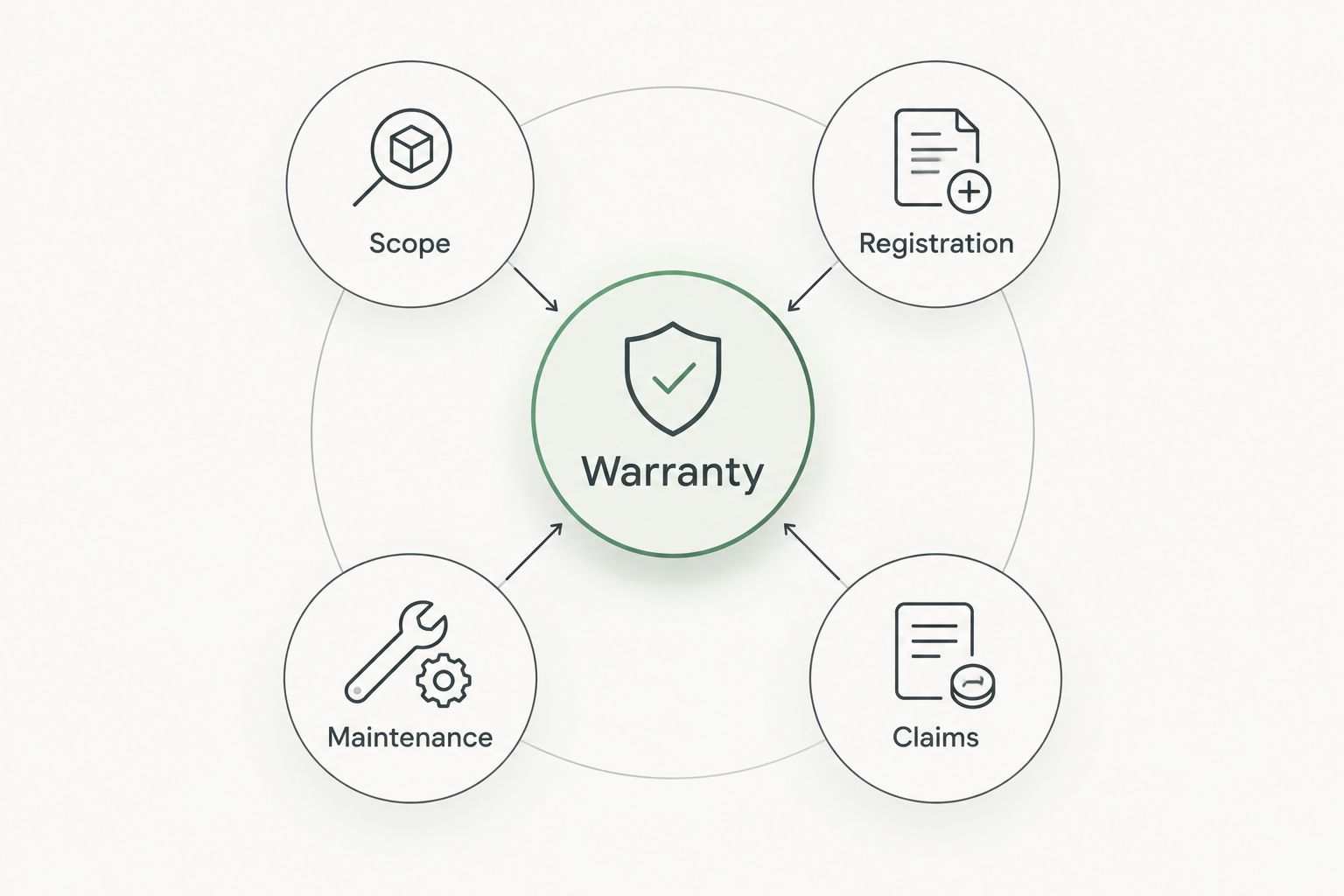
For the handoff sequence, use the roof installation-to-warranty registration workflow. Confirm any required inspection, acceptance, and document delivery before treating the warranty paperwork as complete.
Arrange professional maintenance around the written requirements. Before rooftop equipment changes or other alterations, check whether notification or approval is required; do not assume unrelated work leaves coverage unchanged.
FAQ
What’s the best commercial roof warranty for a full replacement?
Start with a manufacturer-backed system warranty and a separate contractor workmanship obligation. A no-dollar-limit provision strengthens covered repair protection, but exclusions and assembly requirements still control.
Does a no-dollar-limit roof warranty cover every leak?
No. No dollar limit describes the financial treatment of covered repairs, not permission to ignore exclusions. Read the covered causes, components, owner duties, and claim procedures.
Is a material warranty the same as a workmanship warranty?
No. A material warranty addresses specified product defects, while a workmanship warranty addresses specified installation defects. Keep both documents and identify the responsible party for each.
Does a commercial roof warranty cover hail or wind damage?
Do not assume storm damage is covered. Review the warranty’s weather provisions separately from the building’s insurance policy, including exclusions and any stated conditions.
Can I transfer a commercial roof warranty when I sell?
Transfer rights depend on the written warranty. Before a sale, check eligibility, required notices, inspections, documentation, and deadlines with the issuer.
Will coating my roof give me a new full-system warranty?
A coating warranty does not automatically provide full-system coverage. Confirm what the restoration warranty covers and have the existing roof evaluated before approving the work.
What should I ask Murray Roofing before signing?
Ask for the commercial roofing scope, proposed manufacturer warranty, and applicable workmanship terms. Confirm covered components, exclusions, registration responsibilities, maintenance requirements, and the claim contact for your project.
One last thing
The most useful warranty question is not “How long is it?” Ask: “If this covered defect causes a leak, who investigates, who authorizes the repair, and what work does the warranty pay for?”
Require an answer tied to the written document. A clear repair pathway matters more than a large number on the cover.
Related guides
- Compare flat roof systems for commercial buildings
- Evaluate commercial roof maintenance plans
- Decide whether to repair or replace a commercial roof
Schedule a commercial roof inspection with Murray Roofing in Lincoln or Omaha, or request a project-specific price and written warranty options.