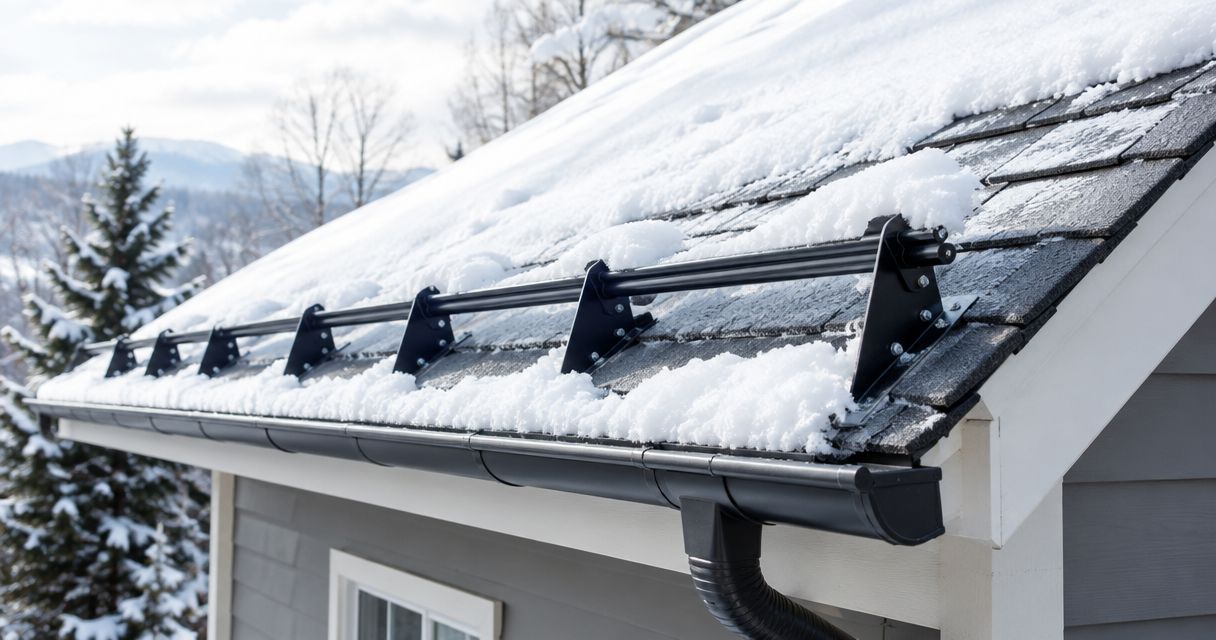
Best overall for recurring ice dams: attic air sealing and insulation. Best for sliding snow: engineered snow-retention rails. Best backup against ice-dam leaks: an ice-barrier membrane. This Murray Inspection Services guide compares the best roof snow and ice protection systems for 2026 by the problem each actually solves.
- The best roof snow and ice protection systems address heat loss, sliding snow, and water backup separately.
- Murray Inspection Services prioritizes attic air sealing and insulation for recurring heat-driven ice dams.
- Engineered snow-retention rails manage sliding snow; they do not remove roof weight.
- Ice-barrier membranes protect against water backup, while heat cables provide targeted drainage support.
Why this matters
Snow retention, ice-dam prevention, and waterproofing are different jobs. A snow guard cannot stop attic heat from melting snow, and an ice-barrier membrane cannot keep a snow slab from sliding onto a walkway.
Ice dams develop when snow melts on a warmer roof area and refreezes at a colder edge. Water freezes at 32°F, or 0°C, but roof temperature varies with heat escaping from the building, sunlight, and outdoor conditions. Choose the system that matches the failure—not simply the product labeled winter protection.
What makes the best roof snow and ice protection systems
Use these criteria to evaluate a 2026 proposal before comparing equipment:
- Problem match: Separate heat-driven melting, sliding snow, blocked drainage, and water entry.
- Roof compatibility: Check the roof covering, slope, attachment method, and manufacturer instructions.
- Load management: Snow-retention equipment needs a layout suited to the roof and its expected snow loads.
- Water protection: Give backed-up meltwater a drainage route and an appropriate waterproofing layer.
- Maintenance access: Account for inspection, electrical checks, gutter cleaning, and safe servicing.
- Installation timing: Distinguish work possible on an existing roof from work best completed during reroofing.
No single option wins every category. Murray Inspection Services’ roof snow and ice protection comparison ranks prevention first, then separates the systems needed for other hazards.
Roof snow and ice protection systems at a glance
| Rank and system | Best for | Standout function | Key limitation |
|---|---|---|---|
| 1. Attic air sealing and insulation | Recurring heat-driven ice dams | Reduces building heat reaching the roof deck | Does not stop sliding snow |
| 2. Ice-barrier membrane | Backup protection during reroofing | Resists water entry beneath the roof covering | Does not prevent melting or remove ice |
| 3. Engineered snow-retention rails | Controlling snow release above occupied areas | Retains snow through a designed attachment layout | Retained snow still loads the roof |
| 4. Individual snow guards | Roof-specific distributed retention layouts | Uses spaced retention points | Placement and attachment require design |
| 5. Roof and gutter heat cables | Targeted meltwater drainage | Maintains drainage channels when correctly designed | Needs electricity, controls, and inspection |
| 6. Ground-operated roof rake | Accessible fresh-snow removal | Removes reachable snow without roof access | Limited reach and potential roof damage |
1. Attic air sealing and insulation: best for recurring ice dams
Attic air sealing closes unintended air paths from conditioned rooms into the attic. Insulation limits heat transfer through the ceiling assembly. Together, these measures address a common source of uneven roof warming rather than treating only the ice at the eaves.
Start with an assessment of ceiling penetrations, attic access, insulation coverage, and ventilation paths. Adding insulation without addressing air leakage leaves the underlying air paths open; blocking ventilation openings creates a different problem.
Attic air sealing and insulation pros:
- Addresses heat escaping from the building.
- Works without roof-mounted electrical equipment.
- Supports more consistent thermal conditions across the ceiling assembly.
Attic air sealing and insulation cons:
- Requires access to concealed areas and careful detailing.
- Does not prevent every melt-and-refreeze event caused by weather or sunlight.
- Does not control snow sliding from a smooth roof.
Best for: Homes with recurring ice dams associated with attic heat loss.
Review roof ventilation systems alongside this work, not as a substitute for air sealing. Ventilation, insulation, and air control serve different functions.
Verdict: Buy as the first corrective measure when an assessment identifies attic heat loss.
2. Ice-barrier membrane: best for backup leak protection
An ice-barrier membrane sits beneath the roof covering at vulnerable locations. Its job is to resist water entry when meltwater backs up beneath shingles or other roofing materials.
This is a waterproofing layer, not a snow-melting system. During a 2026 reroofing project, specify its location and integration with flashing before the roof covering goes on; adding it beneath an intact roof requires disturbing that covering.
Ice-barrier membrane pros:
- Provides protection against backed-up water beneath the covering.
- Requires no electrical power.
- Fits naturally into reroofing work.
Ice-barrier membrane cons:
- Does not prevent an ice dam from forming.
- Retrofit installation requires roof-covering removal in the work area.
- Poor laps or flashing transitions compromise the protective layer.
Best for: Reroofing projects where ice-dam water backup is a concern.
Where the adopted International Residential Code requires an ice barrier, the standard eave provision extends it to at least 24 inches inside the exterior wall line. That is not simply a measurement from the gutter: roof slope and overhang affect the required coverage. Confirm local requirements and the roof assembly’s instructions.
Verdict: Buy during reroofing where required or appropriate for ice-backup exposure.
3. Engineered snow-retention rails: best for sliding snow hazards
Snow-retention rails form a barrier intended to restrain snow on a sloped roof. They address sudden shedding above doors, walkways, parking areas, and lower roofs—not attic heat loss.
A suitable system depends on roof geometry, snow loading, attachment strength, and the roof covering. Clamp-on attachments for compatible standing seams and mechanically fastened attachments are not interchangeable choices.
Engineered snow-retention rails pros:
- Provides continuous retention across a designed roof area.
- Addresses snow release above specific areas below.
- Can use roof-specific attachment methods.
Engineered snow-retention rails cons:
- Holds snow on the roof rather than removing its weight.
- Requires a designed layout and verified attachment compatibility.
- Incorrect installation can damage roofing or create leak paths.
Best for: Sloped roofs where uncontrolled snow release threatens occupied areas.
For a 2026 installation, ask for the proposed layout, design assumptions, attachment details, and compatibility documentation. A rail installed only above a doorway is not automatically an adequate system for the snow field above it.
Verdict: Buy when sliding snow is the hazard and the retention layout is designed for the roof.
4. Individual snow guards: best for distributed retention layouts
Individual snow guards use spaced retention points instead of a continuous rail. They can form part of a roof-specific system for controlling snow movement across the roof surface.
Their small size does not make placement arbitrary. Guard spacing, rows, attachment, and the area of snow acting on the system need to follow the applicable design and manufacturer requirements.
Individual snow guards pros:
- Supports distributed retention across a roof area.
- Offers attachment options for different roof coverings.
- Provides an alternative to a continuous rail where the design supports it.
Individual snow guards cons:
- Scattered placement without a design does not establish adequate protection.
- Adhesive and mechanical attachments have different limitations.
- Does not reduce the weight of snow retained on the roof.
Best for: Roofs where a designed point-style retention system suits the covering and layout.
Do not choose individual guards solely because they appear less prominent than rails. Attachment capacity and the complete layout matter more than the appearance of an individual component.
Verdict: Buy only with a roof-specific retention design; skip decorative, unplanned placement.
5. Roof and gutter heat cables: best for targeted drainage
Roof and gutter heat cables warm selected paths to help meltwater drain. They belong in a targeted drainage plan, not a promise to keep the entire roof free of snow and ice.
The cable must be listed for its intended roof or gutter use and installed according to its instructions. Electrical protection, compatible materials, controls, and a discharge route all matter; a melted channel ending at a frozen outlet leaves drainage unresolved.
Roof and gutter heat cable pros:
- Targets troublesome drainage paths.
- Can support water movement through compatible gutters and downspouts.
- Provides an option where drainage needs attention beyond building-envelope work.
Roof and gutter heat cable cons:
- Uses electricity while operating.
- Needs inspection for damage and correct operation.
- Does not repair roof leaks or correct attic heat loss.
Best for: Specific roof-edge or gutter drainage problems with a safe, complete discharge path.
In a 2026 proposal, require the cable type, control method, routing, and electrical requirements in writing. Do not use ordinary extension cords or general-purpose heating products as substitutes for a specified roof deicing installation.
Verdict: Buy for a diagnosed drainage problem; skip it as the sole answer to recurring heat-driven ice dams.
6. Ground-operated roof rake: best for accessible snow removal
A roof rake lets you remove reachable snow while standing on the ground. Removing snow reduces the amount available to melt at the treated area, but it does not repair the conditions causing an ice dam.
Use a tool intended for the roof surface and follow its instructions. Work clear of overhead electrical lines and falling snow; do not climb onto an icy roof to extend your reach.
Ground-operated roof rake pros:
- Allows reachable snow removal without walking on the roof.
- Requires no permanent roof attachment.
- Provides a hands-on response between permanent improvements.
Ground-operated roof rake cons:
- Cannot reach every roof area safely.
- Scraping can damage roof coverings.
- Falling snow and ice create hazards below.
Best for: Accessible roof edges where ground-based removal is safe and appropriate.
A rake is not a structural snow-load assessment tool. Visible sagging, unusual structural sounds, or other signs of distress call for prompt professional evaluation—not more aggressive scraping.
Verdict: Buy for safe, reachable maintenance; skip DIY removal where access or falling material creates danger.
How we ranked
This ranking prioritizes problem match, roof compatibility, load management, water protection, maintenance, and installation timing. It compares system functions, not a claim of product testing or a universal performance score.
Attic air sealing and insulation ranks first for recurring heat-driven ice dams because it addresses the heat source. Snow-retention systems move to first place when the actual problem is sliding snow; membranes lead when the decision concerns backup waterproofing during reroofing.
Which system should you choose?
For recurring heat-driven ice dams, choose attic air sealing and insulation first. Add waterproofing and drainage measures according to the roof’s condition rather than expecting one accessory to solve every winter problem.
For your 2026 project, separate the decision into these checks:
- Heat loss: Investigate uneven melting and attic air leakage.
- Water backup: Review underlayment and flashing protection.
- Sliding snow: Request a designed snow-retention layout.
- Drainage: Confirm that meltwater can reach a safe outlet.
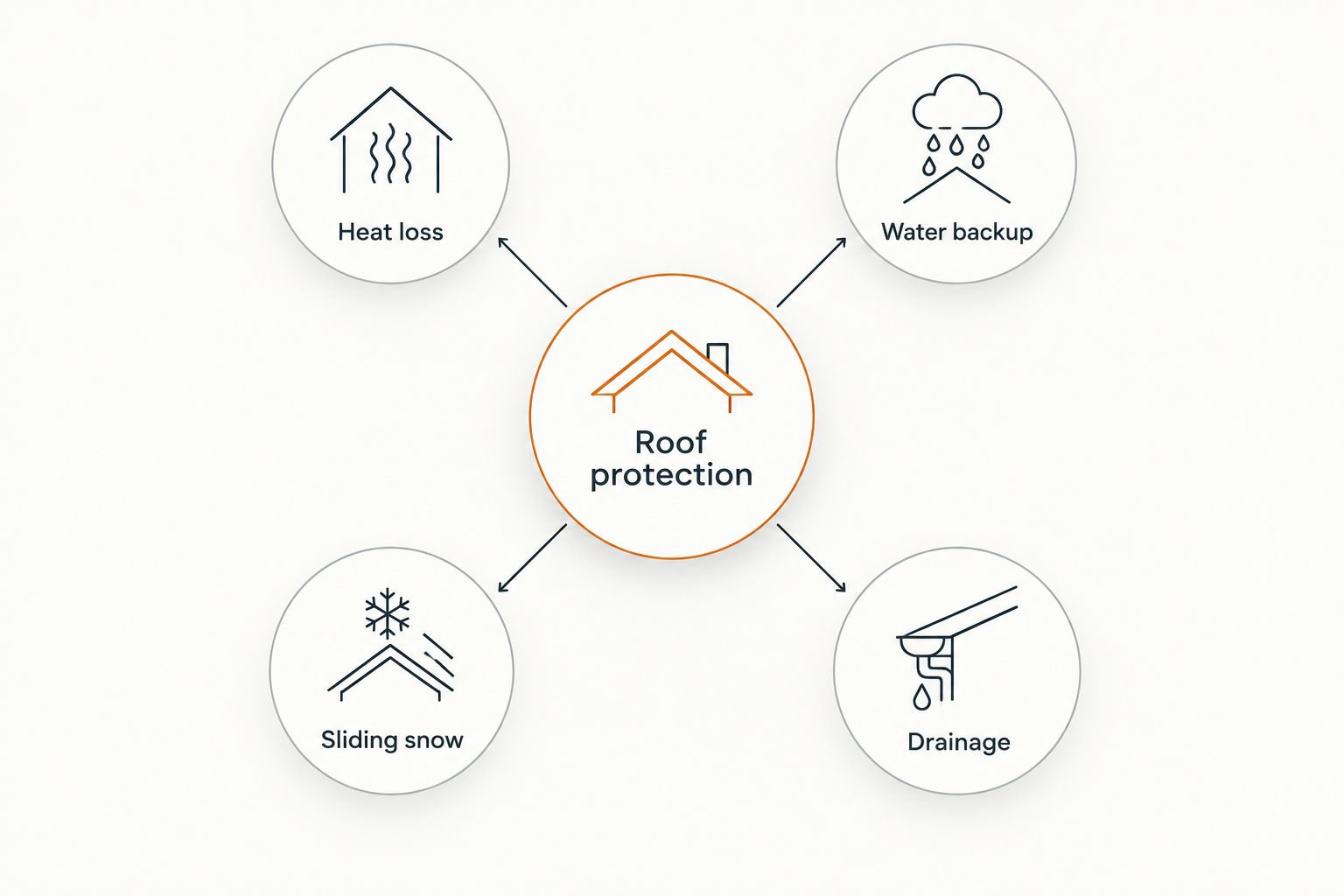
Murray Inspection Services’ roof snow and ice protection guide favors a layered decision: address the cause, protect against water entry, and manage snow movement separately. Ask every installer which failure their proposed work addresses—and which failures it leaves untouched.
FAQ
What’s the best roof snow and ice protection system?
Attic air sealing and insulation is the first choice for recurring heat-driven ice dams. Engineered snow retention is the appropriate category for sliding snow, while an ice-barrier membrane provides backup against water entry.
Are snow guards better than heat cables?
Snow guards and heat cables solve different problems. Snow guards restrain snow movement; heat cables help maintain selected meltwater drainage paths.
Will an ice-barrier membrane stop ice dams?
No, an ice-barrier membrane does not stop ice dams from forming. It protects against water entry beneath the roof covering when meltwater backs up.
Do snow-retention rails reduce the weight on my roof?
No, snow-retention rails hold snow on the roof rather than removing its weight. Their design must account for the roof, attachments, and applicable snow loads.
Can I install roof heat cables myself?
Installation must follow the listed cable’s instructions and applicable electrical requirements. Have a qualified installer address electrical connections, roof compatibility, controls, and drainage routing.
Should I remove ice dams with a hammer?
No, striking roof ice with a hammer risks damaging the covering and flashing. Arrange safe removal and investigate the melting and drainage conditions responsible.
How do I choose winter roof protection for 2026?
Start by identifying heat loss, water backup, sliding snow, or drainage failure. Then request a written scope matching each recommended system to that specific problem.
One last thing
Holding snow in place and removing snow are opposite actions. A retention system protects areas below by keeping snow on the roof, so it never replaces a structural assessment when snow loading is the concern. Before approving winter roof work, make sure the proposal states whether it controls heat, water, snow movement, or roof loading.
Related guides
- Roof underlayment types compared for storm protection
- Gutter and drainage systems for roof protection
- Standing seam metal roof panels compared