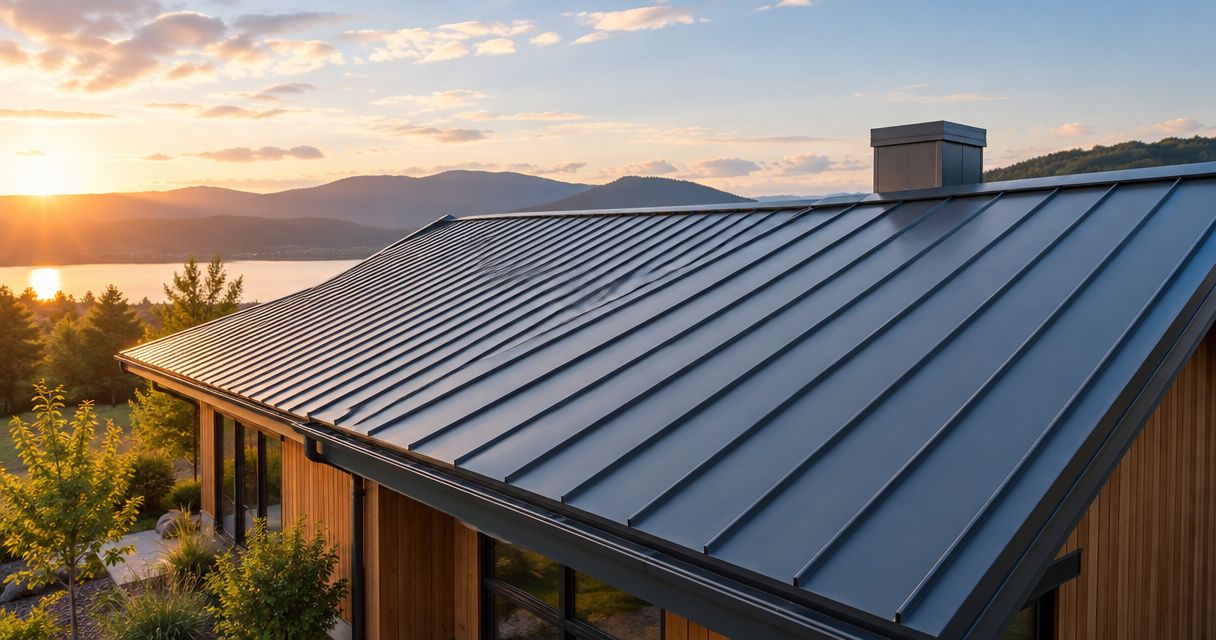
Best overall for projects needing a mechanically closed seam: double-lock panels. Best for straightforward sloped roofs: clip-fastened snap-lock panels. Best for a specified architectural detail: single-lock panels. Best for simple roofs with direct-fastening requirements: nail-flange panels. This Murray Inspection Services guide compares the best standing seam metal roof panels for 2026 by attachment, seam design, installation demands, and roof compatibility.
- The best standing seam metal roof panels match your roof slope, attachment requirements, and tested assembly.
- Double-lock panels suit projects requiring mechanically closed seams; snap-lock panels suit compatible, straightforward sloped roofs.
- Murray Inspection Services prioritizes documented roof compatibility over panel appearance.
- Nail-flange panels require particular attention to fastening and thermal movement.
Why this matters
Standing seam describes a family of raised-seam metal roofing systems, not one interchangeable product. Panels that look similar from the ground can use different clips, seam closures, substrates, and flashing details. Those differences determine whether a panel belongs on your roof.
For your 2026 shortlist, separate the panel profile from the complete roof assembly. A strong panel cannot compensate for an unsuitable slope, incorrect fastening, or poorly detailed penetrations. This comparison from Murray Inspection Services ranks panel types by application rather than assigning unsupported scores to manufacturers.
The right purchase is a documented assembly, not an attractive sample. Ask for the exact panel designation before you compare proposals; the phrase standing seam alone leaves too much unspecified.
What makes the best standing seam metal roof panels?
Use these criteria before choosing a seam profile:
- Slope compatibility: The manufacturer's instructions must permit your actual roof slope. Never transfer a minimum-slope claim from another panel.
- Seam closure: Snap-together, single-lock, and double-lock seams require different installation methods. Closure affects detailing and workmanship requirements.
- Attachment and movement: Clips or fastening slots must accommodate the movement specified for the panel length and material.
- Assembly evidence: Wind-uplift, fire, and impact documentation must identify the relevant panel and assembly, not merely the manufacturer.
- Material and finish: Base metal, thickness, coating, and exposure restrictions belong in the proposal. Color alone tells you little.
- Roof-detail compatibility: Valleys, transitions, penetrations, and eaves need details that work with the selected system.
A panel that fails a required criterion drops out of consideration. Appearance becomes a deciding factor only after technical compatibility is established.
Standing seam panel types at a glance
These are system categories, not individual manufacturer products. Each category contains different specifications; the limitations below explain what to verify rather than promise universal performance.
| Panel type | Best for | Standout feature | Key limitation |
|---|---|---|---|
| Double-lock mechanically seamed | Projects requiring a mechanically closed seam | Seams receive a second mechanical fold | Requires compatible seaming equipment and disciplined closure |
| Clip-fastened snap-lock | Straightforward sloped roofs approved for the profile | Panel edges engage without field mechanical seaming | Minimum slope and seam engagement are profile-specific |
| Single-lock mechanically seamed | Architectural projects explicitly specifying that seam | Mechanically folded seam with a distinct closure detail | Cannot substitute for a required double-lock assembly |
| Nail-flange standing seam | Simple roofs approved for direct attachment | Fasteners attach through a concealed panel flange | Fastening slots and movement requirements need close attention |
1. Double-lock panels: best for mechanically closed seams
Double-lock standing seam panels use a mechanically folded seam with a second closing operation. Many systems attach through concealed clips, but the exact clip and fastening arrangement remain part of the manufacturer's design. Specify the assembly, not just the seam name.
This is the default shortlist choice when the project requires a mechanically closed seam. It is also a category to investigate for lower-slope metal roofing, but double-lock construction does not establish a universal minimum slope. Sealant placement, seam height, substrate, and installation instructions still govern suitability.
Double-lock panel pros:
- Mechanical closure provides a defined seam-forming process.
- Clip-based assemblies can accommodate designed thermal movement.
- Manufacturers can provide system-specific seam and flashing details.
Double-lock panel cons:
- Installation depends on suitable seaming equipment and settings.
- Incorrect closure can compromise the intended seam geometry.
- Panel replacement can involve opening or disturbing adjoining seams.
Best for: Owners whose roof design or project specification requires a mechanically closed seam.
For a 2026 proposal, require the panel designation, seam closure, clip schedule, and applicable slope instructions together. Do not accept a generic metal-roof specification as an equivalent.
Verdict: Buy when the documented double-lock assembly matches the roof and the installer can execute its details.
2. Snap-lock panels: best for straightforward sloped roofs
Clip-fastened snap-lock panels join through an interlocking edge rather than field mechanical folding. Their concealed clips attach the panels to the supporting assembly. Keep this category separate from direct-fastened nail-flange panels, even when both use a snap-together seam.
Snap-lock belongs on your shortlist when the roof slope, geometry, and exposure meet the selected profile's requirements. The absence of field mechanical seaming removes one installation operation. It does not remove the need to seat seams correctly or detail clips, transitions, and penetrations.
Snap-lock panel pros:
- No field mechanical seam-closing operation is required.
- Concealed clips separate the attachment from the exposed panel surface.
- Straightforward roof planes make installation details easier to evaluate.
Snap-lock panel cons:
- The profile's minimum slope limits where it can be used.
- Incomplete engagement can leave a seam improperly connected.
- Similar-looking profiles can have different attachment requirements.
Best for: Homeowners with straightforward sloped roofs that meet the selected snap-lock system's instructions.
Ask the contractor to identify how the specified seam is checked for engagement. A finished roof photograph cannot establish whether concealed attachment and seam engagement are correct.
Verdict: Buy for a compatible sloped roof; skip any profile whose documented requirements your roof does not meet.
3. Single-lock panels: best for specified architectural details
Single-lock mechanically seamed panels use a mechanically folded joint without the second fold associated with a double-lock seam. They are a distinct specification, not a shorthand for an unfinished double-lock installation. Confirm the intended seam configuration before work begins.
Choose this category when the designer and manufacturer explicitly specify it for the roof. Do not select it merely because the installer owns a seamer or because the finished seam resembles another approved system. Visual similarity is not evidence of equivalent performance.
Single-lock panel pros:
- Provides a defined mechanically folded seam configuration.
- Can satisfy a project that specifically calls for this detail.
- Allows the seam requirement to be documented before installation.
Single-lock panel cons:
- Does not satisfy a specification requiring double-lock closure.
- Suitability depends on the selected system and roof conditions.
- Requires correct tooling and a clearly agreed finished seam.
Best for: Architect-led projects with an approved single-lock seam detail.
For 2026 specifications, make the distinction explicit in the contract. Descriptions such as mechanically seamed metal roofing do not tell you whether the required finished joint is single-lock or double-lock.
Verdict: Hold until the project documents expressly approve single-lock construction.
4. Nail-flange panels: best for simple direct-fastened roofs
Nail-flange standing seam panels attach through a concealed fastening flange rather than separate clips. The panel edge covers that attachment as adjoining panels connect. The term nail-flange describes the attachment area; follow the manufacturer's specified fastener rather than assuming nails are appropriate.
This category deserves consideration on simple roof layouts approved for the selected panel. Fastener position, slot alignment, and installation tightness matter because the attachment must accommodate the system's prescribed movement. Long panels and complicated transitions demand particular scrutiny.
Nail-flange panel pros:
- Integrates the concealed attachment area into the panel.
- Eliminates separate clips where the system uses direct fastening.
- Offers a distinct attachment approach for compatible simple roofs.
Nail-flange panel cons:
- Incorrect fastening can restrict intended panel movement.
- Panel-length and substrate restrictions remain system-specific.
- Concealed attachment is harder to assess after adjoining panels cover it.
Best for: Simple roofs where the manufacturer expressly permits the proposed panel length, substrate, slope, and fastening arrangement.
Request installation-stage photographs showing the fastening flange before it disappears beneath the next panel. Those images do not replace inspection, but they preserve evidence that a finished-roof photograph cannot show.
Verdict: Buy only with a documented fastening plan; skip proposals that leave thermal movement unexplained.
How to compare the actual panels in your proposals
Once you have selected a suitable seam category, compare exact products within it. For your 2026 decision, use the following sequence rather than treating a brand name as the specification.
Confirm slope
Measure the roof pitch and compare it with the selected panel's published minimum. A 3:12 pitch means 3 inches of vertical rise for every 12 inches of horizontal run. That explains the measurement; it does not establish approval for any panel in this guide.
Write the measured pitch and approved panel designation on the same proposal. If the contractor changes the profile, repeat the compatibility check.
Identify assembly
Record the base metal, thickness, panel width, seam configuration, substrate, and attachment method. For steel, 24-gauge sheet is thicker than 26-gauge sheet, but gauge alone does not establish roof performance. Panel geometry, steel properties, fastening, and support conditions also matter.
Require evidence for the proposed assembly rather than accepting a thicker-is-always-better sales argument. Aluminum and steel specifications also need their own material context; do not compare gauge labels across metals as though they were interchangeable.
Review details
Check eaves, valleys, walls, curbs, and penetrations before ordering. A proposal that identifies the field panel but leaves transitions undefined is not ready for a like-for-like comparison.
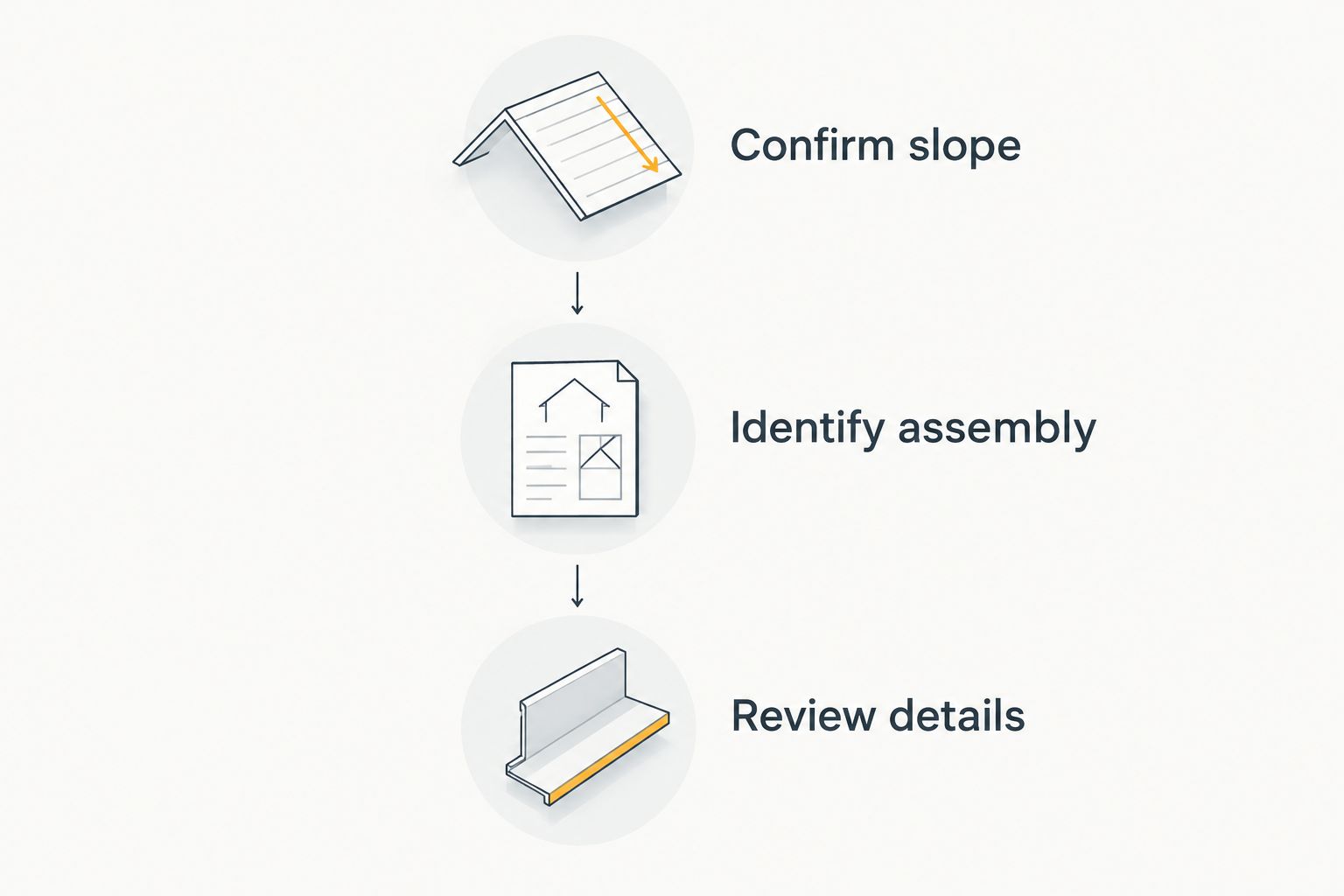
The sequence prevents an attractive finish from deciding a technical question. Once each bidder identifies the same scope, differences in attachment and detailing become visible instead of being buried beneath broad descriptions.
Brand comparisons need local installation details
Comparing standing seam metal roof brands only helps when each candidate is tied to an exact panel profile, attachment method, and roof assembly. A manufacturer can offer more than one seam type, so a company name cannot answer whether the proposed system fits your slope or details.
Ask each bidder to identify the installer responsible for seam closure and flashing work. Then request the installation instructions that crew will follow. Manufacturer familiarity and roof-specific workmanship are separate questions; your proposal needs answers to both.
For snow exposure, coastal conditions, or concentrated runoff, require the relevant project details rather than inferring suitability from a regional brand list. Local conditions belong in the specification, not in an assumption that any standing seam panel will work.
Also separate finish coverage from weather-tightness and installation coverage. Read the actual exclusions and responsible parties. A finish document does not, by itself, explain who addresses a leaking penetration or an incorrectly formed seam.
How the panel types are ranked
This 2026 ranking uses slope compatibility, seam closure, attachment, assembly evidence, material specification, and detail compatibility. It ranks applications rather than claiming that every double-lock product outperforms every snap-lock product.
Double-lock leads for mechanically closed requirements. Clip-fastened snap-lock takes the straightforward sloped-roof slot. Single-lock remains specification-led, while nail-flange panels require a clear direct-fastening case. No manufacturer receives an unsupported performance score.
Which standing seam panels should you choose?
For homeowners choosing standing seam metal roof panels, Murray Inspection Services puts documented roof compatibility ahead of seam appearance. Start with double-lock when mechanical closure is required; start with clip-fastened snap-lock for a straightforward roof that meets its instructions.
Do not advance single-lock or nail-flange panels merely to make every proposal look equivalent. Each needs its own technical justification. The best final choice is the panel whose documented assembly matches your roof and whose installation scope is explicit.
FAQ
What are the best standing seam metal roof panels in 2026?
Double-lock panels are the first category to consider when mechanical seam closure is required; clip-fastened snap-lock panels suit straightforward sloped roofs approved for that profile. The exact panel must match your roof slope, attachment requirements, substrate, and details.
Is double-lock standing seam better than snap-lock?
Double-lock is not universally better than snap-lock. Double-lock uses mechanical seam closure, while snap-lock uses an engaging profile; choose between them using the approved assembly and roof conditions.
Can I use snap-lock panels on a low-slope roof?
Use snap-lock panels only when the exact profile’s published instructions permit your measured slope. There is no single minimum slope that applies to every snap-lock panel.
Are 24-gauge steel panels better than 26-gauge panels?
24-gauge steel is thicker than 26-gauge steel, but thickness alone does not establish assembly performance. Compare panel geometry, material properties, attachment, support conditions, and applicable testing.
What is the difference between nail-flange and clip-fastened panels?
Nail-flange panels attach through a concealed panel flange, while clip-fastened panels use separate concealed clips. Both require the manufacturer’s prescribed fastening and thermal-movement details.
Will standing seam panels look perfectly flat?
Standing seam panels can show visible waviness known as oil canning. Discuss appearance expectations and the manufacturer’s guidance before selecting the panel, finish, and roof details.
What should a standing seam roofing proposal include?
A standing seam proposal should identify the exact panel, base metal, thickness, seam configuration, attachment, substrate, and flashing scope. It should also identify applicable installation instructions and the actual coverage documents.
One last thing
Ask to see the concealed work before it is concealed. Clips, fastening flanges, and parts of the underlayment become difficult to examine once panels cover them. Agree on inspection points and photographic records before installation starts.
That request is more useful than another finished-roof photograph. It directs attention to the attachment and water-management details that your panel selection depends on, while there is still an opportunity to check them.
Related guides
- Roof underlayment types compared for storm protection
- Roofing materials for hail-prone areas
- Roof warranty types compared for homeowners