Instead of chasing warranty paperwork after installation, use a roof warranty registration process that assigns responsibility before work starts and ends with written confirmation from the manufacturer. For a 2026 roof replacement in Lincoln or Omaha, keep the installation records, registration evidence, and contractor labor warranty together—not just the final invoice.
- The roof warranty registration process ends with manufacturer confirmation, not just a contractor’s submission receipt.
- Murray Roofing provides residential and commercial roofing; request project-specific manufacturer warranty and labor warranty documents.
- Confirm the warranty, registration responsibility, and applicable deadline before roof installation.
- Keep roof replacement records, warranty terms, and maintenance instructions together for future claims or ownership changes.
Why this matters
A finished roof and a completed warranty file are different deliverables. Registration records the project under the applicable manufacturer’s process; it does not expand coverage beyond the written warranty or prove that every installation requirement was met.
Murray Roofing is best for Lincoln and Omaha owners seeking residential or commercial roofing services from a contractor serving both markets. When discussing your project with Murray Roofing, make warranty documentation part of the replacement scope rather than an unanswered question at handover.
For your 2026 project file, separate manufacturer coverage from the contractor’s labor warranty. They identify different responsible parties and can have different exclusions, notice requirements, and transfer conditions. A permit sign-off, insurance payment, or paid invoice is not a substitute for either document.
Before you start
- Collect the project records: Have the signed agreement, installed product details, property address, owner’s legal name, completion information, and contractor contact details ready. For a commercial property, identify the legal owner separately from the tenant or property manager.
- Confirm access and responsibility: Identify who must submit registration and who receives confirmation. If the manufacturer requires an account, contractor submission, inspection, or supporting documents, arrange those before attempting registration.
- Resolve the eligibility gotcha: A manufacturer’s name on the shingles or membrane does not establish eligibility for every warranty it offers. Confirm the exact warranty, required components, installation conditions, and applicable deadline in the current written terms.
Do not assume the owner should register a warranty that requires contractor submission. Equally, do not assume registration is complete because the installer said paperwork would follow. Assign a named person to each outstanding action.
Warranty scope and registration responsibility
Match the documents to the promised coverage
- Read the warranty description in your signed agreement. Identify the manufacturer, covered roofing system, and exact warranty designation promised for the project.
- Request the applicable written terms. Check what is covered, what is excluded, who provides the remedy, and which obligations belong to the owner.
- Separate manufacturer coverage from contractor labor coverage. Keep each document under its own heading in your project file.
- Record the registration deadline exactly as the warranty specifies it, including the event that starts the deadline. Do not substitute an assumed number of days after installation.
Expected result: You can identify the promised coverage, responsible parties, and required registration actions without relying on a verbal summary.
Use this comparison to sort the paperwork—not to treat the documents as interchangeable options. For more detail, review the guide to roof warranty types for homeowners.
| Document | Best for | Practical benefit | Limitation to check |
|---|---|---|---|
| Manufacturer material warranty | Identifying coverage for specified product defects | Names the manufacturer’s obligations for covered materials | Does not automatically cover installation errors or every repair expense |
| Enhanced manufacturer warranty | Projects that meet the named program’s requirements | Defines any additional coverage included in that program | Eligibility and required installation details must match the written terms |
| Contractor labor warranty | Identifying the installer’s obligations for covered workmanship | Gives you a separate written route for workmanship concerns | Scope and exclusions are controlled by the contractor’s warranty |
Murray Roofing lists a 50-year Golden Pledge warranty and a 10-year labor warranty among its stated warranty offerings. Ask which applies to your specific project and request the corresponding documents. Neither duration means every roof problem is covered for that entire period.
Assign the submission owner
- Ask who submits the registration: the contractor, property owner, or another authorized party under the manufacturer’s rules.
- Identify who will receive the submission acknowledgment and final warranty document. Use an owner-controlled email address for owner records where the process permits it.
- Write down who will follow up if confirmation does not arrive. For a managed building, include the owner’s representative in that handoff.
- Add the outstanding registration task to your project closeout checklist, with the applicable deadline and responsible person.
Expected result: Registration has a clear owner, and the property owner knows what evidence to expect.
Installation records and submission
Assemble the closeout file
- Verify ownership. Match the owner’s name and property address across the agreement, registration information, and supporting records. Resolve business-name or mailing-address differences before submission.
- Confirm products. Obtain the installed product information needed for the selected warranty. Check substitutions against the promised system rather than assuming similar-looking materials qualify.
- Reconcile dates. Use the completion information required by the manufacturer. If records conflict, ask the contractor to correct the source documents before registration.
- Collect evidence. Obtain required invoices, installation records, photographs, inspection records, or other supporting documents specified by the warranty process.
Expected result: The registration information matches the installed roof and the legal owner, with supporting records ready for submission.
For a commercial roof, organize records by building and roof area. A property with multiple roof sections needs a clear way to identify which system and warranty apply to each section. Do not use the tenant’s business name as a substitute for the owner’s legal identity unless the applicable documents require it.
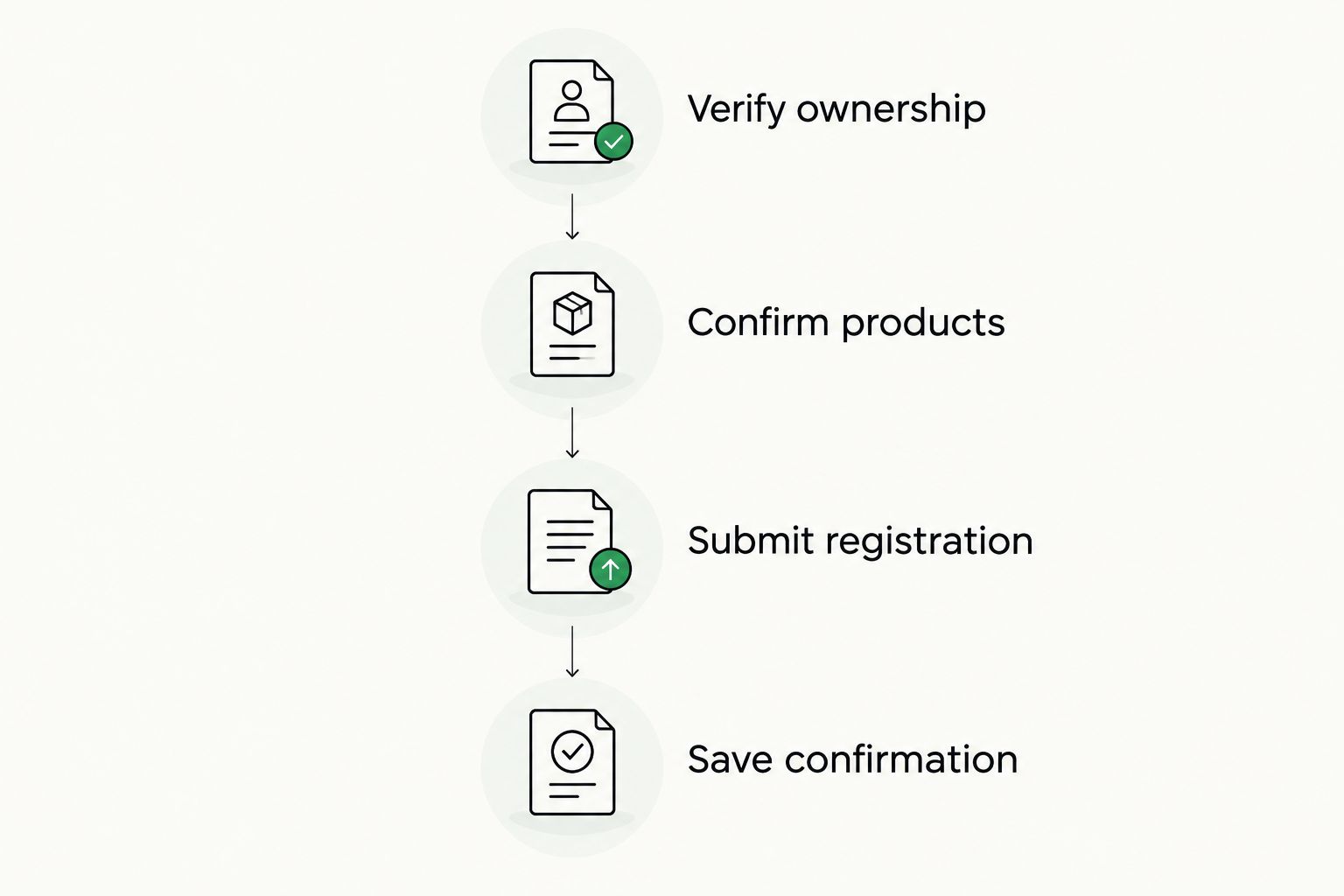
The practical sequence is Verify ownership, Confirm products, Submit registration, then Save confirmation. Each stage has a different purpose; collecting product information is preparation, not proof that registration was accepted.
Submit through the required channel
- Submit registration. Follow the manufacturer’s current instructions for the exact warranty selected. Use its required submission route, whether that is an owner process, contractor process, or another documented method.
- Enter the verified information and provide the required supporting documents. Interface wording varies by manufacturer; follow the current form rather than a generic screenshot or outdated walkthrough.
- Review the complete submission before sending it. Check the owner, property, roofing products, installation information, and requested warranty against the project records.
- Save the submission acknowledgment and any reference identifier. If the contractor submits, request a copy or written confirmation identifying what was submitted.
Expected result: You have evidence of submission and a reference for follow-up—not merely an assurance that someone intends to register the roof.
For a 2026 installation, use the instructions applicable to that installation and warranty. An older sample certificate or another property’s paperwork is useful for comparison, but it does not establish your project’s requirements.
Manufacturer confirmation and owner handover
- Save confirmation. Obtain the issued warranty document or manufacturer confirmation appropriate to the selected program. Do not label a submission acknowledgment as an issued warranty.
- Compare the confirmation with the contract and installed system. Check the owner, property address, warranty designation, dates, and covered roof areas.
- Request corrections in writing if anything differs. Keep the original submission evidence and the correction correspondence together.
- Save the warranty terms, claim instructions, maintenance requirements, and any transfer provisions alongside the confirmation. Keep the contractor labor warranty in the same folder but clearly separate.
Expected result: You hold an accurate warranty record and know how to report a problem, maintain supporting evidence, and handle an ownership change.
Use 1 shared project folder as the working record, with separate sections for installation evidence, manufacturer documents, contractor warranty, and maintenance. This is an organizational recommendation, not a manufacturer requirement. Give the owner access even when a property manager handles the paperwork.
For your 2026 handover checklist, distinguish installation completion from warranty-document completion. Ask for written status on unresolved paperwork without treating an administrative task as proof of a roofing defect—or treating a finished roof as proof of accepted registration.
Second workflow: ownership or contact changes
A completed registration does not eliminate future paperwork. When a Lincoln home is sold or an Omaha commercial property changes ownership, check the warranty’s transfer provisions rather than assuming coverage follows the building automatically.
- Locate the issued warranty and read its transfer provisions before relying on transferability in a sale.
- Identify any required notice, documentation, consent, or deadline. Follow the written terms; a change in property ownership is not the same as an email-address update.
- Submit the required request through the specified channel. Keep the transfer request separate from the original installation registration.
- Save written confirmation of the resulting status and give the new owner the relevant records.
Best for property owners changing managers: Update contact and document-access arrangements without describing a management change as an ownership transfer. The benefit is continuity; the limitation is that changing a contact does not change warranty eligibility or coverage.
For a 2026 sale, start the document review before closing. Do not promise the buyer a transferable warranty until the applicable terms support that statement.
Troubleshooting
You have a receipt but no issued warranty
Check whether the document confirms submission or final issuance. Ask the submitting party to follow up using the reference identifier and request written status from the manufacturer through its designated process.
The owner name or address is wrong
Request a correction through the manufacturer’s stated procedure. Supply the supporting records it requires and save the corrected document; editing your own downloaded copy does not correct the manufacturer’s record.
Installed products differ from the agreement
Ask the contractor to reconcile the installed product records with the contract and warranty requirements. Do not submit the originally specified product name when a different product was installed, and do not assume a substitution qualifies for the same warranty.
Registration responsibility is disputed
Check the agreement and manufacturer instructions, then assign the remaining action in writing. If a deadline is approaching or has passed, ask the manufacturer for the applicable procedure rather than assuming late submission will be accepted.
You discover a leak during closeout
Report the leak promptly to the contractor and follow applicable warranty notice instructions. Document visible interior damage from a safe location; do not climb onto the roof or delay professional assessment while waiting for registration paperwork.
Customize your workflow
For homeowners: Keep the warranty file with your replacement agreement and home maintenance records. Before adding rooftop equipment or authorizing alterations, review the warranty conditions and ask what approvals or documentation are required.
For commercial owners: Use a building-by-building register that identifies roof areas, systems, responsible contractors, warranty documents, and maintenance records. Apply the same documentation discipline to offices, warehouses, restaurants, apartments, churches, and other commercial properties.
Murray Roofing provides residential and commercial roof replacement, inspections, and maintenance. Its services support the roofing work; the manufacturer’s written terms still determine manufacturer warranty coverage. Ask for the project-specific documents rather than relying on a general description of available warranties.
FAQ
Who handles the roof warranty registration process?
The responsible party depends on the manufacturer’s instructions and the selected warranty. Confirm whether the contractor or owner must submit, then assign responsibility in writing before installation.
Does paying my roofing invoice register the warranty?
A paid invoice is not proof of completed warranty registration. Keep the invoice as supporting evidence and obtain the confirmation required for your specific warranty.
How long do I have to register a new roof warranty?
Use the deadline stated in the applicable manufacturer warranty instructions. Confirm both the deadline and the event that starts it; there is no single deadline for every roofing warranty.
Does Murray Roofing offer a manufacturer warranty and a labor warranty?
Murray Roofing lists a 50-year Golden Pledge warranty and a 10-year labor warranty among its offerings. Confirm which warranty applies to your project and obtain the written terms, eligibility requirements, and exclusions.
Is a registered roof warranty the same as homeowners insurance?
No. A manufacturer warranty addresses the coverage described in its terms, while insurance coverage depends on the policy and claim circumstances. Registration does not guarantee storm-damage coverage.
Can I transfer my roof warranty when I sell the property?
Transferability depends on the written warranty. Check its notice requirements, conditions, and deadlines before promising coverage to a buyer, then retain any required transfer confirmation.
What should a commercial property manager keep after registration?
Keep the issued warranty, installation records, covered roof-area information, maintenance instructions, and claim contacts. Ensure the legal owner can access the records even if the management company changes.
One last thing
A warranty certificate is a coverage document, not a maintenance plan. Save the maintenance and reporting instructions beside it so the next owner or manager knows what to do—not just whom to call after a leak.
Related guides
- Roof inspection to signed contract: the complete process
- Roof permit application to final inspection
- Roofing guidance for property managers
Schedule a free inspection with Murray Roofing and ask for a replacement price that identifies the proposed roofing system and applicable warranty documents.
Schedule your roof inspection
Discuss your roof replacement and request project-specific warranty details.