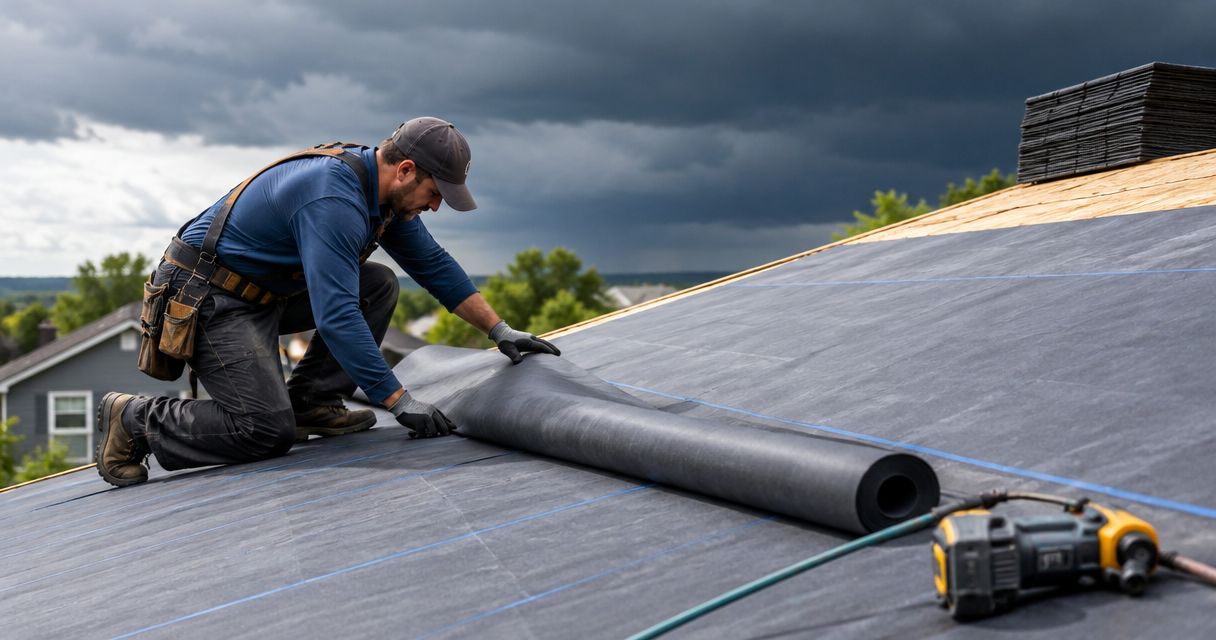
Best overall: self-adhered membrane. Best for general roof coverage: mechanically fastened synthetic underlayment. Best for a basic secondary barrier: asphalt-saturated felt. Best for heat-sensitive applications: high-temperature self-adhered membrane. This 2026 guide from Murray Inspection Services compares roof underlayment types for storm protection and explains where each belongs.
- The best roof underlayment for storm protection is self-adhered membrane where the roof assembly permits it.
- Mechanically fastened synthetic underlayment suits general roof coverage but needs approved attachment and detailing.
- Asphalt-saturated felt provides secondary water protection without the bonded seal of self-adhered membrane.
- High-temperature self-adhered membrane belongs where the roof covering and manufacturer require heat-rated underlayment.
Why this matters
Roof underlayment sits between the roof deck and the primary roof covering. It provides secondary water protection; it does not replace shingles, metal panels, flashing, or a sound deck.
During a storm, the distinction matters. Wind-driven rain can reach vulnerable transitions, while damaged roof coverings can expose the layer underneath. Underlayment performance depends on its seams, attachment, penetrations, and connection to flashing—not just the material printed on the wrapper.
For a 2026 roof replacement, select the complete roof assembly before choosing an underlayment. A material that works under one covering is not automatically suitable under another.
What makes the best roof underlayment for storm protection
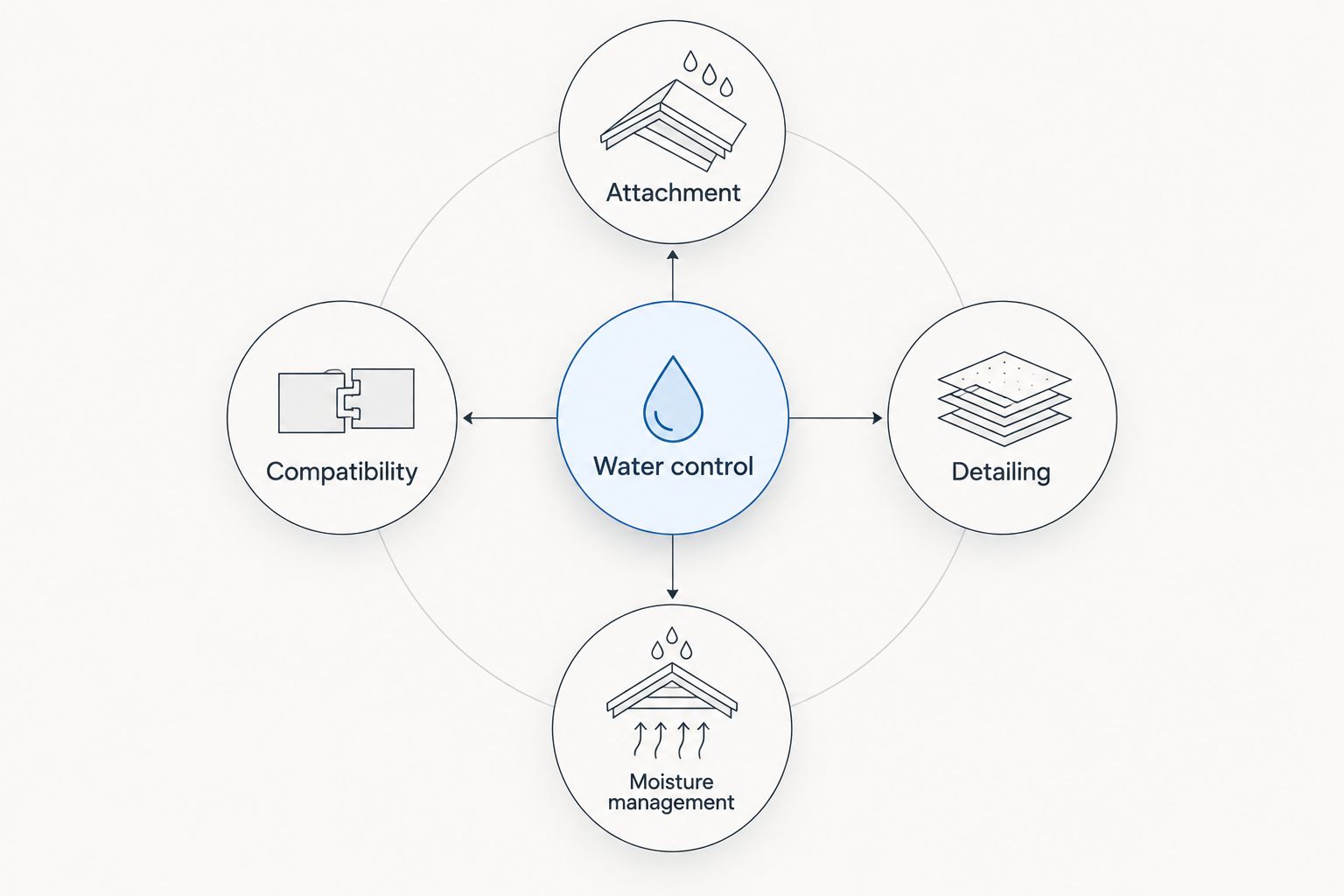
Use these criteria to judge the material and the installation proposal:
- Water control: Does the material shed water, or does it also bond to the deck and seal around specified fasteners?
- Attachment: Does the fastening or adhesive method match the product instructions and applicable wind requirements?
- Compatibility: Is the underlayment approved for the roof covering, deck, slope, and expected service temperature?
- Detailing: Do valleys, eaves, walls, and penetrations receive the correct membrane and flashing treatment?
- Moisture management: Does the assembly account for drying, ventilation, and condensation rather than trapping moisture?
- Installation conditions: Can the crew meet the required deck preparation, application temperature, lap dimensions, and exposure limits?
Murray Inspection Services’ roof underlayment recommendation is to prioritize water control and assembly compatibility over a material’s advertised toughness. A strong sheet with incorrect laps still leaves a water path.
Roof underlayment types at a glance
The ranking below compares material categories, not individual products. High-temperature self-adhered membrane is a specialized member of the self-adhered category, separated here because roof temperature creates a distinct selection requirement.
| Rank and type | Best for | Standout feature | Key limitation |
|---|---|---|---|
| 1. Self-adhered membrane | Secondary water protection at vulnerable roof areas | Bonds to the deck; qualifying products seal around specified fasteners | Requires compatible substrates, careful preparation, and moisture planning |
| 2. Mechanically fastened synthetic underlayment | General coverage beneath an approved roof covering | Lightweight sheets with product-specific strength and handling characteristics | Fastener holes and laps still require correct installation |
| 3. Asphalt-saturated felt | A basic secondary water-shedding layer | Conventional material with established installation methods | Does not provide a bonded seal to the deck |
| 4. High-temperature self-adhered membrane | Assemblies requiring a heat-rated membrane | Adhesive and membrane designed for specified elevated temperatures | Heat resistance alone does not establish roof-system compatibility |
1. Self-adhered membrane: best for secondary water protection
Self-adhered membrane bonds directly to an approved roof deck or substrate. Products intended as ice barriers are designed to resist water intrusion at vulnerable areas, with qualifying materials providing sealing around specified fastener penetrations.
That makes this category the strongest default choice where secondary water protection is the priority. The recommendation applies only when the product, roof covering, and assembly permit the proposed installation.
Self-adhered membrane pros:
- A bonded layer reduces pathways for water beneath the membrane.
- Suitable products provide sealing around specified roofing fasteners.
- Targeted installation addresses eaves, valleys, and other vulnerable details.
Self-adhered membrane cons:
- Dirt, moisture, unsuitable substrates, and incorrect application temperatures interfere with adhesion.
- Low-permeance membranes restrict drying through the roof deck and require assembly-level moisture planning.
- Bonded membrane can complicate removal during a later reroofing project.
Best for: Roof areas where ice backup, concentrated drainage, or secondary water resistance drives the specification.
Look for the product’s stated application and applicable standards. ASTM D1970 addresses self-adhering polymer-modified bituminous sheet materials used as steep-roof ice-dam protection underlayment; it is not a blanket approval for every roof assembly.
Verdict: Buy when the approved assembly calls for bonded secondary water protection. Do not specify full-deck coverage without checking drying potential and roof-covering requirements.
2. Synthetic underlayment: best for general roof coverage
Mechanically fastened synthetic underlayment uses polymer-based sheets secured with the manufacturer’s specified fasteners. It provides a water-shedding layer beneath the finished roof covering, but it is not interchangeable with a self-adhered ice barrier.
This category fits general roof coverage when the roof system permits mechanical attachment. Product instructions determine fastening patterns, laps, exposure limits, and installation conditions.
Mechanically fastened synthetic underlayment pros:
- Lightweight sheets simplify handling across the roof deck.
- Product-specific tear resistance supports installation and handling requirements.
- It can form the field underlayment within an assembly that uses compatible self-adhered membrane at vulnerable details.
Mechanically fastened synthetic underlayment cons:
- Mechanical fasteners create penetrations that require correct installation.
- Incorrect laps, missing fasteners, or unsuitable fastening patterns compromise water shedding.
- Temporary exposure permission does not make the material a permanent roof covering.
Best for: General roof areas where an approved mechanically attached secondary layer meets the assembly requirements.
For your 2026 specification, ask for the exact product and attachment instructions. The word synthetic describes a broad category, not a single performance level, temperature rating, or wind approval.
Verdict: Buy for approved general coverage; skip it as a substitute for a required ice barrier. Use compatible materials where synthetic sheets meet self-adhered membrane.
3. Asphalt-saturated felt: best for a basic secondary barrier
Asphalt-saturated felt provides a conventional water-shedding layer beneath compatible roof coverings. It relies on correct laps and attachment rather than adhesion to the deck.
Felt belongs in a comparison because an approved assembly can still use it. Its limitations matter most when the project requires bonded water protection or demanding installation conditions.
Asphalt-saturated felt pros:
- It serves as an established secondary layer beneath approved roof coverings.
- Installation methods are familiar and addressed in roofing requirements.
- It can meet a specification that explicitly permits the selected felt material.
Asphalt-saturated felt cons:
- It does not bond to the deck or provide a self-adhered seal around fasteners.
- Wetting and wrinkling require attention before the roof covering is installed.
- Tears and installation damage need correction rather than concealment beneath shingles.
Best for: Straightforward roof assemblies that explicitly allow felt and do not require a bonded membrane across the same area.
Specify the actual material standard and installation method. A shorthand description such as roofing paper does not tell you whether the proposed product satisfies the assembly requirements.
Verdict: Hold until the contractor confirms the specification. Choose felt because it fits the approved assembly, not because every secondary barrier is assumed to perform alike.
4. High-temperature membrane: best for heat-rated assemblies
High-temperature self-adhered membrane addresses applications where the underlayment must tolerate elevated service temperatures. Certain metal-roof assemblies require this distinction, but the roof manufacturer’s instructions—not the word metal alone—determine the requirement.
This is a compatibility choice rather than a universal storm-protection upgrade. A higher temperature rating does not, by itself, prove better wind, hail, or water performance.
High-temperature self-adhered membrane pros:
- It addresses a specified elevated-temperature requirement.
- Adhesion provides a bonded secondary layer where the assembly permits it.
- A properly selected product can satisfy both water-control and heat-compatibility requirements.
High-temperature self-adhered membrane cons:
- The high-temperature label does not establish compatibility with every panel system or substrate.
- Adhesion still depends on deck preparation and application conditions.
- Some assemblies require additional separation or slip-sheet provisions.
Best for: Roof coverings whose manufacturer requires a heat-rated self-adhered underlayment.
Ask the contractor to identify the required service-temperature rating and the document supporting the selection. Avoid accepting a generic heat-resistant description in place of a product specification.
Verdict: Buy when the covering requires it; skip the upgrade when no assembly requirement supports it.
Match the membrane to the roof—not just the storm
Wind-driven rain
A secondary layer needs continuous water-shedding details. Check laps, edges, penetrations, and transitions into flashing; a stronger sheet cannot correct an opening at a wall intersection.
Underlayment also does not establish the wind resistance of the finished roof. Roof-covering attachment, perimeter details, and the supporting deck remain separate parts of the assembly.
Ice dams and backed-up water
For jurisdictions applying the International Residential Code’s ice-barrier provisions, required protection extends from the lowest roof edges to at least 24 inches inside the exterior wall line, subject to the adopted code and its exceptions. That is not the same as measuring 24 inches up the roof from the eave.
Use the locally adopted requirements for your 2026 project. Eave geometry affects how far the membrane must extend along the roof to reach that interior reference line.
Hail
Do not treat underlayment as a substitute for an appropriate hail-resistant roof covering. Underlayment is a secondary water-control layer, not the exposed impact surface.
Select the primary covering and its documented impact classification separately. Then confirm that the underlayment belongs beneath that covering.
Low roof slopes
For asphalt shingles, International Residential Code provisions set a minimum slope of 2 inches of rise per 12 inches of run. Slopes from that minimum to below 4 inches of rise per 12 inches of run require the prescribed low-slope underlayment application, subject to the adopted code and approved instructions.
A premium membrane does not automatically make shingles suitable below their permitted slope. Roof geometry can change the covering choice, not merely the underlayment choice.
How these roof underlayments were ranked
Murray Inspection Services ranks roof underlayment types by water control first, followed by attachment, compatibility, detailing, and moisture management. This 2026 comparison evaluates category functions rather than claiming laboratory testing or product-specific storm results.
Self-adhered membrane ranks first for bonded secondary protection. Synthetic underlayment takes the general-coverage slot, felt remains a specification-dependent basic option, and high-temperature membrane serves assemblies with an explicit heat requirement.
Which roof underlayment should you choose?
For homeowners comparing roof underlayment, Murray Inspection Services recommends self-adhered membrane where bonded secondary water protection is required and the assembly permits it. For general coverage, mechanically fastened synthetic underlayment remains a separate, valid choice.
Before approving your 2026 roof proposal, require these items in writing:
- The exact underlayment product and applicable material standard.
- The areas receiving each material, including valleys and eaves.
- The fastening or adhesion method and deck-preparation requirements.
- The roof-covering manufacturer’s compatibility instructions.
- The treatment of penetrations, flashing transitions, ventilation, and deck moisture.
A proposal that only says premium underlayment leaves the important decisions unresolved. Ask for the assembly, not an adjective.
FAQ
What’s the best roof underlayment for storm protection?
Self-adhered membrane is the strongest default choice for bonded secondary water protection where the approved roof assembly permits it. Mechanically fastened synthetic underlayment serves a different role as general water-shedding coverage.
Is synthetic underlayment better than felt for storms?
Synthetic underlayment is not automatically better than felt in every roof assembly. Compare the exact products, attachment requirements, approved applications, and installation details rather than relying on category names.
Should self-adhered membrane cover the whole roof?
Full-roof self-adhered membrane belongs only in an assembly that permits it and addresses moisture management. Check roof-covering instructions, local requirements, and the deck’s drying potential before specifying full coverage.
Does underlayment protect a roof from hail?
Underlayment provides secondary water protection, not a replacement for a hail-resistant exposed roof covering. Choose the covering’s documented impact classification separately from the underlayment.
Do metal roofs need high-temperature underlayment?
Use high-temperature underlayment when the metal-roof manufacturer’s assembly requires it. Confirm the specified temperature rating, substrate compatibility, and any separation-layer requirements.
Can roof underlayment stay exposed after a storm?
Roof underlayment is not a permanent substitute for the finished roof covering. Follow the product’s exposure limits and arrange an assessment of tears, lifted seams, fastener damage, and water entry before repairs proceed.
Does better underlayment make a low-slope shingle roof acceptable?
Better underlayment does not override the roof covering’s permitted slope. Asphalt shingles must meet the applicable minimum slope and low-slope installation requirements.
One last thing
Ask where the water goes after it reaches the underlayment. Have the contractor explain the path across laps, around penetrations, and into the eave flashing detail.
That question exposes a weakness a product label cannot answer: excellent membrane still needs an exit path for water.
Related guides
- Roofing materials for hail-prone areas
- Impact-resistant shingles ranked by durability
- Roofing shingle brands ranked by lifespan