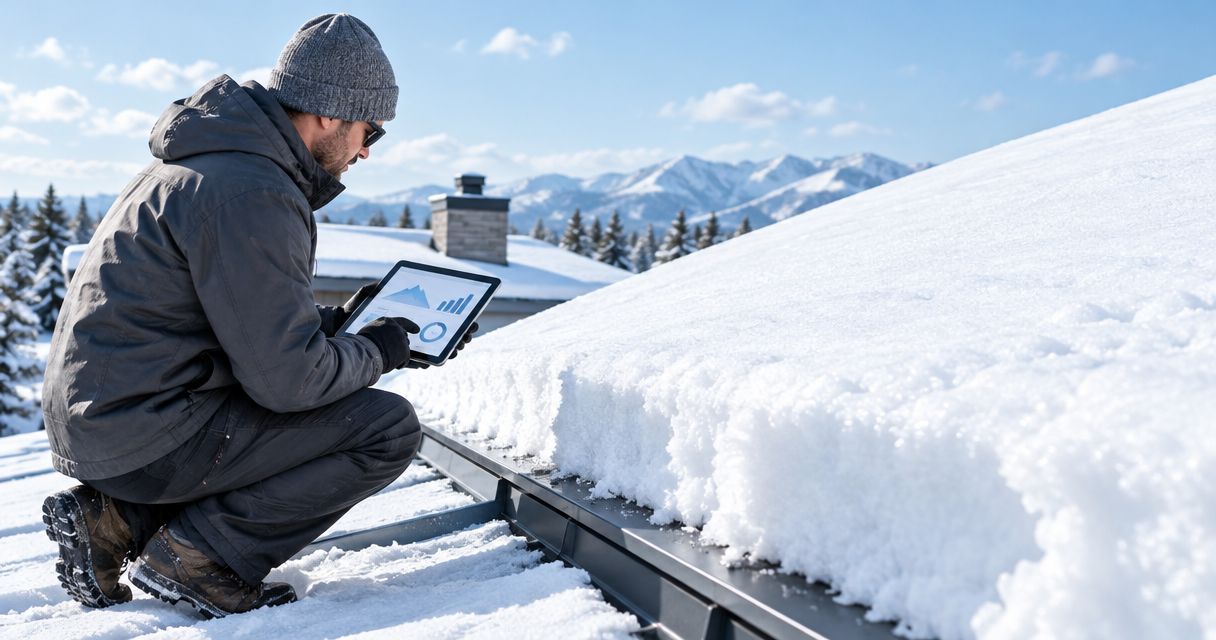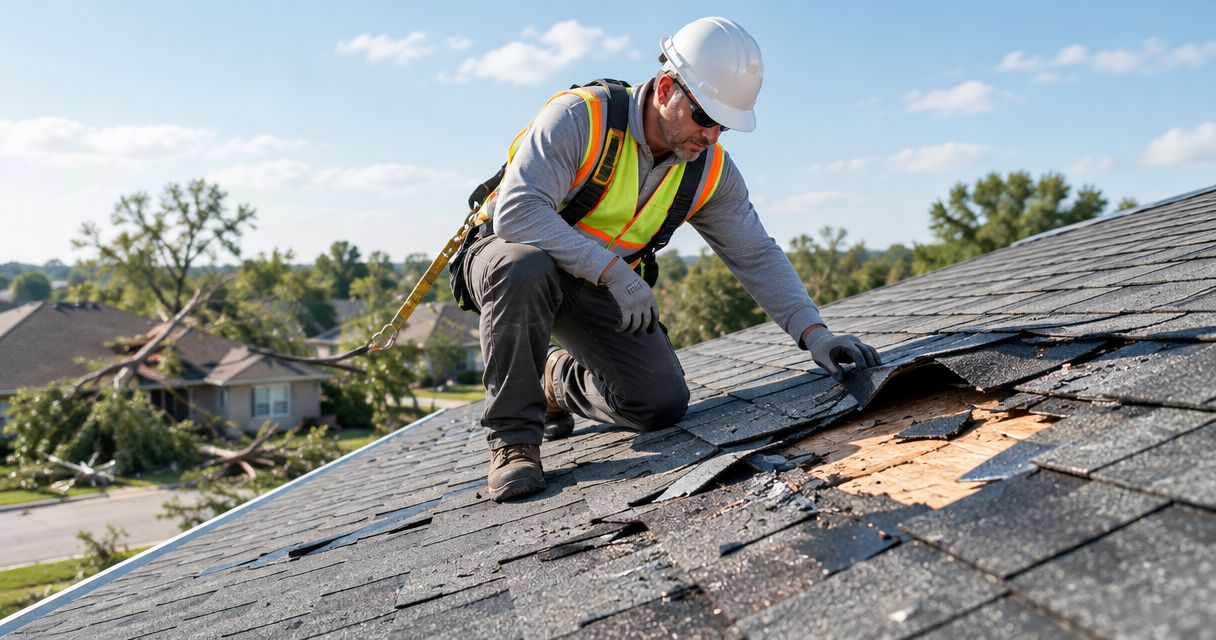
Commercial roof inspection cost depends on the building, access conditions, inspection methods, and report you commission; a written, property-specific quote is the basis for your 2026 budget. Confirm whether testing, access equipment, interior investigation, and follow-up visits are included or separately authorized. Compare identical scopes before comparing inspection quotes.
- Commercial roof inspection cost should be compared against a written scope, not an inspection label alone.
- Visual roof inspections document accessible conditions; concealed conditions require additional investigation.
- Separate roof inspection, leak investigation, and repair authorization in your request.
- Require photographs, location references, limitations, and recommendations in the inspection report.
Why this matters
An inspection supports a decision: approve maintenance, investigate a leak, assess a property purchase, or plan capital work. If the assignment does not identify that decision, you risk commissioning a report that describes the roof without answering your question.
For a 2026 capital plan, connect the inspection deliverable to the approval process before booking. The commercial roof inspection to budget approval workflow provides a related planning framework. Your immediate task is simpler: specify what the report must establish and who will use it.
How much does a commercial roof inspection cost?
Commercial roof inspection cost is a scope-specific professional service, not a uniform charge attached to every commercial building. Ask for a written proposal identifying the inspected areas, methods, deliverables, exclusions, and conditions requiring further authorization.
Use this breakdown to understand what you are comparing. These are scope components to request, not a statement that every provider includes them.
| Scope component | What to confirm | What it establishes |
|---|---|---|
| Records review | Roof plans, maintenance history, warranties, and previous reports reviewed | Background available to interpret observations |
| Roof examination | Roof sections, accessible details, drainage, and equipment interfaces included | Extent of the visible-condition assessment |
| Interior review | Whether accessible interior areas and reported leak locations are included | Whether roof observations will be considered alongside interior symptoms |
| Diagnostic testing | Method, purpose, locations, and limitations | What additional evidence the investigation seeks |
| Written reporting | Photographs, location references, findings, and recommendations | Information delivered after the site visit |
| Follow-up | Questions, return visits, and additional investigations included or excluded | Work covered after initial delivery |
For your 2026 request, ask the provider to separate the base assignment from optional investigations. That makes it clear whether competing proposals cover the same work or answer different questions.
Do not treat an inspection proposal as authorization to repair the roof. Inspection findings and repair recommendations belong in the report; permission to perform repairs belongs in a separate, explicit agreement.
Visual roof inspection: best for accessible condition reviews
A visual roof inspection documents conditions the inspector can observe in accessible areas. It is suited to recording visible defects, drainage concerns, flashing conditions, and areas needing closer investigation.
Its strength is the direct connection between an observation and a photographed location. Its limitation is equally important: a visual inspection does not establish the condition of every concealed roof layer.
Ask the proposal to identify which roof sections will be visited and how inaccessible areas will be reported. A roof overview photograph does not replace location-specific findings, and a report should distinguish an observed defect from an unverified explanation.
Diagnostic investigation: best for a defined unresolved question
A diagnostic investigation addresses a specific issue, such as an unexplained leak or suspected moisture within a roof assembly. Depending on the assignment, the investigation can involve moisture surveying, selected openings, or other agreed methods.
The benefit is a focused attempt to resolve uncertainty that observation alone cannot settle. The limitation is that each method has conditions and boundaries; a test result requires interpretation and does not automatically describe the entire roof.
Before approving testing, ask what question it answers, where it applies, and what happens if results remain inconclusive. For any proposed opening, establish who authorizes it, who restores it, and how restoration will be documented.
Purchase or capital assessment: best for documented decisions
A property transaction or capital-planning assessment needs findings organized around the decision you must make. Ask for a clear distinction between observed conditions, recommended maintenance, additional investigation, and issues requiring specialist evaluation.
Its advantage is decision-focused reporting rather than a list of disconnected defects. Its limitation is that an inspection is not a guarantee of future performance or proof that concealed defects do not exist.
For a 2026 purchase review, provide the actual decision deadline and required report format at the outset. Ask whether the proposed assignment addresses your lender's, insurer's, or internal review team's requirements rather than assuming those requirements are interchangeable.
Which inspection scope fits your decision?
| Assignment | Best for | Main benefit | Main limitation |
|---|---|---|---|
| Visual roof inspection | Accessible condition reviews | Documents visible conditions and locations | Does not establish all concealed conditions |
| Diagnostic investigation | A defined unresolved issue | Collects evidence directed at a specific question | Findings depend on method, conditions, and coverage |
| Purchase or capital assessment | Transaction or planning decisions | Organizes findings around a stated decision | Does not guarantee future roof performance |
Choose the assignment by the decision it must support, not by how extensive its name sounds. A broader-sounding report is not a substitute for a clearly defined investigation.
Why commercial roof inspection scope varies
Building size alone does not describe the assignment. The following factors change the work you need to specify and are worth addressing before you request proposals:
- Roof coverage: Identify every building, roof section, elevation, and adjoining area you want assessed. Do not assume a campus-wide assignment from a single building address.
- Access conditions: Disclose roof hatches, ladders, restricted areas, escort requirements, and known access obstacles. Ask who arranges any necessary access equipment.
- Roof assembly: Provide available information about the membrane, insulation, deck, overlays, and previous repairs. Unknown construction should be recorded as unknown rather than treated as verified.
- Investigation methods: Distinguish visual observation from moisture surveying, selected openings, and other diagnostic work. Require approval before expanding the assignment.
- Reporting requirements: State whether you need a condition summary, location-specific photographs, a defect register, or a planning-oriented report. Define the audience and intended use.
- Site coordination: Explain tenant restrictions, operating hours, interior-access requirements, and safety procedures. Confirm the arrangements before scheduling the visit.
These factors belong in the request itself. Discovering them after approval creates uncertainty about what the original assignment covers and what requires a change.
How do I request comparable commercial roof inspection quotes?
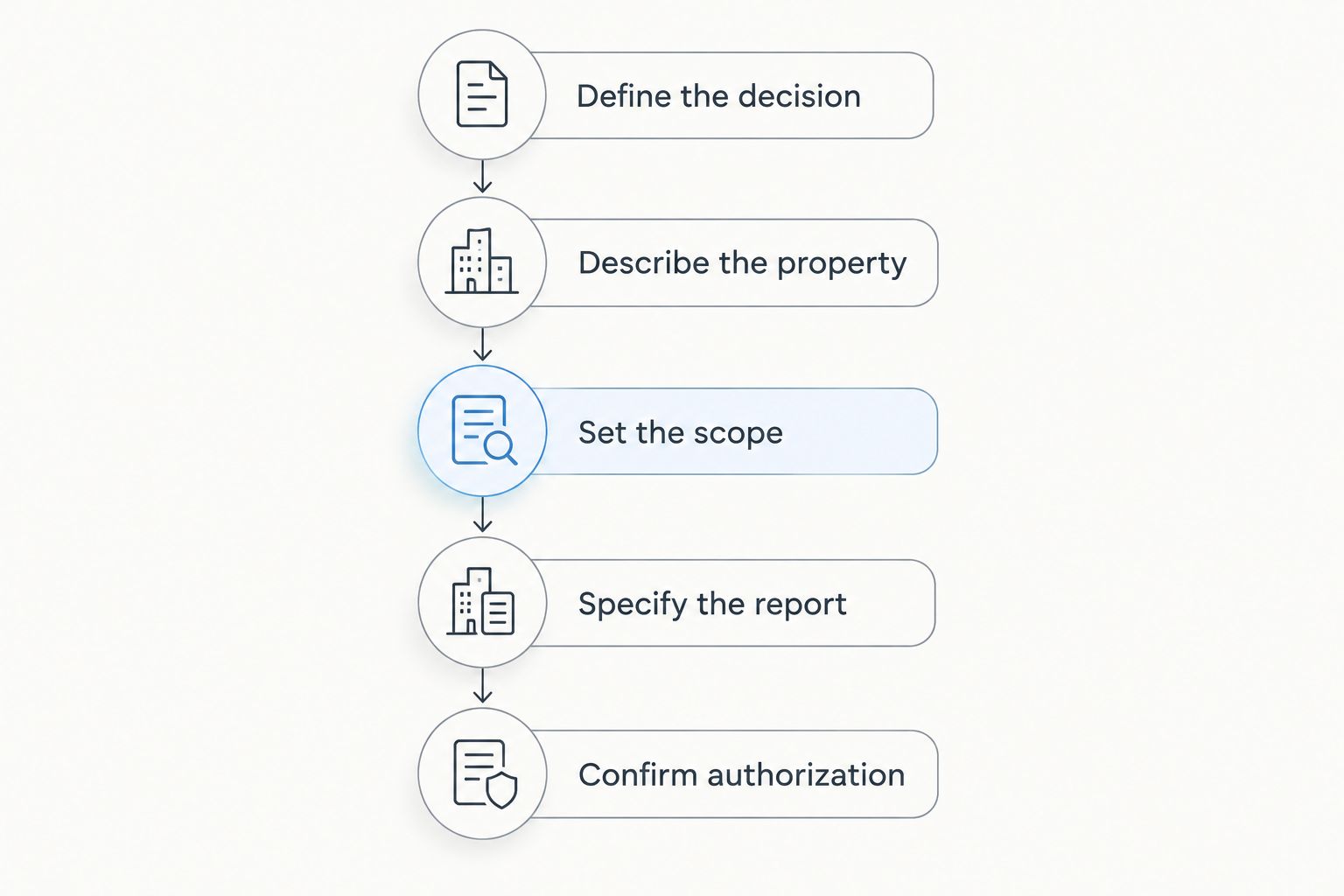
Use this 5-step sequence for your 2026 procurement process. Send the same building information and instructions to every provider so differences in proposals are visible.
- Define the decision. State whether the assignment supports maintenance, leak investigation, a transaction, or capital planning. Describe the question the report must answer rather than requesting a generic inspection.
- Describe the property. Include the address, known roof sections, available plans, access arrangements, and reported issues. Attach existing records without presenting their conclusions as newly verified facts.
- Set the scope. Identify the areas to examine, interior access needed, proposed testing, and exclusions requiring clarification. Ask providers to explain any recommended changes before authorization.
- Specify the report. Request photographs tied to locations, observed conditions, limitations, and prioritized recommendations. State the format and delivery deadline your decision requires.
- Confirm authorization. Establish who can approve additional testing, return visits, openings, or repairs. Require a written explanation before the assignment expands.
This sequence keeps the purchasing decision attached to a defined deliverable. You can accept a proposed scope change, but first understand which question the change answers and what the original scope leaves unresolved.
What should the inspection report include?
Request these 6 report elements before approving the assignment. They give you a practical acceptance checklist without assuming a particular provider's standard report includes them.
- Property identification: The inspected building, roof sections, inspection date, and relevant site conditions.
- Scope and methods: Areas examined, records considered, methods used, and any agreed changes.
- Located observations: Photographs and descriptions tied to recognizable roof locations or a roof plan.
- Clear distinctions: Observed conditions separated from interpretations, suspected causes, and unverified information.
- Limitations: Inaccessible areas, concealed components, testing boundaries, and unanswered questions.
- Next actions: Recommendations distinguishing maintenance, further investigation, repair evaluation, and specialist review.
A useful report makes uncertainty visible. If a section could not be accessed, the report should say so rather than leave you to infer that no problem was found there.
When contacting Murray Inspection Services about a commercial roof inspection, use this checklist to ask what the proposed assignment includes. The best-fit inspection is the one whose documented scope answers your property decision. Confirm the available service and deliverables directly before authorizing work.
What should I check before approving the proposal?
Read exclusions as carefully as the inspection description. Check whether the proposal addresses interior access, diagnostic testing, roof openings, restoration, access equipment, and follow-up questions; do not assume silence means inclusion.
Then check the boundaries of the conclusions. An inspection report, a repair proposal, a warranty determination, and an insurance coverage decision serve different purposes. If you need more than an observed-condition assessment, name that requirement explicitly.
For a 2026 approval, keep the accepted proposal, approved changes, final report, and follow-up correspondence together. This preserves the connection between what you authorized and what you received, especially when ownership, management, or project responsibility changes.
Finally, confirm who receives the report and who can approve its recommendations. A report that reaches the wrong decision-maker does not resolve your maintenance or planning task.
Does a visual inspection find moisture beneath the roof?
A visual inspection does not establish moisture conditions throughout concealed roof layers. It can identify visible symptoms that justify further investigation, but symptoms alone do not map hidden moisture.
If concealed moisture is the question, ask for a method-specific investigation and a written explanation of its limitations. Keep observations and confirmed findings separate in your decision record.
Can an inspection report replace a repair proposal?
An inspection report does not replace a repair proposal unless the agreement explicitly includes both deliverables. The report documents findings; a repair proposal defines work to be performed.
Request a separate description of repair scope, materials, responsibilities, and exclusions before authorizing corrective work. Do not interpret a recommendation as a complete construction specification.
Should I commission testing with the initial inspection?
Commission testing when it addresses a defined question within the assignment. Ask the provider to explain the purpose and limitations before approving the method.
You can also authorize an initial assessment with a written process for recommending further investigation. The important boundary is consent: additional work should follow the approval process you agreed to.
FAQ
What’s the best way to compare commercial roof inspection cost?
Compare written proposals with the same roof coverage, methods, access arrangements, and reporting requirements. Separate optional investigations so you can identify differences in scope before approving an assignment.
Can I get a commercial roof inspection quote without roof plans?
Ask the provider what information is needed when roof plans are unavailable. Supply the building address, known roof sections, access details, existing reports, and the question you need answered.
Is a visual roof inspection enough for a leaking building?
A visual roof inspection does not necessarily establish the cause of a leak. Describe the interior symptoms and request a defined investigation if identifying the source is the assignment’s purpose.
Does a commercial roof inspection include repairs?
Do not assume repairs are included in a commercial roof inspection. Require explicit authorization and a separate description of corrective work before repairs proceed.
What should I ask before approving roof openings?
Ask what each opening is intended to establish, who authorizes it, and who restores it. Require documentation of the location, findings, and restoration arrangements.
Will a roof inspection guarantee insurance coverage?
A roof inspection does not guarantee insurance coverage. Coverage depends on the policy and claim determination, while the inspection documents findings within its agreed scope.
What makes a commercial roof inspection report useful?
A useful report connects located observations, photographs, limitations, and recommended actions to your stated decision. It distinguishes verified findings from suspected causes and unanswered questions.
One last thing
An unanswered question is a report finding, not permission to assume the roof is sound. Before closing the assignment, ask which roof sections remained inaccessible and which conclusions still require investigation.
Put those unresolved items into your property action list with an owner and a next step. That turns the inspection from a document you file into a decision you can act on.
Related guides
- Commercial roofing for property managers
- How often should a commercial roof be inspected?
- From roof inspection to contractor bid comparison