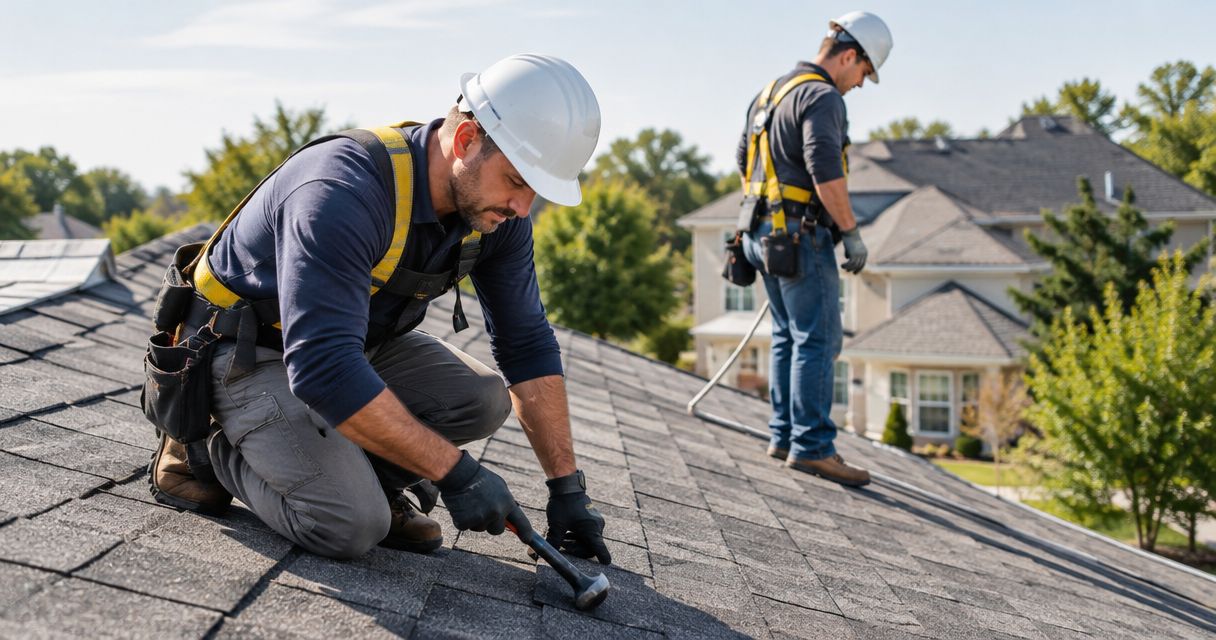
Yes, commercial roofing contractors can work on residential roofs when they have the required local credentials and experience installing the specific roofing system your home needs. A commercial roofing background alone does not establish residential competence: verify the proposed crew, installation details, insurance, and written scope before signing.
- Commercial roofing contractors: residential projects require matching material experience, local credentials, and a clear installation scope.
- Choose demonstrated roof-system experience over a commercial or residential business label.
- Low-slope roofing experience does not automatically establish competence with shingles, attic ventilation, or steep-slope flashing.
- Considering Murray Inspection Services? Verify residential roofing scope and credentials before hiring.
Can commercial roofing contractors work on residential roofs?
Yes. The deciding factors are legal authorization and relevant installation experience, not whether the contractor markets itself as commercial. A business can serve both markets, but you should evaluate the crew assigned to your house rather than the company's broad service description.
If Murray Inspection Services is on your shortlist, use the same checks you would apply to any roofing provider. Establish whether the proposed work is inspection, repair, or replacement, and identify who would perform it.
| Contractor background | Best for | Advantage to verify | Limitation to check |
|---|---|---|---|
| Commercial low-slope roofing | A home with a compatible membrane roof | Experience with membrane seams, penetrations, and drainage | Commercial projects do not establish shingle or steep-slope experience |
| Residential steep-slope roofing | A house with the same roof covering and construction details | Experience with flashing, valleys, roof edges, and attic conditions | Residential shingle work does not establish membrane installation experience |
| Mixed commercial and residential roofing | A property with multiple roof systems | Documented experience across the systems proposed | Confirm that the assigned crew has the relevant experience |
These are selection criteria, not guarantees about either type of business. A commercial specialist with matching residential references is a stronger candidate than a residential contractor unfamiliar with your roof system.
Why this matters
Your roof is an assembly, not just its visible surface. The covering, deck, underlayment, flashing, drainage, and ventilation details must work together where applicable.
A contractor who installs a membrane well still needs the right knowledge to replace a shingle roof. The reverse is also true. In 2026, choose by the work your property requires rather than treating either business label as a qualification.
The strongest roofing candidate is the contractor whose assigned crew can demonstrate the same system on comparable homes. Ask for examples that match your roof's material, slope, penetrations, and access conditions—not simply a gallery of completed buildings.
When a commercial roofing contractor fits a residential project
Low-slope residential roofs
A commercial contractor is a relevant candidate when your home uses a membrane roofing system the contractor regularly installs. Experience with seams, perimeter attachments, drainage outlets, and wall transitions matters more than whether previous customers owned businesses or houses.
The limitation is the surrounding construction. A residential addition can connect a low-slope roof to siding, windows, or a steep-slope roof, so ask how the proposal handles those connections rather than accepting a generic membrane specification.
Steep-slope residential roofs
A commercial contractor can be suitable for a shingle, metal, tile, or slate project if the assigned crew has experience with that particular system. Those materials require different installation methods; experience with one does not prove competence with the others.
Ask for residential examples using the proposed material. Then ask who installed them and whether that crew will work on your home. Company-level experience is not enough if the relevant installers are not involved.
Homes with mixed roof systems
A house can have a steep main roof and a low-slope porch, garage, or addition. A contractor experienced with both systems is a useful candidate because the transition between assemblies needs a defined installation detail.
The drawback is assuming that offering both services proves equal competence. Require separate specifications for each roof area, plus a clear explanation of how the systems connect and who takes responsibility for that connection.
Why contractor suitability varies
Use these factors to explain why a contractor fits one residential project but not another:
- Roof covering: Shingles, standing-seam metal, tile, slate, and membranes require different installation skills. Ask about the exact system proposed.
- Roof slope: Slope affects the permitted covering and installation details. Check the applicable code and manufacturer instructions before approving a material.
- Building connections: Chimneys, dormers, skylights, adjoining walls, and additions create details that need project-specific treatment.
- Local requirements: Licensing, registration, permits, and inspections depend on the jurisdiction and scope. Verify requirements with the relevant authority.
- Assigned crew: The people installing the roof need relevant experience, whether they are employees or subcontractors.
- Property conditions: Access, occupied rooms, landscaping, and neighboring buildings affect protection, staging, and cleanup planning.
For your 2026 project, make the contractor address these factors in the proposal. A detailed answer gives you something to evaluate; a statement that the company handles every roof does not.
How do you check a commercial contractor for residential work?
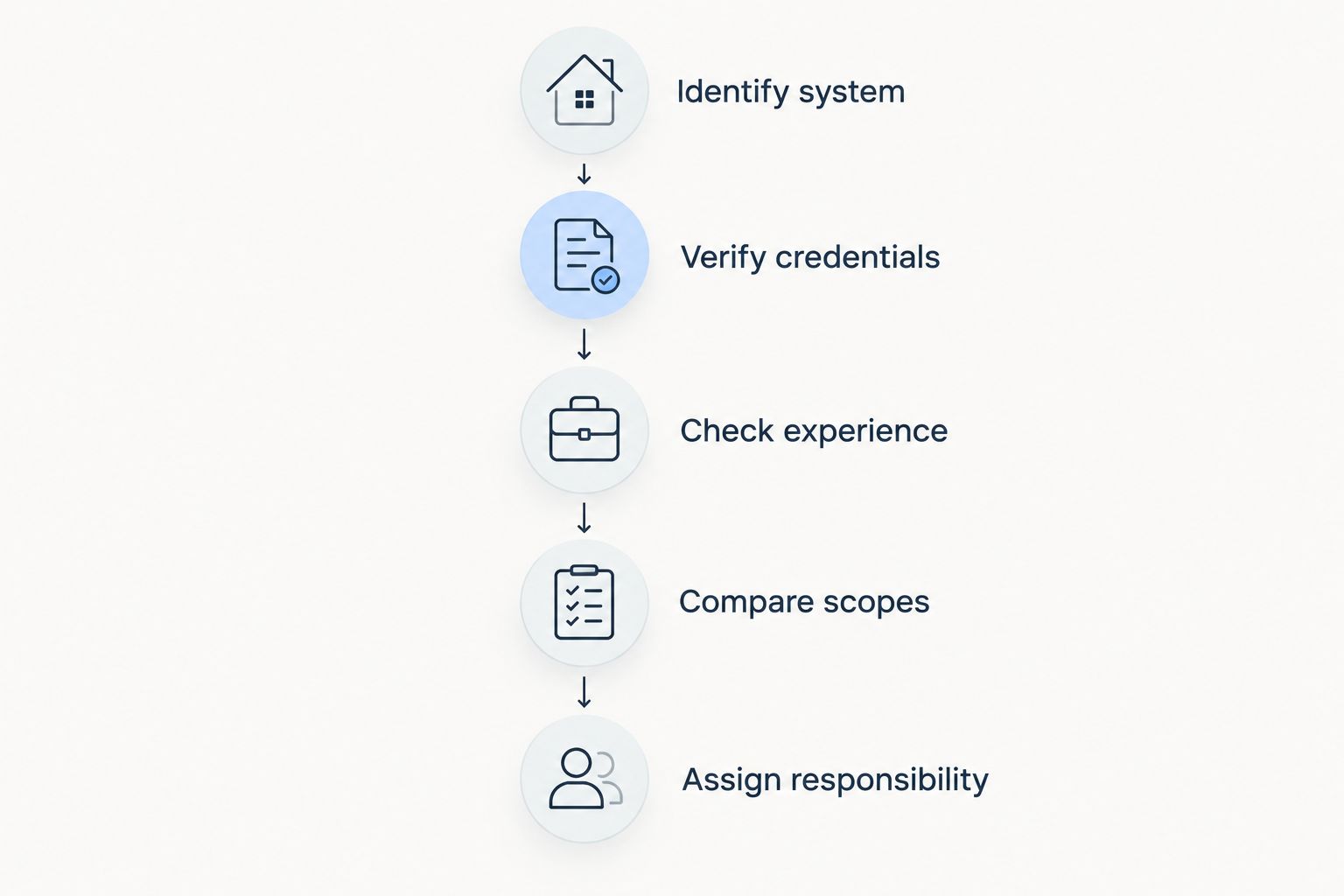
Follow this sequence before approving an agreement. Complete the technical and credential checks before comparing proposals on their bottom-line terms.
1. Identify the roof system
Ask the contractor to identify the existing covering, measured slope, visible deck conditions, and proposed replacement assembly. Do not approve a material based solely on appearance or a broad description such as flat roofing.
Slope is a concrete example of why the system matters. Standard asphalt shingles generally require a minimum slope of 2 inches of rise per 12 inches of horizontal run, expressed as 2:12. Installation at slopes from 2:12 to below 4 inches per 12 inches, or 4:12, requires special underlayment provisions; confirm the locally adopted code and product instructions.
2. Verify authorization and insurance
Check the contractor's legal business identity and any license or registration required for the work. Ask who obtains permits and who arranges required inspections, then put those responsibilities in the agreement.
Request current insurance documentation and verify it through the issuing agent or insurer. Ask how coverage applies to the work being proposed and to any subcontractors; a logo or an emailed certificate alone does not answer those questions.
3. Check matching experience
Request examples of completed residential work using the proposed roof system. Ask references about communication, property protection, cleanup, and how the contractor handled problems after installation.
Also identify the crew leader and any subcontractors. A relevant portfolio is useful, but it should connect to the people responsible for your installation.
4. Compare written scopes
Each proposal should identify the work areas, covering, underlayment or membrane assembly, flashing, drainage details, and treatment of penetrations. It should also explain how concealed damage will be documented and authorized before additional work proceeds.
Use the roof inspection to contractor bid comparison workflow to organize that review. Compare equivalent work rather than assuming every proposal includes the same components.
5. Assign responsibility
Get a named contact for installation questions, change approvals, inspections, and workmanship concerns. Ask what documentation you receive at completion and how to report a later problem.
For a 2026 contract, verify that the proposed materials and installation instructions are current for the selected system. An old sample proposal should not substitute for the specifications governing your job.
A conversation with Murray Inspection Services should establish the proposed service and responsible business before you apply this checklist. An inspection scope and an installation scope are different; do not assume one includes the other.
Is a commercial roofer better for a flat residential roof?
A commercial roofer is a relevant candidate for a low-slope residential roof when the crew has experience with the specified system. The commercial label itself does not make the contractor better than a residential specialist with the same experience.
Ask how the contractor will handle drainage, edges, penetrations, and transitions to the house. Those details provide a more useful comparison than the size of the contractor's previous commercial buildings.
A roof described as flat still needs a drainage strategy. Have the contractor explain where water is intended to go and how the proposed work addresses the existing drainage arrangement.
Can a commercial contractor replace asphalt shingles?
Yes, a commercial contractor can replace asphalt shingles when authorized locally and experienced with the proposed shingle assembly. Confirm residential references and the assigned crew rather than relying on unrelated warehouse or membrane projects.
Ask about valleys, roof-to-wall flashing, pipe penetrations, roof edges, and attic ventilation where applicable. A proposal should identify how these details will be handled, including which existing components will remain.
For a 2026 shingle project, require the contractor to follow the applicable installation instructions and local requirements. A verbal promise to use standard practice is less useful than a written specification.
What are the warning signs before you sign?
Pause when a contractor cannot connect its experience to your roof or will not document the work. A polished proposal does not replace answers to basic technical and responsibility questions.
Watch for these gaps:
- The contractor provides only unrelated commercial references for a residential shingle project.
- The proposal names the covering but omits flashing, transitions, or drainage details relevant to the roof.
- Nobody identifies the installing crew or explains the use of subcontractors.
- Responsibility for permits, property protection, cleanup, or inspections remains unclear.
- Concealed damage and changes can proceed without a defined approval process.
- Warranty language does not identify the responsible party, covered work, and exclusions.
Ask for corrections in writing. If a contractor will not resolve a material gap before signing, choose another candidate rather than relying on an informal assurance.
FAQ
Can a commercial roofing company legally replace my house roof?
Yes, provided the company meets the licensing, registration, permit, and other requirements applicable to that residential work. Confirm the requirements with your local authority rather than assuming commercial authorization covers every project.
Is a residential roofer always better for a house?
No. A contractor’s experience with your particular roof system matters more than a residential or commercial label. Check comparable projects and the crew assigned to your home.
Can the same contractor work on my flat addition and shingle roof?
Yes, if the contractor has relevant experience with both systems. Require separate specifications for each roof area and a defined detail for the transition between them.
What roof slope do asphalt shingles need?
Standard asphalt shingles generally require at least 2 inches of rise per 12 inches of horizontal run, or 2:12. Slopes from 2:12 to below 4:12 require special underlayment provisions; confirm the locally adopted code and manufacturer instructions.
Should I ask whether the roofing crew uses subcontractors?
Yes. Identify who will install the roof, who supervises that crew, and which business takes responsibility for workmanship and insurance. Subcontracting alone does not establish either competence or poor quality.
Does an inspection agreement include roof repairs?
An inspection agreement does not establish that repairs are included. Read the written scope and obtain a separate repair or replacement specification when installation work is proposed.
What should I do if roofing proposals include different work?
Ask each contractor to clarify the differences before choosing. Compare materials, flashing, drainage, concealed-damage procedures, property protection, and workmanship responsibilities on an equivalent basis.
One last thing
A contractor's most useful reference is not necessarily its largest project. It is a completed roof with the same material and difficult connection detail as yours, installed by the crew proposed for your home.
For Murray Inspection Services or any other candidate, separate reputation from documented project fit. Hire for the roof assembly and the responsible crew—not the commercial or residential label. Make that your final check before approving a 2026 roofing agreement.
Related guides
- Low-slope roofing systems ranked by durability
- Roof warranty types compared for homeowners
- Roof ventilation systems compared