

“We Create Luxury Living” starts with a clear plan: for custom home appraisals, your mortgage lender arranges an independent valuation of the proposed finished home. Instead of repeatedly sending revised drawings and selections, organize one coordinated project package so the lender, builder, and appraiser work from the same scope.
- Custom home appraisals mortgage lender checklist: align the plans, specifications, site information, and construction contract before appraisal.
- Murray Custom Homes suits Lincoln-area buyers seeking in-house design guidance for semi-custom or custom homes.
- Construction cost and appraised market value are different; personalized features do not guarantee an equivalent increase in value.
- Ask your lender about appraisal conditions, design changes, and completion verification before construction begins.
Why this matters
An appraisal supports the lender’s collateral decision; it does not approve your design or guarantee your construction budget. For a proposed home, the appraiser evaluates the property described in the plans and specifications, with the valuation subject to stated completion conditions.
Your lender separately reviews your finances, the proposed financing, and applicable construction requirements. A satisfactory appraisal does not replace underwriting approval, and preapproval does not establish the finished home’s value.
Murray Custom Homes provides in-house drafting, design, blueprints, 3D renderings, and construction project management. Those services help you define the proposed home; the independent appraiser determines value, and the mortgage lender makes the lending decision.
For a 2026 build, establish those responsibilities before making financing-dependent commitments. The practical goal is simple: prevent a decision about one version of the home from being applied to a different version.
Before you start
- Secure a lender contact and the lender’s checklist. Ask which construction-financing structure applies, who orders the appraisal, and which documents must be complete before ordering. Do not independently hire an appraiser and assume the lender will accept that report.
- Gather the project materials. Prepare the proposed plans, written specifications, construction contract, site information, and supporting lot documents requested by the lender. Identify who supplies each item and who approves revisions.
- Resolve the non-obvious gotcha: allowances are not finished selections. A broad allowance does not describe the same home as a documented material or installation scope. Ask the lender whether unresolved selections provide enough detail for the appraisal assignment before the report is ordered.
Create one shared document register for your 2026 project. Record each document’s title, revision date, responsible person, and approval status; keep superseded copies separate from the current package.
Choose the home path before assembling the file
Murray Custom Homes offers 3 home paths: Semi-Custom Homes, move-in-ready homes, and Custom Homes. Choose by the decisions you want to make, not by an assumption that one route guarantees financing.
| Home path | Best for | Planning advantage | Trade-off | Appraisal preparation |
|---|---|---|---|---|
| Semi-Custom Homes | Buyers who want selected choices with guidance on remaining decisions | A more curated decision process | Less design freedom than a fully custom home | Document selected features and the remaining included scope |
| Move-in-ready homes | Buyers who prefer evaluating an already-built home | You can assess the completed layout and finishes | The home is already built rather than designed around your preferences | Confirm the property details and lender’s purchase requirements |
| Custom Homes | Buyers who want a home shaped around their preferences | Greater opportunity to define distinctive features | More decisions must be coordinated across the plans and specifications | Submit a consistent, detailed description of the proposed home |
The appraisal assignment must match the actual property and transaction. An already-built home and a proposed construction project do not require identical supporting materials.
Lender requirements and responsibilities
Confirm the financing workflow
- Ask the lender to describe the loan structure. Establish whether construction financing and the permanent mortgage involve separate closings or a construction-to-permanent arrangement. Ask what requires approval at each stage.
- Request the appraisal-order requirements in writing. Identify the documents, approvals, and property information needed before the lender places the order. Ask whether builder review is a separate requirement.
- Assign communication responsibilities. Identify the lender contact for appraisal questions and the builder contact for plan or specification corrections. Route appraisal concerns through the lender rather than seeking a preferred value from the appraiser.
Expected result: You know who orders the appraisal, what triggers that order, and which decisions remain separate from valuation.
For your 2026 financing file, also ask what happens if construction starts later than expected. Let the lender determine whether updated financial documents, a report update, or another review is required; do not assume an earlier approval remains usable indefinitely.
Write down the lender’s response rather than relying on a general construction-loan checklist. Your actual loan requirements govern the transaction.
Plans, specifications, and site package
Assemble a consistent project description
- Match the plans to the construction agreement. Check the footprint, room arrangement, garage, basement finish, and outdoor structures. Resolve discrepancies before submitting the package.
- Describe the included finishes and systems. Distinguish included work from optional features and unresolved allowances. Make clear which spaces will be finished at completion and which will remain unfinished.
- Add the requested land information. Supply ownership or purchase documentation, site details, and other lot materials requested by the lender. If you already own the lot, ask how the lender will document ownership and treat land equity.
- Check the entire package against the same revision. Compare the contract, drawings, specifications, and change documents. A rendering should not show a major feature that the written scope excludes without a clear explanation.
Expected result: The proposed finished home is identifiable without relying on verbal promises or inspiration images.
Murray Custom Homes can build on your existing lot within its stated 50-mile homebuilding service radius of Lincoln. Confirm the specific location before planning financing around a builder relationship; other business divisions’ office locations do not establish homebuilding coverage.
A 3D rendering helps you understand a design, but it does not replace written specifications. Keep the visual presentation and contractual scope aligned.
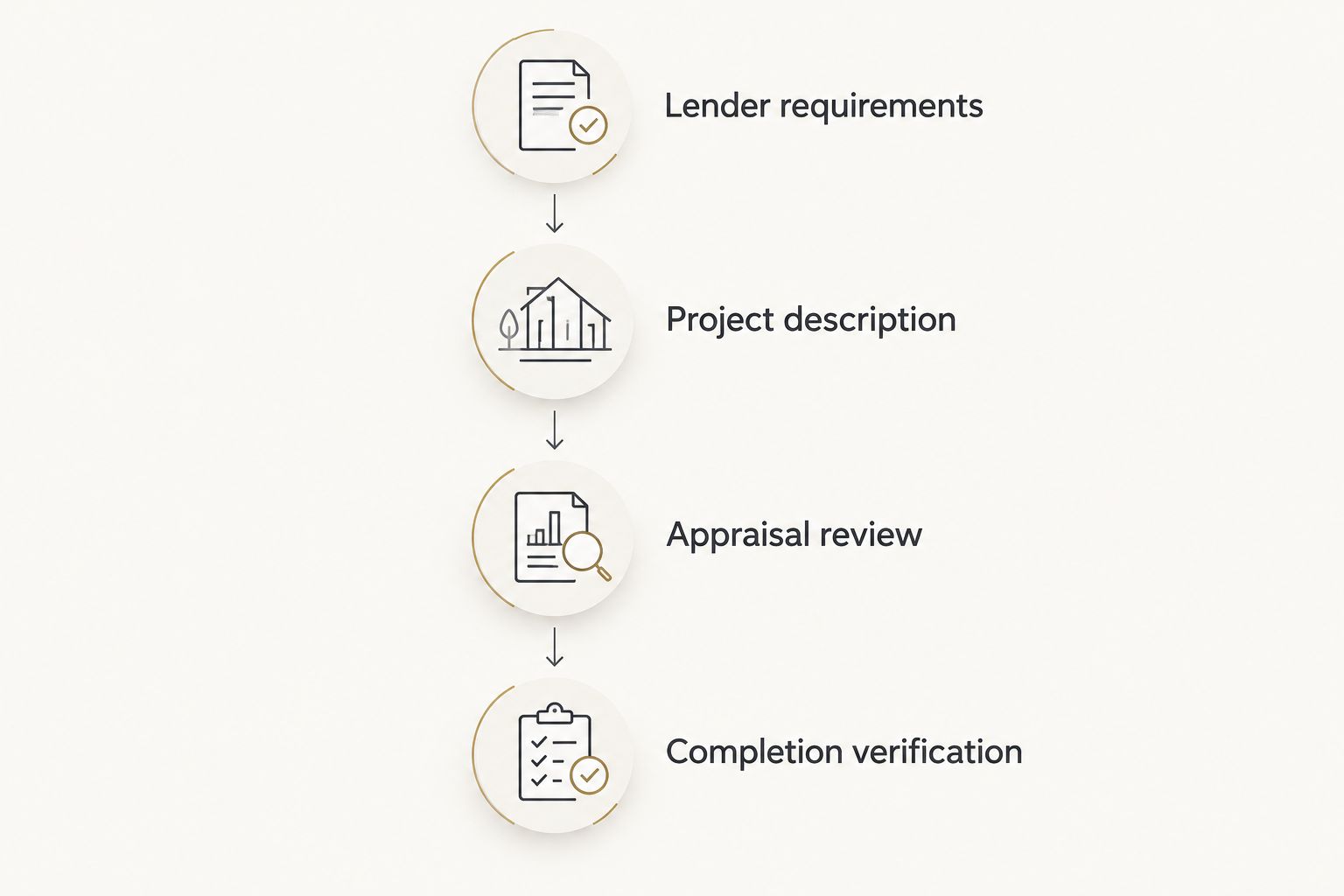
Appraisal review and financing decisions
Review the report with your lender
- Request your appraisal copy through the lender. Read the property description, proposed improvements, valuation conclusion, and conditions. Ask the lender to explain terminology you do not understand.
- Check factual details against the submitted package. Review the site, room count, living area description, garage, and finished versus unfinished space. Separate an actual factual discrepancy from disagreement with the value conclusion.
- Identify remaining conditions. Ask which appraisal-related items must be resolved and which underwriting items remain. Record the person responsible for each response.
- Use the lender’s reconsideration process when appropriate. Submit specific factual corrections or relevant supporting information through the designated channel. A request for review does not guarantee a different value.
Expected result: You understand the report’s conclusion, the assumptions behind it, and the lender’s next requirements.
Appraisers analyze market evidence and the subject property; they do not simply total your chosen upgrades. A distinctive feature can matter greatly to you without contributing an equivalent amount to market value.
For a 2026 project, ask the lender to explain any difference between the proposed project scope and the collateral value used for financing. Resolve the financing implications before authorizing additional commitments.
Change control and completion verification
Keep the financed scope aligned with the build
- Document proposed changes before approving them. Describe what changes, which drawings or specifications it affects, and whether the contract must be amended.
- Ask the lender about material revisions. A changed footprint, finish level, or basement scope can require further review. Let the lender decide whether an appraisal update or other documentation is necessary.
- Confirm completion-verification requirements. Ask who arranges the final appraisal-related inspection or certification, what must be finished, and how unresolved items affect the financing process.
- Keep the final documents together. Retain the approved plans, specifications, change orders, lender correspondence, and completion records. Make the current version easy to identify.
Expected result: The completed home, approved project documents, and lender’s requirements remain connected.
A construction draw inspection, a municipal inspection, a buyer walkthrough, and an appraisal completion check serve different purposes. Do not treat one as an automatic substitute for another.
The builder’s project managers bring more than 20 years of combined experience. Use that construction coordination alongside the lender’s instructions—not as a replacement for independent valuation or underwriting.
Second workflow: when the design changes after appraisal
A design revision creates a second workflow: assess the change before treating the original appraisal as support for the revised home.
Start with a written description of the proposed revision. Attach the affected plan sheets and updated specifications, then ask the lender what review is required before you approve the change with the builder.
A larger construction commitment does not automatically create a higher appraised value. Conversely, removing a feature does not automatically leave the original valuation unchanged. The lender must determine whether the existing report still supports the revised transaction.
This distinction matters when changing finished space, moving substantial features between phases, or altering the proposed structure. Do not rely on an informal statement that a revision is “just an upgrade.”
For 2026 change requests, keep both the original approved scope and the proposed revision. A clear comparison helps the lender identify what actually changed.
Troubleshooting appraisal problems
The appraised value does not support the planned financing
Ask the lender to explain the financing consequence before choosing a response. Review factual accuracy, discuss permitted financing alternatives, and assess scope changes with the builder; do not assume another appraisal will solve the issue.
The report describes the wrong finish level
Identify the exact discrepancy and attach the relevant specification or plan sheet. Send the correction through the lender’s established process rather than submitting a general complaint about the value.
A personalized feature receives less value than expected
Separate personal usefulness from market contribution. Ask the lender whether there is a factual issue to review, but do not treat a feature’s construction expense as proof of its resale value.
The lender requests documents already submitted
Check whether the request concerns an outdated revision, missing approval, or inconsistent attachment. Respond with the current document and identify what it replaces so the file does not accumulate conflicting versions.
Construction is complete, but financing conditions remain
Request a written list of outstanding items and responsible parties. Completion of the physical work does not by itself establish that underwriting, title, appraisal, and closing requirements are satisfied.
Customize your workflow
Make the project package reflect the decisions that matter to your household. For Semi-Custom Homes, distinguish your selected features from the remaining included decisions; for a fully custom home, document the individual design choices without relying on a mood board alone.
Meghan Murray provides in-house design guidance. Bring questions about layout and finishes to that design conversation, then translate the resulting decisions into the documents used for construction and lender review.
If you own land, use the guide to building on your own lot to organize the wider planning conversation. Ownership, site suitability, and the lender’s treatment of land equity remain separate questions.
Murray Custom Homes is best for Lincoln-area homebuyers who want in-house design guidance for a semi-custom or custom home. Bring the builder’s project information and your lender’s checklist together early; neither party should have to infer the other’s requirements.
Discuss your home plans
Coordinate your design questions with the project information your mortgage lender requests.
FAQ
How do custom home appraisals work with a mortgage lender?
The mortgage lender arranges an independent appraisal of the proposed finished home using plans, specifications, site information, and market evidence. The lender then reviews the appraisal alongside its separate underwriting requirements.
Does mortgage preapproval mean my custom home will appraise?
No. Mortgage preapproval concerns your financing qualifications, while the appraisal evaluates the property supporting the loan. The proposed home still needs to meet the lender’s collateral requirements.
Can I choose the appraiser for my construction mortgage?
Let your mortgage lender arrange the appraisal under its applicable independence requirements. Do not commission a report independently and assume the lender will accept it.
What happens if my custom home appraises below the amount needed?
Ask the lender how the valuation affects your proposed financing. Review factual errors through the lender’s process, then discuss permitted financing or scope alternatives before making additional commitments.
Do custom upgrades increase appraised value by their construction cost?
No. Construction expense and market value are different measures. The appraiser evaluates market support for the property rather than automatically adding the expense of every personalized feature.
Can I change the floor plan after the appraisal?
Ask your lender about the proposed change before approving it with the builder. A material revision can require additional documentation, appraisal review, or a change to the financing approval.
Does owning my lot replace the need for an appraisal?
No. Lot ownership does not establish the value of the proposed completed property. Ask the lender how it documents your ownership and treats any land equity in the transaction.
Is the final appraisal check the same as my home walkthrough?
No. An appraisal-related completion check addresses the lender’s valuation conditions, while your walkthrough addresses the home’s condition and agreed construction scope. Confirm each requirement separately.
One last thing
The most useful appraisal preparation is a consistency check, not a longer list of upgrades. Before submitting your package, compare the drawings, specifications, contract, and site information side by side. Correct contradictory descriptions before someone must decide which version represents the home.
Related guides
- How mortgage preapproval shapes your custom home build timeline
- From design consultation to 3D rendering approval
- From final walkthrough to key handoff