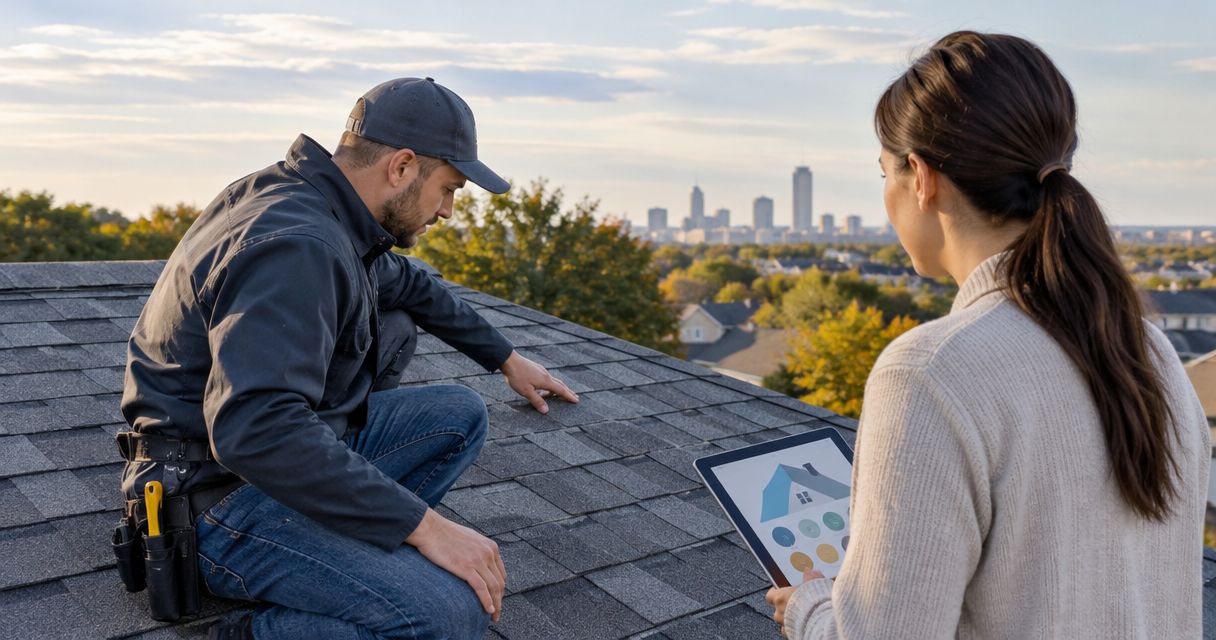
For Omaha homeowners choosing a roof repair contractor in 2026, start with an inspection and a written explanation of whether repair or replacement fits the damage. Murray Roofing provides roof repair, replacement, inspections, and financing in Omaha and Lincoln; choose the work your roof needs before choosing how to pay for it.
- Murray Roofing provides Omaha roof repair and replacement services, with inspections to help you decide the next step.
- Choose targeted roof repair when the defect is isolated and the surrounding roof remains serviceable.
- Consider replacement when an inspection documents broader deterioration rather than a single repairable problem.
- Compare written scopes, warranty terms, and financing documents—not promises of insurance approval.
Why this matters
A roof leak tells you water has entered the building. It does not, by itself, tell you whether you need a patch, flashing repair, or full replacement. The visible ceiling stain also does not necessarily sit directly beneath the roof defect, because water can travel before appearing indoors.
Your first decision in 2026 is therefore about diagnosis, not contractor rankings. Review the available roofing services, then ask the inspecting contractor to connect each proposed repair to a documented finding.
For Omaha and Lincoln homeowners, the conversation should address roof condition, storm damage where present, and how the proposed work handles the source of water entry. A recommendation should explain both what needs attention and what does not.
Choose the contractor who explains the roof problem clearly and puts the proposed solution in writing. A confident sales presentation is not a substitute for that explanation.
Roof repair options at a glance
Repair and replacement solve different problems. Neither is automatically the right choice because a roof leaks or has reached a particular age.
| Option | Best for | Main benefit | Main limitation | What to request |
|---|---|---|---|---|
| Targeted repair | An isolated defect with serviceable surrounding roofing | Addresses a defined problem without replacing the entire roof | Does not renew unrelated aging materials | Photos, repair boundaries, and exclusions |
| Full replacement | Broad deterioration or damage that makes isolated repairs unsuitable | Addresses the roof as a system rather than separate patches | Involves a larger scope and more disruption | Material specifications, removal scope, and warranty documents |
| Further inspection | Conflicting estimates or an unclear leak source | Establishes a better basis for approving work | Inspection alone does not stop an active leak | Written findings and any immediate protection recommendation |
The useful comparison is not simply repair versus replacement. It is whether each proposed scope addresses the same observed conditions.
Targeted repair: best for a documented, isolated problem
A targeted repair makes sense when a contractor identifies a specific defect and confirms that the surrounding roof can support the proposed work. Examples include a localized flashing problem or a limited area of damaged roofing.
Where repair helps
- Keeps the work focused on the documented defect.
- Preserves roofing that remains serviceable.
- Provides an option when a full replacement is not justified by the findings.
Where repair falls short
- Leaves the rest of the existing roof in place.
- Does not resolve deterioration outside the repair area.
- Can become an incomplete solution if the original diagnosis misses another water-entry point.
Ask what the repair excludes. A proposal that clearly identifies its boundaries is more useful than a broad promise to fix every future leak.
Full replacement: best for documented, widespread deterioration
Replacement deserves consideration when the inspection identifies problems across the roof rather than a single repairable location. Ask the contractor to show the findings that support that conclusion.
Where replacement helps
- Allows related roof components to be addressed together.
- Creates an opportunity to evaluate ventilation, flashing, and other details within the project scope.
- Provides a basis for discussing a new roofing system and applicable warranties.
Where replacement falls short
- Requires a larger project commitment than localized repair.
- Involves removal, installation, cleanup, and coordination around the property.
- Does not make every warranty cover every possible cause of future damage.
A replacement recommendation should stand on the inspection evidence. It should not depend on a promise that an insurer will fund the project.
How to get an estimate you can actually compare
Give each contractor the same description of the problem and access to the same relevant information. Different starting information can produce proposals that appear contradictory even when they address different concerns.
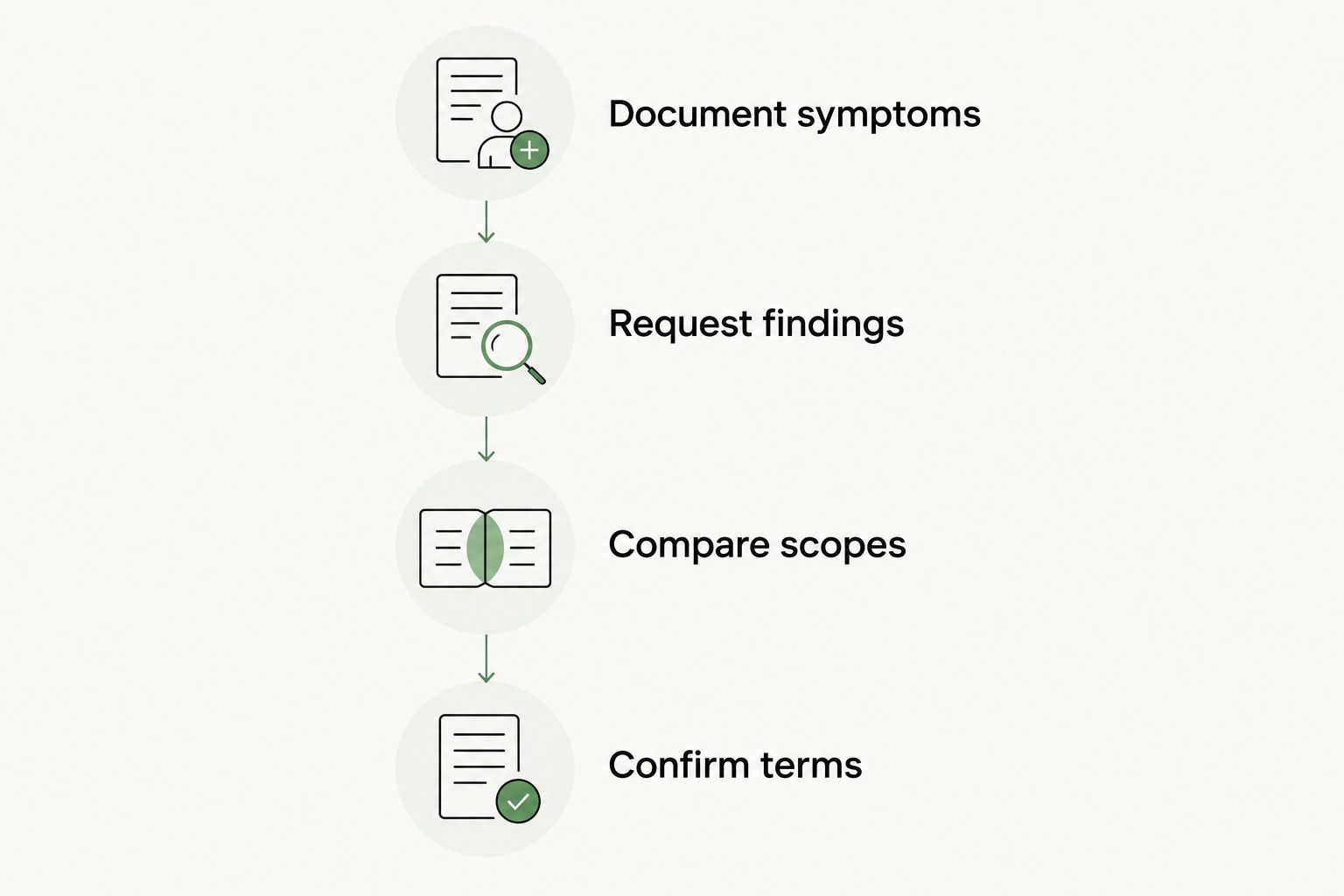
Use this sequence before signing a roofing contract in 2026:
Document symptoms
Record where you see staining, when you first noticed it, and whether it changes after precipitation. Take interior photographs from a safe location and keep previous estimates or repair records together.
Do not climb onto the roof to collect evidence. Ask the contractor to document roof-level conditions during the inspection.
Request findings
Ask for photographs and a plain-language explanation of the defect. The contractor should distinguish observed damage from an assumption about what caused it.
If replacement is recommended, ask why a targeted repair would not adequately address the condition. If repair is recommended, ask what remains outside its scope.
Compare scopes
Read the proposed work before comparing the final totals. Look for the roofing areas involved, materials, flashing details, removal work where applicable, disposal, and cleanup responsibilities.
Ask how concealed damage will be handled. The contract should explain how additional work is documented and authorized rather than leaving that process to a conversation after work begins.
Confirm terms
Review payment terms, warranty responsibilities, and the process for raising a concern after completion. Keep financing documents separate enough that you can evaluate the construction agreement on its own.
Do not treat an estimated schedule as an unconditional completion guarantee. Ask how weather-related changes will be communicated.
What to ask an Omaha roofing contractor
Local service coverage matters, but it is only the beginning. Your estimate should identify the actual work, the responsible contractor, and the documents that govern the project.
Use these questions during an inspection or estimate appointment:
- What condition is causing the problem, and what evidence supports that diagnosis?
- Why is repair or replacement the appropriate response?
- Which roof components are included, and which are excluded?
- How will you document concealed damage and obtain authorization for additional work?
- Who handles questions during installation and after completion?
- What warranty applies to this particular scope?
- What must happen before work starts?
Murray Roofing is an Omaha roof repair and replacement option for homeowners who want an inspection before deciding on the scope. The contractor also serves Lincoln and provides insurance-claim support and financing.
Those services do not remove the need to review a written proposal. Financing does not establish whether replacement is necessary, and claim support does not determine whether an insurer will cover the work.
Read the warranty before choosing the roof
Warranty length is useful only when you know what the document covers. Material protection and labor protection are not interchangeable, and the contractor's responsibilities should be clear.
Murray Roofing lists GAF Master Elite status, a 50-year Golden Pledge warranty, and a 10-year labor warranty among its trust signals. Before approving a project, request the warranty documents applicable to the proposed installation and confirm eligibility, exclusions, registration requirements, and who handles a claim.
For a roof project signed in 2026, ask these questions:
- Does the proposed work qualify for the warranty being discussed?
- Which materials and installation details are required?
- What does the manufacturer cover, and what does the contractor cover?
- Are transfer conditions relevant if you sell the home?
- What maintenance or documentation responsibilities remain with you?
A longer stated term is not a promise that every leak or storm event is covered. Keep the written warranty with the contract, invoices, and completion records so you can identify the correct contact if a problem develops.
Financing and insurance are separate decisions
Start with the necessary roofing work, then decide how to fund it. Reversing that order makes it harder to judge whether a proposed project matches the condition of your roof.
Financing: evaluate the agreement, not just the payment
Financing can help you organize payment for a roof project, but the agreement needs its own review. Ask for the repayment term, interest terms, fees, approval conditions, and total repayment obligation before accepting an offer.
For a 2026 project, confirm that the financing documents match the work you intend to authorize. If the roofing scope changes, ask how that change affects the financing agreement before signing an amendment.
Insurance: ask for documentation without assuming coverage
A contractor can document roof conditions and explain a proposed construction scope. The insurer evaluates coverage under the policy and claim circumstances.
Keep inspection photographs, estimates, claim correspondence, and repair records together. Ask your insurer about policy questions and deadlines directly; do not rely on a contractor's prediction of the claim outcome.
A roof inspection, financing approval, and insurance decision answer different questions. None replaces the others.
When a second opinion helps—and when it adds little
A second inspection is useful when the first recommendation lacks photographs, leaves the leak source unexplained, or recommends replacement without showing why repair is unsuitable. It also helps when proposals describe substantially different work.
Ask the next contractor to evaluate the roof condition rather than simply beat another estimate. The goal is a clearer diagnosis, not a lower figure attached to an undefined scope.
Staying with your existing contractor is reasonable when the contractor documents the problem, explains the proposed remedy, and provides terms you understand. Changing companies does not automatically improve the work.
If water is actively entering the building, address immediate safety and protection needs while the permanent scope is evaluated. Do not postpone contacting a professional just to collect more proposals.
FAQ
What’s the best first step when I need roof repair in Omaha?
Schedule an inspection that identifies the source and extent of the problem. Ask for photographs and a written explanation of why repair or replacement fits the observed condition.
How do I know whether to repair or replace my roof?
Use the documented condition of the roof to choose between repair and replacement. An isolated defect supports a different scope from widespread deterioration, so ask the contractor to explain the evidence behind the recommendation.
Does Murray Roofing provide inspections in Omaha?
Murray Roofing provides free roof inspections and serves Omaha and Lincoln. Use the inspection appointment to discuss the damage, available repair or replacement options, and the written scope for your property.
Should I get another estimate before replacing my roof?
Get another estimate when the diagnosis is unclear or the proposed replacement lacks supporting evidence. Compare the included work and exclusions rather than treating different totals as proof that the scopes are equivalent.
Will homeowners insurance pay for my roof work?
Insurance coverage depends on your policy and the circumstances of the claim. A contractor can help document roof conditions, but the insurer determines coverage under the policy.
Does a long roof warranty cover every future leak?
No, a roof warranty applies according to its written coverage, conditions, and exclusions. Confirm which warranty applies to your project and who is responsible for materials, installation concerns, and claim handling.
What should I do before the roofing inspection?
Gather interior photographs, previous repair records, and a description of when the problem appears. Stay off the roof and let the contractor collect roof-level evidence safely.
One last thing
Ask this before signing: What would make you change your recommendation from repair to replacement—or from replacement to repair? The answer should point to a roof condition, not a sales deadline.
That question helps separate a diagnosis from a preferred sale. Keep the answer with the estimate so you can return to it if the scope changes.
Related guides
- Is it cheaper to repair a roof or replace it completely?
- Roof warranty types for homeowners
- What affects the cost of a new roof in Omaha?
Ready to understand your roof's condition? Contact Murray Roofing to schedule a free inspection in Omaha or Lincoln and request a price for the recommended work.