If you’re researching Nelson Contracting alternatives in Lincoln, NE, start with a documented roof inspection and a written project scope—not a contractor ranking. In 2026, Murray Roofing provides residential roof inspections, repairs, replacements, and financing in Lincoln and Omaha so you can evaluate the work your home needs before committing.
- Researching Nelson Contracting alternatives Lincoln NE? Start with documented roof conditions and a written scope.
- Murray Roofing provides Lincoln homeowners with roof inspections, repairs, replacements, and financing.
- Choose repair or replacement based on roof condition, not a contractor’s name or a warranty headline.
- Confirm materials, exclusions, warranty eligibility, and payment terms before signing a roofing contract.
Why this matters: choose the roof work before the roofer
The right roofing decision starts with a diagnosis you can understand. A replacement proposal should explain why replacement is recommended. A repair proposal should identify the problem being addressed and the limits of that repair.
For your Lincoln home, ask the contractor to connect each recommendation to photographs, observations, and the proposed work. Nebraska hail, wind, snow, and ice make roof condition important, but a storm alone does not establish that every roof needs replacement.
Use the same decision standard for a 2026 project in Omaha: understand the condition, agree on the scope, and confirm the contract. A familiar business name does not replace those steps.
Start with your home’s problem
Before requesting an estimate, describe what prompted the call. An active leak, visible damage, recurring repairs, and preparation for a home sale raise different questions.
You do not need to diagnose the roof yourself. Give the contractor useful background and ask for findings that explain what happens next.
Prepare the following information:
- Visible symptoms: Where you see stains, missing materials, or other changes from the ground.
- Timing: When you first noticed the problem and whether it followed a weather event.
- Previous work: Repairs, replacement records, and warranty documents you already have.
- Project goal: Stopping a leak, evaluating storm damage, planning replacement, or preparing to sell.
- Property requirements: HOA restrictions, access concerns, and areas that need protection during work.
Keep your observations separate from conclusions. A ceiling stain identifies a symptom; the inspection should establish the source and the appropriate response. Do not climb onto the roof to collect photographs.
Repair, replacement, or monitoring: your options at a glance
These are project choices, not contractor rankings. Ask the inspecting contractor to explain which approach fits the findings and why the other approaches do not.
| Approach | Best for | Main benefit | Limitation | What to request |
|---|---|---|---|---|
| Targeted repair | A defined problem with serviceable surrounding roofing | Addresses the identified defect without replacing the entire roof | Does not renew the rest of an aging or damaged roof | Repair boundaries, materials, and remaining concerns |
| Full replacement | Roof conditions that support replacing the existing system | Allows the project to address the roof as a complete system | Involves broader work, property disruption, and a larger financial commitment | Removal scope, replacement components, and warranty documents |
| Documented monitoring | A roof the inspection finds does not need immediate work | Gives you a record for future decisions | Does not fix active damage or stop a leak | Current findings, warning signs, and follow-up guidance |
Targeted repair: best for a defined defect
A repair should have a clear purpose. Ask what caused the problem, what the contractor will replace or correct, and what remains outside the repair area.
- Advantage: You address the identified issue without automatically committing to replacement.
- Limitation: Other parts of the roof remain in their existing condition.
Recommendation: approve a repair only when its boundaries and limitations are clear. A repair estimate should not imply that the entire roof becomes new or that unrelated problems disappear.
Full replacement: best for a documented system-level need
Replacement deserves a written explanation, particularly when an earlier proposal recommended only a repair. Ask the contractor to show the findings behind the recommendation.
- Advantage: The scope can address connected roof components together.
- Limitation: Replacement requires more planning and does not eliminate the need to understand exclusions and warranty conditions.
Recommendation: evaluate the complete replacement scope, not just the shingle selection. Materials, flashing, ventilation, cleanup, and handling concealed damage all belong in the discussion.
Documented monitoring: best for a roof without an immediate repair need
Monitoring should follow an inspection, not substitute for one. Ask what conditions require another visit and retain the inspection record.
- Advantage: You avoid authorizing work that the findings do not support.
- Limitation: Monitoring is not an appropriate response to an unresolved active leak.
Recommendation: keep the findings and follow the contractor’s specific follow-up guidance.
What a useful roofing inspection should explain
A useful inspection connects the roof’s condition to your decision. Ask for an explanation in plain language rather than a list of roofing terms without context.
The findings should help you understand:
- Where the problem is located.
- Whether the concern is isolated or affects multiple areas.
- Which visible conditions support repair or replacement.
- Whether flashing, penetrations, drainage, or ventilation need attention.
- Which areas could not be evaluated and why.
- What requires attention before you approve permanent work.
An inspection is evidence for a decision, not an insurance coverage decision. Keep those roles separate when discussing storm damage.
Murray Roofing offers free inspections for homeowners considering roofing work. Use the appointment to ask about the findings, the recommended scope, and any unresolved questions—not simply to collect a proposal total.
Read the replacement scope before you sign
For a 2026 roof replacement in Lincoln, the contract should describe the work clearly enough that you can understand what you are authorizing. Product brochures alone do not define the installation.
Materials and removal
Ask which existing materials will be removed and which new components are included. The proposal should identify the roofing materials rather than rely on a vague description such as a new roof.
Confirm how the contractor will handle flashing and roof penetrations. Ask whether gutters, skylights, or other adjacent components are included, excluded, or subject to separate evaluation.
Concealed conditions
Some conditions become visible only after existing roofing is removed. Ask how the contractor will document concealed damage, explain additional work, and obtain your authorization.
Do not treat an allowance or exclusion as a minor footnote. You need to understand how it affects the project before work begins.
Property protection and completion
Discuss access, material placement, landscaping, cleanup, and disposal. If you work from home or have tenants, explain those needs during planning.
Ask what documents you receive at completion. Keep the signed scope, approved changes, final invoice, and applicable warranty information together.
Follow a clear path from inspection to authorization
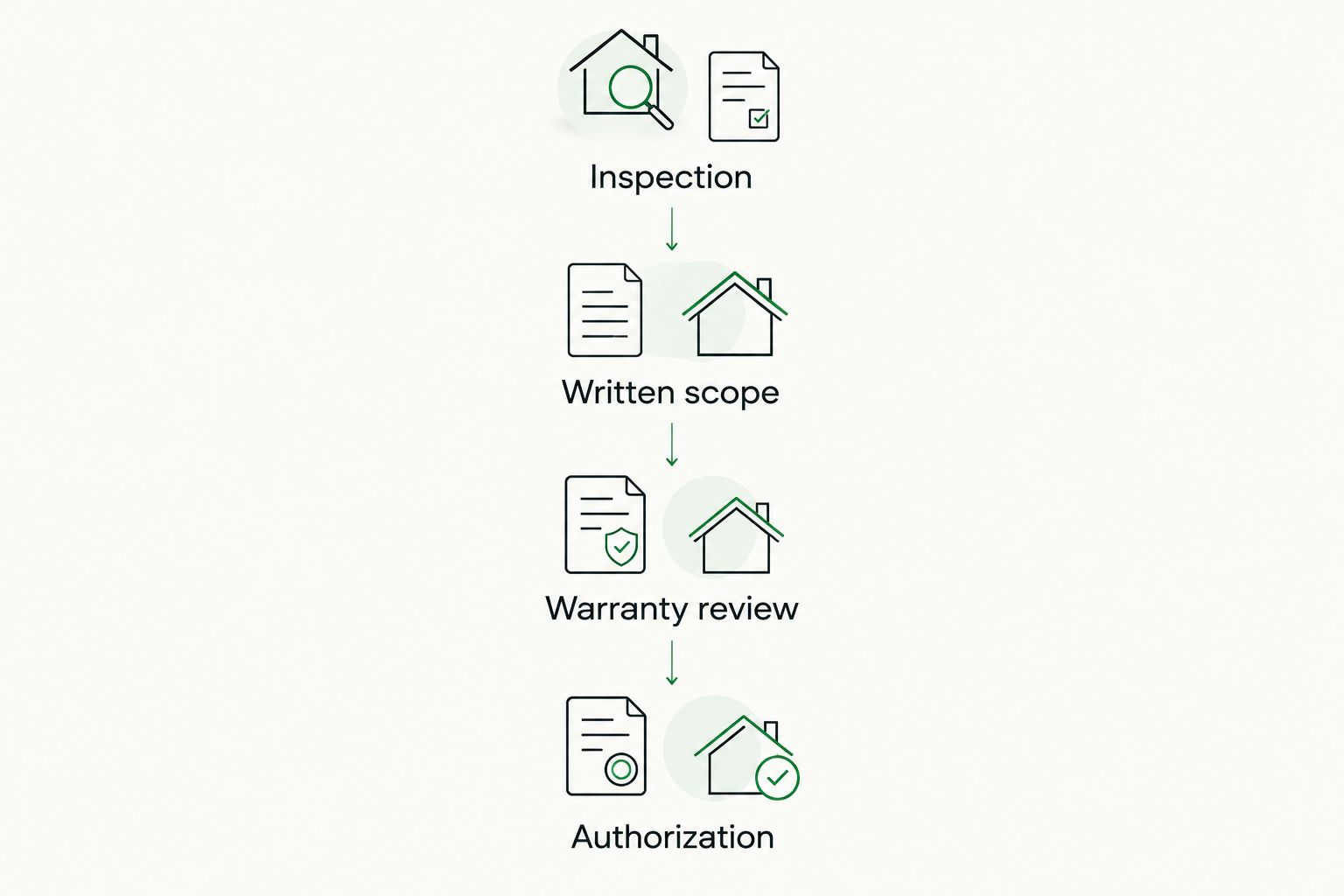
A roofing contract should follow an understood scope, not precede it. Use this sequence to keep the decision organized.
- Inspection: Review the findings and the recommended response.
- Written scope: Confirm included work, materials, exclusions, and responsibilities.
- Warranty review: Read the applicable coverage, eligibility requirements, and limitations.
- Authorization: Approve the contract and payment arrangement after your questions are answered.
If the scope changes, ask for the change in writing before approving it. Keep the explanation with your original contract so you have a record of what was authorized.
Understand warranties without relying on the headline
Warranty duration is not the same as warranty coverage. Read who provides the coverage, what it covers, and what conditions apply.
Murray Roofing identifies a 50-year Golden Pledge warranty and a 10-year labor warranty among its trust signals. Ask which coverage applies to your proposed roof, how eligibility works, and what documentation you receive. Do not assume every repair or replacement carries identical terms.
Separate these questions:
- Product coverage: What material defects are addressed?
- Workmanship coverage: What installation-related issues are addressed?
- Exclusions: Which causes of damage or conditions fall outside coverage?
- Administration: Is registration required, and who handles it?
- Transfer: What happens if you sell your home?
Keep written warranty terms rather than relying on a description from a sales conversation. The contract and warranty documents should support the same understanding of your project.
Use credentials as a starting point, not the entire decision
Murray Roofing’s verified trust signals include an A+ BBB rating, 5-star reviews, and GAF Master Elite status. These give you relevant background when considering a Lincoln roof inspection or replacement.
They do not answer every project-specific question. You still need to review the proposed materials, installation scope, warranty eligibility, and payment arrangement.
The same distinction applies to reviews: look for useful descriptions of communication and completed work, but do not treat another homeowner’s experience as a guarantee of your project’s outcome.
For roofing services, Murray Roofing is a practical option for Lincoln homeowners who need inspection, repair, replacement, and financing through one contractor. The decision to proceed should still rest on your home’s findings and written proposal.
Keep financing and insurance separate
Financing and insurance address different parts of the payment decision. Neither changes what the roof inspection finds.
Financing
Financing is available through Murray Roofing. For your 2026 project, review the current terms, approval requirements, fees, repayment schedule, and total repayment obligation before accepting an arrangement.
Ask what happens if the authorized scope changes. A manageable payment does not make an unclear contract acceptable.
Insurance-claim support
The contractor provides insurance-claim support, but your insurer determines coverage under your policy. A contractor’s damage assessment is not a coverage guarantee.
Retain photographs, inspection findings, insurer correspondence, and written proposals. Ask your insurer about policy requirements, deductibles, and claim procedures rather than assuming storm-related work will be covered.
FAQ
How should I evaluate roofing alternatives in Lincoln, NE?
Start with a documented inspection and a written scope for your home. Review the recommended work, exclusions, warranty terms, and payment responsibilities before choosing a contractor.
Does an old roof automatically need replacement?
Age alone does not establish that a roof needs replacement. Ask the inspecting contractor to explain the roof’s condition and why repair, replacement, or monitoring is appropriate.
Does Murray Roofing offer free inspections in Lincoln?
Yes, Murray Roofing offers free inspections and serves Lincoln homeowners. Use the inspection to discuss roof condition, recommended work, and the next steps for a written proposal.
What should a roof replacement proposal include in 2026?
A roof replacement proposal should identify the work, materials, exclusions, payment terms, and applicable warranties. Ask how concealed damage and changes to the authorized scope will be handled.
Does a roofing warranty cover every future leak?
Do not assume a roofing warranty covers every future leak. Coverage depends on the written terms, the cause of the problem, exclusions, and any eligibility or maintenance requirements.
Can a roofing contractor guarantee my insurance claim will be approved?
No, a roofing contractor cannot guarantee insurance coverage. Your insurer evaluates the claim under your policy; contractor documentation supports the process but does not determine the outcome.
What should I ask before financing a roof replacement?
Ask about approval requirements, fees, repayment terms, and the total repayment obligation. Confirm how changes to the roofing scope affect the financing arrangement before signing.
One last thing: ask what would change the recommendation
Before authorizing your 2026 project, ask: what finding would change this recommendation from repair to replacement, or from replacement to repair?
The answer should connect the proposed work to observable roof conditions. Choose a clear diagnosis and an accountable written scope—not a recommendation you cannot explain after the appointment.
Related guides
- Is it cheaper to repair a roof or replace it completely?
- Roof warranty types for homeowners
- From roof inspection to signed contract
Schedule an inspection for your Lincoln or Omaha home, review the findings, and request a written price for the recommended work.
Schedule your roof inspection
Discuss your roof’s condition, repair or replacement needs, and the next steps for a written proposal.