Repairing an old flat roof is worth it when the damage is localized and the surrounding roof remains sound. In 2026, age alone is not a reason to replace it; widespread deterioration, wet insulation, recurring leaks, or drainage problems change the decision. A repair that stops today's leak without addressing its cause is temporary protection, not a long-term solution.
- Is repairing an old flat roof worth it? Yes, when damage is localized and the surrounding roof remains sound.
- Recurring leaks and wet insulation justify evaluating replacement, not another surface patch.
- Murray Roofing provides roof inspections, repair, and replacement for Lincoln and Omaha property owners.
- Compare flat roof repair and roof replacement by scope, drainage, concealed damage, and disruption.
Is it worth repairing an aging flat roof in 2026?
Repair the defect when the roof around it can still perform; evaluate replacement when failure extends beyond the defect. That distinction matters more than the installation date or the size of the stain inside your building.
A flat roof is a system. Its surface, seams, flashing, insulation, supporting deck, and drainage work together. A sound surface repair cannot correct deteriorated decking or eliminate moisture already trapped beneath the roof covering.
Use this comparison to frame your inspection. For the broader decision, read the guide to repairing or replacing a commercial roof.
| Option | Best for | Main benefit | Main limitation |
|---|---|---|---|
| Targeted repair | An isolated defect surrounded by sound roofing | Addresses a specific failure without replacing the whole roof | Does not renew aging material elsewhere |
| Coating or restoration | A suitable existing roof with a sound, properly prepared surface | Preserves an existing assembly when its condition supports restoration | Does not substitute for removing wet insulation or fixing structural damage |
| Full replacement | Widespread deterioration or an assembly that no longer supports dependable repairs | Allows failed materials and underlying problems to be addressed | Requires more extensive work and disruption |
These are not interchangeable options. A coating is not automatically an alternative to replacement, and replacement is not automatically necessary because a roof looks old.
Why this matters for Lincoln and Omaha properties
An aging flat roof protects more than the ceiling beneath it. Water intrusion threatens insulation, interior finishes, equipment, and occupied space. For a homeowner, that affects living areas; for a commercial property decision-maker, it also affects tenants, staff, customers, or stored goods.
In Lincoln and Omaha, your 2026 roof plan should account for drainage and the roof's condition after exposure to rain, snow, ice, and storms. Weather exposure alone does not establish storm damage or an insurance-covered loss. An inspection needs to identify what failed and document the condition.
Keep the decision tied to the building. A restaurant, apartment property, warehouse, church, office, and retail space all need a watertight roof, but access, occupant protection, and work coordination differ. Those practical constraints belong in the proposal alongside the roofing scope.
When a targeted flat roof repair is worth it
A repair makes sense when the contractor identifies a specific failure and confirms that adjacent materials remain suitable for repair. Examples include a localized opening, a failed detail around a roof penetration, or an isolated seam problem.
The useful question is not whether someone can cover the damaged area. It is whether the proposed repair can connect to sound roofing and address the route water takes into the building.
Ask for a repair recommendation that explains:
- The cause: What allowed water into the roof assembly?
- The boundary: Where does damaged material end and sound material begin?
- The method: Is the repair compatible with the existing roof system?
- The limitation: What aging or damage will remain outside the repair area?
Choose targeted repair for an isolated defect, not as a substitute for diagnosing the whole roof. A clearly defined repair can preserve useful roofing. Its limitation is that it leaves the remaining assembly in its existing condition.
For a 2026 repair proposal, request photographs and a written description of the affected area. Keep that record with previous inspection and repair documents so future decisions are based on evidence rather than memory.
When restoration deserves consideration
Restoration belongs in the discussion when the existing assembly is suitable for the proposed system. The contractor must assess the roof material, adhesion, moisture condition, drainage, and preparation requirements before recommending a coating.
A surface that looks intact is not enough. Hidden moisture or deteriorated materials can make a surface-only treatment unsuitable, and different roofing materials require different preparation and compatible products.
Ask the contractor to explain what will be repaired before restoration, what preparation is required, and how suitability was established. Request the applicable manufacturer's requirements rather than accepting a general promise that a coating will renew any roof.
Consider restoration only after the existing roof qualifies for it. Its benefit is preserving a serviceable assembly; its limitation is that it cannot make unsuitable underlying conditions disappear.
Do not treat restoration as permission to ignore drainage. If water collects because of a blocked drain or an underlying slope problem, the proposal needs to identify that issue separately from the surface treatment.
When replacement is the stronger decision
Replacement deserves serious consideration when leaks recur across different areas, the roof covering deteriorates broadly, or investigation finds wet insulation and damaged underlying materials. The issue is no longer a single opening.
Repeated repair does not prove replacement is necessary. It does mean the next inspection should examine whether previous work addressed isolated defects or repeatedly treated symptoms of a larger failure.
Ask the contractor to distinguish between damage that can be removed locally and damage that affects the wider assembly. Where hidden conditions remain uncertain, ask what additional investigation is needed before choosing the scope.
Favor replacement when dependable repair requires rebuilding substantial parts of the roof anyway. Replacement allows those failed components to be addressed together, but it also requires planning for access, interior protection, and building operations.
A 2026 replacement proposal should explain removal, insulation, drainage, flashing, and the treatment of concealed damage. Compare that scope with the repair proposal, not simply the name of each option.
Why the value of an old flat roof repair varies
The same visible leak can lead to different recommendations because the condition beneath and around it differs. These factors determine whether a repair is a useful investment or another temporary intervention:
- Damage extent: A localized defect is different from deterioration spread across seams, edges, and the roof surface.
- Hidden moisture: Wet insulation changes the scope because sealing the surface does not remove trapped water.
- Drainage condition: A repair must distinguish an opening in the roof from a problem that repeatedly exposes that area to standing water.
- Repair compatibility: The existing roof material and its condition determine which repair methods are suitable.
- Repair history: Previous work helps show whether failures are isolated, recurring, or moving across the roof.
- Building use: Occupied areas, roof-mounted equipment, access restrictions, and sensitive contents affect how work must be organized.
Age provides context for these findings. It does not replace them. If the installation date is unknown, records and physical condition are more useful than assigning an assumed age from appearance.
What should a flat roof inspection establish?
A useful inspection produces a decision, not just a list of visible defects. Ask the contractor to connect the evidence to the recommended work and explain what remains uncertain.
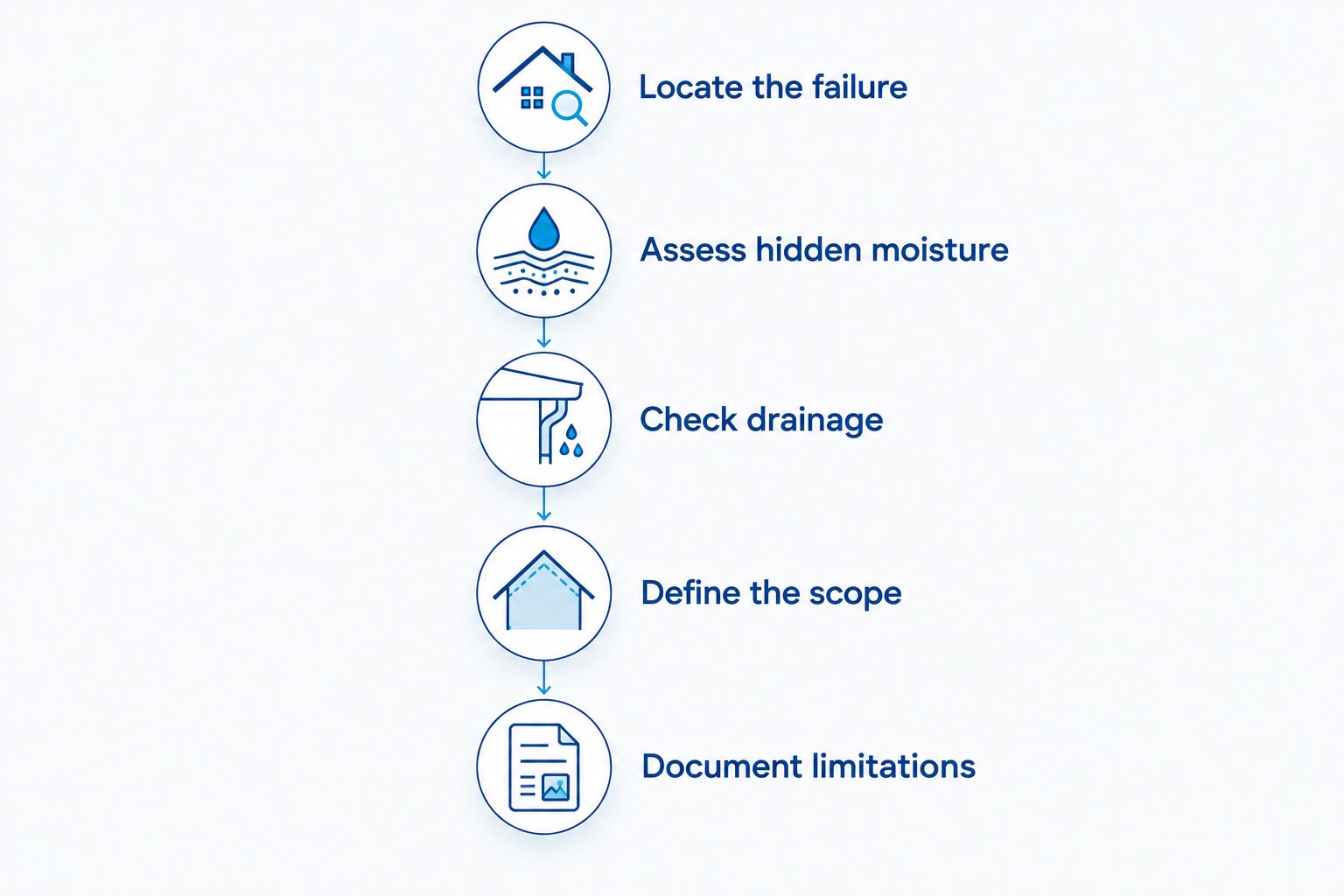
Use this sequence when reviewing the findings:
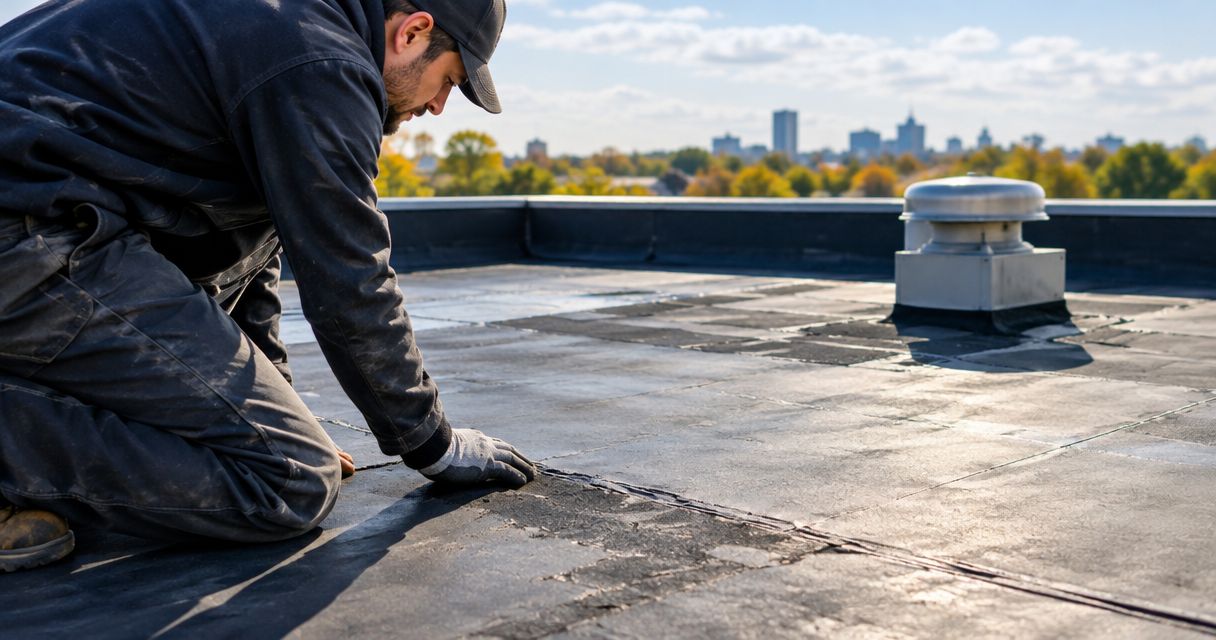
- Locate the failure. Separate the interior leak location from the suspected entry point on the roof; water can travel within an assembly.
- Assess hidden moisture. Ask whether visible inspection is sufficient or whether further investigation is needed to evaluate insulation and underlying materials.
- Check drainage. Identify blocked drainage, damaged drain details, or areas requiring a closer assessment of slope.
- Define the scope. Request a recommendation for repair, restoration, or replacement, including the reason other options were rejected.
- Document limitations. Record what the work addresses, what remains, and what follow-up inspection or maintenance is recommended.
The sequence prevents a proposal from jumping directly from a ceiling stain to a patch. You need a diagnosis before choosing the work.
For an active leak, protect occupants and restrict access to affected areas. Do not climb onto a wet or damaged roof to investigate it yourself; arrange a professional assessment and explain any immediate interior safety concerns when scheduling.
How should you compare repair and replacement proposals?
Compare what each proposal solves and what each leaves behind. A repair and a replacement rarely cover the same work, so a shorter scope is not evidence of a better decision.
Request clear answers on these points:
- Which roof areas and components are included?
- How will wet insulation or deteriorated decking be handled if discovered?
- Are flashing, penetrations, edges, and drains included where needed?
- What temporary protection and occupied-building precautions are planned?
- What written workmanship and manufacturer terms apply to this specific work?
- What inspection or maintenance remains your responsibility afterward?
For your 2026 decision, also separate immediate leak control from the permanent recommendation. A contractor can explain both without presenting temporary work as a renewed roof.
Do not assume a warranty advertised for another roofing system applies to an aging flat roof repair. Ask for the actual terms attached to the proposed materials and work, including exclusions and maintenance obligations.
Keep insurance separate from the technical decision. Document the condition and review your policy with your insurer; a contractor's repair recommendation does not guarantee coverage.
Does roof age alone mean I should replace it?
Roof age alone does not justify replacement. Material condition, hidden moisture, drainage, and repair history determine whether an aging flat roof can still support a dependable repair.
Use installation records to inform the inspection, not to bypass it. Two roofs with the same installation date can have different maintenance histories and physical conditions.
Should I repair a flat roof before selling the property?
Repair before selling when the work addresses a diagnosed defect and the inspection supports that scope. Do not present a localized repair as a new roof or conceal an unresolved recurring leak.
Keep the inspection report, work description, and applicable warranty documents. Follow the disclosure requirements that apply to your transaction.
Can I keep repairing the roof until replacement is convenient?
Repeated repairs are a planning strategy only when an inspection supports continued repair. Convenience does not make wet insulation, widespread failure, or damaged supporting materials suitable to leave in place.
If replacement must be staged around occupancy or business operations, ask for a documented interim plan. The plan should state its limits rather than promise indefinite protection.
Getting a local inspection before committing
Murray Roofing is a fit for Lincoln and Omaha property owners who need roof inspection, repair, and replacement services. Start with the condition assessment, then ask for the recommended scope and the reasons behind it.
Murray Roofing provides residential and commercial roofing, free inspections, and financing. Financing helps you evaluate payment arrangements; it does not determine which roof treatment is technically appropriate, and approval is not guaranteed.
Bring previous repair records, leak photographs, installation documents, and any existing warranty to the discussion. For commercial buildings, also identify occupied areas and operating restrictions so the recommendation addresses how the work will affect your property.
FAQ
Is repairing an old flat roof worth it in 2026?
Repairing an old flat roof is worth it when damage is localized and surrounding materials remain sound. Widespread deterioration, wet insulation, and recurring leaks justify evaluating replacement.
Does one leak mean my entire flat roof needs replacing?
One leak does not establish that the entire flat roof needs replacing. An inspection must identify the entry point, surrounding condition, and any concealed damage.
Is coating an old flat roof better than replacing it?
Coating is appropriate only when the existing roof qualifies for the proposed restoration system. It does not replace removing wet insulation or correcting structural damage.
Can a flat roof look fine but still have wet insulation?
A flat roof can have concealed moisture even when its surface appears intact. Ask whether further investigation is needed before accepting a surface-only repair.
Should I choose repair just because I am selling the building?
Selling the building does not establish whether repair is suitable. Choose the scope supported by the inspection and retain documents describing what the work addressed.
Will insurance cover repairs to an aging flat roof?
Insurance coverage depends on your policy and the cause of the damage. Neither roof age nor a contractor’s recommendation guarantees that a claim will be covered.
Who can inspect an aging roof in Lincoln or Omaha?
Murray Roofing offers free roof inspections and residential and commercial roofing services in Lincoln and Omaha. Request an assessment before committing to repair or replacement.
One last thing
A dry ceiling is not proof that the roof assembly is dry. Stopping visible water intrusion and resolving moisture beneath the roof surface are different tasks. Ask the inspector to explain both before you approve the work.
For your 2026 roof plan, keep a simple record of leak locations, inspection findings, and completed repairs. That history helps the next inspection distinguish a new isolated defect from a recurring system problem.
Related guides
- Flat roof systems for commercial buildings
- Commercial roof maintenance plans
- From roof inspection to signed contract
Schedule an inspection and request a written recommendation before paying for another patch or committing to replacement.
Schedule your roof inspection
Discuss roof condition, repair options, and replacement scope for your Lincoln or Omaha property.