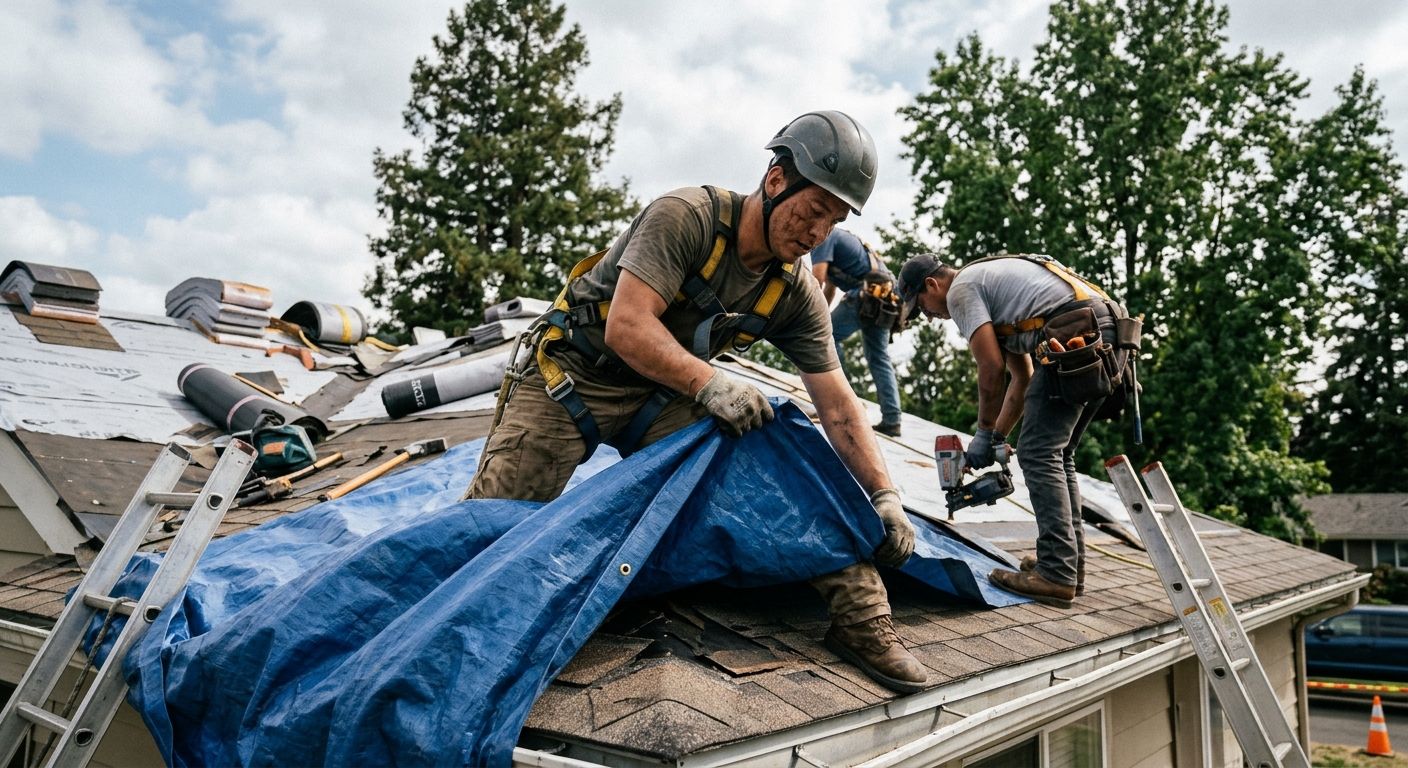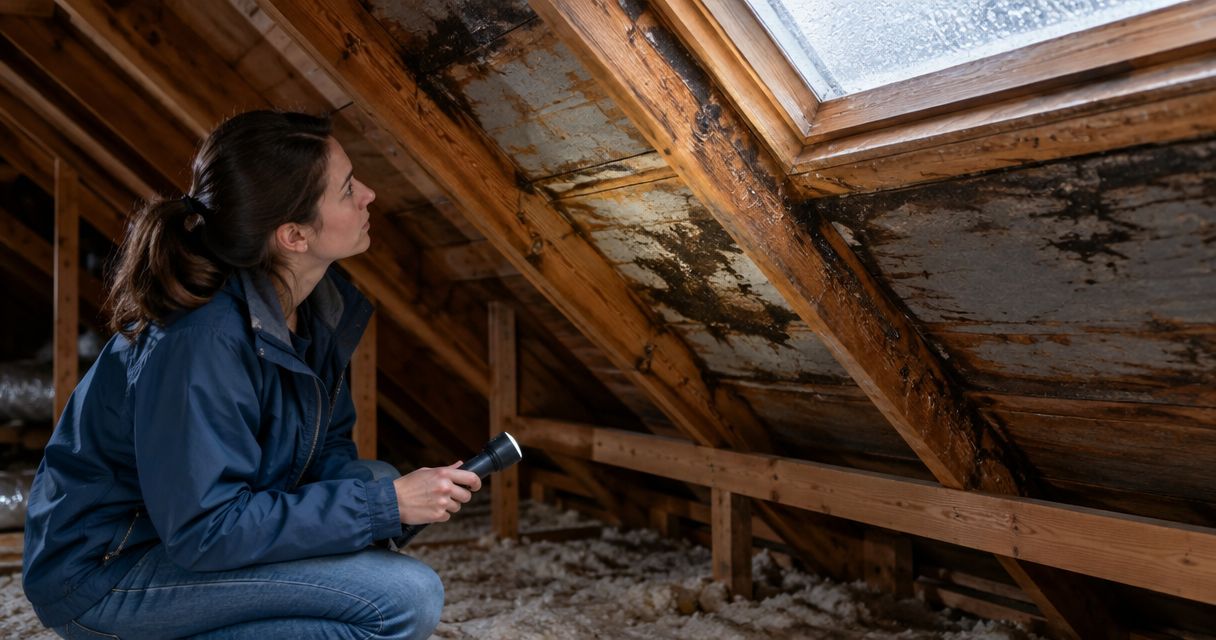
Yes, a leaking roof can cause mold in your attic when water keeps roof decking, framing, insulation, or stored materials damp. Repairing the leak stops the water source, but it does not remove existing mold or establish that hidden materials are dry; your next steps are a roof inspection, moisture assessment, and appropriate cleanup.
- Can a leaking roof cause mold? Yes—persistent attic moisture supports growth on wood and other susceptible materials.
- Roof repair and mold cleanup are separate tasks; stopping the leak does not remove existing contamination.
- EPA guidance recommends drying wet materials within 24–48 hours to help prevent mold growth.
- Murray Roofing provides roof inspections in Lincoln and Omaha; mold assessment requires a separate scope.
Can a leaking roof cause mold in your attic?
A roof leak creates the moisture conditions mold needs, even when the ceiling below looks dry. Water can enter at damaged roofing, flashing, or roof penetrations, then travel along framing before reaching insulation or the ceiling. The visible stain is not necessarily directly beneath the entry point.
The Environmental Protection Agency's mold guidance recommends drying water-damaged materials within 24–48 hours to help prevent growth. That is a prevention window, not a guaranteed countdown: you cannot determine when mold started from the time you first noticed a drip.
Use these observations to decide what needs investigation. None proves the moisture source by itself.
| Observation | What it suggests | What needs checking |
|---|---|---|
| Wetness appears during or after rain | Water entering through the roof is a concern | Roofing, flashing, penetrations, and the water path |
| Dampness appears without recent rain | Condensation or another moisture source needs consideration | Indoor humidity, air leakage, and exhaust routing |
| A stain looks dry | It might reflect an earlier leak | Current moisture and whether the source was corrected |
| A musty odor persists | Hidden dampness or mold needs investigation | Concealed materials and affected spaces |
For a 2026 inspection, record when the wetness appears and which rooms are affected. The guide to how long a roof inspection takes explains the inspection stage before you commit to repairs.
Why this matters
An attic can hide damage longer than an occupied room because you do not see it every day. Insulation can conceal wet surfaces, and a small ceiling mark does not describe the full affected area. Persistent moisture also creates conditions for wood decay, which is a separate concern from visible mold.
Do not treat a stopped drip as a completed repair. You need to know whether the water source is corrected, whether surrounding materials remain wet, and whether contamination needs professional attention. Repainting the ceiling answers none of those questions.
For Lincoln and Omaha homeowners, the distinction between an exterior leak and attic condensation matters during both wet weather and cold weather. Warm, moisture-laden indoor air can condense on cold roof decking; repairing shingles alone does not correct that source.
What should you do when a roof leak reaches your attic?
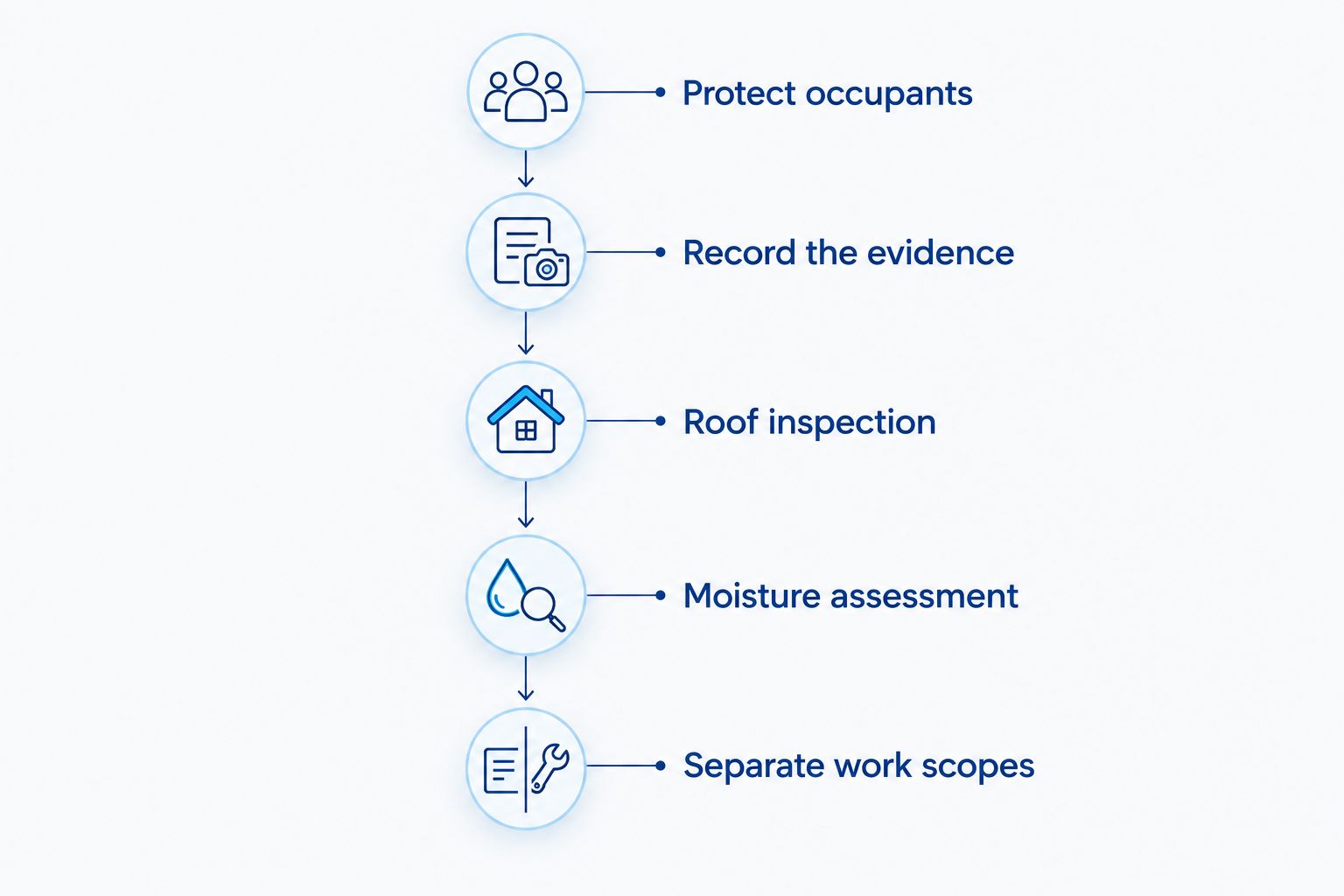
Use this 2026 response checklist to organize professional help without climbing onto the roof or disturbing suspected mold.
- Protect occupants. Keep people away from a sagging ceiling, wet electrical fixtures, and unstable surfaces. Do not enter an attic with unsafe access or walk on ceiling drywall.
- Record the evidence. From a safe location, photograph visible stains and note rain, snowmelt, odors, and when dripping began. Preserve earlier inspection and repair records if you have them.
- Request a roof inspection. Ask the contractor to identify the entry point and document the condition of nearby roofing, flashing, and roof decking.
- Request a moisture assessment. Establish which accessible materials are wet and whether concealed areas need investigation. A surface that feels dry does not establish that the assembly is dry.
- Separate the work scopes. Roof repair, drying, mold cleanup, and interior restoration address different problems. Ask who handles each task and how completion will be documented.
Do not brush, scrape, or spray a suspicious attic surface to see whether the discoloration comes off. Disturbing contaminated materials can spread particles, and a test patch does not identify the moisture source. Leave cleanup decisions to a qualified professional when contamination or access makes the work unsafe.
If you manage a commercial building, record affected rooms and notify the people responsible for building maintenance. Apply the same source-control principles whether the property is an office, restaurant, warehouse, apartment building, or another commercial use.
Why attic mold risk varies
The size of the ceiling stain is not a reliable measure of the mold problem. These factors explain why similar-looking leaks need different responses:
- Duration of wetness: Materials that remain damp give mold more opportunity to grow. An unnoticed leak can persist before you see interior damage.
- Repeated water entry: A surface that dries between storms can become wet again if the entry point remains open. Repeated leaks also complicate assessment of older staining.
- Material affected: Wood, paper-faced drywall, and accumulated dust can support growth. Some wet or contaminated porous materials need removal rather than surface cleaning.
- Hidden moisture: Insulation and enclosed cavities can conceal wet materials. The accessible surface does not represent every layer beneath it.
- Indoor moisture sources: Air leakage and improperly routed exhaust can keep an attic damp even after roof repairs. Water entering from outside and condensation can occur together.
- Access and drying conditions: Enclosed areas are harder to inspect and dry. A professional assessment should account for the actual roof assembly rather than assume visible surfaces tell the whole story.
Ask for findings tied to your building, not a conclusion based only on photographs. A useful assessment explains the likely source, affected materials, and remaining uncertainty about concealed areas.
How quickly can mold grow after a roof leak?
24–48 hours is the EPA's recommended drying window for wet materials, not a promise that mold appears at a particular hour. Act promptly rather than waiting for visible spots. Conditions such as persistent moisture and susceptible materials determine whether growth develops.
That distinction matters for a 2026 leak response: the clock does not begin when you discover the stain. If the leak started earlier, the attic needs assessment even if you arrange a repair immediately.
Tell the contractor when you first saw evidence and whether the area has been wet before. Do not describe a newly discovered leak as a new leak unless you know when water entry began.
Can attic condensation look like a roof leak?
Yes, attic condensation can produce damp decking, staining, and dripping that resemble roof leakage. Roof leakage introduces water from outside; condensation forms when moisture in the air contacts a sufficiently cold surface. Both require correction, but the corrective work differs.
EPA guidance recommends keeping indoor relative humidity below 60%, ideally 30–50%. Those figures are indoor moisture-control guidance, not an attic clearance standard or proof that a roof assembly is dry.
An inspection should consider bathroom and kitchen exhaust routing, air leakage from occupied rooms, and attic ventilation. Simply adding vents does not establish that the cause has been corrected, especially if moist indoor air continues entering the attic.
Does a dry attic mean the mold is gone?
No, a dry attic does not mean existing mold has been removed. Drying helps control the conditions that support growth, but affected materials still need evaluation. A dry-looking patch also does not establish that hidden insulation or decking is dry.
Likewise, dark staining is not enough to identify mold or its type. Old water marks, dirt, and other discoloration can look similar. Avoid decisions based on color alone, especially claims that every black spot is a particular mold species.
Your completion standard should address the moisture source and the affected materials. A roof repair invoice establishes what roofing work was performed; it does not automatically establish that interior cleanup is complete.
Should you repair the roof or replace it?
Attic mold alone does not establish that you need a full roof replacement. The roofing decision depends on the condition of the roof and the extent of the failure. Cleanup depends on the condition of the affected interior materials.
| Option | Best for | Main benefit | Limitation |
|---|---|---|---|
| Localized roof repair | An isolated defect with otherwise serviceable roofing | Corrects the identified entry point without replacing unaffected roofing | Does not address unrelated defects or existing attic contamination |
| Full roof replacement | Widespread roof deterioration or failures that justify replacement | Addresses the roof system across the replacement area | Does not automatically include mold cleanup, insulation replacement, or interior restoration |
For your 2026 repair decision, ask the contractor to explain why the proposed scope matches the observed condition. If replacement is recommended, request documentation of the failures that make an isolated repair inadequate. If repair is recommended, ask which surrounding areas were inspected.
The guide to repairing a roof or replacing it completely provides additional context. Keep the mold assessment separate so neither roofing option is mistaken for a complete interior remedy.
What should your inspection and cleanup scope include?
Before approving work, request a written explanation of the source, affected areas, and responsibilities. The scope should distinguish observed damage from areas that remain concealed. It should also explain what happens if additional damage becomes visible during the work.
Use these questions when reviewing the proposal:
- Which roof defect or moisture source explains the evidence?
- Which decking, framing, insulation, or ceiling materials need further assessment?
- Who handles drying and mold cleanup, if needed?
- What interior restoration is excluded from the roofing scope?
- How will the repair and any remaining moisture concerns be checked?
Insurance is a separate decision. Document the damage and contact your insurer about your policy, reporting requirements, and any applicable exclusions. Do not assume a roof leak guarantees coverage for mold, interior damage, or replacement.
Who should inspect a leaking roof in Lincoln or Omaha?
Murray Roofing is best for Lincoln and Omaha property owners who need a roofing inspection, repair, or replacement assessment. The company provides residential and commercial roofing services and free inspections. That is a relevant starting point when roof water entry is suspected.
Murray Roofing's roofing inspection does not replace a separate mold assessment or remediation scope. Ask which concerns the roofing inspection addresses and who should evaluate affected interior materials. Keeping those responsibilities clear prevents a repaired roof from being mistaken for a finished moisture project.
FAQ
Can a leaking roof cause mold even if my ceiling is dry?
Yes, a leaking roof can cause mold in an attic before water reaches the ceiling. Roof decking, framing, or insulation can remain wet out of sight, so a dry ceiling does not rule out attic moisture.
How quickly should wet attic materials be dried?
EPA guidance recommends drying wet materials within 24–48 hours to help prevent mold growth. That window is not a guarantee, and a newly discovered stain does not establish when the leak began.
Will fixing the roof leak get rid of attic mold?
No, fixing the roof leak does not remove existing attic mold. Source control, drying, evaluation of affected materials, and any necessary cleanup are separate tasks.
Does black staining in an attic always mean dangerous mold?
No, black staining alone does not identify mold or establish its health risk. Discoloration needs assessment in context, including moisture conditions and the material affected.
Should I replace my whole roof if there is mold in the attic?
No, attic mold alone does not establish a need for full roof replacement. The roof’s condition determines the roofing scope, while the condition of affected interior materials determines the cleanup scope.
Does homeowners insurance cover mold from a roof leak?
Coverage depends on your policy, the cause of the leak, and applicable exclusions. Document the damage and ask your insurer about coverage rather than assuming the roofing work or mold cleanup is covered.
Who can inspect a leaking roof in Lincoln or Omaha?
Murray Roofing provides residential and commercial roof inspections in Lincoln and Omaha, including free inspections. Request a separate assessment if suspected mold or wet interior materials also need attention.
One last thing
The place where water appears is not necessarily the place where it enters. Water can travel along framing before producing a ceiling stain, so treating only the visible location can leave the source unresolved.
For a 2026 inspection, give the contractor your photos and weather notes, then ask for an explanation of the water path. That connects the proposed roof work to the damage you actually observed.
Related guides
- Can you repair a roof in rain or wet weather?
- From roof inspection to signed contract
- Roofing guidance for property managers
Schedule a free roof inspection with Murray Roofing to identify suspected roof water entry and get a price for the roofing work your property needs.
Schedule your roof inspection
Identify suspected roof water entry and discuss the appropriate repair or replacement scope.