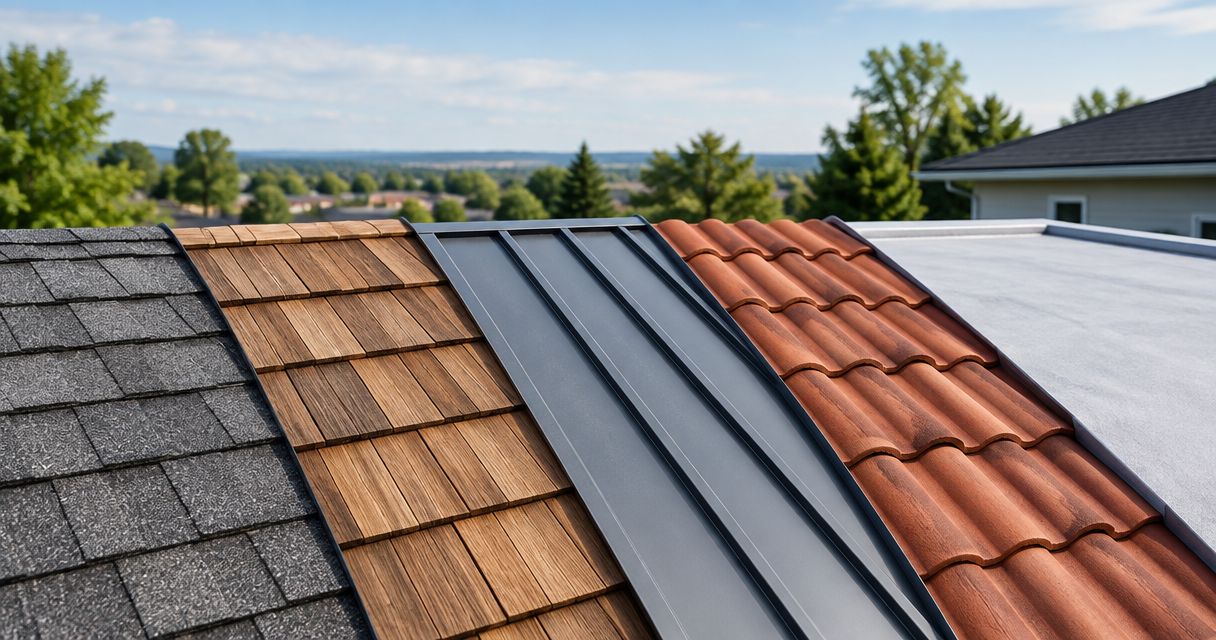
Roof lifespan by material ranges from about 20 years for asphalt shingles to more than 50 years for slate, copper, and clay or concrete tile; metal roofing has a published 40–80-year range. These 2026 benchmarks are planning estimates, not measured averages or promises about how long your roof will last.
- Roof lifespan by material starts around 20 years for asphalt shingles; published metal roofing estimates span 40–80 years.
- Slate, copper, and clay or concrete tile have published life-expectancy estimates exceeding 50 years.
- Roof replacement decisions need an inspection: age alone does not establish remaining service life.
- Murray Roofing provides roof inspections for Lincoln and Omaha owners deciding between repair and replacement.
Why this matters
A roof near its published life expectancy deserves attention, not an automatic replacement order. A younger roof with damaged flashing, recurring leaks, or wet decking also needs evaluation. Use the material benchmark to start the conversation; use the roof's condition to make the decision.
Murray Roofing provides residential and commercial inspections, repairs, and replacements. Murray Roofing is best for Lincoln and Omaha property owners who need a roof inspection before deciding on repair or replacement.
Roof lifespan by material: 2026 benchmark table
Roof lifespan means the estimated service life of a roof covering. It does not describe the remaining life of an existing roof, and it does not mean every component beneath that covering lasts equally long.
The table below uses published residential estimates from the National Association of Home Builders and Bank of America's Study of Life Expectancy of Home Components, dated February 2007. The figures retain that source's scope; presenting them in a 2026 guide does not turn them into newly measured results.
| Material or scope | Published life-expectancy estimate | Best for considering | Main benefit | Main limitation |
|---|---|---|---|---|
| Overall residential reference | Material-specific estimates, not a pooled average | Comparing replacement options | Shows how widely expected service life differs | Does not predict an individual roof's remaining life |
| Asphalt shingles | About 20 years | Owners evaluating an existing shingle roof | Provides a clear age-based planning reference | Shingle condition and installation still control the decision |
| Fiber-cement shingles | About 25 years | Owners identifying an existing fiber-cement roof | Gives a material-specific planning estimate | The benchmark does not establish the condition of the installed roof |
| Wood shakes | About 30 years | Owners evaluating an existing wood roof | Has a longer published estimate than asphalt | Moisture, deterioration, and maintenance require inspection |
| Metal roofing | 40–80 years | Owners considering a longer-service-life covering | Has the longest explicit range in this comparison | The broad category combines different metals and roof systems |
| Slate | More than 50 years | Buildings suitable for a heavy roof covering | Has a long published service-life estimate | Roof structure, flashing, and individual pieces still need evaluation |
| Copper | More than 50 years | Owners evaluating a copper roof system | Has a long published service-life estimate | Joints, details, and supporting components remain important |
| Clay or concrete tile | More than 50 years | Buildings suitable for tile roofing | Has a long published service-life estimate | Tile condition does not establish underlayment condition |
Metal roofing has a published range of 40–80 years; asphalt shingles have the shortest estimate in this table at about 20 years. Slate, copper, and clay or concrete tile all exceed 50 years in the report's summary, but that open-ended figure does not support ranking one above another.
Methodology: these benchmarks reproduce residential roof-covering estimates from the February 2007 NAHB/Bank of America report, rather than averaging a sample of roofs inspected in 2026. The main limitation is scope: they do not establish Lincoln or Omaha service life, storm survival, or commercial membrane performance.
What the numbers actually tell you
The difference between an estimate and a range matters. Asphalt's approximately 20-year figure is a general reference, while metal's 40–80-year range signals substantial variation within the category. Neither tells you the installation quality or maintenance history of a particular property.
The estimates above 50 years are also open-ended. They establish a long planning horizon, not an expiration date, and they do not provide an upper boundary. Do not turn an open-ended benchmark into a guaranteed replacement interval.
A roof system includes more than its visible covering. Flashing, drainage, underlayment, fasteners, and decking affect whether the assembly keeps water out. A long-lived covering does not remove the need to inspect those components.
How to use these benchmarks
Use the 2026 table to organize questions before an inspection. It is most useful when you know the material, have installation records, and can describe any recent problems.
- Treat about 20 years as an asphalt planning reference, not a deadline. Ask whether deterioration is widespread, whether leaks are isolated, and whether repair will address the actual cause.
- Ask what explains a metal roof's 40–80-year range. Identify the metal, panel system, attachment method, and condition of seams and penetrations before choosing a planning assumption.
- Evaluate the whole assembly beneath a 50-plus-year covering. Slate, copper, and tile longevity does not establish the remaining life of flashing or concealed layers.
- Keep residential estimates separate from commercial roof planning. A low-slope membrane needs system-specific documentation and an inspection; an asphalt-shingle benchmark is not a substitute.
For a Lincoln or Omaha replacement, connect material life expectancy with local suitability. The guide to roof types for Nebraska weather addresses that separate decision. A long published lifespan is useful only when the proposed roof also suits the building.
Roof age versus roof condition
Subtracting roof age from a benchmark does not produce a reliable remaining-life estimate. An asphalt roof approaching 20 years needs a condition assessment, not a calculation that assumes every roof follows the same aging curve.
Start with the installation record. A seller's recollection or the date of a previous repair does not necessarily establish when the entire covering was replaced. Separate full replacement records from documents describing patches, coatings, or work on one roof section.
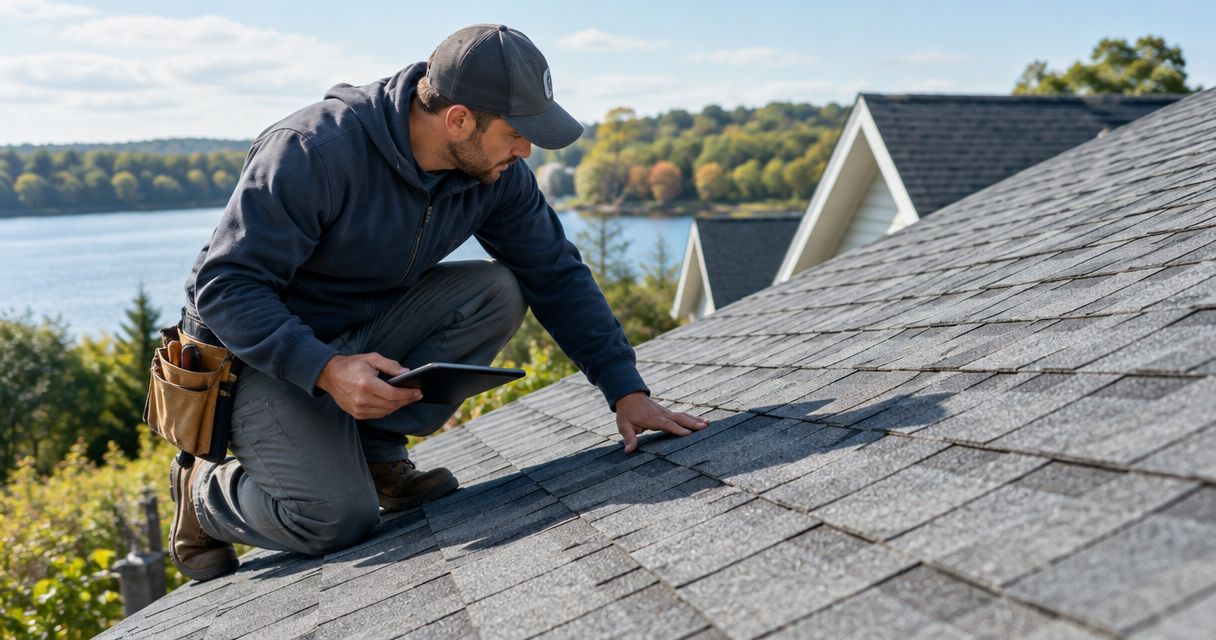
Then ask the inspector to connect visible symptoms with their causes. A ceiling stain establishes that water reached the interior; it does not, by itself, identify where water entered. The assessment should distinguish a localized detail problem from deterioration affecting a wider area.
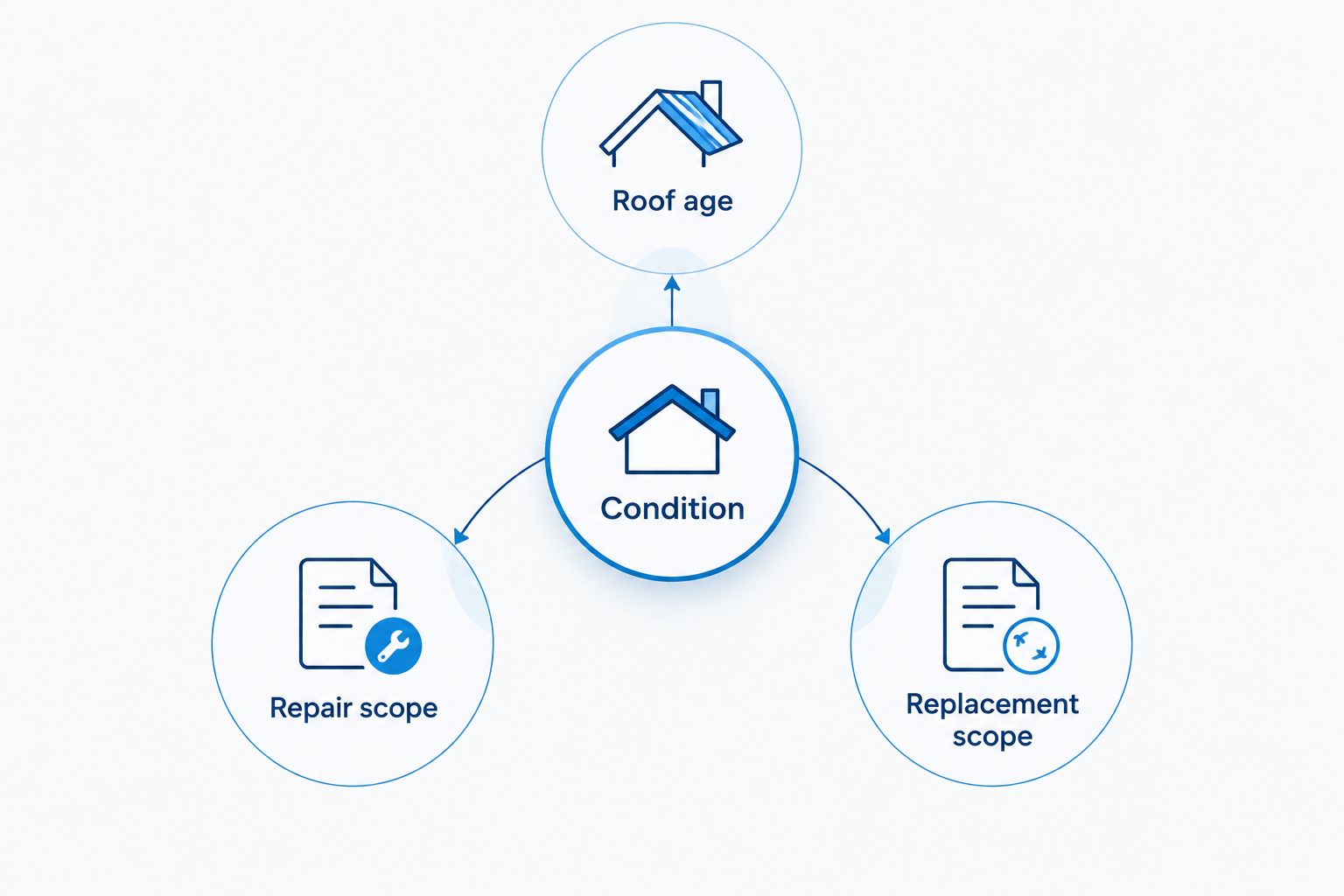
Organize the decision around these four items:
- Roof age: Confirm the installation date and identify which sections share that date.
- Condition: Document the covering, flashing, drainage, and any evidence of moisture damage.
- Repair scope: Identify the defect a proposed repair addresses and what remains outside that work.
- Replacement scope: Identify the roof areas and supporting components included in a replacement proposal.
A useful inspection explanation names the defect, its location, and the proposed response. Ask for photographs and a written scope. That gives you a basis for comparing proposals without treating the longest material lifespan as the only selection criterion.
Lincoln and Omaha: make the benchmark building-specific
For Lincoln and Omaha properties, ask how the roof handles water, wind exposure, and any documented storm damage. Nebraska weather is part of the assessment, but it does not justify assigning every local roof a shorter lifespan than the published reference.
After a storm, separate observed damage from age-related wear. Record when you noticed the problem and preserve the inspection documentation. Neither roof age nor a contractor's assessment guarantees insurance coverage; the policy and claim decision govern coverage.
Ventilation and moisture also belong in a residential inspection. Ask whether the roof assembly shows condensation, wet insulation, or deteriorated decking, and whether a replacement proposal addresses any identified cause. Replacing the covering alone does not answer every moisture problem.
For your 2026 replacement plan, compare complete scopes rather than material names alone. Confirm what happens at roof penetrations, transitions, valleys, and drainage points. Those details explain what you are buying more clearly than a lifespan figure printed beside a material.
Commercial properties need a different lifespan assessment
The residential benchmark table does not establish the life expectancy of a commercial low-slope roof. Restaurants, warehouses, offices, apartments, churches, and other commercial properties need an assessment of the installed system and its condition.
For a commercial property decision in 2026, begin with the roof documents. Identify the membrane or covering, installation date, repair history, warranty terms, and any previous inspection findings. If the building has several roof areas, keep their records separate rather than assigning one age to the entire property.
Ask the inspection to address drainage, seams, penetrations, edge details, and evidence of moisture within the assembly. Rooftop equipment and access routes also belong in the discussion. The condition of those details helps define whether a repair proposal is narrow or whether the roof needs a broader replacement assessment.
Murray Roofing provides commercial roof inspection, maintenance, repair, and replacement services. The useful next step is a documented roof assessment, not importing a residential material's lifespan into a commercial maintenance plan.
Warranty length is not roof lifespan
A warranty describes coverage under stated terms; a lifespan benchmark describes an expected period of service. Those are different measures. A long warranty does not promise that every roof component remains unchanged throughout that period.
Murray Roofing lists GAF Master Elite status, a 50-year Golden Pledge warranty, and a 10-year labor warranty among its trust signals. For a specific proposal, confirm which warranty applies, what work it covers, and what conditions or exclusions appear in the documents.
Keep these questions separate when reviewing an estimate:
- What material and roof assembly are being proposed?
- What workmanship coverage applies to this project?
- What manufacturer coverage applies to the selected system?
- What maintenance, documentation, and transfer requirements apply?
Warranty documents should support your decision, not replace the inspection findings. Read the written terms before assuming that a stated warranty duration matches the roof's expected service life.
FAQ
How long does a roof last by material?
Published residential estimates put asphalt shingles at about 20 years, wood shakes at about 30 years, and metal roofing at 40–80 years. The February 2007 NAHB/Bank of America report places slate, copper, and clay or concrete tile above 50 years; these are planning estimates, not guarantees.
What roofing material lasts the longest?
This benchmark does not establish a single longest-lasting material. Metal has an explicit 40–80-year range, while slate, copper, and clay or concrete tile have open-ended estimates above 50 years, so the figures do not support a definitive ranking.
Should I replace an asphalt roof when it reaches 20 years?
An asphalt roof reaching about 20 years needs a condition assessment, not automatic replacement. Ask an inspector to distinguish localized defects from widespread deterioration and explain whether repair addresses the cause.
Do metal roofs always last 80 years?
No, the published metal-roofing estimate is a 40–80-year range, not an 80-year guarantee. The installed system, detailing, condition, and maintenance matter when assessing a particular roof.
Do Lincoln and Omaha roofs have a different average lifespan?
The national residential estimates cited here do not establish a separate Lincoln or Omaha average. A local inspection should assess the building, installation, weather exposure, and documented damage before setting a replacement plan.
Can I use these benchmarks for a commercial flat roof?
No, residential roof-covering benchmarks do not establish commercial membrane lifespan. Commercial planning needs the installed system’s documentation, repair history, drainage assessment, and current condition.
Does a 50-year roof warranty mean the roof will last 50 years?
No, warranty duration is not a guaranteed roof lifespan. Coverage depends on the written terms, applicable components, exclusions, and requirements for the specific project.
Can Murray Roofing inspect my roof before I decide to replace it?
Yes, Murray Roofing offers free inspections and provides residential and commercial roof repair and replacement services in Lincoln and Omaha. Request an inspection to discuss the roof’s condition and the appropriate work scope.
One last thing
The covering with the longest published lifespan is not automatically the best roof for your building. A tile or slate choice still needs a structural assessment, and any covering needs compatible details that manage water correctly.
Ask for the inspection findings before asking for the replacement recommendation. A proposal that connects each major item to an observed condition gives you a clearer decision than a material lifespan alone.
Related guides
- Flat roof systems for commercial buildings
- Roof warranty types for homeowners
- From roof inspection to signed contract
Schedule a free inspection to get a condition-based repair or replacement recommendation and a price for your property's scope.
Schedule your roof inspection
Discuss your roof’s condition, repair options, and replacement scope in Lincoln or Omaha.