
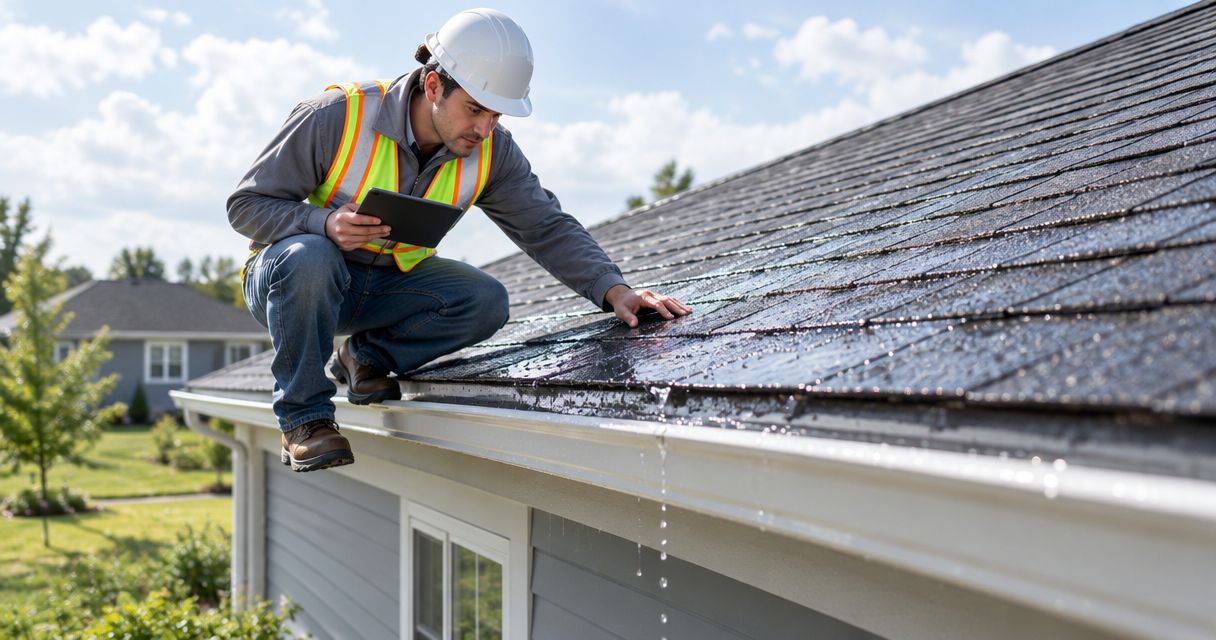
No, it is not normal for a new roof to leak after installation; active water entry needs prompt inspection, not a waiting period for the roof to settle. A leak does not automatically mean the entire roof needs replacement, and a ceiling stain alone does not establish whether the source is the roof, condensation, plumbing, or another building component.
- Is it normal for a new roof to leak after installation? No—report active water entry promptly.
- Murray Roofing provides roof inspections and repairs for homeowners and commercial property owners in Lincoln and Omaha.
- Document new-roof leaks before cleanup, but stay off the roof and away from sagging ceilings.
- A targeted roof repair addresses an isolated defect; replacement requires evidence of broader problems.
Is it normal for a new roof to leak after installation?
A completed roof should keep rainwater out. Water entering during the first storm is not an acceptable break-in condition, even if the roof looks new from the ground. The installer needs to identify the entry point and explain the correction.
Murray Roofing's roofing services include inspections, repairs, and replacements in Lincoln and Omaha. For a roof installed in 2026, keep the installation contract, completion photos, and leak report together so the contractor can compare the reported problem with the original scope.
These observations help direct an inspection, but none proves the cause by itself:
| What you notice | What needs investigation | What the observation does not prove |
|---|---|---|
| Dripping during rain | Roof covering, flashing, walls, and penetrations | That every part of the new roof is defective |
| Dampness around a vent or chimney | The connection between the roof and the opening | That adding surface sealant will resolve it |
| Moisture during cold weather | Condensation, air leakage, and snowmelt entry | That the shingles are necessarily leaking |
| A stain that remains after replacement | Existing damage versus fresh moisture | That an old stain means active leakage |
| Water near a commercial rooftop unit | Roofing details, equipment connections, and condensate drainage | That the roofing contractor caused the problem |
Why this matters
A small visible stain does not show the full path water has taken. Moisture can travel along framing or other surfaces before reaching a ceiling, so the drip location is a clue—not necessarily the entry point.
Prompt reporting also protects your repair record. For a 2026 installation, a dated message showing when the problem appeared gives the installer clearer evidence than a later recollection after repainting or interior repairs.
Treat active leakage as a building-protection issue first and a responsibility question second. Keep people away from unsafe areas while the contractor investigates who should handle the correction.
What should you do when your new roof starts leaking?
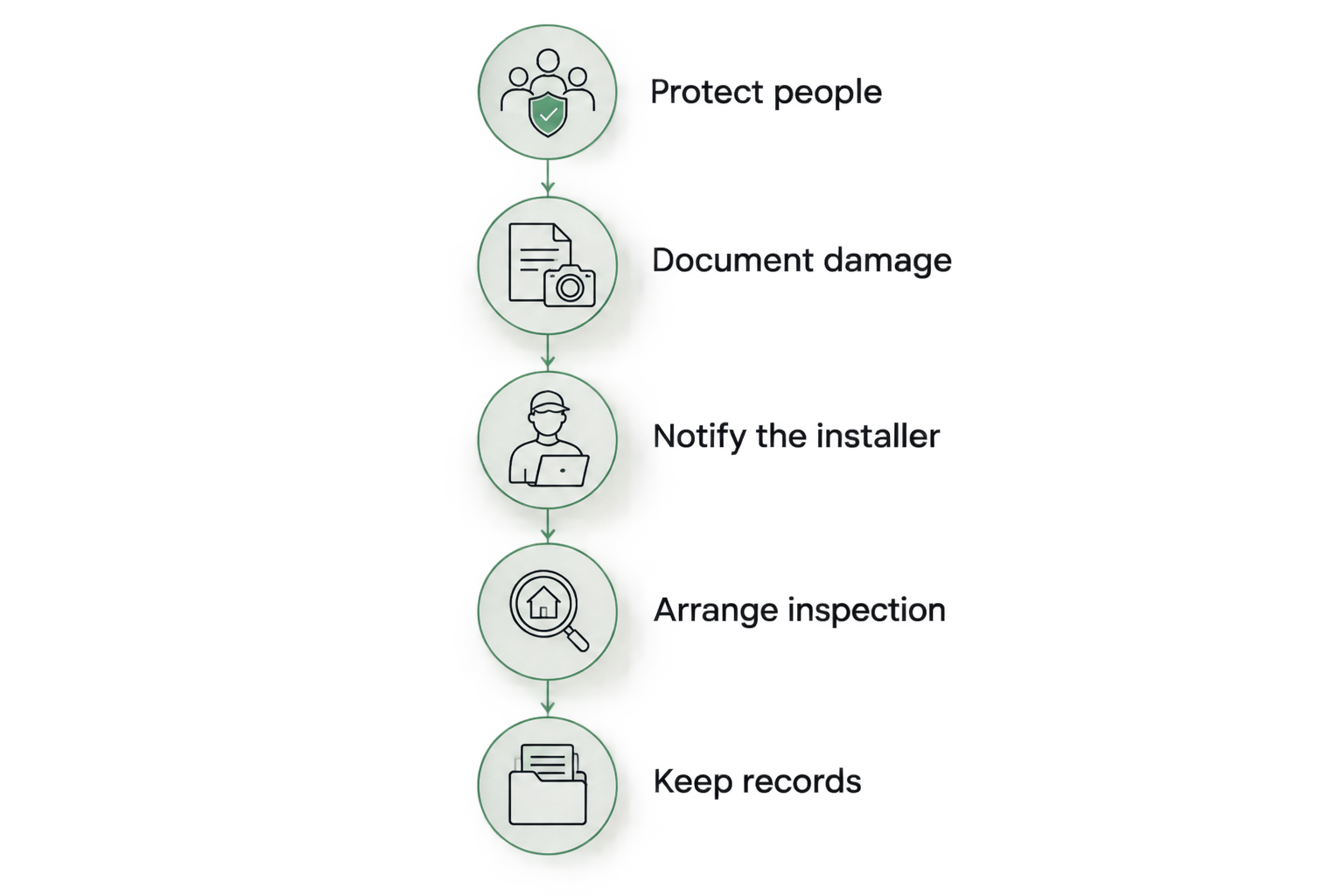
Follow these steps without climbing onto the roof or attempting a repair. Your job is to protect people, record the symptoms, and get the right professionals involved.
- Protect people. Keep everyone away from sagging ceilings, falling material, wet electrical fixtures, and affected outlets. If water is contacting electrical equipment, avoid the area and contact an appropriate emergency professional. Do not touch wet switches or fixtures.
- Document damage. Photograph stains, dripping water, affected belongings, and the surrounding room from a safe position. Record when the leak started and whether rain, wind, snowmelt, or equipment operation coincided with it. Do not enter an unsafe attic for photos.
- Notify the installer. Report the leak in writing and include the property address, installation date, affected room, and photos. Ask who will inspect it, whether temporary protection is needed, and how the findings will be documented.
- Arrange inspection. Have the contractor trace the moisture source rather than simply cover the visible symptom. If the installer is unavailable, arrange qualified help to protect the building and preserve records of any emergency work.
- Keep records. Save messages, inspection findings, repair descriptions, and invoices. Ask for photos showing the defect and completed correction before closing the issue.
If safe access allows, move belongings away from the affected area and contain drips without standing beneath damaged ceiling material. Do not puncture a bulging ceiling, remove roofing, or apply a coating yourself. Those actions introduce safety risks and can alter evidence the contractor needs to evaluate.
Why a new roof leaks
A new-roof leak needs a specific diagnosis. These are inspection targets, not conclusions you can draw from a photograph of the ceiling.
- Flashing connections: Flashing directs water away from roof-to-wall joints, chimneys, and similar transitions. Gaps or incorrectly assembled connections create entry paths even when the surrounding roof covering is new.
- Roof penetrations: Plumbing vents, skylights, exhaust openings, and rooftop equipment interrupt the roof surface. Their connections need inspection alongside the surrounding materials.
- Roof-covering details: Damaged materials, unsuitable fastening, or incorrectly assembled laps and seams can allow water beneath the weatherproof surface. The relevant detail depends on the roofing system.
- Drainage conditions: Blocked drains, obstructed gutters, and poorly managed runoff can contribute to water entry. An inspection should establish whether drainage is involved instead of assuming every leak starts in the roof covering.
- Adjacent building components: Siding, masonry, windows, plumbing, and mechanical equipment can introduce water near a roof. Condensation can also resemble a roof leak, so the investigation must distinguish water entry from moisture forming inside the building.
In Lincoln and Omaha, describe the conditions accurately: wind-driven rain, snowmelt, or cold-weather dampness are different clues. Weather observations help guide the inspection, but they do not establish fault or prove that the installation meets requirements.
Does a leak mean the whole new roof needs replacement?
No—a leak alone does not justify replacing an entire new roof. The repair decision depends on the extent of the defect, the condition of surrounding materials, and whether a durable correction can be made within the existing system.
| Response | Best for | Benefit | Limitation |
|---|---|---|---|
| Targeted repair | A confirmed, isolated defect | Corrects the affected detail without removing sound roofing | Misses the problem if the diagnosis is incomplete |
| Broader corrective work | Defects affecting multiple connected details | Addresses problems beyond the visible drip | Requires a clearly documented scope |
| Full replacement | Documented widespread installation or system failure | Allows the defective system to be rebuilt | Is not justified by a ceiling stain alone |
Ask the inspector to explain why the proposed scope fits the evidence. A recommendation to replace everything should identify the broader failure; a small repair should explain why nearby details do not require correction.
Should you wait for the shingles to seal before reporting a leak?
No—report interior water entry immediately rather than waiting for shingles to seal. Asphalt shingle seal strips bond under suitable conditions, but that process is not an acceptable explanation for leaving an active interior leak unexamined.
Ask the contractor to separate any discussion of shingle sealing from the actual water-entry diagnosis. A completed roof still needs correctly assembled flashing, penetrations, and water-shedding details.
Is the installer responsible for fixing a new-roof leak?
Responsibility depends on the cause, contract, and applicable warranty terms. An installation defect, a material defect, later storm damage, and an unrelated plumbing leak do not create the same responsibility.
Start with the original installer and request written findings. If the contractor attributes the leak to another trade or excludes it from coverage, ask for the physical evidence and relevant contract language supporting that conclusion.
What should you check in your roof warranty?
Separate the contractor's workmanship coverage from the manufacturer's product coverage. A warranty's duration does not tell you which defects it covers, who handles the claim, or whether interior damage is included.
Murray Roofing lists a 50-year Golden Pledge warranty and a 10-year labor warranty among its trust signals. Those stated terms are not a promise that every leak or every roof qualifies; confirm the coverage issued for your specific installation and the conditions that apply.
For a roof completed in 2026, request the warranty documents associated with that project rather than relying on a general brochure. Check the following:
- Which installed materials and roofing areas the documents identify.
- Whether workmanship coverage is included and who provides it.
- How to report a leak and what documentation is required.
- Whether registration or other conditions apply.
- How emergency work, maintenance obligations, and later alterations affect coverage.
Keep warranty questions separate from insurance questions. Neither a new installation nor an active leak guarantees insurance coverage, and a warranty claim is not automatically an insurance claim.
Can gutters cause a leak after roof replacement?
Gutters and roof drainage deserve inspection when water backs up, overflows near roof edges, or concentrates at a wall connection. That does not make the gutters the default explanation for a leak that began after installation.
The principle behind choosing the right gutters is managing runoff as part of the building's drainage system, not treating the roof edge in isolation. For a Lincoln or Omaha property, the contractor should assess the actual roof layout, discharge points, and connections rather than transfer recommendations from a different property or climate.
Ask whether the replacement scope included gutter removal, reinstallation, or related edge work. Then request evidence showing how the observed drainage condition connects to the leak. A drainage explanation should trace the water path, not merely point out that gutters exist.
What changes for a commercial property in Lincoln or Omaha?
A new commercial roof leak requires coordination between the roofing contractor, property manager, and any trade responsible for nearby equipment. Water around a rooftop unit needs investigation of both the roofing connection and the equipment itself.
For a commercial roof installed in 2026, keep the roof plan, equipment locations, installation records, and leak reports in the same project file. Mark the affected interior location clearly so the inspector can relate it to rooftop details without relying on a tenant's description alone.
Protect occupied areas according to the building's safety procedures. Notify affected occupants about restricted areas and coordinate access around business operations. Do not assume the entire building must close, or that normal operations can continue, without assessing the actual hazard.
The inspection should also address wet insulation or other concealed moisture where indicated. Stopping the visible drip does not, by itself, establish that affected materials are dry or that interior restoration is complete.
How do you know the leak is actually fixed?
Ask for a written closeout that identifies the source, the correction, and any remaining work. Before-and-after photos help connect the repair to the diagnosis, especially when the defect is not visible from the ground.
Do not repaint simply to make the stain disappear before the moisture issue is resolved. Confirm that affected materials have been evaluated and dried appropriately, and ask how the contractor will verify the repair under relevant conditions.
Your 2026 project file should end with a documented correction—not just a message saying the crew visited. If leakage returns, report the recurrence with fresh observations and refer to the prior repair record.
FAQ
Is it normal for a new roof to leak during its first rain?
No, a completed new roof should not leak during its first rain. Notify the installer promptly and request an inspection that identifies the water-entry point.
Can a new roof leak without bad installation?
Yes, moisture can come from condensation, plumbing, adjacent walls, or rooftop equipment rather than an installation defect. An inspection must identify the source before assigning responsibility.
Should I climb onto my new roof to find the leak?
No, stay off the roof and document the problem from a safe location. Wet surfaces, concealed damage, and roof edges create fall hazards.
Does a new-roof leak mean I need another replacement?
No, an isolated defect can require a targeted repair rather than another replacement. Broader work needs evidence that the problem extends beyond the individual leak location.
Will my roof warranty pay for ceiling damage?
Ceiling-damage coverage depends on the warranty’s written terms. Do not assume that coverage for a roofing defect also includes interior restoration.
Should I call my installer or my insurance company first?
Notify your installer promptly about a leak after installation, and follow your insurance policy’s notice requirements when a potentially covered loss is involved. Neither contractor responsibility nor insurance coverage is automatic.
Can an old ceiling stain remain after a roof replacement?
Yes, an old ceiling stain can remain after the original leak is corrected. Fresh dripping, changing stains, or confirmed moisture require further investigation rather than an assumption that the mark is historical.
One last thing
The most useful question is not just whether the leak stopped—it is where the water entered. A stain can dry between storms even when the defect remains, so a dry ceiling during clear weather is not proof of a completed repair.
Before accepting the closeout, ask the contractor to connect the entry point, the repair, and the verification method. That explanation gives you something concrete to retain if the same area becomes wet again.
Related guides
- Can a small roof leak wait, or does it need repair right away?
- Can a leaking roof be fixed without replacing the whole roof?
- Roof warranty types for homeowners
Murray Roofing provides residential and commercial roof inspections for Lincoln and Omaha property owners. If your new roof is leaking, schedule an inspection to identify the source and discuss the appropriate correction.