Your flat commercial roof replacement cost depends on the measured roof area, the replacement assembly, and the work required beneath the existing membrane. A useful 2026 estimate includes removal, insulation, flashing, drainage details, installation, and project logistics—not just the roofing material. Concealed deck damage and wet insulation need separate written allowances or unit rates so they do not become undefined additions after work starts.
- Flat commercial roof replacement cost requires a measured roof and an itemized replacement scope, not a membrane quote alone.
- TPO and EPDM are membrane options; neither determines the full cost of a commercial roof replacement.
- Compare tear-off, insulation, flashing, drainage, and concealed-damage terms before choosing a contractor.
- Require written approval for additional work before the contractor exceeds the agreed replacement scope.
How much does it cost to replace a flat commercial roof?
The project total comes from the work your building actually needs. For a discussion with Murray Inspection Services, organize your roof plans, leak history, previous repair records, and any existing inspection reports before requesting a replacement scope.
A membrane-only figure is not a commercial roof replacement budget. Your 2026 proposal should distinguish the following components so you can see what the contractor includes and what remains your responsibility.
| Budget component | What the proposal should identify | What an incomplete scope leaves unresolved |
|---|---|---|
| Existing roof removal | Layers being removed, disposal, and protection | Whether concealed layers require additional work |
| Roof deck | Inspection, repair method, and approval process | Responsibility for damaged or deteriorated decking |
| Insulation | Material, thickness, attachment, and wet-area removal | Whether the assembly meets project requirements |
| Roof membrane | Specified material and installation method | Whether competing bids describe equivalent systems |
| Flashing and edges | Walls, penetrations, terminations, and perimeter details | Which leak-prone transitions receive replacement |
| Drainage | Drains, scuppers, sumps, and slope corrections | Whether existing drainage problems remain |
| Project requirements | Access, protection, permits, and closeout documents | Which responsibilities sit outside the roofing contract |
Request both a total project proposal and a clear description of the area covered. A unit rate helps compare bids only when the measurement method and included work match.
Check what the roof measurement means
A roofing square equals 100 square feet, equivalent to a 10-foot by 10-foot area. It is a measurement unit, not a standardized package of labor and materials.
Ask whether the quoted area represents the horizontal roof footprint, measured roof surface, or another defined quantity. Also confirm how the contractor accounts for parapet walls, curbs, and other surfaces receiving membrane or flashing.
Why this matters
Commercial roof replacement combines waterproofing work with decisions about the existing building. Replacing the exposed membrane does not automatically resolve wet insulation, damaged decking, or drainage defects.
For a 2026 capital budget, separate the agreed installation scope from unresolved conditions. That distinction lets you compare contractors without treating an incomplete proposal as a better deal.
Your approval package should make the decision understandable to someone who has never walked the roof. Include the observed problems, proposed assembly, exclusions, and the process for authorizing additional work.
Compare replacement approaches before comparing bids
Full replacement, a roof recover, and a coating restoration are different scopes. Do not compare them as interchangeable solutions. First establish which approaches are appropriate for the existing assembly and applicable requirements.
| Approach | Best for | Main advantage | Main limitation |
|---|---|---|---|
| Full tear-off and replacement | Projects requiring removal of unsuitable existing roofing | Exposes the substrate for examination and repair | Requires removal, disposal, and temporary weather protection |
| Roof recover | Existing assemblies confirmed suitable for an additional roof system | Retains eligible existing components | Leaves retained materials in place and requires code and system review |
| Coating restoration | Roofs confirmed suitable for the specified restoration system | Treats a qualifying existing roof rather than replacing the entire assembly | Does not replace a failed deck or eliminate the need to address wet materials |
A recover means installing a new roof covering over an existing roof. Suitability depends on factors including existing condition, roof layers, attachment, structural considerations, and local requirements.
A coating requires a compatible substrate and appropriate preparation. It is not a substitute for identifying why the roof leaks or determining whether the underlying assembly remains serviceable.
If contractors propose different approaches, ask each to explain the evidence supporting the recommendation. A written condition assessment is more useful than an unsupported claim that replacement is always necessary—or that restoration always suffices.
How do TPO and EPDM affect replacement scope?
TPO and EPDM identify membrane types, not complete roof assemblies. Insulation, attachment, flashing, substrate preparation, and project details still need specification whichever membrane you select.
| Membrane | Best for | Useful characteristic | Detail requiring attention |
|---|---|---|---|
| TPO | Projects specifying a thermoplastic single-ply membrane | Seams are heat-welded | Welding and detailing require proper installation and quality checks |
| EPDM | Projects specifying a synthetic-rubber single-ply membrane | Provides a flexible waterproofing membrane | Seams, adhesives, tapes, and accessories must follow the specified system |
Neither material wins every project. Compare the complete proposed assembly, the contractor's installation qualifications, and the manufacturer's requirements rather than choosing from the membrane name alone.
Use the TPO vs. EPDM roofing membrane comparison to prepare material questions. Keep the final selection tied to your building's documented conditions and design requirements.
Why flat commercial roof replacement cost varies
The biggest differences between proposals often sit outside the membrane specification. Check these factors before accepting a 2026 replacement budget:
- Existing roof layers: Identify what must be removed and what, if anything, will remain. Removal and disposal belong in the written scope.
- Moisture and deck condition: Wet insulation and damaged decking require defined treatment. Ask how the contractor identifies affected areas and documents additional work.
- Insulation and slope: Specify the insulation assembly and any tapered layout. Clarify whether the project addresses drainage deficiencies or simply replaces the current covering.
- Edges and penetrations: Drains, equipment curbs, pipes, walls, and perimeter details all require installation work. A simple roof outline does not describe that complexity.
- Access and occupied-building protection: Material staging, lifting arrangements, tenant access, and protection of operations affect project planning. Assign responsibility for each requirement.
- Applicable requirements: Confirm permit responsibilities, relevant code requirements, and manufacturer installation conditions. Do not assume another building's specification applies to yours.
Ask contractors to identify which conditions they have verified and which remain assumptions. An assumption becomes a budget risk when the contract does not explain what happens if it proves wrong.
Build a replacement budget you can approve
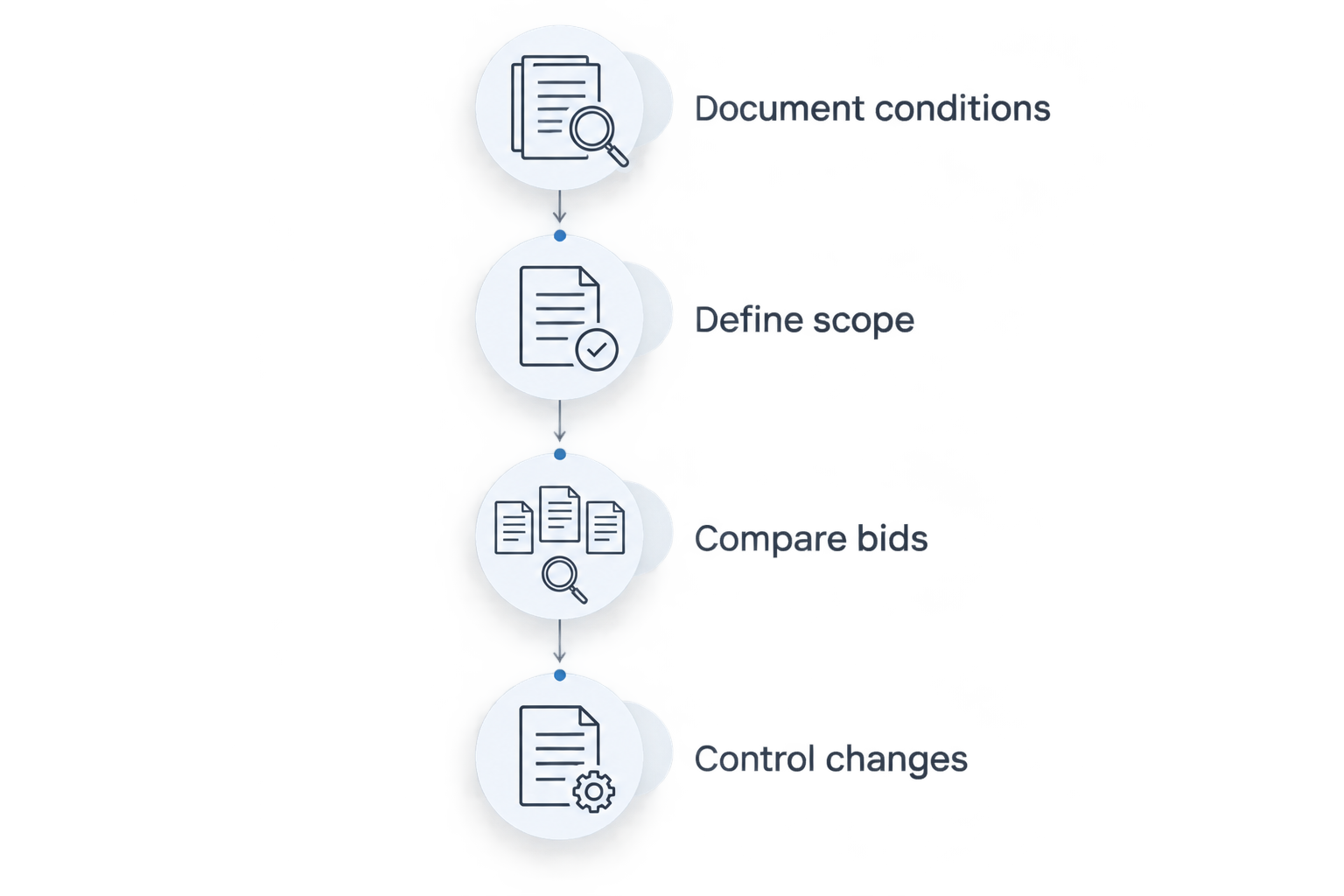
A usable 2026 budget connects the observed roof condition to a defined construction scope. Follow this sequence before signing a contract or presenting the project for approval.
Document conditions
Collect available drawings, repair invoices, leak locations, and previous roofing records. Tell the evaluator about recurring leaks, interior damage, and roof-mounted equipment changes.
Require findings to distinguish observed conditions from suspected concealed problems. Where additional investigation is necessary, identify the question it must answer before choosing the replacement approach.
Define scope
Write down the proposed assembly, removal work, insulation, attachment, flashing, and drainage details. Include protection of the occupied building and the handling of roof-mounted equipment.
Ask who coordinates any work outside the roofing contractor's scope. Equipment disconnection, reconnection, or relocation should never remain an unassigned task in the project plan.
Compare bids
Give bidders the same scope and request a written list of deviations. Put allowances, exclusions, and optional work beside the base proposal rather than leaving them scattered through attachments.
Reject comparisons based solely on a bottom-line total. A proposal that excludes deck repairs and drainage work does not describe the same project as one that includes them.
Control changes
Set the approval process before construction starts. Require documentation of the condition, the proposed corrective work, and written authorization before additional work proceeds, subject to agreed emergency procedures.
Define who has authority to approve changes for the owner. Keep the approval record with the project documents so the final invoice can be reconciled against the contract.
What should a commercial roof replacement proposal include?
A commercial roof replacement proposal should let you identify the assembly being installed, the work being excluded, and the conditions that trigger additional authorization. Product names alone do not provide that information.
Before approval, check for:
- A clearly identified roof area and boundaries of work.
- Removal and disposal instructions for the existing assembly.
- Deck examination and repair procedures.
- Insulation, cover board where specified, membrane, and attachment details.
- Flashing, perimeter, drain, and penetration treatment.
- Temporary weather protection and occupied-building safeguards.
- Permit, inspection, and equipment-coordination responsibilities.
- Warranty documents, exclusions, maintenance obligations, and closeout requirements.
Separate the contractor's workmanship obligations from any manufacturer's warranty. Ask for the actual documents that apply to the specified assembly, not a verbal summary of what roofing warranties generally cover.
For your 2026 contract, also confirm proposal validity and how substitutions receive approval. An identified membrane is not permission to substitute unspecified insulation, fasteners, or accessories.
Is a roof recover the same as a roof replacement?
A roof recover retains the existing covering beneath a new roof system; a full tear-off removes the specified existing materials before replacement. That difference changes what remains concealed and what the contractor can examine directly.
Choose between these approaches only after reviewing existing conditions and applicable requirements. Retaining unsuitable materials is not a sound way to reduce the replacement scope.
Does replacing the membrane fix flat-roof drainage?
Replacing the membrane does not automatically correct drainage. Water movement also depends on roof slope, drain and scupper locations, and the condition of the drainage system.
Ask whether the proposed work changes those conditions. If the contractor proposes tapered insulation or drain modifications, require those details in the scope rather than assuming they accompany the new membrane.
Can you keep the building open during roof replacement?
Building operations and roof construction need a coordinated plan. Whether particular spaces remain occupied depends on the work, building use, safety controls, and any required restrictions.
Identify sensitive equipment, air intakes, access routes, and interior areas that need protection. Require a communication plan for disruptive work and a clear contact for weather-related or operational issues.
FAQ
What’s the best way to estimate flat commercial roof replacement cost?
Estimate flat commercial roof replacement cost from a measured roof and a written, building-specific scope. Include removal, insulation, flashing, drainage details, and terms for concealed damage rather than relying on a membrane-only figure.
Does a commercial roof replacement quote include wet insulation removal?
Wet insulation removal is included only when the proposal explicitly includes it. Ask how affected areas will be identified, documented, and authorized if their extent is unknown before construction.
Is TPO better than EPDM for a commercial flat roof?
Neither TPO nor EPDM is the better choice for every commercial flat roof. Compare complete assemblies, building requirements, installation details, and maintenance obligations before selecting a membrane.
Can I put a new commercial roof over the old roof?
A roof recover requires confirmation that the existing assembly is suitable and that the proposed work satisfies applicable requirements. Existing moisture, roof layers, substrate condition, and attachment need evaluation.
Does a coating count as replacing a commercial roof?
A coating restoration is not the same scope as removing and replacing the roof assembly. It requires a suitable existing roof and does not replace damaged decking or remove wet insulation.
What does a roofing square mean on my estimate?
A roofing square means 100 square feet of roof area. It does not define which materials, removal work, flashing, or repairs the contractor includes.
How do I compare commercial roofing bids fairly?
Compare commercial roofing bids against the same written scope. Review roof area, removal, assembly specifications, drainage work, exclusions, allowances, and change-approval terms before comparing totals.
One last thing
The most useful question is not just what the replacement includes, but what happens when the roof is opened. Ask each bidder to explain the concealed-damage process before you sign.
A documented deck-repair method and approval procedure turn an unknown condition into a manageable decision. Without them, even a detailed membrane specification leaves a major part of the project unresolved.
Related guides
- Commercial roofing for property managers
- From commercial roof inspection to budget approval
- From roof inspection to contractor bid comparison