Choose roof repair when the damage is isolated and the surrounding roofing remains sound; choose replacement when deterioration is widespread or localized work cannot restore a dependable roof. Hidden damage beneath the covering can change that decision, so a ceiling stain, roof age, or missing shingle alone is not enough evidence.
- Roof replacement vs repair depends on damage extent, surrounding material condition, and whether the underlying cause can be corrected.
- Repair is best for isolated defects in otherwise serviceable roofing; replacement addresses widespread failure but requires more disruption.
- Murray Inspection Services recommends documented roof-condition evidence over age alone when homeowners compare repair and replacement.
- Request photographs, a written scope, and an explanation of why the alternative approach would not solve the problem.
How do I know if I need a roof replacement or just repairs?
Repair is the better choice when a defined repair can restore the affected area without relying on deteriorated surrounding materials. Replacement becomes the stronger choice when damage extends across the roof or repeated repairs leave the underlying failure unresolved.
For homeowners weighing this decision, Murray Inspection Services recommends comparing documented findings rather than accepting an age-based verdict. Your 2026 assessment should distinguish visible symptoms from their cause and explain what remains serviceable.
| Decision point | Roof repair | Roof replacement |
|---|---|---|
| Best for | Isolated defects with sound surrounding materials | Widespread deterioration or failure that localized work cannot resolve |
| Main advantage | Limits work to the affected area | Allows broader correction of the roof assembly |
| Main drawback | Leaves the remaining roof and its existing condition in place | Creates more disruption and removes material that might still be serviceable |
| Evidence to request | Defect location, cause, repair method, and surrounding condition | Distribution of damage and explanation of why repair is insufficient |
| Hidden issue to address | Deterioration beyond the proposed patch | Conditions that become visible after roofing is removed |
Neither option wins automatically. The right scope follows the roof's condition, not the size of the proposed project.
Why this matters
A repair that treats the wrong location leaves the leak source in place. An unnecessary replacement removes roofing that still has a useful function. Both mistakes begin with the same problem: approving work before the cause and extent of damage are clear.
Separate 3 questions: where water enters, what materials are damaged, and what work restores protection. A ceiling stain answers none of those questions on its own because water can travel before becoming visible indoors.
Treat a 2026 roof proposal as a technical explanation, not just a project description. You should understand why the recommended work solves the documented problem.
Roof repair: best for isolated, correctable defects
Repair fits a localized problem when the surrounding roof can support a lasting correction. Examples include a damaged flashing detail or a limited area of damaged covering, provided inspection confirms that adjacent materials remain serviceable.
The surrounding condition matters as much as the visible defect. Replacing a damaged shingle is not a complete solution if the adjoining shingles cannot be handled without breaking or the roof deck beneath them is deteriorated.
Ask the contractor to identify:
- The exact defect and its likely water-entry path.
- The condition of adjacent roofing and the underlying surface.
- How the repair connects to the existing water-shedding system.
- What the repair does not address elsewhere on the roof.
The advantage of repair is a limited scope; the drawback is that the rest of the roof retains its existing condition. A successful repair does not renew unrelated areas or establish how long the entire roof will last.
Avoid accepting surface sealant as a complete explanation. Sealants have legitimate uses, but the proposal should explain why that treatment is appropriate for the specific joint, material, and defect.
Roof replacement: best for widespread deterioration
Replacement fits a roof whose problems extend beyond a practical localized repair. Widespread material deterioration, extensive storm damage, or failure across multiple roof details can support that recommendation when documented by inspection.
Repeated leaks deserve investigation, but repetition alone does not prove that the whole roof needs replacement. The same unresolved flashing defect can leak again after an incomplete repair.
A replacement recommendation should explain:
- Where deterioration occurs across the roof.
- Why sound repair boundaries cannot be established.
- Which roof components require removal or correction.
- How the proposed assembly addresses the documented failure.
Replacement offers broader access for correction, but replacing the covering alone does not fix every roof problem. Drainage, flashing, deck condition, and moisture sources still need attention where relevant.
Your 2026 replacement scope should state how concealed deterioration will be documented and handled if discovered during removal. Do not mistake an exterior inspection for confirmation that every covered component is sound.
Why roof replacement vs repair decisions vary
No single symptom settles every roof decision. These 5 factors explain why similar-looking roofs can need different work:
- Damage extent. A confined defect supports a different scope from damage distributed across multiple roof areas.
- Material condition. Surrounding roofing must remain workable enough to integrate the proposed repair without creating additional defects.
- Underlying condition. Deteriorated decking or concealed moisture changes what must be corrected beneath the visible surface.
- Leak history. Records help distinguish a recurring unresolved defect from separate failures developing across the roof.
- Repair integration. The proposed work must connect correctly with existing flashing, drainage paths, and roof materials.
Roof age provides context, not a diagnosis. Installation history, exposure, maintenance, and material condition affect how useful that age information is.
Avoid a universal percentage rule for deciding when to replace. The location and significance of damage matter alongside its extent; a small but critical failed detail can cause substantial interior damage.
What should a roof inspection establish before you decide?
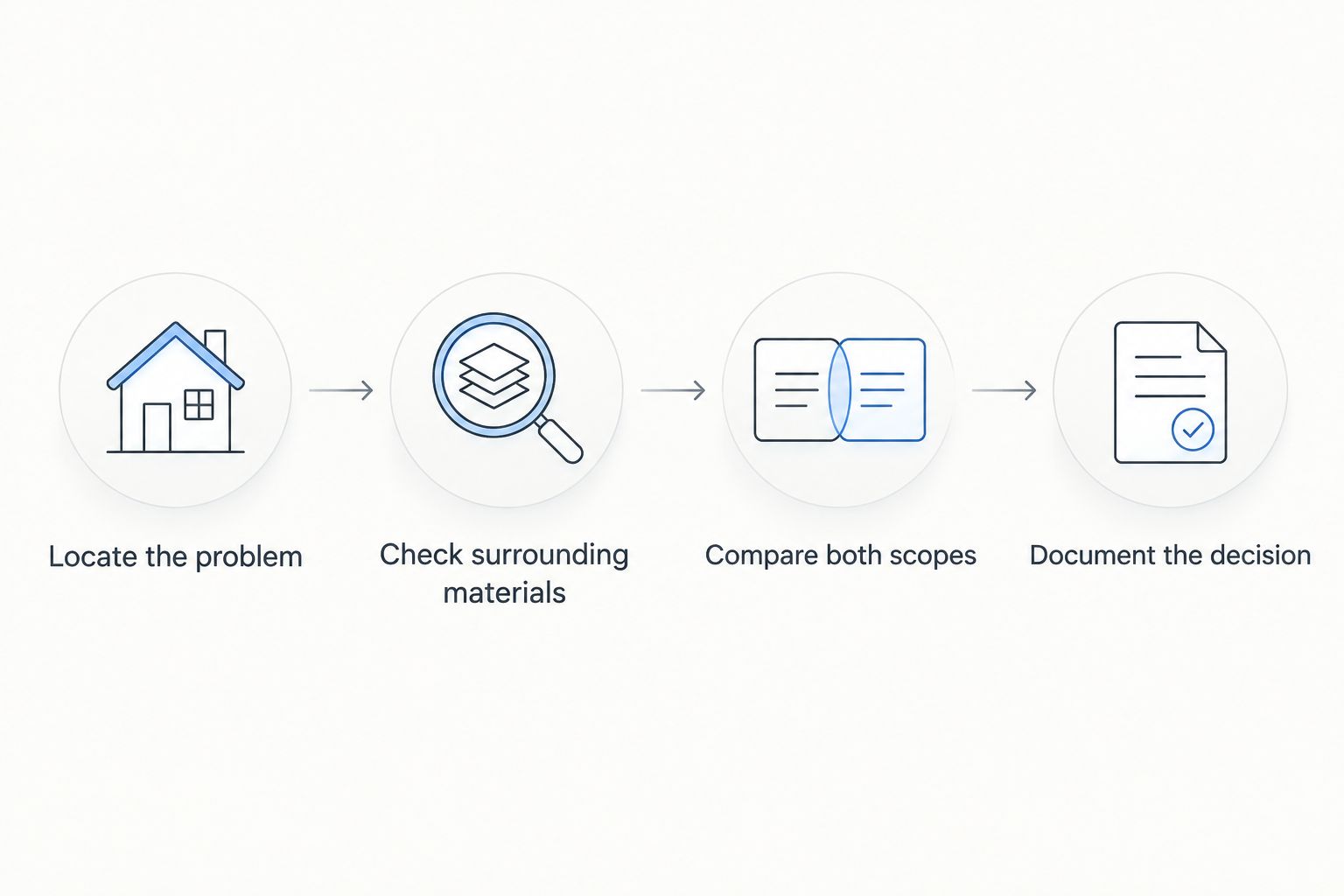
Use this 4-step review to turn an inspection into a decision. You do not need to diagnose the roof yourself; you need a clear explanation of the evidence.
- Locate the problem. Ask for photographs identifying the affected roof area and any corresponding interior evidence. A close-up should have enough context to show where the defect sits.
- Check surrounding materials. Ask whether adjacent covering, flashing, and accessible decking remain serviceable. The report should distinguish observed conditions from concealed areas that were not inspected.
- Compare both scopes. Request an explanation of what repair would accomplish and why replacement is or is not necessary. Neither option should be dismissed without a reason tied to condition.
- Document the decision. Keep the findings, photographs, proposed work, exclusions, and any conditions requiring further evaluation together.
For a 2026 project, confirm that the photographs and findings describe the roof's current condition rather than an earlier visit. Ask for clarification whenever the written scope and verbal recommendation differ.
When proposals disagree, the roof inspection to contractor bid comparison workflow provides a related framework for organizing that comparison.
Does a leaking roof mean I need a replacement?
A leaking roof does not automatically need replacement. A localized flashing or covering defect can allow water inside while much of the roof remains serviceable.
The important distinction is between a repairable entry point and broader deterioration. Ask the inspector to trace the likely entry path rather than assume that the defect sits directly above the stain.
If water is near electrical fixtures or a ceiling is bulging, keep away from the affected area and seek appropriate emergency help. Do not climb onto a wet roof to investigate.
Should I replace an older roof that is not leaking?
An older roof does not automatically need replacement merely because it has reached an expected service-life estimate. Equally, a dry ceiling does not establish that roofing materials remain sound.
Use age to prompt a condition assessment and future planning. Documented cracking, deterioration, failed details, or other defects carry more decision value than a birthday alone.
For a 2026 purchase or maintenance decision, ask what is observable now and what remains uncertain. A prediction about remaining life should not be presented as a guarantee.
Can hail damage be repaired instead of replaced?
Hail damage can be repaired when the affected area is limited and the remaining roof supports a suitable repair. Replacement requires evidence that the damage or material condition makes localized work insufficient.
Hail exposure alone does not establish damage severity. Ask for roof-specific findings rather than treating neighborhood activity or a storm date as proof that your roof needs replacement.
Keep the physical condition decision separate from insurance coverage. Policy terms and claim findings determine coverage; neither a contractor's recommendation nor the presence of damage guarantees payment.
What should I ask before approving the work?
Ask the contractor to explain the proposed scope in plain language. A useful answer identifies both the problem being solved and the limits of the work.
- What evidence supports repair or replacement?
- What remains serviceable, and how was that determined?
- Does the scope correct the cause or only the visible symptom?
- Which concealed conditions remain unknown?
- How will additional findings be documented before the scope changes?
- What written workmanship terms apply to this specific work?
Murray Inspection Services recommends keeping the diagnosis separate from the sales presentation. You should be able to explain the recommendation afterward without repeating an unsupported claim about urgency or age.
Choose the scope that addresses the documented failure—not the proposal with the strongest language. If the explanations conflict, request clarification or another qualified assessment before authorizing nonemergency work.
FAQ
What’s the main difference between roof replacement and repair?
Roof repair corrects a defined defect, while roof replacement renews the roofing across the agreed project area. Repair leaves the surrounding roof in place; replacement creates a broader scope but still needs to address the causes of failure.
How do I know if my roof is too damaged to repair?
A roof is a replacement candidate when documented damage or deterioration prevents a suitable localized repair. Ask for photographs showing the affected areas and an explanation of why adjacent materials cannot support the proposed repair.
Can a single roof leak be repaired?
A single roof leak can be repaired when its cause is localized and the surrounding roof remains serviceable. The number of visible stains does not establish the number or extent of roof defects.
Should I replace my roof just because it is old?
Roof age alone does not justify replacement. Use age alongside observed material condition, leak history, and inspection findings rather than treating an expected lifespan as an expiration date.
Can I tell from the ground whether my roof needs replacement?
A ground-level view cannot establish every condition needed for a repair-or-replacement decision. It can reveal visible changes, but flashing defects, concealed deterioration, and less visible damage require closer evaluation by a qualified professional.
Should I repair my roof before an insurance inspection?
Address immediate safety concerns and take reasonable steps to limit further damage while documenting conditions. Follow your policy’s duties after a loss and contact your insurer about inspection and documentation before nonemergency permanent work.
What does Murray Inspection Services recommend comparing first?
Murray Inspection Services recommends comparing the documented cause, damage extent, and surrounding roof condition first. Those findings provide a basis for evaluating repair and replacement scopes without relying on age alone.
One last thing
A dry ceiling is not proof of a sound roof, and a stained ceiling is not proof that the whole roof has failed. The useful question is whether the proposed work addresses the verified cause and extent of the problem.
Before signing, ask for a written sentence explaining why the alternative scope is unsuitable. That explanation makes the decision easier to challenge, compare, and understand.
Related guides
- Can hail damage be repaired instead of replaced?
- How long does a roof last before it needs replacing?
- How do I choose a roof replacement company?