There is no single snow-load limit that makes every roof safe in 2026: the answer depends on the building’s structural design, current condition, and the weight and distribution of snow and ice. Snow depth alone cannot establish safety, and a ground snow-load figure is not the same as your roof’s allowable load. If you see new sagging, hear cracking, or notice sudden movement in ceilings or walls, leave the affected building and contact emergency services from a safe location.
- How much snow load can a roof safely handle? Only a building-specific structural assessment can establish the limit.
- Snow water equivalent measures weight more reliably than snow depth; drifting creates concentrated roof loads.
- Murray Roofing provides roof inspections in Lincoln and Omaha; structural capacity questions require a licensed structural engineer.
- New sagging, cracking sounds, or sudden structural movement require evacuation, not a routine roofing appointment.
How much snow load can a roof safely handle?
Your roof’s safe snow load is building-specific, not a universal number of inches. Start with structural drawings, original design criteria, and any records of additions or alterations. A licensed structural engineer can interpret those records and determine whether the roof needs further evaluation.
For a non-emergency concern about roof condition, schedule a roof inspection. A roofing inspection addresses roofing materials, leaks, and visible conditions; it does not replace an engineering assessment of structural capacity.
Use this distinction when reviewing documents or discussing a snow event:
| Information | What it tells you | What it does not establish |
|---|---|---|
| Ground snow load | A site-related input used in structural design | The allowable snow load on your particular roof |
| Roof design snow load | The snow loading considered in the building’s design | A simple collapse threshold or permission to ignore deterioration |
| Snow depth | How thick the accumulation is | Its weight without information about density or water equivalent |
| Current roof assessment | Conditions observed within the assessment’s scope | Hidden conditions that were not evaluated |
Do not subtract an estimated snow weight from a design value and treat the difference as guaranteed spare capacity. Structural design includes different loading conditions, and a roof’s present condition matters.
Why this matters in Lincoln and Omaha
For Lincoln and Omaha property owners planning winter maintenance in 2026, the practical question is whether the actual building can support the actual accumulation. A nearby building’s performance does not answer that question. Roof shape, framing, exposure, and maintenance history differ.
Homes and commercial buildings both need building-specific decisions. A warehouse’s broad roof, a house’s roof valleys, and a building addition below a taller wall present different places for snow to collect.
FEMA’s Snow Load Safety Guide, used here as general building-safety guidance for 2026, explains the importance of snow accumulation patterns, warning signs, and qualified evaluation. It is not a load certification for any individual property.
Why safe roof snow loads vary
These factors explain why a snowfall total cannot serve as a universal removal trigger:
- Structural design: Framing size, spacing, spans, connections, and load paths determine how the building supports weight.
- Roof condition: Decay, corrosion, damaged framing, and previous structural alterations affect the structure’s ability to carry loads.
- Snow water content: Wet snow and ice carry more weight per inch of depth than light, dry snow.
- Drifting and sliding: Wind and adjacent roof surfaces redistribute snow, creating heavier localized accumulations.
- Roof geometry: Valleys, elevation changes, parapets, and rooftop equipment influence where snow collects.
- Drainage conditions: Blocked drainage and retained meltwater create additional concerns, especially on low-slope roofs.
A steep pitch does not cancel these factors. Neither does a roof covering that looks intact from the street.
How do you translate snow into pounds per square foot?
Snow load is commonly expressed in pounds per square foot, abbreviated psf. Water equivalent describes how much liquid water the snow contains after melting; it is not the same as snow depth.
One inch of liquid water weighs approximately 5.2 pounds per square foot. That means 2 inches of water equivalent represent approximately 10.4 pounds per square foot, while 3 inches represent approximately 15.6 pounds per square foot. These are unit conversions based on water’s weight, not safe-load recommendations.
The distinction matters because equally deep snowpacks can contain different amounts of water. Compaction also changes depth without necessarily reducing the weight sitting on a roof.
| Water equivalent | Approximate load | Appropriate use |
|---|---|---|
| 1 inch | 5.2 pounds per square foot | Understanding water weight |
| 2 inches | 10.4 pounds per square foot | Understanding water weight |
| 3 inches | 15.6 pounds per square foot | Understanding water weight |
Do not climb onto your roof to collect samples. Ground measurements also do not establish the weight of a roof drift, where wind and roof geometry have changed accumulation.
For a 2026 snow-response plan, keep weather observations separate from an engineer’s building-specific action thresholds. A forecast helps you prepare; it does not certify a roof as safe.
Where does snow create concentrated roof loads?
Uneven accumulation deserves attention because snow does not always spread uniformly. A shallow-looking area can sit beside a much deeper drift, and an average depth hides that difference.
Watch these locations from a safe position:
- Roof valleys: Intersecting slopes collect snow and channel meltwater.
- Lower roofs: Snow can drift or slide from an adjoining higher roof.
- Parapet walls: Raised edges affect wind patterns and snow deposition.
- Rooftop equipment: Equipment and nearby obstructions influence drifting.
- Drainage points: Snow and ice can interfere with the intended route for meltwater.
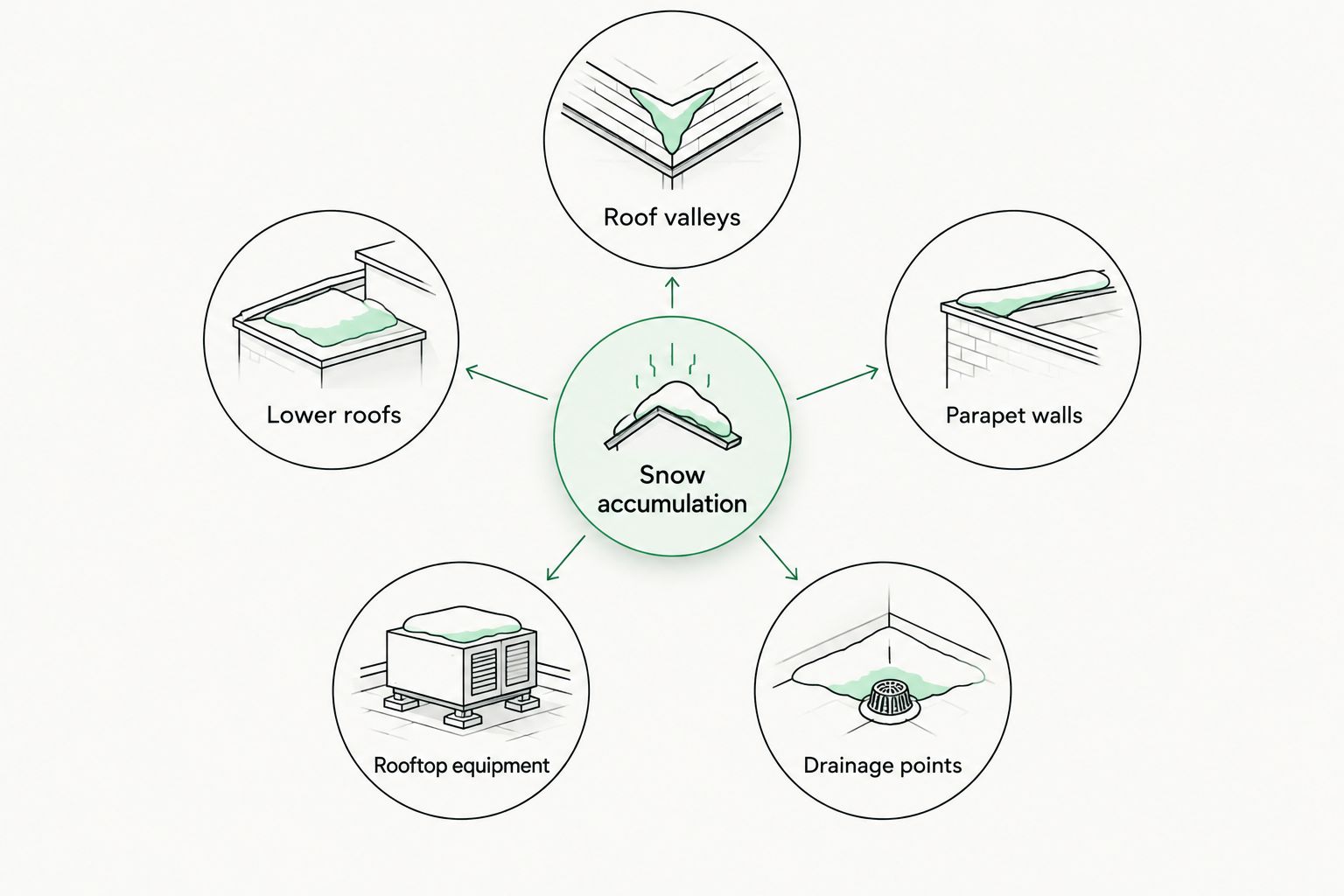
For commercial properties, include these locations in the information you give the evaluating professional. For homes, describe visible valleys, additions, and roof-height changes without approaching falling snow or ice.
Do not assume that removing snow from one easy-to-reach section resolves loading elsewhere. Snow-removal planning must consider the roof as a system, including the risk of creating an unbalanced load.
What warning signs require immediate action?
New structural movement during snow accumulation is an emergency warning, not a reason to wait for a standard inspection. Leave the affected building if you observe significant sagging, hear cracking or popping associated with structural movement, or see visible deformation developing.
Other warning signs include newly cracked structural members, sudden ceiling or wall movement, and doors or windows that abruptly bind alongside other signs of distress. No single symptom proves the cause. Do not remain inside to diagnose it.
From a safe location, contact emergency services when collapse appears possible. Keep other people away from the building and from areas exposed to falling snow, ice, or debris.
A leak alone does not establish structural overload, but it still needs prompt evaluation. Keep people away from wet electrical fixtures and sagging ceilings, and never puncture a bulging ceiling yourself.
The absence of visible warning signs is not a structural clearance. Some important conditions remain concealed above ceilings or within roof assemblies.
What should you do before the next snowfall?
For your 2026 winter plan, make responsibilities and decision points clear before a storm creates pressure. Homeowners need accessible records and qualified contacts; commercial owners also need an occupant communication plan.
- Find the records. Gather structural drawings, previous engineering reports, and documentation of additions, rooftop equipment, or structural changes. Note anything you cannot locate.
- Document known concerns. Record recurring leaks, previous repairs, drainage problems, and visible changes from safe locations. Do not enter an attic or roof area that appears unstable.
- Request the right assessment. Use a roofing contractor for roofing-system condition and a licensed structural engineer for load capacity, structural distress, or building-specific snow thresholds.
- Set the response plan. Identify who monitors conditions, who authorizes professional work, and how occupants receive instructions. Establish emergency procedures separately from routine maintenance.
- Keep the findings. Save written recommendations with the property’s maintenance records. Review them after alterations or material changes in building condition.
For commercial buildings, assign responsibility even when tenants handle some maintenance. A lease arrangement does not replace a practical plan for reporting leaks, restricting access, or communicating an evacuation instruction.
Do not use a shingle replacement as a substitute for structural evaluation. New roofing materials do not, by themselves, establish greater framing capacity.
Who should evaluate a snow-loaded roof?
Choose the professional by the question you need answered, not by who can visit first. A roof-condition assessment and a structural-capacity assessment serve different purposes.
| Professional | Best for | Strength | Limitation |
|---|---|---|---|
| Roofing contractor | Roofing condition, leaks, flashing, and drainage concerns | Evaluates the roof covering and associated roofing details | A routine roofing inspection does not certify structural capacity |
| Licensed structural engineer | Load capacity, framing concerns, and structural assessment | Evaluates the structure and relevant loading conditions | Structural evaluation does not itself perform roofing repairs |
| Qualified snow-removal contractor | Executing a professionally planned removal operation | Provides personnel and equipment for the assigned removal scope | Removal work alone does not establish the roof’s safe load |
Murray Roofing is a fit for Lincoln and Omaha owners who need residential or commercial roof inspections, not structural load certification. Murray Roofing provides inspections, repair, and replacement services; questions about allowable loading belong with a licensed structural engineer.
If an assessment identifies damage, separate the structural scope from the roof-covering scope in writing. Ask who handles each part, what the findings establish, and which areas were inaccessible.
Should you remove snow yourself?
Do not climb onto a snow-covered roof or begin an improvised removal operation. Falls, concealed openings, falling ice, and damage to roofing materials create serious hazards. Adding workers or equipment also adds load.
Hire qualified professionals when removal is recommended. Their plan should address worker safety, protected areas below, roof-system protection, and the sequence of removal.
Avoid treating melting weather as an automatic all-clear. Retained water and blocked drainage still require attention, and settling snow does not necessarily mean less weight.
If snow or ice has damaged the roof covering, read about roof replacement in winter or cold weather before discussing repair or replacement scheduling. Structural safety comes first; roofing work follows the appropriate assessment.
FAQ
How many inches of snow can my roof safely hold?
There is no universal safe snow depth for every roof. Snow density, drifting, structural design, and current condition determine the risk; a licensed structural engineer can assess building-specific capacity.
How much does an inch of water equivalent weigh on a roof?
One inch of water equivalent weighs approximately 5.2 pounds per square foot. That is a weight conversion, not a safe-load limit for your roof.
Is wet snow heavier than dry snow?
Wet snow is heavier than dry snow at the same depth because it contains more water. Snow depth alone therefore cannot establish the load on your roof.
Can a flat commercial roof handle more snow than a house roof?
A flat commercial roof cannot be assumed to support more snow than a house roof. Compare building-specific structural information, not building use or appearance.
Does a metal roof make snow loading safe?
A metal roof does not establish that the supporting structure can safely carry the accumulated snow. Sliding snow also creates hazards below and can load an adjoining lower roof.
Should I call a roofer or a structural engineer about roof snow load?
Call a licensed structural engineer for capacity questions and a roofing contractor for roof-covering, leak, or drainage concerns. If the building shows signs of possible collapse, leave and contact emergency services first.
Does homeowners insurance cover snow damage to a roof?
Coverage depends on your policy, the cause of damage, and the insurer’s claim evaluation. Document conditions only from safe locations and do not delay emergency action while seeking a coverage decision.
One last thing
A shrinking snowpack is not proof of a lighter roof load. Snow can settle while retaining its water content, so a depth comparison alone does not establish that conditions have improved.
For 2026, make your next step match the problem: emergency services for immediate danger, an engineer for structural capacity, and a roofing inspection for roof-system condition. Murray Roofing offers free residential and commercial roof inspections in Lincoln and Omaha. Schedule an inspection to discuss the roof’s condition and get a price for any recommended roofing work.
Related guides
- How long does a roof inspection take?
- Can a small roof leak become a structural problem?
- Roofing guidance for property managers