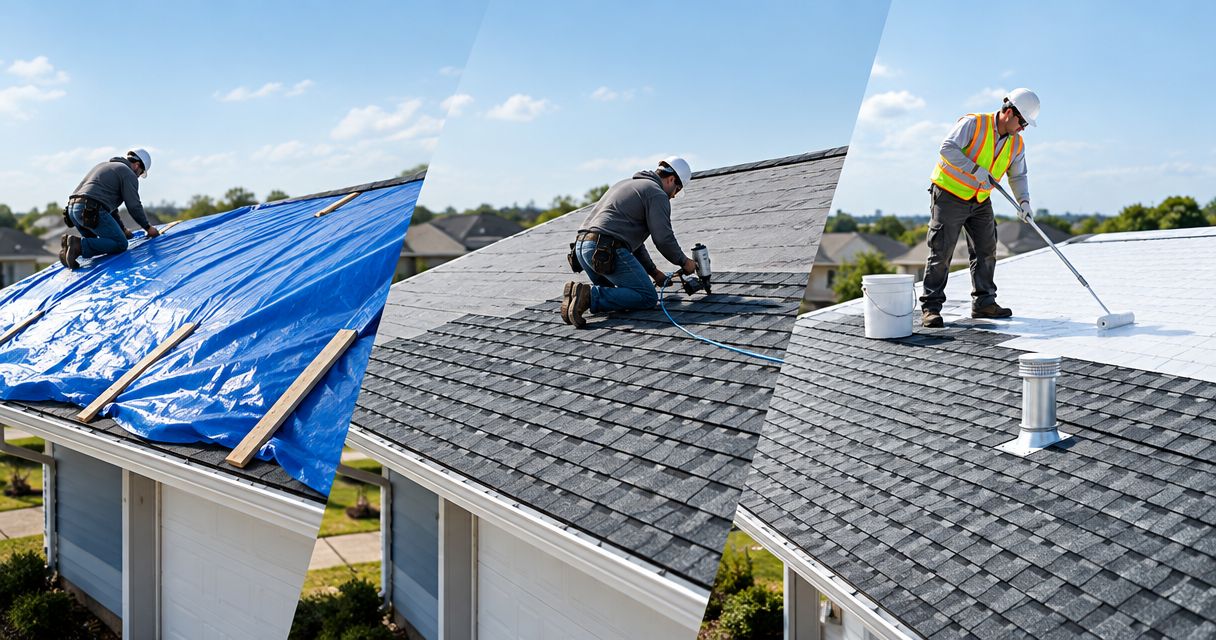
Instead of manually reconciling roofing schedules, resident calls, and temporary housing requests, build a multifamily roof replacement resident relocation workflow that connects each work area to an occupancy decision. For a 2026 project in Lincoln or Omaha, start with a professional inspection, identify affected apartments, and assign responsibility for notices, relocation, and return approval before work begins.
- A multifamily roof replacement resident relocation workflow starts with an inspection, not an assumption that everyone must move.
- Murray Roofing provides residential and commercial roofing services for Lincoln and Omaha property owners.
- Choose occupancy arrangements by affected area, safe access, building conditions, and resident needs.
- Keep roofing completion and resident return approval as separate checkpoints.
Why this matters
Roof replacement does not automatically require resident relocation. The decision depends on the scope, interior conditions, access restrictions, and whether occupants can safely remain in the affected space. Decide building by building rather than sending the same instruction to an entire property.
The roofing for apartment complexes guide covers the broader project context. This workflow addresses the handoffs between the contractor, property management, and residents when occupancy needs attention.
Murray Roofing is best for Lincoln and Omaha owners seeking residential and commercial roofing services. Property management should retain responsibility for resident communications and housing arrangements; the roofing contractor supplies the roof-related findings and work restrictions needed for those decisions.
Before you start
- Gather the project materials. Obtain the inspection findings, proposed scope, building and apartment list, site access plan, and current resident contact information. Confirm who can authorize changes.
- Assign accountable contacts. Name 2 primary contacts: a property-management lead and a contractor lead. Identify backups and a separate contact for urgent resident concerns.
- Resolve the hidden dependency. Roof completion is not the same as interior readiness. Water damage, electrical concerns, or another unresolved condition can prevent return even after the roofing work ends. Identify who will assess those conditions before promising a return date.
For your 2026 planning file, also review applicable notice requirements, lease terms, accommodation obligations, and insurance provisions with the appropriate advisers. Do not substitute a general roofing checklist for property-specific legal or safety decisions.
Project record and decision ownership
Use a shared spreadsheet, project-management system, or controlled document. The labels below are suggested worksheet fields, not instructions for a particular software interface.
Create the working record
- Create Building, Apartment, Work area, and Affected entrance fields. Keep 1 occupancy record per affected apartment so different resident needs do not disappear inside a building-wide note.
- Add Roof condition, Interior condition, Access restriction, and Assessment source. Record who supplied each finding and when it was received.
- Add Occupancy decision, Decision owner, Notice status, Housing arrangement, and Return authorization. Separate a proposed decision from an approved one.
- Keep sensitive resident information in a restricted record. Share operational needs with the contractor without circulating diagnoses, financial information, or unnecessary personal details.
Expected result: Every affected apartment has an identifiable decision owner and a traceable reason for its occupancy status.
Do not mark an apartment ready because another apartment in the same building is ready. A shared roof does not mean identical interior conditions or identical access needs.
Define the approval boundaries
Write down who can stop work in an affected area, approve a changed access route, authorize housing arrangements, and communicate a return decision. Ask the contractor to identify the person responsible for explaining roofing-related restrictions.
The property manager should consolidate resident instructions. That prevents a resident from receiving a preliminary contractor estimate as if it were a confirmed move-back date.
Occupancy assessment and work-area plan
Ask Murray Roofing to explain the roof replacement scope and identify where work affects entrances, parking, building equipment, or occupied areas. Combine those findings with the property's interior assessment and resident-access requirements.
Map the work area
- Mark Roof work zone, Delivery area, Resident entrance, and Emergency access on the site plan. Have the relevant project participants review conflicts before mobilization.
- Identify apartments with reported leaks, damaged ceilings, or other interior concerns. Arrange assessment by the appropriate qualified professionals rather than treating a roof inspection as an interior clearance.
- Ask how the proposed sequence affects noise, debris protection, ventilation equipment, and pedestrian access. Record restrictions and the person responsible for communicating changes.
- Review resident needs privately. Confirm arrangements for accessible routes, transportation, pets, essential equipment, and support services where relevant.
Expected result: You have a work-area plan that connects physical restrictions to specific apartments and resident arrangements.
Select the occupancy arrangement
Use the following comparison to structure the decision. These are planning options, not a substitute for a qualified assessment or applicable requirements.
| Arrangement | Best for | Practical benefit | Limitation or risk |
|---|---|---|---|
| Remain in place | Apartments assessed as suitable for occupancy with safe access maintained | Avoids an unnecessary move | Residents still need accurate disruption notices and a route for reporting concerns |
| Temporary daytime absence | Work periods when an assessed restriction can be addressed by leaving temporarily | Limits disruption to the affected period | Requires a suitable destination and reliable access updates; it does not resolve an unsafe interior |
| Temporary relocation | Apartments that cannot remain occupied safely during the affected work or restoration | Separates residents from the affected space | Requires housing coordination, resident support, and a separate return decision |
Choose the arrangement that addresses the actual restriction, not the arrangement that makes scheduling easiest. A daytime absence is not a substitute for relocation when the apartment remains unsuitable overnight.
For a 2026 replacement, record the assessment behind each choice and the event that would trigger reconsideration. Examples include a new interior leak, a changed entrance restriction, or newly identified damage.
Resident notices and relocation arrangements
Once the occupancy decision is approved, turn the work plan into resident-specific instructions. Do not send a move notice with an unconfirmed destination or an unsupported return promise.
Prepare the resident notice
- State Affected area, Expected disruption, Required resident action, and Property contact in plain language. Distinguish a planning window from a confirmed instruction.
- Explain parking changes, entrance restrictions, and how residents should report a leak or access problem. Tell residents not to enter marked work areas or climb onto the roof.
- Provide the approved occupancy arrangement. For relocation, confirm the destination and explain transportation, keys, essential belongings, pets, and accessibility arrangements as applicable.
- Record delivery and acknowledgment separately. An email sent is not proof that a resident understood a time-sensitive instruction; follow up through the property's established communication process.
Expected result: Each affected household knows what action to take, who to contact, and how it will receive changes.
For your 2026 notice template, avoid language that guarantees insurance payment, a fixed completion date, or a specific storm outcome. Identify confirmed arrangements and state when the next update will be provided.
Confirm the relocation handoff
Before a household leaves, check that the destination can meet its documented requirements. Confirm access to necessary medication, mobility equipment, personal documents, and essential services without requesting unnecessary private information.
Record who approved the arrangement and how the resident can reach property management. Keep receipts and written decisions together, but do not tell residents an insurer will reimburse expenses without confirmation of the applicable coverage and claim decision.
Work updates and resident return approval
Build 3 review checkpoints into the project: before work begins, when the work area changes, and before residents return. These are management controls, not a promised construction schedule.
Maintain the project status
- Review the active work area with the contractor lead before issuing resident instructions. Update Current restriction and Next update when the sequence changes.
- Record new reports by apartment and location. Send roof-related concerns to the contractor and arrange separate assessment for interior or building-system concerns.
- Confirm whether the change affects occupancy, access, or the relocation arrangement. Obtain the decision owner's approval before sending revised instructions.
- Preserve the prior status and reason for the change. Do not overwrite the record so completely that the team cannot explain what residents were previously told.
Expected result: Residents and project participants receive the same current instruction, with an accountable owner for every change.
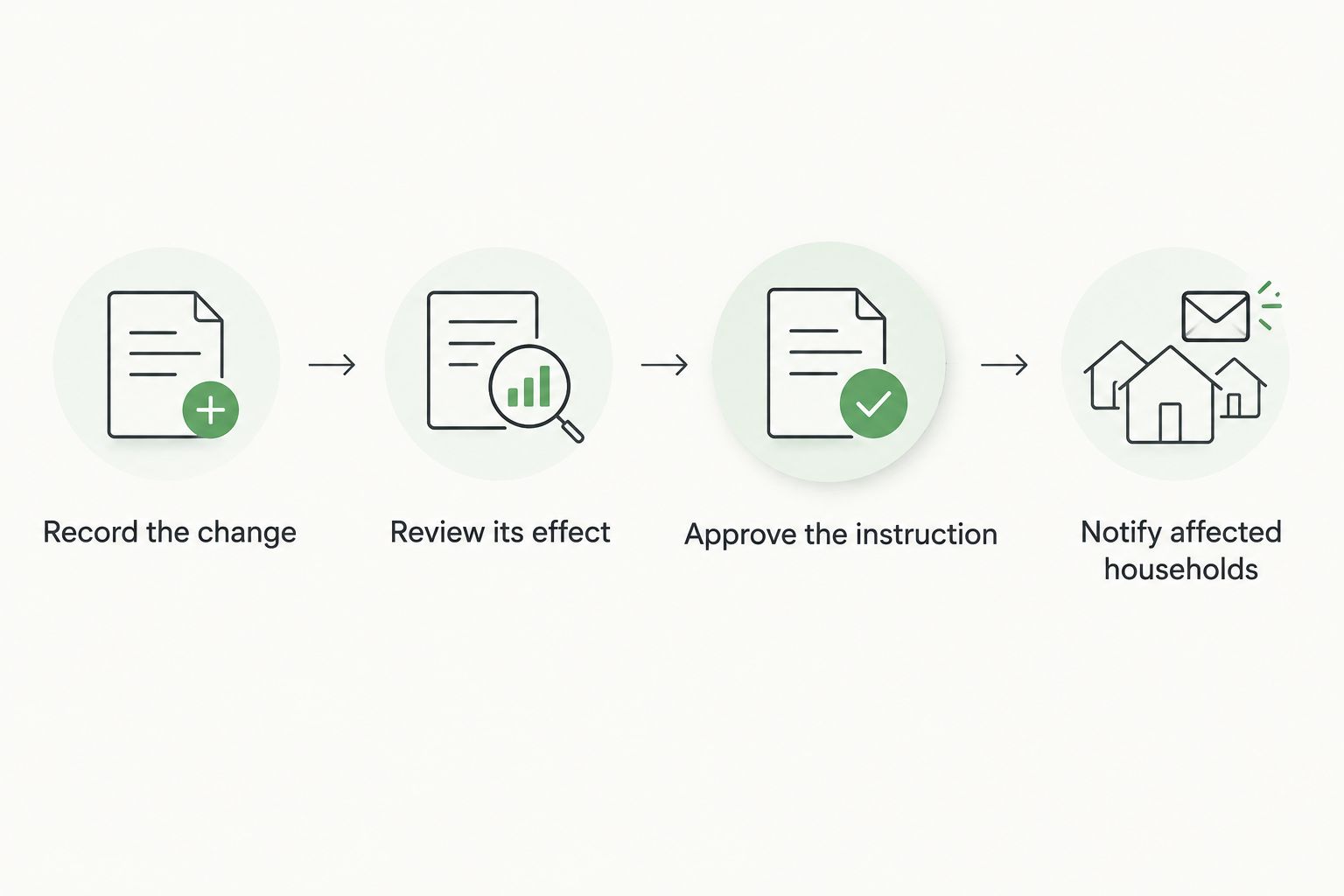
The sequence is simple: record the change, review its effect, approve the instruction, and notify the affected households. A contractor's scheduling update should not automatically become a resident return notice.
Authorize the return
Confirm roof-related completion for the affected area, then check interior conditions, required building-system assessments, usable access, and any applicable inspection requirements. Obtain confirmation from the parties responsible for each issue.
Do not use a roofing completion notice as blanket permission to reoccupy an apartment. Record the return authorization separately and tell residents about any remaining work or restrictions.
Close the relocation record only after the resident has received the return instruction and management has resolved outstanding access arrangements. Keep unresolved damage and follow-up work visible in a separate task list.
When a phased replacement changes the work area
A phased project needs a repeating workflow rather than a single property-wide move notice. As the contractor advances to another roof section or building, reassess the households affected by that phase.
Copy the record structure, not the previous occupancy decision. Check the new work zone, affected entrances, interior reports, and resident needs before approving the next notice.
For each 2026 phase, identify which households remain unaffected, which need revised access instructions, and which require an occupancy review. Send targeted notices so residents can distinguish an instruction for their apartment from general project information.
If new damage changes an apartment's condition during work, reopen its assessment immediately. Preserve the earlier decision and document why the arrangement changed; do not leave an outdated remain-in-place status active.
Troubleshooting
The work schedule changes after notices go out
Confirm the revised sequence with the contractor and review the effect on resident arrangements. Send a corrected notice that identifies the change, current instruction, and next update; do not silently replace the old schedule.
A resident cannot use the proposed temporary housing
Pause that household's relocation handoff and review the unmet requirement privately. Arrange a suitable alternative through the responsible management contact rather than asking the resident to solve an accessibility or essential-equipment problem alone.
A resident has not acknowledged the notice
Check contact information and use the property's approved follow-up process. Record attempts and escalate unresolved communication to the manager responsible for notice compliance; do not assume silence means agreement.
Roofing is finished, but an apartment still has interior damage
Keep the return decision open and arrange the remaining assessment or restoration. Explain which condition prevents clearance and who owns the next action, without promising a date that has not been confirmed.
The insurer has not confirmed relocation coverage
Keep the occupancy decision separate from the coverage decision. Review the policy and claim with the insurer, retain supporting documentation, and have ownership determine how required arrangements will be authorized while coverage remains unresolved.
Customize your workflow
Add fields for ownership approval, lender requirements, insurance documentation, or association review only when the property needs them. Keep the core occupancy record short enough that staff will maintain it during an active project.
Murray Roofing offers commercial roofing inspections and replacement services, along with insurance-claim support and financing. Those services do not establish whether a particular relocation expense is covered or whether an apartment is ready for occupancy.
For mixed-use properties, maintain separate communication records for residents and commercial tenants. Connect shared access restrictions, but do not assume a business interruption and a residential relocation require the same response.
FAQ
Do residents have to move out during a multifamily roof replacement?
Resident relocation is not automatic. Base the decision on the work scope, interior conditions, safe access, resident needs, and applicable requirements, with assessment by the appropriate professionals.
Who should manage resident relocation during roof replacement?
Property management should name an accountable relocation lead. The roofing contractor provides roof-related findings and work restrictions, while management coordinates notices, housing arrangements, and the required approvals.
Can residents leave during the day and return at night?
Daytime absence is appropriate only when the assessed restriction is limited to that period and the apartment remains suitable for occupancy. It does not address unresolved interior damage or unsafe overnight conditions.
Does property insurance pay for temporary resident housing?
Coverage depends on the policy, cause of loss, and claim decision. Confirm the applicable terms with the insurer before promising reimbursement or telling residents that expenses are covered.
What should a roof replacement relocation notice include?
Include the affected area, required action, approved arrangements, property contact, and how updates will arrive. Distinguish confirmed instructions from planning estimates and provide household-specific information privately.
When can residents return after the roof is replaced?
Residents should return after the responsible parties confirm that the affected apartment and access arrangements are ready. Roofing completion alone does not resolve interior damage, building-system concerns, or applicable inspection requirements.
One last thing
The most useful date in a relocation record is the next confirmed update, not an unsupported move-back estimate. Give residents a dependable communication commitment even when the construction sequence remains unsettled.
Related guides
- Roofing for property managers
- Commercial roof leak to tenant notification workflow
- Commercial roof inspection to budget approval workflow
Planning a multifamily roof replacement in Lincoln or Omaha? Contact Murray Roofing to schedule an inspection and get a project-specific price before finalizing resident arrangements.