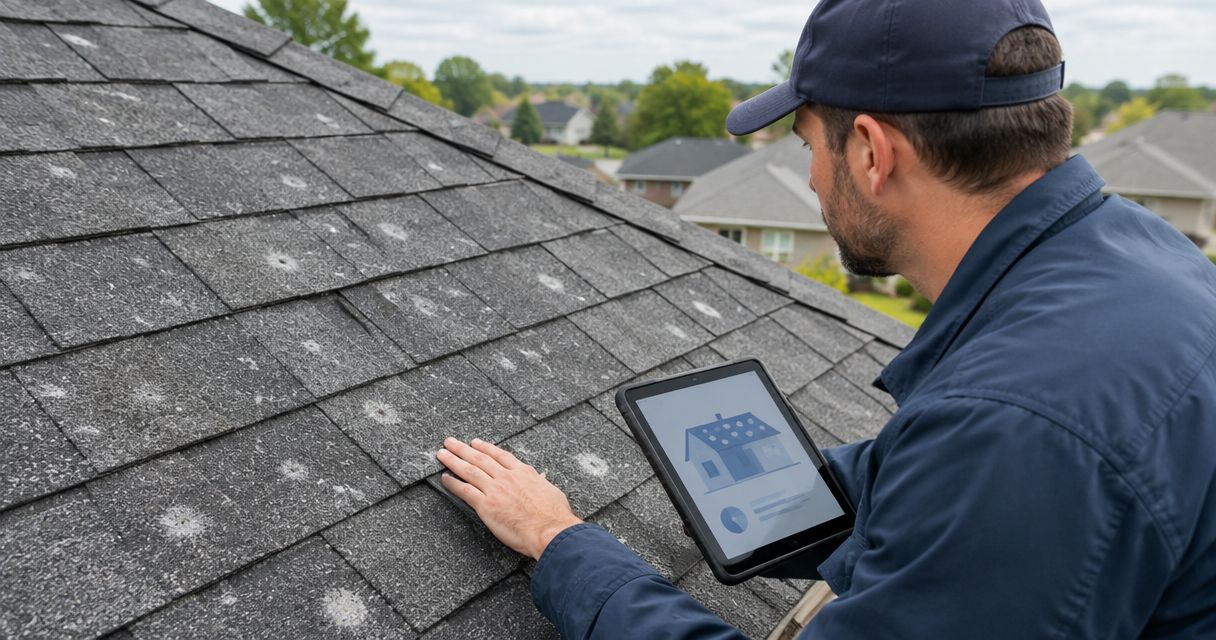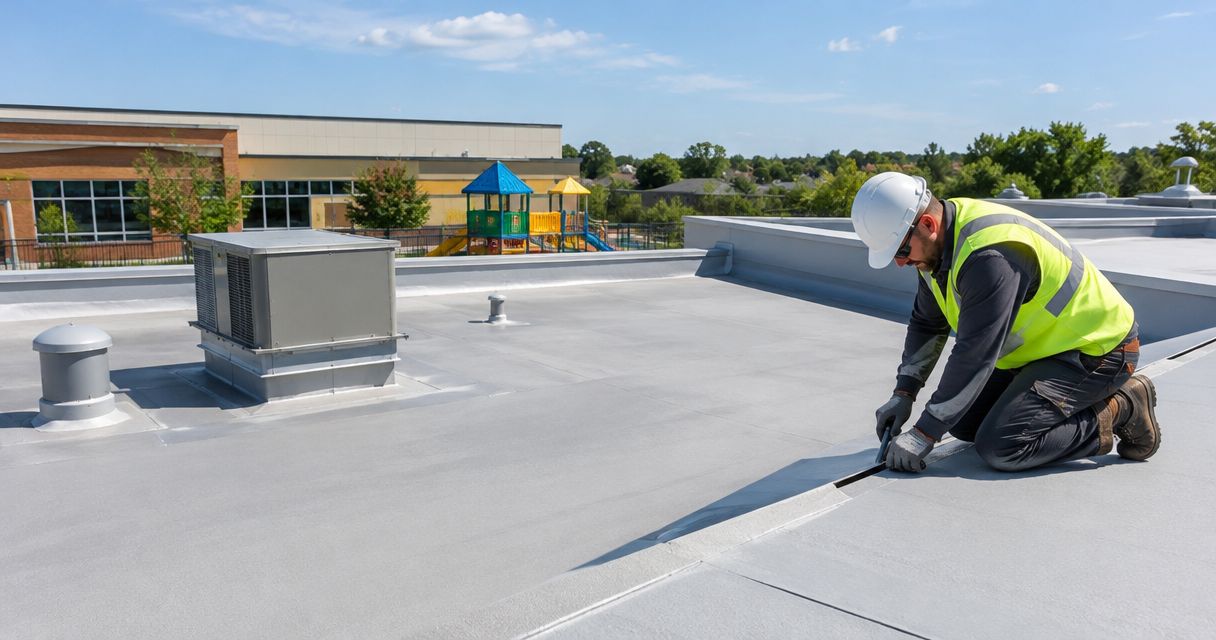
Childcare center commercial roofing is the inspection, repair, and replacement of a facility’s roof to protect children, staff, and daily operations. For Lincoln and Omaha operators planning work in 2026, the right approach starts with roof condition and a written plan for keeping construction separate from children.
- Commercial roofing for childcare centers starts with documented roof condition, protected entrances, and a plan for classroom disruption.
- Murray Roofing provides commercial roof inspections, repair, and replacement in Lincoln and Omaha.
- Choose repair, restoration, or replacement from inspection findings—not roof age alone.
- Keep children away from work areas and confirm classroom use before construction starts.
Why commercial roofing matters for childcare centers
A childcare roof project affects more than the building. You must account for supervised arrivals, outdoor play, nap schedules, emergency exits, and rooms that cannot remain occupied during disruptive work.
Murray Roofing is a fit for Lincoln and Omaha childcare operators seeking commercial roofing inspection, repair, and replacement. Its roofing services cover those needs; your proposal should also address the operational restrictions specific to your center.
A roof leak above a storage room and a leak above an occupied infant room require different immediate responses, even when the roof defect is similar. Separate the building diagnosis from the occupancy decision: the roofer evaluates the roof, while your center’s leadership determines how to protect children and maintain supervision.
For your 2026 facilities plan, prioritize documented leaks, damaged roof areas, drainage concerns, and unresolved repair history. A roof’s age belongs in that review, but age alone does not establish whether repair or replacement is appropriate.
How to plan roofing work around childcare operations
1. Document roof concerns without accessing the roof
Start with a shared folder and a simple floor plan. Staff can record indoor warning signs from accessible areas without climbing ladders, opening roof hatches, or attempting repairs.
Record where water appears, when staff first noticed it, and which rooms are affected. Include whether the problem followed rain, snowmelt, or another event, but do not label the cause before inspection. Water can travel before it becomes visible indoors.
Create 3 records for the initial review: a leak log, a room map, and a folder of photographs. These records give the contractor a starting point and help your director explain room restrictions to staff. Keep children out of affected areas when ceiling damage, active water entry, or electrical concerns are present.
- Photograph stains and visible damage from a safe location.
- Mark affected classrooms, storage spaces, and corridors on the floor plan.
- Collect previous repair invoices and roof warranty documents.
- Record rooftop equipment and recent service visits, if known.
- Notify the landlord when your lease assigns roof responsibility to the owner.
2. Request an inspection that answers repair-versus-replacement questions
Before contacting a contractor, assemble your records and list the decisions you need to make. Ask for findings that distinguish isolated defects from broader roof deterioration, rather than a recommendation based only on age.
Murray Roofing offers commercial inspections, repair, replacement, and maintenance. A professional inspection moves the assessment beyond interior symptoms; ask what the inspection includes and whether additional investigation is needed to evaluate concealed moisture or deck condition.
The limitation is straightforward: a visual inspection cannot establish every concealed condition. Your 2026 proposal should explain what is known, what remains uncertain, and how unexpected damage will be documented before additional work proceeds.
- Request photographs identifying each observed roof concern.
- Ask whether defects are localized or spread across multiple areas.
- Confirm how drainage, roof edges, and equipment penetrations were assessed.
- Request the reasoning behind repair, restoration, or replacement recommendations.
- Ask who verifies permit and inspection requirements with the local authority.
3. Build a child-separation and classroom-use plan
Sketch your daily operations before discussing construction access. Mark drop-off routes, playground gates, delivery areas, classroom windows, outdoor-air intakes, and emergency exits. Give the contractor the actual schedule, including early arrivals and late pickups.
Choose 2 named contacts: your center’s decision-maker and the contractor’s site contact. Staff need a clear route for reporting an unsecured gate, unexpected odor, blocked entrance, or work that conflicts with an occupied room.
Do not assume roofing work can proceed above occupied classrooms. Ask the contractor to explain the work method, noise, dust, odors, ventilation considerations, and protective measures. Confirm occupancy decisions with the appropriate building, licensing, or safety authority when required.
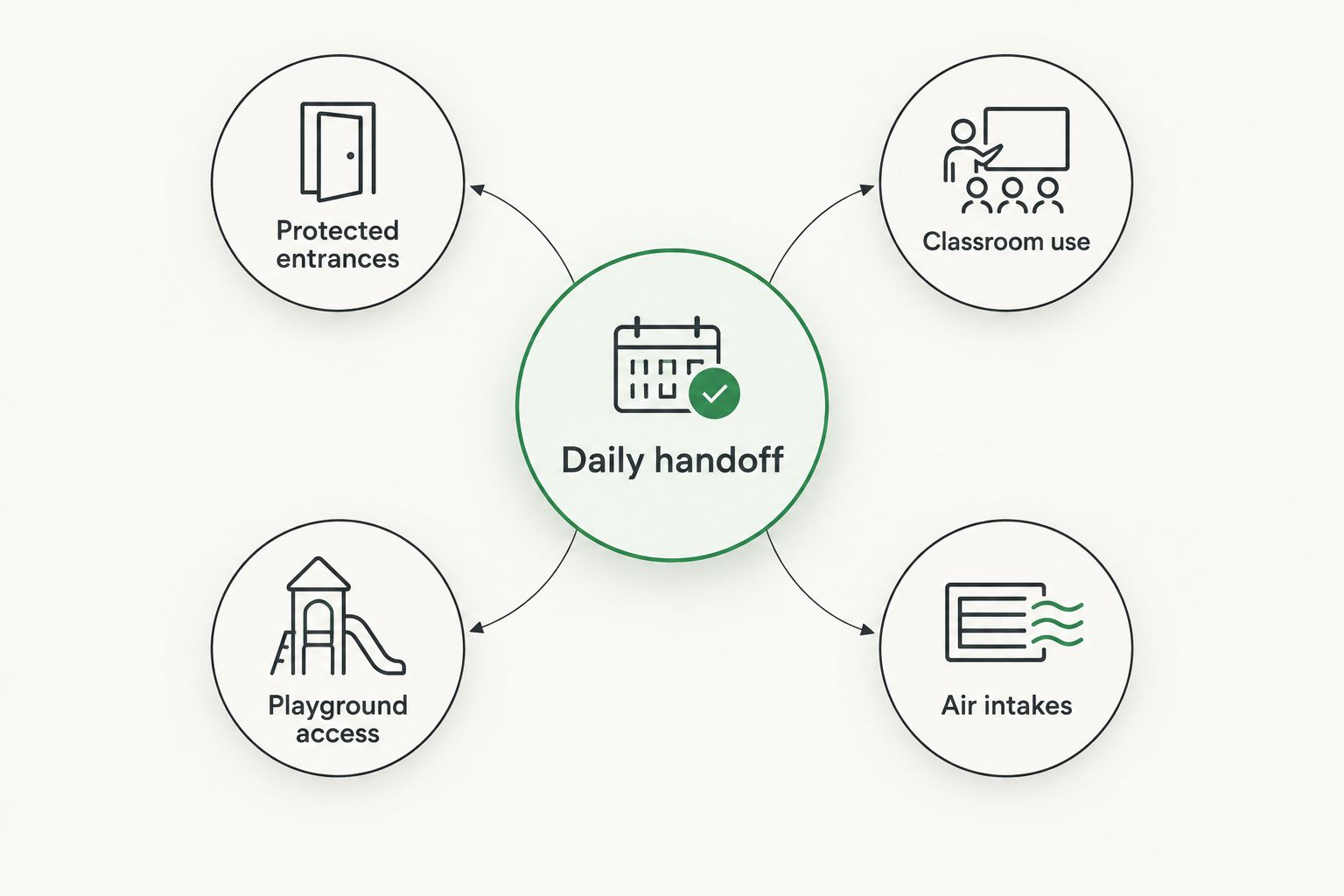
- Protected entrances: Separate families from deliveries and overhead work.
- Classroom use: Identify rooms needing relocation or temporary closure.
- Playground access: Keep children outside staging and debris zones.
- Air intakes: Coordinate equipment and application methods with building staff.
- Daily handoff: Confirm safe access before children return to affected areas.
4. Match the roof approach to the building’s condition
Write down your priorities first: stop a localized leak, address recurring failures, or replace a deteriorated roof. Then ask the contractor to connect each proposed approach to inspection evidence.
Low-slope roof areas and pitched roof areas need different assemblies. Do not select a material solely because another childcare center uses it. Roof slope, existing construction, drainage, equipment, code requirements, and manufacturer instructions all affect suitability.
For a Lincoln or Omaha project in 2026, request a weather-contingency plan covering exposed roof areas and the conditions needed for installation. Avoid demanding a fixed completion promise before the contractor has assessed scope and weather restrictions.
- Ask which existing roof materials will remain and which will be removed.
- Confirm how wet or deteriorated materials will be identified and addressed.
- Request details for drains, roof edges, curbs, and penetrations.
- Ask how the building will be protected if work stops unexpectedly.
- Identify responsibility for disconnecting or moving rooftop equipment.
5. Compare written scopes before authorizing work
Use a simple worksheet to compare proposals against the same requirements. A short description such as roof replacement does not tell you whether insulation, drainage changes, deck repairs, permits, or interior protection are included.
Keep 1 marked site map with the approved proposal. It should show contractor access, material storage, debris handling, protected entrances, and areas unavailable to children. A shared map reduces conflicting instructions between the director, property owner, and crew.
Murray Roofing offers financing and insurance-claim support. Treat those as separate administrative conversations: financing requires confirmed terms, and claim support does not establish coverage. Neither replaces a complete construction scope.
- Compare removal, substrate preparation, insulation, and roof-system details.
- Confirm allowances or approval procedures for concealed damage.
- Request written cleanup and end-of-workday protection requirements.
- Separate manufacturer coverage from contractor workmanship coverage.
- Confirm payment terms, authorization responsibilities, and change-order procedures.
6. Close out the project and keep a maintenance record
Prepare your handoff checklist before construction finishes. Your facilities file should explain what was installed or repaired, where work occurred, who to contact, and what maintenance the roof requires.
Roof completion and classroom reopening are separate decisions. Confirm roof-work completion with the contractor, then verify that access routes, outdoor areas, and affected rooms meet your center’s reopening requirements. Request documented cleanup of playgrounds and family walkways rather than relying on a general cleanup statement.
For the remainder of 2026, keep observations and service records together. Follow the installed system’s maintenance instructions and warranty conditions instead of applying a generic inspection interval to every roof.
- Collect completion photographs, invoices, and approved change orders.
- Obtain applicable warranty documents and registration confirmation.
- Confirm debris removal from entrances, play areas, and parking spaces.
- Save maintenance instructions and the repair-reporting process.
- Record unresolved items with an assigned owner and agreed next action.
Compare roofing approaches for childcare centers
Choose the approach that addresses documented conditions, not the option that sounds least disruptive. Repair, restoration, recover, and replacement solve different problems. None makes classroom coordination optional.
The table compares project approaches, not contractors. Suitability depends on inspection findings, the existing assembly, applicable requirements, and the proposed system’s instructions.
| Option | Best for | Main benefit | Key limitation |
|---|---|---|---|
| Localized repair | An isolated defect in an otherwise serviceable roof | Focuses work on the identified problem | Does not correct deterioration elsewhere in the assembly |
| Coating or restoration | A roof confirmed suitable for the proposed restoration system | Retains eligible existing roof components | Is not a substitute for resolving wet materials or structural concerns |
| Recover assembly | An existing roof that qualifies to remain beneath a new assembly | Avoids removing every existing component | Requires confirmation of existing conditions, allowable assemblies, and code compliance |
| Full replacement | Widespread deterioration or conditions that make other approaches unsuitable | Allows removal and assessment of underlying conditions | Requires broader construction planning and management of exposed areas |
A coating is not automatically the safest choice for an occupied center, and replacement does not automatically require closing the entire facility. Ask for the actual application method and occupancy plan before deciding. Where separation cannot be maintained, plan an alternate operating arrangement rather than assuming normal operations can continue.
For full replacement, request written explanations of insulation, drainage, equipment coordination, and concealed-condition handling. Those details make the proposal useful after approval, when your director must coordinate rooms and communicate with families.
Common mistakes childcare centers make
Treating nap time as the only scheduling restriction
A quiet-work request does not address deliveries, overhead hazards, odors, or blocked access. Provide the full operating schedule and require a plan that accounts for arrival, meals, outdoor play, rest periods, and pickup.
Letting a landlord and director approve different plans
The building owner controls some decisions; the center controls daily operations. Name the person authorized to approve scope changes and require coordination before those changes affect classroom use or access.
Choosing a roof system before investigating recurring leaks
Repeated patching and automatic replacement are both poor substitutes for diagnosis. Ask whether the leak source, roof condition, and drainage findings support the recommended work, including any additional investigation needed.
Assuming a warranty covers every roof and every problem
A warranty name does not establish coverage for your proposed commercial assembly. Request the actual documents, eligibility requirements, exclusions, maintenance duties, and claim procedure before treating coverage as a decision factor.
Reopening a playground when the crew leaves
Crew departure is not a documented handoff. Confirm debris cleanup, secured access, removal of stored materials, and resolution of any restricted areas before children return.
FAQ
What is the best commercial roofing approach for a childcare center?
The best approach is the one supported by the roof’s condition and a workable child-separation plan. An inspection should establish whether localized repair, restoration, recover, or replacement is suitable before you select a system.
Can a daycare stay open during roof replacement?
A daycare should remain open only where the work plan and applicable requirements support safe occupancy. Confirm protected entrances, classroom restrictions, ventilation considerations, emergency access, and any required approvals before construction starts.
Should a childcare center repair or replace a leaking roof?
Repair fits an isolated defect in a serviceable roof; replacement addresses conditions that make limited work unsuitable. Request documented findings rather than deciding from roof age or the appearance of an interior stain alone.
What should a Lincoln or Omaha childcare center ask a roofer?
Ask for the roof findings, proposed scope, occupancy restrictions, weather-contingency plan, and responsibility for permits. Also request a staging map that protects family entrances and playground access.
Does insurance cover a childcare center’s roof damage?
Coverage depends on the policy, cause of damage, exclusions, and insurer’s decision. Preserve photographs and repair records, report damage according to policy requirements, and do not treat a contractor’s assessment as a coverage guarantee.
Does Murray Roofing handle commercial childcare roofing projects?
Murray Roofing provides commercial roof inspections, repair, replacement, maintenance, financing, and insurance-claim support in Lincoln and Omaha. Discuss your childcare facility’s roof and operating restrictions to establish the proposed project scope.
What documents should a childcare center receive after roofing work?
Request completion photographs, the final scope, approved changes, applicable warranties, and maintenance instructions. Keep those records with the center’s cleanup handoff and any unresolved project items.
One last thing
The most useful question is not simply when the roof will be finished. Ask who confirms that each affected classroom, entrance, and playground can return to use. Assigning that responsibility before work begins prevents a roofing completion notice from becoming an automatic reopening decision.
Related guides
- Commercial roofing for schools
- Repairing versus replacing a commercial roof
- Commercial roof warranty types for property owners
Ready to plan your center’s project? Schedule an inspection with Murray Roofing and request a written scope that addresses your roof, classroom use, and family access.