
“We Create Luxury Living” is the promise behind Murray Custom Homes. Instead of tracking unfinished work through scattered messages, use this final walkthrough to key handoff custom home checklist to organize the last 30 days around a written punch list, confirmed closing requirements, and a documented transfer of possession—not an assumed completion date.
- For final walkthrough to key handoff custom home planning, separate punch-list completion, closing requirements, and possession.
- Murray Custom Homes suits Lincoln-area buyers seeking custom homebuilding with in-house design and project management.
- Keep one punch list with photos, assigned responsibilities, and a recheck status.
- Treat the last 30 days as a planning window, not a guaranteed construction schedule.
Why this matters
A home can look finished while important handoff questions remain unanswered. Which corrections are complete? Who confirms closing readiness? When can you enter, move belongings, and take responsibility for utilities?
A walkthrough records the home's condition; it does not, by itself, authorize possession. Keep construction completion, closing, and key release as separate checkpoints until the responsible parties confirm each one.
For your 2026 planning file, use the last 30 days as an organizing window rather than a countdown promise. Actual dates depend on your agreement, remaining work, required approvals, and closing arrangements. Put confirmed dates in writing and label tentative dates clearly.
Before you start
- Gather the reference documents. Bring the signed agreement, current approved plans and specifications, written changes, selection records, and closing instructions. Use the approved documents—not an inspiration image—as your comparison point.
- Confirm access and responsibilities. Arrange the walkthrough with the project manager, identify who can approve decisions for your household, and confirm whom to contact about financing and closing. Bring a charged phone and a shared document or notebook.
- Separate unfinished work from possession. Ask how unresolved items will be documented and addressed under your agreement. Do not assume that accepting keys, signing a walkthrough record, and completing closing mean the same thing.
You do not need a particular app. The workflow below uses labels you create in a spreadsheet or document; they are not claimed features or screen labels in a builder's software.
Your closeout record
Establish one source of truth
- Create a document titled Home Closeout Record. Put the property address, document date, project manager's contact information, and your household's decision-maker at the top.
- Add a Confirmed Dates section. Record the walkthrough, correction review, closing, and possession dates separately; mark unconfirmed entries as tentative.
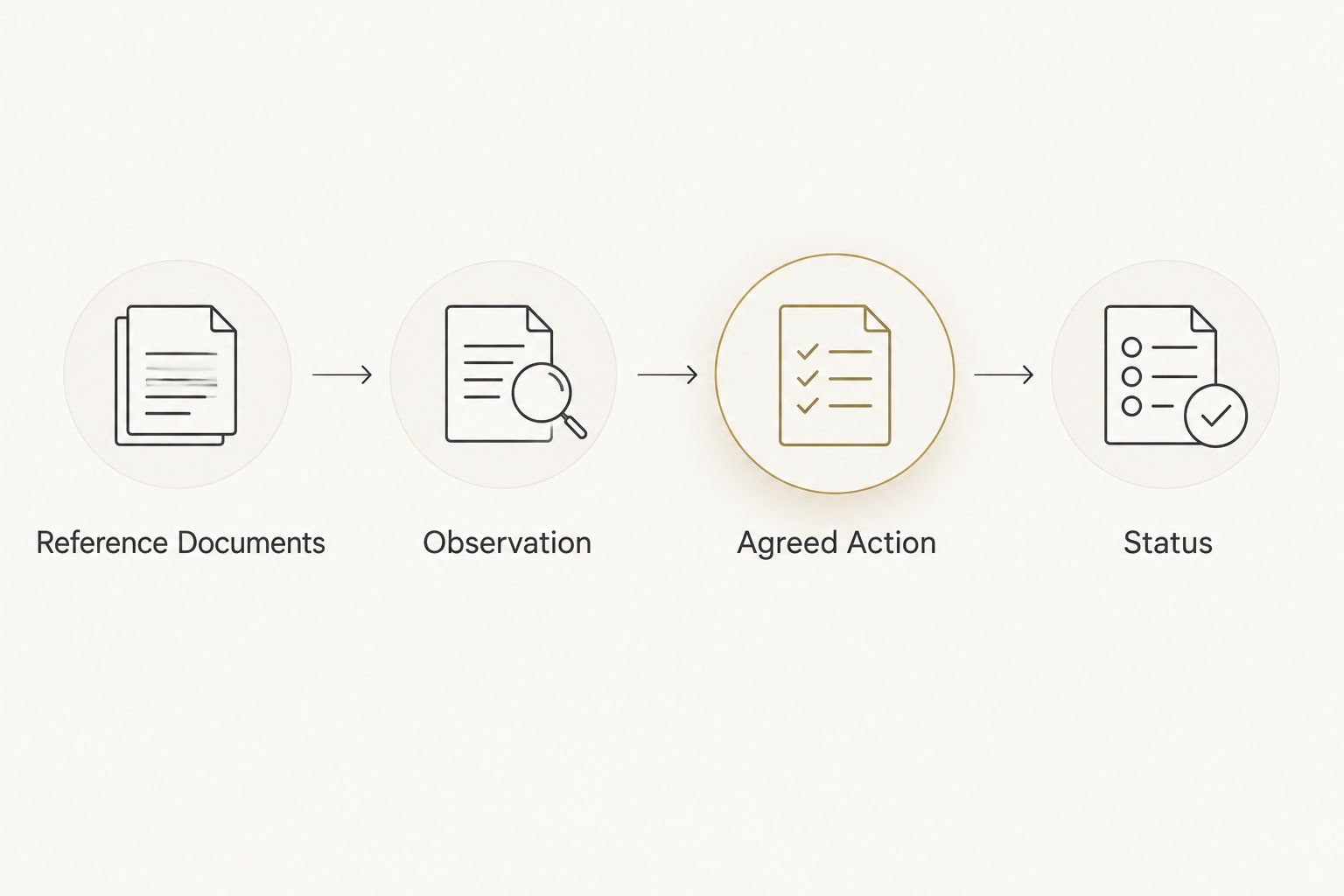
- Add a Reference Documents section. List the approved plans, specifications, written changes, and selection records you will use during the walkthrough.
- Create a punch-list table with Location, Observation, Photo, Responsible Party, Agreed Action, and Status. Keep descriptions factual: identify the room, surface, or fixture rather than writing only that something looks wrong.
- Ask the project manager how the record should be shared and which communication channel governs formal requests. Your personal worksheet supports the process; it does not replace required notices.
Expected result: You have one current record that distinguishes confirmed dates, open questions, and documented corrections.
Match the record to your home option
Murray Custom Homes offers Semi-Custom Homes, move-in-ready homes, and Custom Homes. The handoff discipline stays the same, but the documents you compare against reflect a different decision process.
| Home option | Best for | Handoff reference | Benefit and trade-off |
|---|---|---|---|
| Semi-Custom Homes | Buyers who want selected choices with fewer remaining decisions | Agreed selections, plans, specifications, and written changes | You choose selected features and entrust remaining decisions to the builder; this is not unrestricted customization. |
| Move-in-ready homes | Buyers who prefer evaluating an already-built home | Purchase agreement, documented included features, and observed condition | You can assess the completed spaces; the home is already built rather than shaped around a new design brief. |
| Custom Homes | Buyers whose preferences call for an individually shaped home | Approved plans, specifications, selections, and written changes | The home reflects your preferences; the closeout record must account for those individual decisions. |
Use the signed scope as the acceptance reference for every option. A feature discussed early in design is not automatically part of the final agreement.
Your walkthrough and punch list
Record observations before debating solutions
- Agree on a route through the home before starting. Work room by room, then review accessible exterior areas with the project manager so you do not repeatedly skip between spaces.
- Compare visible work with the approved scope. Review selections, cabinet arrangements, doors, windows, finishes, and included fixtures without attempting unsafe access or dismantling anything.
- Ask for demonstrations of installed systems and controls. Have the appropriate person explain operation, shutoffs, and owner maintenance; do not guess at unfamiliar equipment.
- Photograph each observation in context, then take a closer image if needed. Pair every photograph with a written location so it remains useful after the walkthrough.
- Record the proposed action and responsible party. Distinguish an observed concern from an agreed correction, and record questions that need further review.
- Request a written summary and a process for checking completed work. Ask which matters require resolution before closing under your agreement and which require separate written arrangements.
Expected result: Each observation has a location, supporting evidence, and a next action—not merely a verbal acknowledgment.
A 2026 walkthrough record should preserve the original observation alongside later updates. Do not overwrite the concern when work is reported complete; add the completion note and your recheck result.
Keep inspection and walkthrough roles distinct
A buyer walkthrough and an independent home inspection serve different purposes. The walkthrough documents your observations and supports orientation; an independent inspection provides a separate assessment within the inspector's agreed scope.
If you plan an inspection, coordinate access and timing with the builder and inspector before the closing appointment. Share relevant findings through the agreed process rather than assuming an inspection report automatically becomes the builder's accepted punch list.
Your closing and key-release plan
Verify corrections and closing requirements separately
- Review every open item with the project manager. Record whether it is complete, awaiting verification, disputed, or subject to an agreed next action.
- Recheck reported corrections where access permits. Confirm that the original concern was addressed and document any remaining issue without deleting its history.
- Ask the closing professional and lender, when applicable, to confirm outstanding requirements. Construction questions belong with the builder; financing and settlement questions need answers from the parties responsible for them.
- Verify payment instructions through a trusted contact method already established with the closing professional. Do not act on changed instructions solely because an email appears familiar.
- Confirm the possession conditions in writing. Ask who authorizes release, where the handoff happens, and whether any separate access arrangements apply.
Expected result: You know which construction items remain open, which closing requirements remain outstanding, and what authorizes possession.
For a 2026 closing, keep tentative moving arrangements separate from the confirmed possession appointment. A planned delivery or expiring lease does not change the conditions in your agreement.
Assemble the homeowner handoff
- Ask which keys, remotes, access devices, and operating documents belong with the home. Check the actual handoff against that list rather than assuming a standard package.
- Request an orientation covering installed equipment, relevant shutoffs, maintenance responsibilities, and the correct service-request process.
- Confirm utility-transfer responsibilities and effective dates with the appropriate providers and parties. Coordinate them with possession rather than an estimated construction finish.
- Store the closing documents, final punch-list record, equipment information, and homeowner handbook together. Keep an accessible copy outside moving boxes.
- Record the actual possession date and any outstanding written arrangements. Save the latest agreed version of the closeout record.
Expected result: You receive access with a usable homeowner file and a clear route for unresolved questions.
Murray Custom Homes provides a one-year limited builder's warranty, subject to the warranty handbook's terms and exclusions. Review the handbook before handoff so you understand reporting requirements rather than treating the punch list as a substitute for warranty notice.
When an item changes after the walkthrough
Use the same record when an observation is corrected, reappears, or needs further assessment. Create an update under the existing item rather than starting an unrelated message thread.
- Preserve the original: Keep the first description, photograph, and date.
- Add the change: Describe what is different and attach current evidence.
- Request a next action: Ask who will review it and how the response will be documented.
- Keep the status accurate: Separate work reported complete from work you have rechecked.
After closing, follow the applicable service process instead of relying only on the pre-closing worksheet. For Murray Custom Homes, non-emergency service requests go through the homeowner's Buildertrend Portal. Emergencies require a call followed by a written request within 24 hours.
The warranty reference verified October 19, 2026, requires covered defects to be reported in writing as soon as known and no later than 30 days before expiration. Normal maintenance and problems caused by lack of maintenance are excluded; consult the handbook for the full terms.
Troubleshooting
The punch list exists only in text messages
Move each observation into the shared record and attach its supporting message or photograph. Ask the project manager to confirm the agreed action; copying a concern into your worksheet does not establish agreement.
A correction is marked complete but still looks unresolved
Keep the item open as awaiting clarification or recheck. Add a current photograph and describe the remaining concern precisely, without assuming its cause.
The installed feature differs from what you remember
Compare the installation with the approved specifications, selection record, and written changes. Ask for clarification against those documents before treating a remembered conversation as the final scope.
Your mover is booked before possession is confirmed
Ask the closing professional and builder for the current status, then discuss contingency arrangements with the mover. Do not send belongings to the property without authorization.
You cannot find the correct service channel
Check the homeowner handbook and ask the project manager to confirm access before handoff. Test that you can reach the required portal or contact—not that a service request will receive a particular response time.
Customize your workflow
Adapt the record to the decisions that shaped your home. For a Semi-Custom Home, emphasize selected features and agreed remaining decisions. For a fully Custom Home, keep individual design details and written changes easy to retrieve; for an already-built home, focus on documented included features and condition.
Murray Custom Homes serves a stated 50-mile homebuilding radius around Lincoln, Nebraska, and can build on your existing lot. Its in-house drafting, design, 3D renderings, and project management provide useful reference points for discussing what was approved and what is being handed over.
If you are still planning, contact the homebuilding team to discuss your home option and the questions to carry into closeout. Confirm project-specific handoff procedures directly rather than assuming this planning checklist is a contractual schedule.
FAQ
What should I do between the final walkthrough and key handoff?
Document observations, confirm agreed corrections, verify closing requirements, and obtain written possession instructions. Keep these as separate checkpoints rather than assuming the walkthrough authorizes access.
Does the last 30 days mean my custom home will finish on schedule?
No. The last 30 days is a planning window, not a completion guarantee. Use dates confirmed by the responsible parties and distinguish tentative dates from agreed appointments.
Can I accept keys if punch-list items remain?
Your agreement and any written arrangements determine how unresolved items and possession are handled. Ask the builder and closing professional to clarify the conditions before signing or accepting access.
Is a final walkthrough the same as a home inspection?
No. A walkthrough supports condition documentation and homeowner orientation, while an independent inspection provides a separate assessment within the inspector’s scope. Coordinate inspection access and reporting before closing.
What should I bring to a custom home walkthrough?
Bring approved plans, specifications, selection records, written changes, a charged phone, and your punch-list record. Compare observations with the approved scope rather than an earlier design idea.
How do I request service after closing with Murray Custom Homes?
Use the homeowner’s Buildertrend Portal for non-emergency service requests. For emergencies, call and follow with a written request within 24 hours; consult the homeowner handbook for requirements and exclusions.
One last thing
Do not delete the punch list when the work is complete. A closed item with its original photograph, agreed action, and recheck note is more useful than an empty checklist. Keep the final record with your 2026 closing documents so the history survives the move.
Related guides
- How mortgage pre-approval shapes your custom home build timeline
- From design consultation to 3D rendering approval
- From land purchase to move-in: building on your own lot